








As an Amazon Associate, SportCoaching earns from qualifying purchases.



Find Your Next Running Race
Ready to put your training to the test? Here are some upcoming running events matched to this article.
 Coach Graeme

Last updated:
Nipple chafing — jogger's nipple, runner's nipple, whatever you call it — is one of the most common and preventable problems in distance running. A study found that 35.7% of runners logging over 64 km per week experience it. Yet most cases are entirely avoidable with the right combination of gear, lubricant, and preparation. This guide covers exactly what causes it, the most effective prevention methods, what to do if it hits mid-race, and how to treat it properly so you're back running fast.
Not sure where to start with training?
Tell us your goal and schedule, and we’ll give you clear direction.
No obligation. Quick, practical advice.
Explore our running advice and tips for more helpful articles and resources.
The mechanism is simple: each stride causes your shirt to shift slightly across your chest. Over a long run, that adds up to tens of thousands of friction contacts between fabric and skin. Several factors make it worse:
Sweat. Moisture softens skin and makes it more vulnerable to friction. Sweat-soaked fabric also clings and tugs differently than dry fabric. As sweat dries, it leaves salt crystals on fabric — and those crystals act like fine-grit sandpaper on already tender skin. This is why chafing often feels worse in the second half of a long run.
Fabric choice. Cotton is the main villain. It absorbs moisture, holds it against your skin, and stays wet for the entire run. Moisture-wicking synthetics (polyester, nylon) move sweat away from the skin and dry quickly, dramatically reducing friction. Polyester has a moisture regain of around 0.4% compared to cotton’s 8.5% — meaning a wet cotton shirt carries roughly 20 times more moisture per gram than a wet polyester shirt.
Fit. A loose shirt shifts with every stride, creating more friction than a fitted shirt that moves with your body. Seams, tags, and rubberised logos are additional friction points — cut them out or avoid shirts that have them across the chest.
Cold weather. Cold air causes nipples to become more erect and protrude further, increasing their contact with fabric.
👉 Swipe to view full table
| Method | How It Works | Reliability | Best For | Downside |
|---|---|---|---|---|
| Adhesive nipple covers | Physical barrier between skin and fabric | ★★★★★ | Long runs, races, all weather | Can be uncomfortable to remove; may peel in heavy sweat if not waterproof |
| Band-Aids / medical tape | Physical barrier | ★★★★☆ | Everyday training runs | May not stay on in rain or very heavy sweat |
| Vaseline / petroleum jelly | Lubricant reduces friction | ★★★☆☆ | Short-medium runs, warm weather | Washes off with sweat; can transfer to clothing |
| BodyGlide / anti-chafe balm | Dry lubricant barrier | ★★★★☆ | Hot, sweaty conditions; races | Needs reapplication on very long efforts |
| Moisture-wicking fitted shirt | Reduces moisture and fabric movement | ★★★★☆ | All runs — foundation prevention | Alone not enough for 2+ hour runs |
| Talcum / alum powder | Keeps skin dry to reduce friction | ★★☆☆☆ | Cool, low-sweat conditions | Ineffective once sweating heavily |
For runs under 60 minutes in a well-fitted synthetic shirt, a dry lubricant like BodyGlide is typically enough. For runs over 90 minutes, races, or rainy conditions, use adhesive covers as your primary protection — they’re the only method that stays reliable regardless of sweat volume.
Men are significantly more prone to nipple chafing than women because there is no padding between shirt and nipple. The standard approach: apply nipple covers or waterproof Band-Aids before every run longer than 60 minutes, and use BodyGlide or Vaseline underneath for extra protection. Cut or remove all tags from training shirts, and replace cotton shirts permanently with moisture-wicking synthetics. Running shirtless eliminates the problem entirely in warm conditions — this is a legitimate and effective strategy for training, if not racing.
Pre-cut your Band-Aids slightly smaller than the nipple area so the adhesive borders don’t roll up against fabric. Press firmly for 15–20 seconds to maximise adhesion before heading out.
Women are better protected by their sports bras but not immune — particularly to two distinct types of chafing:
Nipple chafing in women occurs mainly with older, stretched sports bras that have lost their shape and shift laterally during runs. A well-fitted, snug sports bra that doesn’t move eliminates most nipple friction. If your current bra has visible cup movement when you jump in place, it’s too loose.
Under-bra chafing (along the band or lower edge) is a separate issue caused by the bra band rubbing back and forth. This is particularly common on long runs and in heat. Apply BodyGlide or Vaseline along the bra line before runs over 60 minutes. In severe cases, under-bra chafing can lead to skin breakdown and secondary infection — treat it immediately if the skin is broken.
Seams and clasps on the back or sides of sports bras can also cause back and side chafing — look for seamless or flatlock-seam construction if this is a problem for you.
If you feel that burning sting developing mid-run or mid-race and you have nothing on you, the fastest emergency fix is to wet your shirt at the next water station. Soaking your shirt and keeping it wet reduces friction dramatically — wet fabric that sticks to skin moves with you rather than sliding against you. It’s counterintuitive but it works.
If there’s a medic or first aid tent on the course, they will almost always have Vaseline or anti-chafe product. Ask for it — this is a completely normal request and medics at any major race expect it. Apply generously and continue.
Increasing pace slightly to shorten total race duration is a legitimate tactic if the pain is manageable. Slowing down simply extends the time the fabric is abrading the skin.
Treat it as soon as you finish — don’t wait until the next day. Shower with warm water and mild soap, but don’t rub the area. Pat dry gently. Then:
Mild chafing (red, tender, skin intact): Apply a thin layer of Vaseline or zinc oxide cream to protect the area and keep it from drying out. Cover loosely with a plaster if clothing will rub against it. Avoid running until tenderness resolves — typically 1–3 days.
Moderate chafing (cracked, raw, or weeping skin): Apply antibiotic ointment (Neosporin or equivalent triple antibiotic) then cover with sterile gauze held in place with medical tape. Change the dressing daily. Avoid running for at least 3–5 days or until a dry scab has formed. Don’t pick at scabs — the skin under is still thin and will rechafe immediately if you return too soon.
Severe chafing (bleeding, signs of infection): Clean thoroughly, apply antibiotic ointment, dress the wound, and see a GP if there are signs of infection (increasing redness, warmth, pus, or fever). Don’t run until fully healed.
👉 Swipe to view full table
| Severity | Signs | Treatment | Return to Running |
|---|---|---|---|
| Mild | Redness, tenderness, skin intact | Vaseline or zinc oxide; loose plaster if needed | 1–3 days |
| Moderate | Cracked, raw, or weeping skin | Antibiotic ointment + sterile gauze daily | 3–7 days |
| Severe | Bleeding; signs of infection | As above; see a GP if infection suspected | Until fully healed; GP clearance |
Once healed, your nipples will remain more sensitive and re-prone to chafing for several weeks. Use adhesive covers on every run until the skin has fully toughened back up — don’t skip protection just because the pain has gone.
As an Amazon Associate, SportCoaching earns from qualifying purchases.
You don’t need expensive products. The most effective tools are the simplest:
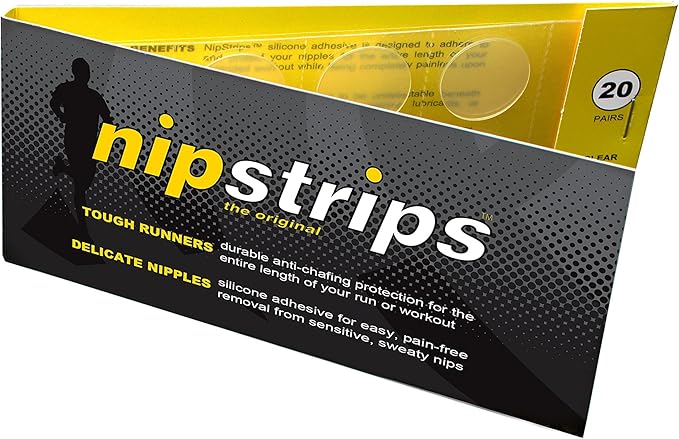
Adhesive nipple covers: Products like NipGuards, NipEaze, or Body Glide nipple balm are designed specifically for runners. Any waterproof round plaster or medical tape over a small gauze pad works equally well at a fraction of the cost.
Anti-chafe balm: BodyGlide is the most widely used in Australia. It applies like a deodorant stick and doesn’t transfer to clothing the way Vaseline does. 2Toms BlisterShield and Squirrel’s Nut Butter are solid alternatives. The same product works for thigh chafing, underarm chafing, and foot blisters.
Running shirt: Any well-fitted, tagless, moisture-wicking polyester or nylon shirt is sufficient. You don’t need a technical racing top — a fitted $20 supermarket synthetic shirt outperforms an expensive cotton tee every time. If you’re using a shirt with a logo across the chest, run your fingers over it. If it has a raised or rough texture, it will chafe.
Chafing, blisters, and gear problems are often symptoms of a training load your body hasn't adapted to yet. Our running coaching programme helps you build mileage progressively — so your skin, joints, and muscles adapt together.
Explore Running Coaching →What causes nipple chafing when running?
Repeated friction between shirt fabric and nipples over thousands of strides, worsened by sweat, dried salt crystals, cotton fabric, loose fit, and cold weather making nipples more erect.
How do I stop nipple chafing when running?
Use adhesive nipple covers or waterproof Band-Aids as your primary protection, combined with a fitted moisture-wicking shirt. Apply BodyGlide or Vaseline as a secondary barrier. Use at least two methods on runs over 90 minutes.
How long does jogger’s nipple take to heal?
Mild chafing: 1–3 days. Cracked or broken skin: 1–3 weeks. Apply antibiotic ointment and cover with sterile gauze. Don’t run through open wounds.
Why do nipples bleed during a marathon?
Each nipple contacts fabric 30,000–50,000 times during a marathon. Sweat softens skin, dried salt acts as an abrasive, and adrenaline masks the pain until after the finish. Prevention is the only answer — there’s no mid-race treatment as effective as having covered up at the start.
Does Vaseline prevent nipple chafing when running?
Yes, but it washes off with heavy sweat. Use it for shorter runs or as a backup to adhesive covers on long runs and races.
Once you’ve had bad nipple chafing, you don’t forget it. The good news is that a 30-second pre-run habit — covers on, BodyGlide applied, cotton shirt in the bin — eliminates the problem permanently. For longer races and marathon training, make adhesive covers part of your gear checklist alongside your shoes and nutrition. The same attention to friction prevention that protects your nipples applies to thighs, underarms, and feet — all common long-run chafing sites that respond to the same lubricant and barrier strategies.
For more on managing the physical side effects of distance running, see our guides on nausea after running and how to avoid cramps while running.
Ready to put your training to the test? Here are some upcoming running events matched to this article.


Head Coach & Founder, SportCoaching
Graeme is the founder of SportCoaching and has coached more than 750 athletes from 20 countries, from beginners to Olympians, in cycling, running, triathlon, mountain biking, boxing, and skiing. His coaching philosophy and methods form the foundation of SportCoaching's training programs and resources.
No matter your goals, SportCoaching offers tailored training plans to suit your needs. Whether you’re preparing for a race, tackling long distances, or simply improving your fitness, our expert coaches provide structured guidance to help you reach your full potential.
Smart, progressive training from 5km to marathon with weekly guidance.
What’s included
Browse upcoming Australian running, cycling, and triathlon events in one place. Filter by sport, check dates quickly, and plan your training around something real on the calendar.
Choose your plan to get started with personalized training plans designed to help you reach your goals.


Minna Backman
When you’re new, feedback is especially important, and Graeme is highly skilled at both analyzing numbers and understanding the importance of mental strength.











