










Find Your Next Cycling Race
Ready to put your training to the test? Here are some upcoming cycling events matched to this article.
 Coach Graeme

Last updated:
Two apps dominate the indoor cycling world: Zwift, the gamified virtual world that turned turbo training into a global sport, and Rouvy, the realism-first platform that lets you ride real roads from your pain cave. Both are excellent — both cost the same — and choosing between them is genuinely difficult because they serve different riders. This guide breaks down every meaningful difference across routes, graphics, pricing, training tools, community, and hardware compatibility so you can make the right call for your goals.
Not sure where to start with training?
Tell us your goal and schedule, and we’ll give you clear direction.
No obligation. Quick, practical advice.
Explore our cycling advice and tips for more helpful articles and resources.
👉 Swipe to view full table
| Feature | Rouvy | Zwift |
|---|---|---|
| Graphics style | Real-world video + AR avatars | Animated 3D virtual worlds |
| Routes | 50,000+ real-world AR routes | Virtual worlds + real-venue recreations |
| Monthly price (single) | US $19.99 | US $19.99 |
| Annual price | US $179.99 | US $199.99 |
| Group/shared plans | Yes (Duo + Group) | No |
| Community size | Smaller, growing | Very large (millions of users) |
| Racing | Yes (real-world course races) | Yes (extensive calendar, large fields) |
| Structured workouts | Yes | Yes |
| Training plans | Yes | Yes |
| Group rides | Yes | Yes (incl. group workouts) |
| Gamification / levels | Limited | Extensive (XP, levels, unlockables) |
| Smart trainer compatibility | All major brands | All major brands + Zwift hardware |
| Running mode | No | Yes (treadmill) |
| Acquired FulGaz | Yes (2025) | No |
This is the starkest difference between the two platforms and the one most likely to determine which app you prefer long-term.
Zwift uses fully rendered 3D animated environments. Its flagship world, Watopia, is a fictional island with volcanos, jungle roads, desert flats, and alpine climbs — none of it real, all of it designed to keep you engaged. Zwift also includes digital recreations of real-world venues used for professional racing, including routes from the UCI Road World Championships. The aesthetic is unapologetically game-like: cartoon-smooth animation, rider avatars, power-ups, and visual rewards for effort. For riders who grew up gaming or who find the immersive-world format motivating, Zwift’s visual approach works exceptionally well. For riders who find it too synthetic, it can feel disconnected from what they love about cycling.
Rouvy takes the opposite approach. It shoots real-world road footage — from the Alpe d’Huez, the Stelvio, Mont Ventoux, Mallorca, New Zealand, Japan, and thousands of other locations — and overlays your avatar on the video so it appears you are actually riding those roads. The resistance on your smart trainer adjusts in real time to match the actual gradient of the route. The result is as close to being on that road as indoor cycling currently gets. In 2025, Rouvy acquired FulGaz, another real-world video platform, further expanding its content library. Rouvy’s augmented reality is not perfect — avatars can look slightly superimposed on the footage — but the overall sense of riding a real road is compelling, particularly on famous climbs.
Rouvy has over 50,000 augmented reality routes covering more than 240,000 km of real-world roads. The breadth of coverage is remarkable — from Tour de France and Giro d’Italia stage routes to obscure local roads users have uploaded themselves. Rouvy allows users to upload their own GoPro footage and convert it into rideable AR routes, meaning the library keeps growing organically. For athletes preparing for specific events — a sportive, a gran fondo, a triathlon bike leg — riding the actual course indoors ahead of race day is a genuine competitive advantage.
Zwift‘s route library is smaller in raw numbers but deeply developed in a way Rouvy’s is not. Each world has been carefully designed to offer variety in gradient, distance, and challenge. The signature Alpe du Zwift climb — Zwift’s fictional equivalent of Alpe d’Huez — has become a benchmark fitness test for indoor cyclists worldwide. Zwift regularly adds new worlds and guest routes (including real venues). The content never changes in the way real roads do, but within Zwift’s universe there is enough variety to prevent staleness for most riders.
Zwift wins this category decisively. With millions of registered users and hundreds of events running at any given hour, Zwift’s community is one of its defining strengths. At the peak of the COVID-19 pandemic in January 2021, over 43,000 riders were simultaneously on the platform. Organised racing on Zwift is a genuine sport — there are category-based races, team events, Zwift Racing League seasons, and even prize money at the elite level. Finding a group ride or race that fits your schedule and ability at any time of day is rarely difficult. For riders motivated by competition and social riding, Zwift’s network effects are hard to match.
Rouvy’s community is smaller but growing. Races on Rouvy are typically contested on real-world course footage, which adds a layer of specificity that pure virtual racing lacks. The platform also offers virtual training camps — structured multi-day riding experiences on themed route collections. Rouvy’s social features have improved significantly and ghost riders (bots set to specific paces) mean you always have something to chase, even riding solo. For those preparing for real-world events, the ability to race on the actual course footage is a meaningful advantage. For more on structured cycling training, see our complete guide to a cycling fitness plan and our list of Zwift workouts every cyclist should try.
Both platforms offer structured workout libraries and training plans, and both integrate with popular training ecosystem tools. The quality and breadth of structured training available on each platform has converged significantly in recent years.
Zwift has a large workout library covering everything from recovery spins to VO2 max intervals, plus multi-week training plans built around events like the Zwift Academy. Workouts are delivered with on-screen text cues and power targets that adjust automatically on a smart trainer. Group workout mode — where a group of riders completes the same workout together with a rubber-banding feature to keep the group together — is unique to Zwift and excellent for coached group sessions. For structured training metrics, see our guide on what FTP means in cycling and our best cycling VO2 max workouts.
Rouvy offers its own workout library and training plans, with the option to complete structured sessions on any route. The ability to do interval work while riding actual road footage adds a specificity that pure virtual worlds cannot offer — you can run a threshold session on the same climb you are targeting in your next race. Rouvy also supports custom workout uploads from TrainingPeaks and similar platforms. Our 30-minute indoor trainer workouts and bicycle trainer workouts for triathletes are compatible with both platforms.
As of mid-2025, both Rouvy and Zwift are priced at US $19.99 per month for a single subscription. Annual plans reduce the cost: Zwift is US $199.99/year; Rouvy is US $179.99/year. Rouvy additionally offers Duo and Group plans that can reduce the per-person cost to around US $8–$10 per month when shared between training partners or household members — a significant saving if multiple people in your household ride. Pricing is denominated in USD and may vary by region.
👉 Swipe to view full table
| Plan | Rouvy | Zwift |
|---|---|---|
| Monthly (single) | US $19.99 | US $19.99 |
| Annual (single) | US $179.99 | US $199.99 |
| Duo / shared plan | Yes (discounted) | No |
| Group plan (5 riders) | ~US $8.40/person/month | Not available |
| Free trial | Yes (7 days) | Yes (7 days) |
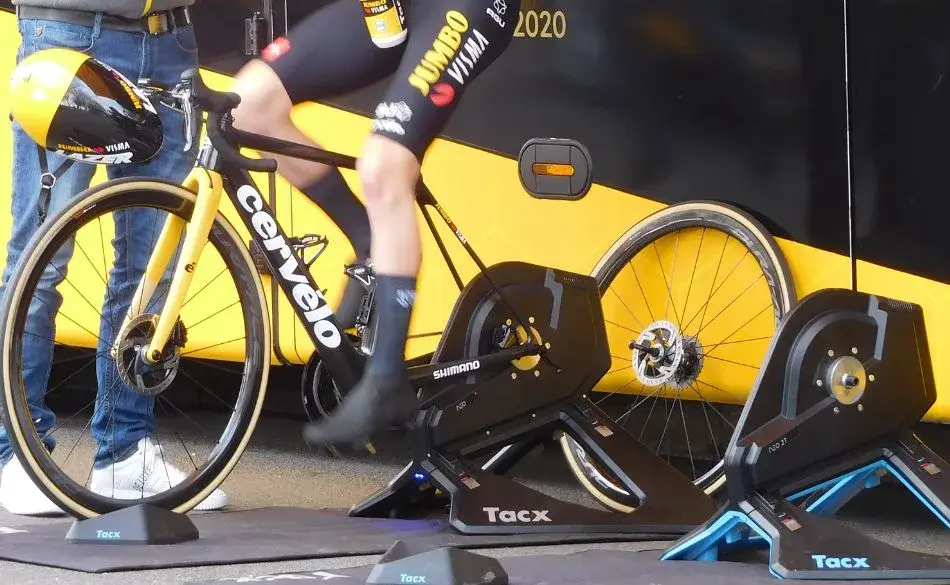
Both apps work with all major smart trainers via Bluetooth and ANT+ — Wahoo KICKR, Tacx NEO, Elite Direto, Saris H3 and others are supported on both platforms without issue. Non-smart trainers paired with a power meter or speed/cadence sensor also work on both, though without automatic resistance control. Zwift additionally offers its own proprietary hardware: the Zwift Cog and Zwift Ride, which enable virtual gear shifting within Zwift’s environment. This hardware is designed specifically for Zwift and is not intended for use with Rouvy. Rouvy does not produce its own hardware.
👉 Swipe to view full table
| You Should Choose... | If You... |
|---|---|
| Zwift | Want the biggest racing and group riding community |
| Zwift | Are motivated by gamification, levels, and unlockables |
| Zwift | Want to run on a treadmill as well as ride |
| Zwift | Prefer game-style graphics and virtual world exploration |
| Rouvy | Want to ride real-world roads and iconic climbs |
| Rouvy | Are training for a specific real-world event or course |
| Rouvy | Have training partners to share a group plan with |
| Rouvy | Prefer realism over game-like aesthetics |
| Both | Train seriously indoors year-round and want variety |
A common path for serious indoor cyclists is to start with Zwift (the larger community makes it easier to find riding partners and get motivated), then add Rouvy when event-specific course preparation becomes relevant, or simply to break up the monotony of virtual worlds. Both offer 7-day free trials — the best way to decide is to ride both before committing to an annual plan. For triathlon-specific indoor training, see our guides on bike trainer workouts for triathletes and the best triathlon training apps.
Also worth comparing: our MyWhoosh vs Zwift guide covers the free alternative to Zwift that has grown significantly in recent years.
Want to make every indoor session count?
Our cycling coaches design structured plans that integrate with Zwift, Rouvy, or any platform — built around your goals, schedule, and events.
Cycling Coaching → Training Plans →Is Rouvy or Zwift better?
Neither is universally better — they serve different riders. Zwift wins on community, racing volume, and gamification. Rouvy wins on realism, real-world route specificity, and value when using shared plans. Riders who train seriously indoors often use both.
How much does Rouvy cost compared to Zwift?
Both are US $19.99/month for a single user. Annually, Rouvy is US $179.99 vs Zwift’s $199.99. Rouvy’s Group plan (5 riders) reduces cost to approximately US $8.40 per person per month — Zwift has no equivalent shared plan.
Does Rouvy work with Zwift’s hardware?
Rouvy works with all major smart trainers via Bluetooth and ANT+. Zwift-branded hardware (Zwift Cog, Zwift Ride) is designed for Zwift’s virtual shifting system specifically and is not intended for use with Rouvy.
Can you race on Rouvy like you can on Zwift?
Yes, Rouvy has racing on real-world course footage. However, Zwift’s race calendar is far larger, with hundreds of events daily and much bigger fields at every ability level. Rouvy racing is smaller-field but more course-specific.
What is the difference between Rouvy and Zwift graphics?
Zwift uses animated 3D virtual worlds. Rouvy uses real-world video footage with AR avatars overlaid. Rouvy is more realistic; Zwift is more immersive and game-like. Which you prefer comes down to whether you want to feel like you are cycling through a game or through an actual place.
Ready to put your training to the test? Here are some upcoming cycling events matched to this article.
Head Coach & Founder, SportCoaching
Graeme is the founder of SportCoaching and has coached more than 750 athletes from 20 countries, from beginners to Olympians, in cycling, running, triathlon, mountain biking, boxing, and skiing. His coaching philosophy and methods form the foundation of SportCoaching's training programs and resources.
No matter your goals, SportCoaching offers tailored training plans to suit your needs. Whether you’re preparing for a race, tackling long distances, or simply improving your fitness, our expert coaches provide structured guidance to help you reach your full potential.
Structured cycling coaching to build power, endurance, and speed.
What’s included
Browse upcoming Australian running, cycling, and triathlon events in one place. Filter by sport, check dates quickly, and plan your training around something real on the calendar.
Choose your plan to get started with personalized training plans designed to help you reach your goals.


Minna Backman
When you’re new, feedback is especially important, and Graeme is highly skilled at both analyzing numbers and understanding the importance of mental strength.