Want help turning consistency into progress? Coaching keeps your training simple, structured, and sustainable.
Start Coaching →
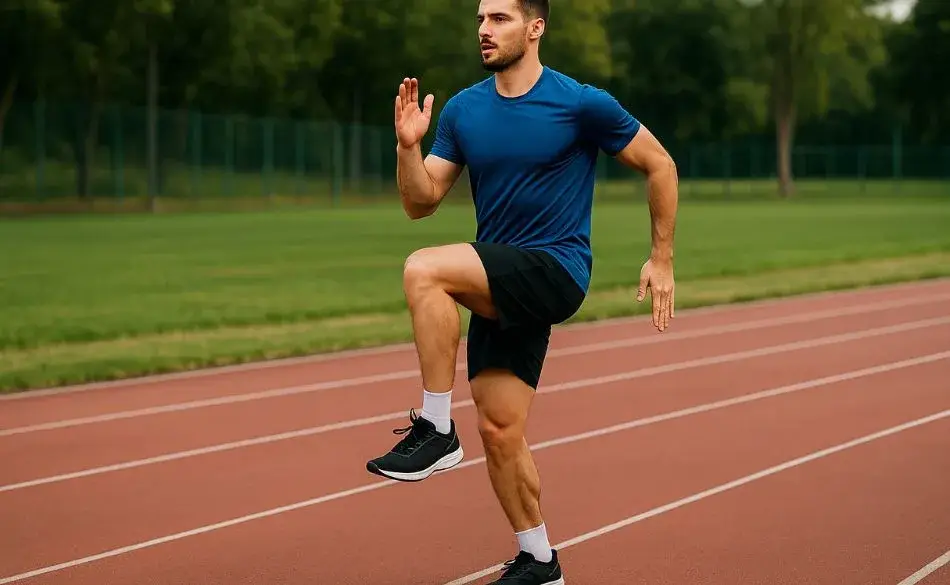
Runner performing high knees exercise on an outdoor track

Last updated:

High Knees: The Running Drill That Makes You Faster and Fixes Your Form

High knees look deceptively simple — run on the spot with your knees driving high. But done correctly, they're one of the most effective drills in a runner's toolkit. They strengthen the hip flexors and glutes, train the neuromuscular patterns behind faster cadence, and prepare your legs for the demands of a hard workout in under two minutes.

This guide covers exactly how to do high knees with proper form, which muscles are working and why, the specific benefits for runners, common errors to avoid, and three ready-to-use workout formats.

Chat with a SportCoaching coach

Not sure where to start with training?

Tell us your goal and schedule, and we’ll give you clear direction.

No obligation. Quick, practical advice.

Article Categories:

Explore our running advice and tips for more helpful articles and resources.

Quick Answer

High knees train the front-side mechanics of your stride — knee drive, hip flexor strength, cadence, and arm coordination. Done for 2–3 sets of 20 metres or 20–30 seconds before a run, they activate the muscles that make you faster and more efficient. The key is quality: tall posture, forefoot landing, quick rhythmic tempo.<

What Are High Knees?

High knees are a dynamic running drill performed either in place or moving forward, where you drive each knee up toward hip height with a quick, alternating rhythm. Arms pump in opposition to the legs — the same pattern as running — while your core stays braced and your chest stays tall.

The exercise mimics and exaggerates the front-side mechanics of the running stride. Where normal running involves a moderate knee lift and natural hip flexor engagement, high knees forces a greater range of motion and faster muscle recruitment — essentially taking the most powerful part of your stride and training it in isolation.

They’re used across track, road, and trail running as both a warm-up drill and a conditioning tool, and are equally effective for beginners building coordination and experienced runners sharpening their form.

Muscles Worked During High Knees

High knees engage more muscle groups than most runners realise. Here’s what’s working and what each muscle contributes to your running performance:

👉 Swipe to view full table

Muscle Group Role in High Knees Running Benefit
Hip flexors (iliopsoas) Drive the knee upward on each rep Stronger knee drive = longer, more powerful stride
Quadriceps Extend the knee and absorb landing force Better shock absorption; protects knee joint
Glutes Stabilise the hip and drive push-off More power on hills and at pace; reduces hip drop
Hamstrings Assist leg recovery after each drive Faster leg turnover; reduces strain on lower back
Calves Propel off the forefoot on each step Improved ankle spring; better hill and sprint power
Core (abs, obliques) Stabilise torso, prevent lateral sway More efficient arm-leg coordination; better posture under fatigue
Arms (shoulders, biceps) Drive in opposition to the legs Reinforces correct arm mechanics for faster running

The hip flexors and calves are worked more intensely than in normal running because the movement demands a higher range of motion and a forefoot-only contact pattern. This is where much of the speed and form benefit comes from. For complementary hip work, see our guide to hip strengthening exercises for runners.

How to Do High Knees: Step-by-Step

There are two versions — in place and moving forward. Both are effective. Moving forward transfers more directly to running mechanics; in place works well indoors or in limited space.

High Knees in Place

  1. Stand tall with feet hip-width apart, arms at your sides.
  2. Brace your core lightly and shift slightly onto the balls of your feet.
  3. Drive your right knee up to hip height as your left arm swings forward.
  4. As the right foot returns to the ground (forefoot first), immediately drive the left knee up with your right arm swinging forward.
  5. Continue alternating at a quick, rhythmic tempo. Each landing should be light and quiet — not a slap.
  6. Keep your torso tall throughout. Lean slightly forward from the ankles — not from the waist.

High Knees Moving Forward

  1. Same starting position, but you’ll travel forward over 20–30 metres.
  2. Drive each knee up to hip height as you move forward, covering ground with short, quick steps.
  3. Focus on the quality of each knee drive rather than how quickly you cover the distance.
  4. Arms stay at 90 degrees, swinging forward and back — not crossing the midline.
  5. Walk back to the start and repeat.

Key form cues to remember: tall spine, slight ankle-lean, forefoot landing, elbows at 90 degrees, knees to hip height (not chest), quiet footfalls, and crisp rhythm. After your sets, follow up with 20–40 metres of relaxed running strides to blend the drill into your natural mechanics while the pattern is still fresh.

Benefits of High Knees for Runners

Stronger hip flexors and stride mechanics. Weak hip flexors limit knee drive and shorten your stride. High knees directly load the hip flexors through their full range of motion under fatigue, building strength and endurance that carries over to faster, longer strides in training and racing. This is one reason coaches include high knees in drill sequences for all distances from 5K to marathon. For more on improving stride efficiency, see our running technique and cadence guide.

Improved cadence and neuromuscular timing. High knees train the nervous system to fire the muscles of the lower limb faster and in a more coordinated sequence. Research on dynamic movement drills has confirmed their positive effect on lower-limb muscle activation patterns and neuromuscular timing — the brain-to-muscle speed that determines how quickly you can turn your legs over. Higher cadence with the same effort means better running economy and less impact per kilometre.

Better running posture under fatigue. Late in a long run or race, posture breaks down — hips drop, the torso leans forward from the waist, and arm swing becomes sloppy. High knees reinforce the upright posture and core stability required to maintain form when tired. Because the drill is performed standing tall with a braced core, it builds the postural endurance that transfers to the last 10 km of a marathon or the final intervals of a track session.

Forefoot striking and calf strength. The forefoot-only contact pattern in high knees strengthens the calves and trains the ankle springiness that makes efficient running feel lighter and faster. Heel-striking under fatigue is one of the most common form breakdowns — and regular high knees practice builds the neuromuscular habits and calf endurance that help maintain forefoot contact longer into a run. This also improves performance on hills and sprint finishes. See our guide to speed work for runners for how to layer this into your training.

Zero equipment, any location. Unlike most strength exercises, high knees need nothing but a small patch of ground. They work in a hotel room, a park, a car park before a trail run, or next to your front door before heading out. This makes them one of the most consistently accessible warm-up tools for runners who travel or have unpredictable schedules.

Common High Knees Mistakes — and How to Fix Them

👉 Swipe to view full table

Mistake What it looks like Fix
Leaning back from the waist Torso tilting backward as knees come up Lean slightly forward from the ankles, not from the hips. Brace your core before starting.
Knees not reaching hip height Knee lift stops mid-thigh; feels like jogging in place Slow down the tempo slightly and focus on height over speed. Use a target like a raised hand or a mark on the wall.
Heel striking Foot landing flat or heel-first; heavy, slapping sound Think about landing lightly on the ball of your foot. Keep contacts short and quiet.
Arms crossing the midline Arms swinging across the body rather than forward-back Keep elbows at ~90 degrees and drive hands from cheek height to hip height, in a straight line.
Bouncing vertically Gaining height on each rep rather than quick turnover Think horizontal rhythm, not vertical jump. Stay compact and quick.
Hips dropping or rotating Pelvis tilting side to side with each knee lift Strengthen glutes with core and glute exercises. During the drill, think about keeping your hips level and square.

How to Use High Knees in Your Training

As a pre-run warm-up drill. This is the most common and effective use. Two to three sets of high knees before any quality session — intervals, tempo, or long run — activates the hip flexors, elevates heart rate, and primes your neuromuscular system for the work ahead. The entire sequence takes 90 seconds and makes the first kilometre feel significantly smoother.

Warm-up drill sequence: Leg swings (10 each side) → High knees 2 × 20 metres → A-skips 2 × 20 metres → Relaxed strides 2 × 60 metres.

As a HIIT or conditioning drill. High knees can be used as a standalone cardio and conditioning tool when you need a short, high-intensity session. Because they spike heart rate quickly, they fit naturally into HIIT circuits for runners.

HIIT format: 30 seconds high knees / 15 seconds rest × 8 rounds. Rest 90 seconds. Repeat for 2–3 total sets. This produces a challenging cardiovascular stimulus and significant hip flexor and calf fatigue. A single set takes 6 minutes; 2–3 sets with rest fits comfortably into 20 minutes.

As a speed drill in track sessions. Many track coaches use high knees as part of a drill sequence before interval sessions to prime fast-twitch muscle fibres and reinforce good sprint mechanics. Moving-forward high knees over 30–40 metres, followed immediately by a controlled acceleration, help bridge the gap between drill technique and actual running speed. See our guide to interval training for runners for how to structure these sessions.

How Often Should Runners Do High Knees?

As a warm-up drill, high knees work well before every run — 2–3 sets takes under two minutes and compounds significantly over a training block. As a conditioning drill, 2–3 sessions per week is sufficient to see strength and form benefits without accumulating excessive fatigue in the hip flexors.

👉 Swipe to view full table

Use case Volume Frequency When
Pre-run warm-up drill 2–3 × 20m or 20 sec Before every quality session After leg swings, before strides
HIIT conditioning 8 × 30 sec on / 15 sec off 2–3 × per week Standalone or as part of a circuit
Speed drill sequence 4–6 × 30–40m reps Before interval or track sessions After the general warm-up, before intervals begin

If you’re building a structured running program from scratch, our running training plans include warm-up drill protocols and speed sessions that incorporate high knees and other form drills into a progressive weekly structure.

High Knees vs Other Running Drills

High knees sit within a family of running drills that all target different aspects of stride mechanics. Understanding where each fits helps you choose the right drill for your goal.

High knees vs A-skips: Both train knee drive and hip flexor activation. High knees emphasise rapid tempo and cardiovascular conditioning. A-skips add a skip rhythm and focus more on ankle stiffness and precise ground contact. Most coaches use both in the same drill sequence.

High knees vs butt kicks: High knees train front-side mechanics (knee drive, hip flexion). Butt kicks train back-side mechanics (hamstring recovery, heel-to-glute speed). Both are complementary — front-side and back-side mechanics together determine stride efficiency.

High knees vs bounding: Bounding develops explosive power and horizontal force application. High knees develop speed and conditioning. Bounding is typically used in power-focused sessions; high knees in warm-up and HIIT contexts. For a complete approach to running speed, see our speed work guide for runners.

Add High Knees to Your Running Routine

High knees are one of the highest-return warm-up investments available to runners. Two minutes before a quality session builds hip flexor strength, trains cadence, reinforces forefoot mechanics, and prepares your neuromuscular system for the work ahead. The drill is simple to learn, needs no equipment, and improves with every session.

Start with the warm-up format — 2 × 20 metres before each run — and add the HIIT or track-drill versions once the movement feels natural. Within a few weeks you’ll notice the difference in how the first kilometres of a hard session feel.

Want a running program that includes drills, speed work, and structured progression?

Our coaching and training plans incorporate high knees and other running drills into a complete weekly structure — so every session has a purpose and builds toward your goal.

Get Running Coaching View Training Plans

FAQ: High Knees Exercise for Runners

What do high knees do for runners?
High knees strengthen hip flexors, quads, glutes, and calves while training the neuromuscular patterns behind faster, more efficient running. They improve knee drive, cadence, and form — making them one of the most effective drills at any level.

How do you do high knees correctly?
Stand tall with a slight forward lean from the ankles. Drive each knee to hip height as you swing the opposite arm forward. Land on the forefoot. Keep your core braced and your elbows at roughly 90 degrees. Aim for quick, rhythmic tempo — avoid bouncing vertically or letting hips drop.

How often should runners do high knees?
As a warm-up drill: before every quality run session, 2–3 sets of 20 metres or 20–30 seconds. As a conditioning drill: 2–3 times per week. The entire warm-up use takes under two minutes and compounds meaningfully over a training block.

Do high knees improve running speed?
Yes. High knees train the front-side mechanics of the stride — the explosive knee drive that generates power and cadence. Stronger hip flexors and better neuromuscular coordination both contribute to faster, more efficient running over time.

What is the difference between high knees and A-skips?
Both target knee drive and hip flexor activation. High knees focus on rapid tempo and conditioning. A-skips add a skip rhythm and emphasise ankle stiffness and ground contact mechanics. Both are complementary and often used together in a warm-up drill sequence.

Find Your Next Running Race

Ready to put your training to the test? Here are some upcoming running events matched to this article.

Graeme - Head Coach and Founder of SportCoaching

Graeme

Head Coach & Founder, SportCoaching

Graeme is the founder of SportCoaching and has coached more than 750 athletes from 20 countries, from beginners to Olympians, in cycling, running, triathlon, mountain biking, boxing, and skiing. His coaching philosophy and methods form the foundation of SportCoaching's training programs and resources.

750+
Athletes
20+
Countries
7
Sports
Olympic
Level

Start Your Fitness Journey with SportCoaching

No matter your goals, SportCoaching offers tailored training plans to suit your needs. Whether you’re preparing for a race, tackling long distances, or simply improving your fitness, our expert coaches provide structured guidance to help you reach your full potential.

  • Custom Training Plans: Designed to match your fitness level and goals.
  • Expert Coaching: Work with experienced coaches who understand endurance training.
  • Performance Monitoring: Track progress and adjust your plan for maximum improvement.
  • Flexible Coaching Options: Online and in-person coaching for all levels of athletes.
Learn More →

Choose Your Next Event

Browse upcoming Australian running, cycling, and triathlon events in one place. Filter by sport, check dates quickly, and plan your training around something real on the calendar.

View Event Calendar