





Find Your Next Running Race
Ready to put your training to the test? Here are some upcoming running events matched to this article.
 Coach Graeme
Last updated:
Cross country races don't have a single set distance. They range from 2K for young athletes to 12K for elite senior men, depending on age, gender, competition level, and country. If you're looking for a quick answer: most US high school races are 5K (3.1 miles), but that's just one point on a much wider spectrum.
Not sure where to start with training?
Tell us your goal and schedule, and we’ll give you clear direction.
No obligation. Quick, practical advice.
Explore our running workouts and tips for more helpful articles and resources.
Cross country races are typically 3–12 km (1.9–7.5 miles). Youth: 2–3K. High school (US): 5K. College women: 6K. College men: 8–10K. International elite: 10K. The exact distance depends on age group, gender, and competition level. See the full chart below.
👉 Swipe to view full table
| Level | Distance (km) | Distance (miles) | Notes |
|---|---|---|---|
| Youth (under 10) | 1–2 km | 0.6–1.2 mi | Fun runs and introductory events |
| Youth (10–13) | 2–3 km | 1.2–1.9 mi | Club and school-level competition |
| Middle school (US) | 3 km (or 2 mi) | 1.9 mi | Some regions use 2 miles instead of 3K |
| High school — JV / freshman (US) | 3.2–4 km | 2–2.5 mi | Shorter distances for developing runners |
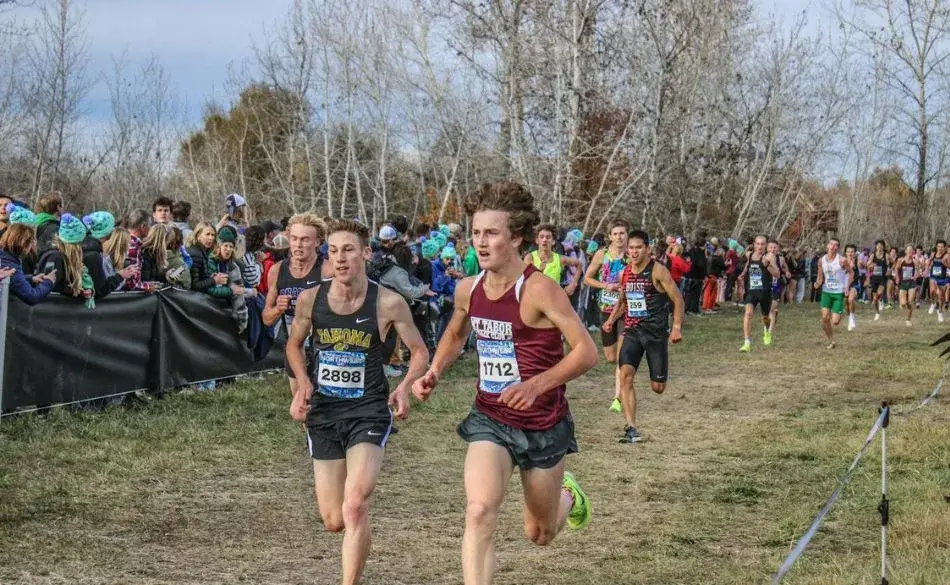
| High school — varsity (US) | 5 km | 3.1 mi | Standard US varsity distance, both genders |
| NCAA DI & DII women | 6 km | 3.7 mi | Campaign underway to change to 8K |
| NCAA DIII men & women | 8 km | 5.0 mi | Equal distance for both genders |
| NCAA DI & DII men (regular season) | 8 km | 5.0 mi | Some meets use 10K |
| NCAA DI men (nationals) | 10 km | 6.2 mi | Championship distance |
| World Athletics — junior women | 6 km | 3.7 mi | World Cross Country Championships |
| World Athletics — junior men | 8 km | 5.0 mi | World Cross Country Championships |
| World Athletics — senior women | 10 km | 6.2 mi | Equalised with men in recent editions |
| World Athletics — senior men | 10 km | 6.2 mi | Run on 2 km loops |
| UK national championships (senior men) | 12 km | 7.5 mi | Longest standard XC distance |
| Adult community / parkrun-style XC | 5–10 km | 3.1–6.2 mi | Varies by event and organiser |
The key takeaway: there is no single “cross country distance.” The sport’s defining feature is that courses vary — in distance, terrain, and surface — which is what makes it different from track and road racing.
Cross country traditions differ significantly between countries. In the US, high school races are almost universally 5K, and the sport is tightly linked to the school system. In the UK, distances vary more and tend to be longer — senior men’s national championship races are 12K, and club-level races often range from 6K to 10K depending on the age group and region.
At the international level, the World Athletics Cross Country Championships use 2 km loops with total distances of 6K (junior women), 8K (junior men), and 10K (senior men and women). Australia follows a similar structure for national championships, with distances varying by age group from 3K to 10K.
Unlike a marathon or 10K road race, cross country doesn’t require a certified, measured course. Races are run over natural terrain — grass, mud, hills, woodland — and the course layout depends on the available land. This means distances can vary slightly between venues, even within the same competition level.
The other major variable is age appropriateness. Younger runners race shorter distances because their musculoskeletal systems are still developing. Longer distances are reserved for older, more experienced athletes who have built the endurance to handle them safely. This progression — from 2K through to 10–12K — reflects a sensible development pathway that prioritises long-term health over early specialisation.
Regardless of the specific distance, cross country demands a different kind of fitness than road or track racing. The uneven terrain, elevation changes, and soft surfaces mean you’ll run slower than your road pace for the same effort — and that’s normal.
If you’re preparing for a cross country season, focus on running on varied surfaces (grass, trails, hills), building consistent weekly volume, and practising race-pace efforts on terrain similar to your target course. For runners transitioning from road to cross country, our how to start running guide covers building a sustainable base, and our interval running guide helps structure speed work.
How long is a high school cross country race?
Most US high school varsity races are 5K (3.1 miles). JV races are often 2–3 miles, and freshman races may be 2–2.5 miles. In the UK and Australia, distances vary more widely by age group.
How long is a college cross country race?
NCAA DI and DII men typically race 8K (regular season) or 10K (nationals). Women race 6K. DIII runs 8K for both genders. There’s an ongoing campaign to standardise all collegiate distances to 8K.
How long is a cross country race in miles?
Between about 1.2 miles (2K) for youth and 7.5 miles (12K) for elite senior men. The most common distance is 3.1 miles (5K), standard for US high school and many adult community events.
How far do professional cross country runners race?
At the World Athletics Cross Country Championships, senior men and women both race 10K on 2 km loops. National championship distances vary by country but are generally 10–12K for senior men and 8–10K for senior women.
Is cross country always 5K?
No. 5K is standard for US high school varsity, but distances vary widely. Youth races can be as short as 2K, college races range from 6K to 10K, and international championships are 10K or longer.
Cross country races range from 2K for the youngest athletes to 12K for senior men at national level. The most common distance worldwide is 5K, but the sport’s diversity is part of its appeal — no two courses are the same, and the distance is just one variable alongside terrain, weather, and competition.
Use the table above to find the distance for your age group and competition level, and train accordingly. If you’re not sure how to structure your training for a specific distance, a running coach can help you build a plan that matches your goals and current fitness.
Our running coaching programmes build structured plans that match your target distance, fitness level, and race schedule — so you arrive at the start line prepared and confident.
Ready to put your training to the test? Here are some upcoming running events matched to this article.


Head Coach & Founder, SportCoaching
Graeme is the founder of SportCoaching and has coached more than 750 athletes from 20 countries, from beginners to Olympians, in cycling, running, triathlon, mountain biking, boxing, and skiing. His coaching philosophy and methods form the foundation of SportCoaching's training programs and resources.
No matter your goals, SportCoaching offers tailored training plans to suit your needs. Whether you’re preparing for a race, tackling long distances, or simply improving your fitness, our expert coaches provide structured guidance to help you reach your full potential.
Smart, progressive training from 5km to marathon with weekly guidance.
What’s included
Browse upcoming Australian running, cycling, and triathlon events in one place. Filter by sport, check dates quickly, and plan your training around something real on the calendar.
Choose your plan to get started with personalized training plans designed to help you reach your goals.


Minna Backman
When you’re new, feedback is especially important, and Graeme is highly skilled at both analyzing numbers and understanding the importance of mental strength.











