










As an Amazon Associate, SportCoaching earns from qualifying purchases.


Find Your Next Running Race
Ready to put your training to the test? Here are some upcoming running events matched to this article.
 Coach Graeme

Last updated:
Barefoot running sits at an unusual intersection in the running world — it has a genuine scientific rationale, a meaningful body of supporting research, passionate advocates, and a significant injury history among runners who adopted it too quickly. The honest summary of the current evidence is that the benefits are real but conditional, the risks are real and often understated, and the transition is the part that most articles either skip over or treat as a brief footnote.
This guide covers what the research actually shows — including where it's genuinely uncertain — why the injury profile of barefoot running shifts rather than disappears, the specific transition protocol that protects connective tissue, and who should approach this carefully or avoid it altogether.
Not sure where to start with training?
Tell us your goal and schedule, and we’ll give you clear direction.
No obligation. Quick, practical advice.
Explore our running training advice for more helpful articles and resources.
The barefoot running movement gained major momentum from Daniel Lieberman’s 2010 Harvard study showing that habitually barefoot runners landed with lower impact peaks than heel-striking shod runners. This was widely interpreted as evidence that barefoot running was safer. The fuller picture is more nuanced.
A 2014 PMC systematic review — the most comprehensive to date — concluded that “no definitive conclusions can be drawn regarding specific risks or benefits to running barefoot, shod, or in minimalist shoes” due to the lack of high-quality evidence. A 2024 PMC review found clearer biomechanical signals: transitioning to minimalist footwear produces a more anterior foot strike, higher cadence, lower vertical loading rate, less knee energy absorption, and a shorter stride length — all potentially beneficial adaptations. The same review found, however, that minimalist footwear places higher degrees of stress on the ankle joints and produces increased injury rates when the transition is abrupt.
The most important finding across this literature: the injury profile of barefoot running doesn’t disappear. It shifts. Barefoot running tends to reduce loading on the knee and hip — which is relevant for runners with patellofemoral pain or IT band syndrome. At the same time, it increases loading on the Achilles tendon, calf musculature, and the small bones of the forefoot. Metatarsal stress reactions and calf strains are the most common injuries in runners who transition too quickly. Whether this trade-off benefits any individual runner depends on their specific injury history.
One commonly repeated claim — that barefoot running is more metabolically efficient because you’re not carrying the weight of shoes — is more complicated than usually stated. When researchers controlled for shoe mass by adding weights to barefoot runners’ feet, shod running was actually 3–4% more metabolically efficient. The arch spring mechanism of the foot (which shoes partially suppress) does contribute efficiency, but the increased muscular work required to manage impact without cushioning appears to offset this advantage. Running economy differences are small and highly individual.
Foot and lower leg muscle development. This is the most consistently supported benefit in the research. Studies show significant increases in foot muscle volume after runners transition to minimalist footwear, primarily in the intrinsic foot muscles. Runners who stayed in conventional shoes showed no comparable change. These muscles support the arch, contribute to push-off efficiency, and provide proprioceptive feedback about ground contact. Conventional cushioned shoes reduce the demand on these muscles across thousands of daily strides.
Improved proprioception. The thick cushioning of modern running shoes reduces sensory feedback from the ground. Barefoot running — and to a lesser extent minimalist footwear — provides far more direct feedback about foot position, terrain texture, and contact force. This proprioceptive richness improves balance, enhances automatic gait adjustment to terrain variation, and is one mechanism by which barefoot training can support better running form.
Higher cadence and shorter stride. Most runners instinctively shorten their stride and quicken their cadence when barefoot — because the immediate feedback of unpadded ground contact makes overstriding uncomfortable. This is biomechanically beneficial and connects directly to the form work discussed in our running technique and cadence guide. The benefit here is real whether you use barefoot, minimalist shoes, or simply focus on cadence improvement with conventional footwear.
Reduced knee and hip loading. There is reasonable evidence that forefoot landing patterns associated with barefoot running reduce patellofemoral joint stress and knee energy absorption compared to heel-striking in cushioned shoes. For runners specifically experiencing knee pain, this is a meaningful finding worth exploring — with appropriate caution about the offsetting Achilles and forefoot loading.
Bone density. Weighted impact loading stimulates bone remodelling. The increased proprioceptive demand and ground feedback of barefoot activity, combined with foot muscle activation, may support bone density in the foot and lower leg — though this is harder to isolate specifically from other exercise effects.
Achilles tendon and calf injury on abrupt transition. The single most reliable finding in the barefoot running literature is that abrupt transition produces a significant spike in Achilles and calf injury rates. The Achilles tendon and calf are not accustomed to the loading pattern of forefoot/midfoot striking in runners habituated to heel-striking in cushioned shoes. Bone marrow swelling in the metatarsals — a precursor to stress fractures — has been found in runners who increase barefoot mileage too quickly. This is not a minor risk. It has ended training blocks for well-motivated runners who followed online advice to “just go slowly at first” without understanding what that actually means.
Metatarsal stress reactions. The small bones of the forefoot are substantially more loaded in forefoot/midfoot striking than in the heel-strike pattern of cushioned shoe running. Without the protective distribution of impact that cushioning provides, these bones must adapt to a new loading pattern. This takes months, not weeks. Runners who have spent years in cushioned shoes have metatarsals that have never been conditioned for this load. Bone marrow swelling can progress to stress fractures if progression is too aggressive.
Surface and environmental hazards. True barefoot running (no shoes) exposes the feet to cuts from glass or sharp debris, abrasion on rough surfaces, temperature extremes, and parasitic infection risk in some environments. In urban Australian settings — broken glass, hot asphalt reaching 60°C+ in summer — truly barefoot running is impractical for most training.
The cardiovascular vs structural fitness lag. Your cardiovascular system adapts to new training within weeks. The connective tissue of your feet, Achilles tendon, and metatarsals adapts over months. A runner whose aerobic capacity allows 5km feels fine barefoot and does 5km — but their Achilles tendon and metatarsals have been given a completely new loading pattern for 40 minutes. The injury shows up 2–3 weeks later, not during the run. This is the most consistent pattern that produces injury in otherwise sensible runners. Our marathon mileage guide covers this cardiovascular vs structural adaptation lag in the context of running volume — the same principle applies precisely to barefoot transition.
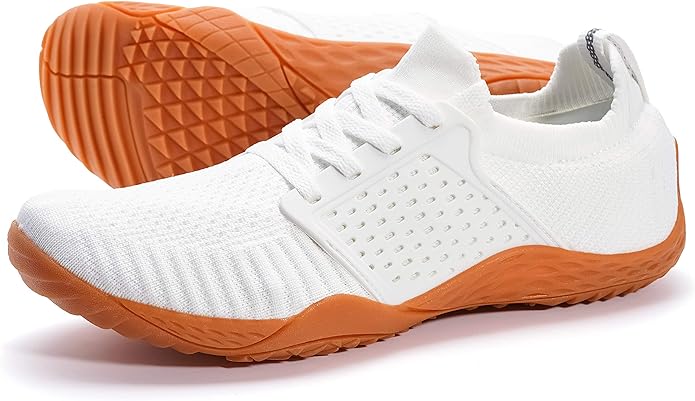
True barefoot running and minimalist shoe running are not the same thing, despite being grouped together in most articles and much of the research. The British Journal of Sports Medicine published research finding that running in a minimalist shoe “is not the same as running barefoot” biomechanically, even at matched speeds.
| True barefoot | Minimalist shoes | Conventional running shoes | |
|---|---|---|---|
| Heel-to-toe drop | 0mm | 0–4mm | 8–12mm typical |
| Cushioning | None | Minimal (2–6mm stack) | Significant (20–40mm stack) |
| Proprioception | Maximum | High | Reduced |
| Surface protection | None | Basic (cuts, temperature) | Full |
| Foot muscle activation | Maximum | High | Reduced |
| Transition requirement | Longest — full structural adaptation | Significant — similar to barefoot | Standard running adaptation |
| Practical for training volume | Limited — surface and environmental constraints | Yes — primary training tool for minimalist approach | Yes |
For most recreational runners interested in the benefits of barefoot-style running, minimalist shoes are the more practical training tool. They provide the same biomechanical stimulus as barefoot running with surface protection that makes regular training volume feasible. They still require the same careful transition approach. They are not a shortcut.
The most consistent advice across the literature: start far more slowly than you think you need to, and increase volume far more gradually than seems necessary. Research found bone marrow swelling in runners transitioning too quickly — this is the precursor to stress fractures, and it happens before you feel pain. The fact that a run feels fine means nothing about whether the structural adaptation is keeping pace. Beginner runners should note that our beginner running guide recommends building a solid conventional shoe base before exploring any form changes — this applies equally to barefoot transition.
A well-studied 12-week programme began at 10% of total mileage in minimalist shoes and increased by 10% each week. A more conservative practical approach for runners with no barefoot background:
Weeks 1–2: Foot exposure only. 5–10 minutes of barefoot walking indoors on smooth flooring. No running yet. This is about introducing the foot to unpadded contact and beginning intrinsic muscle activation. Also begin foot strengthening exercises: calf raises, single-leg balance, toe spread and curl exercises. These can be done in your regular shoes and are the structural preparation that makes the running transition safer. Our warm-up and cool-down guide covers where these exercises fit into your daily routine.
Weeks 3–4: Short barefoot/minimalist runs. Add 5–8 minutes of barefoot jogging (grass, a track, or soft surface) 3 times per week. Remain in conventional shoes for all other running volume. Keep total barefoot volume very low. Expect calf and arch soreness in the first sessions — this is normal adaptation. Genuine pain, especially in the Achilles or metatarsals, is a signal to reduce volume further.
Weeks 5–8: Gradual build. Increase barefoot/minimalist session duration by no more than 10% per week — the same progressive overload principle that governs running mileage. Move to minimalist shoes once basic barefoot form feels natural. Keep all other running in conventional shoes. Do not increase barefoot volume and overall running volume simultaneously.
Weeks 9–16: Integration. If all is going well — no Achilles pain, no forefoot bone tenderness, good form maintained — begin replacing some conventional shoe sessions with minimalist shoe sessions. Only increase the proportion of minimalist running once each new level is comfortable across multiple sessions, not just one.
Important: if you’re currently building mileage for a marathon or other event, this is not the time to begin a barefoot transition. The 10% mileage increase rule and the barefoot transition protocol place simultaneous demands on the same connective tissue. One or the other — not both at the same time.
Our guide on easy run effort is relevant here: all barefoot and minimalist transition sessions should be at genuinely easy Zone 2 effort. The form change and structural adaptation are the stimulus; adding cardiovascular intensity on top produces overload without proportional benefit.
Barefoot running naturally encourages better mechanics, but some runners — particularly those who have heel-struck in cushioned shoes for years — find that the instinctive form improvements need reinforcement. The key changes:
Shorter stride, higher cadence. These happen naturally when barefoot, because landing in front of the hips with a straight knee on unpadded ground creates immediate feedback. If you’re still overstriding barefoot, think “quick and light” rather than trying to place the foot differently. Increasing cadence is the mechanism — our running technique guide covers the 5–10% cadence increase approach that works both in shoes and barefoot. Strides — the short controlled accelerations covered in our speed work guide — are also a useful barefoot form drill when done on a soft surface, because the natural feedback encourages quick, light foot contact.
Land under the hips, not in front of them. The same principle that applies to shod running applies here. Barefoot running provides more immediate feedback when you overstride — the discomfort is a useful signal, not a problem to be overridden.
Soft, quiet contact. Think “land lightly” rather than “land on the forefoot.” Consciously trying to land on the ball of the foot can produce excessive calf and Achilles loading. Landing quietly — with minimal sound — tends to produce a natural midfoot contact pattern in most runners and reduces the overactive forefoot striking that causes calf problems.
Approach with significant caution or avoid entirely if: you have a history of plantar fasciitis, Achilles tendinopathy, or metatarsal stress fractures; you currently have flat arches with no prior barefoot exposure; you are actively building mileage toward a race; you use orthotics or motion-control shoes for a medically identified structural issue; you are a beginner runner who hasn’t yet established consistent running base; or you are over 50 with low bone density or osteoporosis risk. For youth runners (8–14), OSU-Cascades FORCE Lab research found barefoot and minimal shoe running can double impact loading rates — gradual transition with professional guidance is particularly important.
For older runners, the bone stress considerations are more significant — the same metatarsal loading that adapts in a healthy younger runner over 12 weeks can produce stress fractures more readily in a masters runner with reduced bone density. Our guide for older athletes covers how training adaptations change with age, including why the connective tissue timeline for adaptation lengthens with age — making the already conservative transition protocol even more conservative for runners over 50.
As an Amazon Associate, SportCoaching earns from qualifying purchases.
Does barefoot running reduce injuries?
Mixed evidence. The injury profile shifts — less knee and hip loading, more Achilles and forefoot loading — rather than reducing overall. A 2014 systematic review found no definitive conclusions either way. The critical variable is transition speed: runners who transition gradually have better outcomes; abrupt transition consistently produces elevated injury rates.
What is the difference between barefoot and minimalist running?
Barefoot = no shoes, maximum proprioception, no surface protection. Minimalist = thin-soled shoes (0–4mm drop) that mimic barefoot loading while providing basic protection. Research shows they are biomechanically different. Both require similar careful transition. Minimalist shoes are more practical for training volume in most settings.
How long does it take to transition to barefoot running?
Minimum 8–12 weeks; 24 weeks is more conservative and appropriate for runners with no barefoot background. Start with 5–10 minutes 3x/week on soft surfaces. Never increase barefoot volume more than 10% per week. Don’t transition while simultaneously building running mileage.
Is barefoot running more efficient than shoes?
Not straightforwardly. When shoe mass is controlled for experimentally, shod running is 3–4% more metabolically efficient. The arch spring benefit of barefoot is offset by increased muscular demand. Economy differences are small and individual.
Who should avoid barefoot running?
Achilles tendinopathy, plantar fasciitis, or metatarsal stress injury history; current mileage-building phase; flat arches with no barefoot background; orthotics users; beginner runners; runners over 50 with bone density concerns. These don’t mean never — they mean not now, and not without professional guidance if you do proceed.
Ready to put your training to the test? Here are some upcoming running events matched to this article.


Head Coach & Founder, SportCoaching
Graeme is the founder of SportCoaching and has coached more than 750 athletes from 20 countries, from beginners to Olympians, in cycling, running, triathlon, mountain biking, boxing, and skiing. His coaching philosophy and methods form the foundation of SportCoaching's training programs and resources.
No matter your goals, SportCoaching offers tailored training plans to suit your needs. Whether you’re preparing for a race, tackling long distances, or simply improving your fitness, our expert coaches provide structured guidance to help you reach your full potential.
Smart, progressive training from 5km to marathon with weekly guidance.
What’s included
Browse upcoming Australian running, cycling, and triathlon events in one place. Filter by sport, check dates quickly, and plan your training around something real on the calendar.
Choose your plan to get started with personalized training plans designed to help you reach your goals.


Minna Backman
When you’re new, feedback is especially important, and Graeme is highly skilled at both analyzing numbers and understanding the importance of mental strength.











