



Quick Answer
Fastest: Berlin, Valencia, Rotterdam. Most scenic: Paris, Rome, Athens, Barcelona. Best for beginners: Paris, Valencia, Amsterdam. Best atmosphere: London, Berlin. Most unique: Midnight Sun (Tromsø), Loch Ness, Marathon du Médoc. The two European World Marathon Majors are Berlin (September) and London (April).At a Glance: 12 Best European Marathons Compared
👉 Swipe to view full table
| Marathon | 2026 Date | Course | Entry | Approx. Cost | Best For |
|---|---|---|---|---|---|
| Berlin 🇩🇪 | Sep 27 | Flat, fast | Lottery | €130–160 | PB chasers, world records |
| London 🇬🇧 | Apr 26 | Mostly flat | Lottery | £50–80 (charity spots higher) | Atmosphere, bucket list |
| Paris 🇫🇷 | Apr 12 | Gently rolling | Open (fills fast) | €100–140 | Beginners, scenic city tour |
| Valencia 🇪🇸 | Dec 6 | Flat, fast | Open | €60–85 | PB hunters, value |
| Amsterdam 🇳🇱 | Oct 18 | Flat | Open | €85–115 | First-timers, fast autumn race |
| Athens 🇬🇷 | Nov 9 | Hilly (net downhill) | Open | €70–100 | History, the original route |
| Rome 🇮🇹 | Mar 15 | Mostly flat, some cobbles | Open | €50–80 | Sightseeing, landmarks |
| Barcelona 🇪🇸 | Mar 15 | Flat, coastal | Ballot | €70–90 | Spring weather, scenery |
| Rotterdam 🇳🇱 | Apr 12 | Flat, fast | Open | €80–110 | Speed, well-organised |
| Stockholm 🇸🇪 | Aug 29 | Rolling hills | Open | SEK 900–1,300 | Scenic Nordics, island city |
| Midnight Sun (Tromsø) 🇳🇴 | Jun 20 | Hilly, coastal | Open | NOK 1,000–1,500 | Unique experience, fjords |
| Seville 🇪🇸 | Feb 22 | Flat | Open | €40–60 | Winter PB, budget-friendly |
Costs are approximate race entry fees only and may vary. Check official race websites for exact 2026 pricing. Dates shown are confirmed or projected based on historical scheduling.
Berlin Marathon — The Fastest Course in Europe
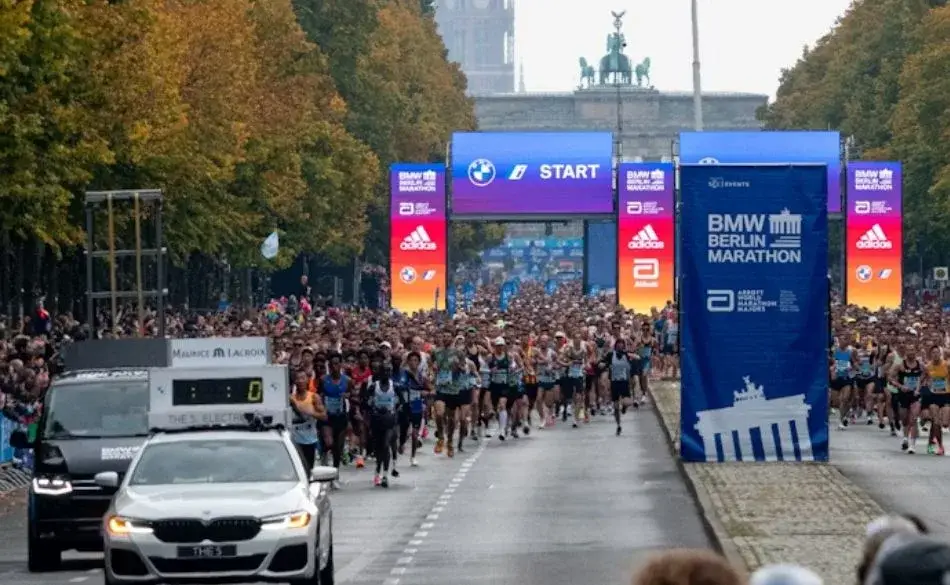
Berlin is where marathon world records go to fall. The course is pancake-flat, the roads are wide, the September weather is typically cool and dry, and the organisation is flawless. It’s no coincidence that both the men’s and women’s world records have been set here. If you have one goal — a fast time — Berlin is the answer.
The route passes the Reichstag, Berlin Cathedral, and Potsdamer Platz before a dramatic finish at the Brandenburg Gate. Over a million spectators line the streets. Entry is by lottery, which opens about 10 months before race day, and demand far exceeds supply. Tour operators sell guaranteed spots at a premium. Around 45,000 runners take part.
Berlin’s accessibility makes it popular with Australian runners: direct flights from Singapore or Dubai connect easily, accommodation is cheaper than London or Paris, and the city itself is compact and well-connected by public transport. If you want a structured training plan to make the most of the flat course, start preparing 16–20 weeks out.
London Marathon — The Best Atmosphere in Europe
London is one of the six Abbott World Marathon Majors and arguably the hardest to get into. The ballot accepts hundreds of thousands of entries for roughly 50,000 spots. Charity entries are available but require fundraising commitments (typically £2,000+). If you get a place, it’s worth every effort.
The course runs from Greenwich through Canary Wharf, past Tower Bridge, along the Embankment, and finishes near Buckingham Palace. Crowd support is relentless — over 750,000 spectators create a wall of noise from start to finish. The mix of elite athletes, charity runners, and costumed participants makes London uniquely festive.
The course is mostly flat with a few gentle inclines. April weather is unpredictable — anything from 8°C sunshine to 15°C drizzle — so dress in layers and prepare for both. London is an easy destination from Australia via direct flights to Heathrow.
Paris Marathon — The Most Scenic City Route
If you want to run past the Eiffel Tower, the Louvre, Notre-Dame, and the Champs-Élysées in a single morning, Paris is your race. The course is a rolling sightseeing tour of one of the world’s most beautiful cities, with nonstop crowd support, live bands, and a festive atmosphere that keeps you moving even when your legs want to stop.
Paris is one of the best marathons in the world for beginners thanks to generous cut-off times (~6 hours) and an encouraging atmosphere. The April weather is generally mild (10–16°C). Entry is open registration — no ballot — but it fills fast, so register as soon as entries open.
The course isn’t perfectly flat: there are gentle rolling sections through Bois de Vincennes and Bois de Boulogne. Some cobblestone stretches add character but require attention. Over 50,000 runners participate, making it one of the largest marathons in the world.
Valencia Marathon — Europe's Best-Value PB Course
Valencia has rapidly become one of Europe’s most popular marathons, and for good reason. The course is flat, fast, and beautifully organised. The December date means cool running temperatures (10–14°C), and the route passes through the stunning City of Arts and Sciences complex. Entry fees are among the lowest in Europe — typically €60–85.
Valencia has a 6-hour cut-off, which makes it accessible to all ability levels, but it’s designed for speed. The flat profile and mild conditions make it ideal for chasing a target pace. It regularly features among the world’s fastest road marathon results outside the Majors.
For Australians, Valencia is a short flight from major European hubs like London, Paris, or Barcelona. The city itself is affordable, with excellent food, beaches, and a compact historic centre that’s easy to explore on tired post-race legs.
Amsterdam Marathon — Fast, Flat, and Beginner-Friendly
Amsterdam is a World Athletics Platinum Label event that starts and finishes at the historic 1928 Olympic Stadium. The course is flat, running through the city centre, past the Rijksmuseum, along the Amstel River, and through Vondelpark. October weather is cool (8–14°C) — ideal for distance running.
It’s one of the most welcoming races for first-timers: well-organised, affordable, and with a 5.5-hour cut-off. Registration is open (no ballot), but it sells out. Around 15,000 marathon runners participate alongside half marathon and 8 km events. Amsterdam is also a fantastic city to visit — compact, bike-friendly, and full of museums, canals, and cafés.
Athens Marathon — The Original Route
Every marathon in the world traces its origins to this course. The Athens Marathon follows the legendary route from the town of Marathon to the Panathenaic Stadium — the marble stadium where the first modern Olympic Games were held in 1896. If you care about running history, this is a pilgrimage.
The course is not flat. There’s a significant uphill section from about 10 km to 31 km, gaining roughly 200 metres of elevation before a long descent into Athens. It’s not a PB course — it’s an experience course. November weather is usually pleasant (12–18°C). Entry is open and the field is around 20,000 runners.
For a deeper understanding of how marathon timing works — chip time, gun time, split mats — it’s worth reading up before any big European race, especially one with 20,000+ starters.
Rome Marathon — Run Through 2,000 Years of History
Rome’s marathon route passes the Colosseum, St. Peter’s Basilica, the Roman Forum, Piazza Navona, the Pantheon, and the Spanish Steps — all within 42.2 km. No other marathon packs as many world-famous landmarks into a single course. It’s held in March, with spring temperatures around 10–16°C.
The course is mostly flat but includes some cobblestone sections that can be hard on tired legs. Entry is open registration, typically €50–80, making it one of the more affordable European destination marathons. The field is around 12,000–15,000 runners. Rome is also one of the best cities in the world for post-race eating — a legitimate part of the experience.
Barcelona Marathon — Mediterranean Spring Running
Barcelona combines warm spring weather, a flat coastal course, and one of Europe’s most vibrant cities. The route passes the Sagrada Família, Casa Batlló, Camp Nou, and finishes near the waterfront. March temperatures are typically 10–17°C with low rain probability — close to ideal marathon conditions.
Entry is by ballot (introduced recently due to demand), so apply early. Around 20,000 runners participate. Barcelona is a fantastic race-holiday destination — the architecture, food, beaches, and nightlife make it easy to extend the trip. Direct flights from Australian east-coast cities connect through Doha or Singapore.
Rotterdam, Stockholm, and Three More Worth Knowing
Rotterdam Marathon (April)
Rotterdam is one of the fastest marathon courses in the world — flat, well-paced, with strong crowd support along the Maas River. Dutch logistics are superb. If you want speed without the Berlin ballot stress, Rotterdam is a strong alternative. Open registration, ~€80–110.
Stockholm Marathon (August)
Stockholm offers a scenic loop through the island city, starting and finishing at the 1912 Olympic Stadium. The course has gentle rolling hills and passes waterfront parks, the medieval old town, and green spaces. It’s the largest marathon in Scandinavia (~23,000 runners). The noon start time is unusual and atmospheric.
Midnight Sun Marathon, Tromsø (June)
Run a marathon at midnight under full daylight, above the Arctic Circle. The course follows fjords and coastal roads with snow-capped mountain views. It’s hilly and not for PB-chasing, but the experience is utterly unique. Small field (~5,000 runners), open registration.
Seville Marathon (February)
Europe’s flattest marathon and one of its cheapest (often under €50). February temperatures in southern Spain are 8–16°C — perfect running weather while much of Europe is still in winter. A great early-season PB attempt. The city is stunning and affordable.
Loch Ness Marathon (October)
A point-to-point course along the southern shore of Loch Ness, finishing in Inverness. Mostly downhill, incredibly scenic, and small enough (~8,000 runners) to feel personal. Scottish autumn weather is unpredictable — prepare for wind, rain, or sunshine within the same hour.
Which Marathon Suits Your Goal?
Chasing a PB? Berlin, Valencia, Rotterdam, or Seville. All flat, fast, and well-organised for speed.
Running your first marathon? Paris, Valencia, or Amsterdam. Generous cut-offs, great atmospheres, and flat-to-gentle courses. A solid beginner marathon training plan will have you ready in 16 weeks.
Want the ultimate bucket-list experience? London or Athens. London for the atmosphere and Major status. Athens for the history and the finish inside the Panathenaic Stadium.
Looking for something unique? Midnight Sun (24-hour daylight), Loch Ness (scenic Scotland), or Marathon du Médoc in Bordeaux (wine tastings at aid stations — yes, really).
Travelling from Australia? Consider combining your European marathon with a wider trip. Many Australian runners pair a spring marathon (Paris, Rome, Barcelona) with European travel, or use an autumn race (Berlin, Amsterdam, Athens) as the anchor of a European holiday. Budget 2–3 days before race day for jet-lag recovery — flying from Australia means 20+ hours of travel and significant time zone shifts.
Tips for Australian Runners Racing in Europe
Jet lag. Arrive at least 3 days before race day. The time difference from AEST to Central European Time is 8–9 hours. Give your body time to adjust sleep and meal timing. Some runners arrive a full week early and use easy runs to settle in.
Season reversal. If you’re training through an Australian winter for a European spring marathon (or vice versa), your body is already used to cool conditions — which is an advantage. But be aware that a March race in Rome can still reach 18°C, which may feel warm after a Melbourne winter.
Nutrition and hydration. Bring your own race-day fuel (gels, chews, electrolytes). Don’t assume the aid stations will stock what you’re used to. Practise post-race nutrition strategies during training so you have a reliable recovery routine abroad.
Shoes. European marathons often include cobblestone or uneven sections (Paris, Rome especially). Make sure your race shoes can handle varied surfaces — and ensure they’re well broken in before you travel. Check whether your chosen shoe model is compliant with race rules on stack height.
Registration. Book early. Many European marathons open registration 6–12 months ahead. Australian tour operators like RunFun Travel sell guaranteed entries to popular races with accommodation packages — useful for London and Berlin where ballot odds are low.
FAQ: Best Marathons in Europe
What is the fastest marathon in Europe?
Berlin. It holds the men’s and women’s world records and is the flattest, fastest major marathon course. Valencia, Rotterdam, and Seville are also very fast.
What is the best European marathon for beginners?
Paris and Valencia are excellent first-marathon choices — flat-to-gentle courses, generous cut-offs (~6 hours), great atmosphere. Amsterdam is another strong option.
Which European marathons are World Marathon Majors?
Berlin (September) and London (April). These are two of the six Abbott World Marathon Majors.
How do I enter European marathons from Australia?
Most use open registration (first-come) or a lottery/ballot (Berlin, London, Barcelona). Register early — entries open 6–12 months ahead. Australian tour operators like RunFun Travel offer guaranteed entry packages.
When is the best time of year for European marathons?
Spring (March–May) and autumn (September–November). Avoid mid-summer in southern Europe unless you’re heat-acclimatised.
Beyond Europe: More Marathon Inspiration
If you’re building a global marathon bucket list, we’ve covered the best marathons in Asia, the best marathons in Australia, the best marathons for beginners worldwide, and the biggest marathons in the US. For something closer to home, check out the best half marathons in New Zealand.
Whether you're targeting a PB in Berlin or your first finish in Paris, our coaching programmes build your fitness progressively, manage training around travel, and get you to the start line confident and injury-free.
Find Your Next Running Race
Ready to put your training to the test? Here are some upcoming running events matched to this article.
Henderson Newcastle Marathon 2026
Brisbane Trail Marathon 2026