







Find Your Next Running Race
Ready to put your training to the test? Here are some upcoming running events matched to this article.
 Coach Graeme
Last updated:
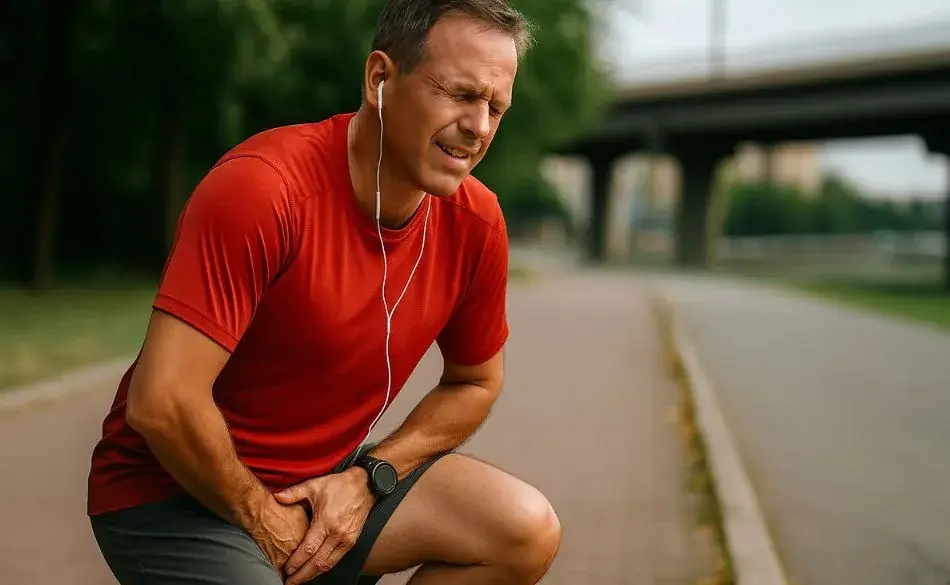
Groin pain is one of the more frustrating running injuries — it rarely announces itself with a dramatic moment, tends to linger despite rest, and is notoriously easy to misdiagnose because so many different structures sit in the same region. The groin encompasses tendons, muscles, ligaments, and bones all attached to or near the pelvis, any of which can become irritated from the repetitive loading of running. Getting on top of it early, and treating the right cause, makes the difference between a two-week blip and a three-month setback. This guide covers the most common causes of groin soreness after running, how to identify which one you are dealing with, and what to do about it.
Not sure where to start with training?
Tell us your goal and schedule, and we’ll give you clear direction.
No obligation. Quick, practical advice.
Explore our running training advice for more helpful articles and resources.
An adductor strain is an acute tear of the inner thigh muscles (adductor longus, brevis, or magnus) that pull the legs toward the body’s midline. In runners, strains most commonly occur during sprints, hill intervals, or sudden changes in direction that overstretch a muscle that is not prepared for the load. The pain is usually felt as a sharp pull in the inner thigh during the activity, followed by soreness and stiffness in the hours after. Mild strains (Grade 1) feel like a dull ache and do not limit walking; moderate strains (Grade 2) cause noticeable weakness and tenderness; severe strains (Grade 3) involve significant tearing and usually make weight-bearing painful.
Adductor tendinopathy is an overuse condition affecting the tendons that connect the adductor muscles to the pubic bone. Unlike an acute strain, it develops gradually over days or weeks — often in runners who have increased mileage, intensity, or hill work without adequate recovery. The pain is typically located at or near the bony point of the pubic bone (not mid-muscle), is worse after rest and during the first few minutes of a run, and may ease temporarily with warm-up before returning at higher intensities. It is one of the most common causes of chronic groin pain in runners and can be definitively diagnosed with ultrasound or MRI. Research shows that progressive strengthening — not stretching or massage — is the most effective treatment, with the Hölmich et al. active training protocol returning approximately 80% of athletes to sport compared to only 13% with passive treatment.
The hip flexors (primarily the iliopsoas) lift the knee forward during each running stride and can become strained from overuse or from running fatigue. Hip flexor strain produces pain in the front of the hip and groin, typically worst at the start of a run or when lifting the knee against resistance. Tight hip flexors — particularly common in people who sit for long periods — increase the risk of strain by limiting hip extension and forcing the hip to compensate. The hip strengthening exercises for runners guide covers the key exercises to address this.
Osteitis pubis is inflammation of the pubic symphysis — the joint where the two halves of the pelvis meet at the front. It is an overuse injury caused by repetitive shearing forces on the pubic bone and is particularly common in distance runners with poor pelvic and core stability. Pain is typically felt in the centre of the pubic area and can radiate into the adductors or lower abdomen. It develops gradually over weeks or months, often in runners who push through early groin warning signs. MRI typically shows bone oedema (swelling) at the pubic symphysis. Osteitis pubis requires relative rest and a structured pelvic strengthening programme; it is one of the slower-healing groin conditions, often taking 3–6 months to fully resolve.
Hip impingement occurs when abnormal contact between the ball of the femur and the hip socket causes friction and irritation during hip movement. In runners, impingement pain is usually felt deep in the groin — often described as a dull ache at the front of the hip during or after running — and may also present as stiffness and clicking. It develops gradually and is often linked to poor pelvic stability, excessive femoral internal rotation during running, and underlying bony anatomy. FAI cannot be confirmed without imaging (X-ray or MRI). Treatment focuses on modifying load, improving hip mobility, and strengthening the surrounding musculature. See our guide on hip strengthening exercises for relevant exercises.
This is the most serious cause of groin pain in runners and must be ruled out if pain is constant, present at rest or during walking, or has not responded to any treatment over several weeks. A femoral neck stress fracture develops from cumulative bone stress — most commonly in runners who have recently increased mileage significantly, underfuel (particularly common in female athletes with low energy availability), or have low bone density. The pain is typically a deep, poorly localised groin and thigh ache that worsens with weight-bearing and does not ease with warm-up. Any suspected stress fracture requires urgent medical evaluation and imaging (MRI is preferred over X-ray for early detection). Running must stop immediately — continuing through a femoral neck stress fracture risks complete fracture, which is a surgical emergency.
A sports hernia is a tear in the soft tissue of the lower abdomen in the inguinal region. Despite the name, it does not involve the actual protrusion of abdominal contents typical of a true hernia — there is no visible bulge. It tends to cause deep groin pain that worsens with exertion and may be accompanied by pain when coughing, sneezing, or rolling over in bed. Sports hernias are less common in pure runners than in sports involving twisting (football, hockey), but they do occur. Diagnosis requires clinical assessment and MRI. First-line treatment is a structured strengthening programme for 12–24 weeks; surgery is reserved for cases that do not respond.
👉 Swipe to view full table
| Condition | Pain Location | Onset | Key Feature | Red Flag |
|---|---|---|---|---|
| Adductor strain | Inner thigh, mid-muscle | Sudden (during sprint/hill) | Sharp pull felt during activity | Bruising, significant weakness |
| Adductor tendinopathy | Pubic bone attachment | Gradual (weeks) | Worse after rest, eases then returns | Persists >3 months without treatment |
| Hip flexor strain | Front of hip/groin | Gradual or sudden | Pain lifting knee against resistance | Constant pain, unable to walk normally |
| Osteitis pubis | Central pubic bone | Gradual (months) | Radiates to adductors/abdomen | Worsens with coughing/straining |
| Hip impingement (FAI) | Deep front hip/groin | Gradual | Clicking, stiffness, ache at end range | Bony locking sensation |
| Femoral neck stress fracture | Deep groin and thigh | Gradual, worsening | Present at rest, worse with walking | Pain at rest — stop running immediately |
| Sports hernia | Lower abdomen/groin | Gradual or acute | Pain with coughing, sneezing | No improvement with conservative care |
Relative rest and load management. For most groin injuries, complete rest is rarely necessary and can actually delay recovery by allowing the tissues to decondition. The better approach is relative rest — reducing running volume and intensity to a level that does not provoke pain, while maintaining fitness through low-impact cross-training such as swimming or cycling. See our guide on recovery runs for guidance on managing training load during injury.
Progressive strengthening. The most important — and most evidence-based — treatment for adductor tendinopathy and osteitis pubis is progressive strengthening of the adductor muscles. Research by Hölmich et al. showed an active strengthening protocol returned 79% of athletes to sport at 4-month follow-up, compared to just 14% with passive physiotherapy (stretching, massage, ultrasound). The progression starts with non-painful isometric exercises (squeezing a ball between the knees while lying on your back), advances to isotonic exercises (side-lying hip adduction, sumo squats), and then to dynamic loaded exercises (Copenhagen adductor exercise, single-leg Romanian deadlift). For relevant exercises, see our guide to hip adductor exercises and our strength training programme for runners.
Core and hip stability work. Weak gluteal and core muscles force the adductors and hip flexors to compensate during the single-leg stance phase of running, increasing load on groin structures. Addressing glute and core weakness is therefore an essential part of preventing recurrence. Our guides on core exercises for runners, glute minimus exercises, and hip strengthening for runners cover this in detail.
Ice and anti-inflammatories (short term). In the acute phase (first 48–72 hours after onset or flare-up), ice applied for 15–20 minutes several times daily can reduce local inflammation and pain. Non-steroidal anti-inflammatory medication (ibuprofen) can help manage pain in the short term but should not be used as a way to keep running through an injury.
Return to running. The Hölmich protocol advises no running for the first six weeks of treatment for adductor tendinopathy and osteitis pubis, after which easy jogging on a level surface is introduced if pain-free. Return should be gradual — shorter, easier runs first, with at least 24 hours between sessions to monitor symptom response. For pain-managed return protocols, see our guide to pain during running vs after running.
👉 Swipe to view full table
| Condition | Typical Recovery Time | Key Treatment | Return to Full Running |
|---|---|---|---|
| Adductor strain (Grade 1) | 1–3 weeks | Relative rest, gentle loading | When pain-free at easy pace |
| Adductor strain (Grade 2) | 3–8 weeks | Progressive strengthening | When strength symmetric bilaterally |
| Adductor tendinopathy | 6–12 weeks | Hölmich strengthening protocol | After 6 weeks no-run + pain-free jog |
| Hip flexor strain | 2–6 weeks | Rest, hip flexor/glute strengthening | When pain-free with resisted hip flexion |
| Osteitis pubis | 3–6 months | Pelvic stability, load management | Gradual, guided by symptom response |
| Hip impingement (FAI) | 8–16 weeks (conservative) | Load modification, hip strengthening | Guided by physiotherapist |
| Femoral neck stress fracture | 2–4 months | Non-weight-bearing rest, medical care | Only after imaging confirms healing |
Build volume and intensity gradually. The single greatest risk factor for runner’s groin injury is a sudden spike in training load — too much mileage, too many hills, or too many speed sessions without adequate base. Following a structured training plan with progressive overload built in significantly reduces injury risk. See our strength training programme for runners for how to structure this.
Strengthen the adductors and glutes year-round. Most runners focus strength work on quads and calves. The adductors and glutes are consistently undertrained relative to the demands running places on them. Including Copenhagen adductor exercises and single-leg glute work 2–3 times per week is one of the most effective injury prevention strategies available. Our guide on hip adductor exercises provides a full routine.
Warm up properly before hard sessions. Groin strains are most likely to occur during sprints, interval sessions, or hill repeats when cold muscles are suddenly asked to produce high force. A dynamic warm-up that includes lateral lunges, leg swings, and hip circles specifically prepares the adductors and hip flexors for high-demand efforts. Our 15-minute stretching and mobility routine is a good reference.
Address hip and pelvic stability weaknesses. Runners with weak glutes and poor pelvic control place excessive shearing load on the pubic symphysis and adductor tendons with every stride. Addressing these weaknesses — through single-leg exercises, hip abductor work, and core stability training — reduces the compressive load on groin structures. See our best core exercises for runners and does running strengthen your core for relevant guidance.
See a physiotherapist promptly if: pain persists for more than 7–10 days despite relative rest; the pain is present when walking, climbing stairs, or at rest; there is swelling, bruising, or obvious muscle weakness; you have had the same groin problem before and it has recurred; or you suspect a stress fracture (deep bone pain that worsens with weight-bearing). Self-treatment is appropriate for mild, recent-onset adductor soreness — but the groin is a complex area and accurate diagnosis significantly improves treatment outcomes. Conditions like osteitis pubis and femoral neck stress fracture require professional assessment and cannot be reliably managed through self-directed treatment alone.
Managing injury and want to stay on track?
Our coaches work around injuries, adjust your training load, and build the strength work that keeps you running consistently.
Get Started → Running Coaching → Triathlon Coaching →Why is my groin sore after running?
The most common causes are adductor strain or tendinopathy (inner thigh overuse), hip flexor strain, osteitis pubis (pubic bone inflammation), and hip impingement. Less commonly, a femoral neck stress fracture or sports hernia can cause post-run groin pain. Identifying the specific cause is essential — each has a different treatment approach.
How long does groin soreness from running take to heal?
Mild adductor strains typically resolve in 1–3 weeks. Tendinopathy takes 6–12 weeks of structured strengthening. Osteitis pubis often requires 3–6 months. A femoral neck stress fracture needs 2–4 months of rest and medical management. Early, correct treatment significantly shortens recovery time for all conditions.
Should I keep running with a sore groin?
Not without assessment. Running through groin pain typically worsens the condition. If soreness resolves within 24 hours after an easy run, cautious continuation may be appropriate. Pain that persists beyond 48 hours, is present during walking, or is accompanied by swelling warrants rest and physiotherapy assessment before continuing.
What is the difference between a groin strain and adductor tendinopathy?
A groin strain is an acute muscle tear — a sudden sharp pain during a sprint or forceful movement. Adductor tendinopathy is a gradual overuse condition of the tendon near the pubic bone — worse after rest, easing briefly with warm-up then worsening with intensity. Tendinopathy responds to progressive strengthening; an acute strain needs initial relative rest before loading.
What exercises help groin pain from running?
The most evidence-based exercises are the Copenhagen adductor exercise, side-lying hip adduction, sumo squats, and single-leg Romanian deadlifts — used progressively from isometric through to dynamic loading. Hip abductor and core strengthening should complement adductor work. Passive treatment (stretching, massage alone) has a poor track record compared to active strengthening protocols.
Ready to put your training to the test? Here are some upcoming running events matched to this article.


Head Coach & Founder, SportCoaching
Graeme is the founder of SportCoaching and has coached more than 750 athletes from 20 countries, from beginners to Olympians, in cycling, running, triathlon, mountain biking, boxing, and skiing. His coaching philosophy and methods form the foundation of SportCoaching's training programs and resources.
No matter your goals, SportCoaching offers tailored training plans to suit your needs. Whether you’re preparing for a race, tackling long distances, or simply improving your fitness, our expert coaches provide structured guidance to help you reach your full potential.
Smart, progressive training from 5km to marathon with weekly guidance.
What’s included
Choose your plan to get started with personalized training plans designed to help you reach your goals.


Minna Backman
When you’re new, feedback is especially important, and Graeme is highly skilled at both analyzing numbers and understanding the importance of mental strength.











