Why Every Runner Should Master the High Knees Exercise
Most runners skip the high knees exercise, thinking it is just another warm-up drill. But in reality, it is one of the most effective movements to build running form, hip flexor strength, and overall stride efficiency. When done correctly, it trains your body to run with rhythm, power, and coordination.
The high knees drill activates your glutes, core, and hip flexors (the muscles that drive each stride forward). These muscles often weaken from long hours of sitting or steady running without variation. By performing high knees regularly, you can re-train those areas to engage correctly, helping you maintain proper running posture even when you start to fatigue.
It is also a powerful dynamic warm up for runners. In less than 30 seconds, you increase your heart rate, improve circulation, and wake up the nervous system that controls balance and coordination. That means when you start your run, your legs and core are already firing in sync, reducing your risk of injury.
Here is what happens when you make this drill part of your training:
- You develop faster leg turnover and better running cadence.
- Your core stability improves, helping maintain upright posture on long runs.
- You strengthen your hip flexor activation, improving drive and lift.
- You sharpen your coordination, balance, and body control.
For example, one of the athletes I coach added the standing high knees drill twice a week before easy runs. Within three weeks, she noticed smoother transitions when accelerating and less tightness in her hips. Small, consistent practice built a noticeable difference in her stride rhythm.
If you want to feel lighter, quicker, and more efficient on your feet, this single exercise can help unlock that next level.
If you're set on achieving a standout 10K result, our 10K Running Training Plan is built to guide you every step of the way, from first strides to finish-line strength.
You’ll receive a targeted programme with weekly mileage, speed and recovery sessions, and pacing advice all tailored to your current fitness and goal time.
The plan adapts via TrainingPeaks and fits into your busy schedule, helping you train consistently, avoid injury, and make real progress toward race day.
Train smart, stay focused, and turn your 10K ambition into achievement.
Get the 10K Plan

How to Do the High Knees Exercise Correctly
The goal is clean high knees form, not speed at any cost. Start tall, ribs stacked over hips, eyes forward. Keep your core tight to support core stability. Think quick, light steps with minimal ground contact.
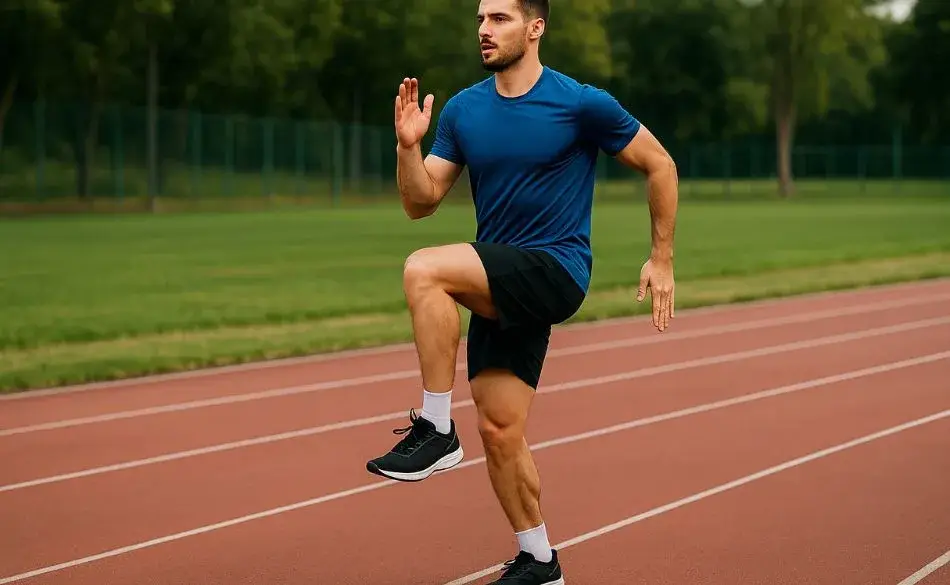
Begin with standing high knees in place. Drive one knee to hip height while the opposite arm swings forward. Land softly on the ball of your foot. Switch sides without twisting your torso. Keep your arms close to your body so the movement looks like relaxed sprint mechanics.
Focus on three cues: lift, strike, recover. Lift the knee with active hip flexor activation. Strike the ground under your center of mass. Recover the foot quickly so your running cadence stays snappy. Breathe steadily and keep your jaw relaxed to avoid tension.
Use short sets so your technique stays sharp. Try 2–3 rounds of 20–30 seconds with 30–45 seconds of easy walking between sets. That dose works well as a dynamic warm up for runners before workouts or races.
Add intent with these form cues:
- Posture: tall spine, slight forward lean from the ankles.
- Arms: elbows about 90 degrees, swing cheek to hip.
- Feet: land on the forefoot, keep contacts quick and quiet.
- Knees: lift to hip height without flaring out.
- Core: brace lightly so your torso stays stable.
- Tempo: aim for crisp rhythm rather than maximal speed.
Avoid common errors that waste energy and strain joints. Cleaning these up will improve leg drive in running and help the drill transfer to your stride.
- Overstriding in front of your body.
- Bouncing vertically instead of moving rhythmically.
- Dropping the hips or leaning back.
- Crossing arms across the midline.
- Letting feet slap the ground loudly.
Finish with 20–40 meters of relaxed strides. This helps you blend the drill into natural running mechanics while the pattern is fresh.


The Science Behind the High Knees Exercise
The high knees exercise is more than a warm-up; it is a science-backed way to improve how efficiently you move. When you lift your knees quickly and maintain posture, you train the same muscles and coordination patterns used in running. That is why professional coaches include it in every dynamic warm up for runners.
Research shows that repeated high-knee movements strengthen the hip flexors and core muscles while improving leg drive and neuromuscular timing. These benefits can positively influence stride efficiency and running cadence. In simple terms, you are teaching your brain and muscles to fire faster and more precisely with every step.
To understand what happens, here is a breakdown of how the drill targets different muscle groups and what each contributes to your running mechanics:
👉 Swipe to view full table
| Muscle Group | Primary Function During High Knees | Benefit for Runners |
|---|---|---|
| Hip Flexors | Lift the knee and control hip motion | Improves knee drive and forward momentum |
| Core Muscles | Stabilize the torso and maintain posture | Enhances core stability and reduces excess movement |
| Glutes | Extend the hips for propulsion | Boosts power and stride length |
| Calves | Assist in quick ground contact and push-off | Improves running cadence and rhythm |
| Hamstrings | Control the downward phase of each stride | Supports smooth recovery and reduces overstriding |
Think of this exercise as a bridge between the gym and the road. The coordination you build transfers directly to your running mechanics. The more consistent you are, the faster your body learns efficient movement patterns.
Adding even two short sets of high knees drills before interval sessions or long runs can help reinforce technique and prepare the muscles for higher workloads. Over time, that means less wasted energy and more speed where it counts.
While research directly measuring high knees exercises in runners is limited, studies have confirmed the impact of dynamic movement drills on muscle activation and knee biomechanics. A 2021 biomechanics study by Matabuena et al. examined how gait patterns change with training intensity, and a 2023 sEMG analysis by Hatamzadeh et al. found that dynamic movement drills improve lower-limb muscle activation patterns. These findings support how high knees exercises enhance neuromuscular coordination and running efficiency when performed consistently.
To further strengthen the smaller stabilizing muscles that support your stride, check out our guide on glute minimus exercises for runners. These movements complement the benefits of high knees by improving hip stability and balance during every step.


When and How Often to Do the High Knees Exercise
Like most running drills, timing and frequency matter. Doing the high knees exercise too often can fatigue your hip flexors, while doing it rarely means you will not gain its benefits. The key is consistency without overuse.
For most runners, 2–3 sessions a week is ideal. The drill can fit into your dynamic warm up for runners before tempo runs, intervals, or hill repeats. Each set should last 20–30 seconds, followed by a short rest. It is better to focus on control and running form than raw speed.
Here is how to structure it depending on your experience level:
- Beginners: Start with marching high knees for 15–20 seconds, two rounds, once a week. This helps you build rhythm and coordination safely.
- Intermediate runners: Try 2–3 sets of standing high knees lasting 25–30 seconds, twice per week before quality workouts.
- Advanced athletes: Add high knees sprints or integrate them into a plyometric running drill routine, 3–4 times weekly during speed phases.
For recovery days or base training blocks, reduce frequency to once a week or replace them with low-impact versions such as marching high knees. These maintain coordination without adding unnecessary fatigue.
Think of this drill as you would any technical skill. Quality repetitions reinforce proper running posture and build muscle memory. Over time, you will feel more responsive and powerful off the ground. For long-term improvement, pair high knees with complementary moves like butt kicks, skips, and bounding exercises to cover different aspects of stride efficiency.


Mistakes Runners Make With Doing The High Knees Running Drill
Even though the high knees exercise looks simple, small mistakes can reduce its effectiveness and even cause discomfort. Proper running form and awareness make the difference between a productive drill and wasted effort.
Here are some of the most frequent errors runners make and how to fix them:
- Leaning too far back: This puts stress on the lower back and reduces hip flexor activation. Keep your spine tall and lean slightly forward from the ankles.
- Overstriding: Driving the knees too far forward wastes energy and slows rhythm. Focus on lifting the knees high, not pushing them outward.
- Heavy landings: Slamming the feet down adds impact to the shins and knees. Land softly on the balls of your feet to protect your joints and improve running cadence.
- Weak arm drive: Lazy arms cause your timing to fall apart. Swing your arms naturally from the shoulders, keeping elbows at 90 degrees.
- Going too fast too soon: Many runners rush the movement, which breaks form and balance. Start slow and increase pace only when your rhythm feels controlled.
To get the most from the high knees drill, think about posture and rhythm. Keep your head stable, chest open, and core firm. The goal is to mimic running mechanics in a smaller, more focused movement pattern. Quality matters more than intensity here.
If you feel tightness in your hip flexors or quads after this drill, spend a few minutes stretching and performing mobility exercises for runners. Over time, your range of motion will improve, allowing you to lift your knees higher without strain.
When you perform the high knees exercise correctly, it becomes one of the most effective ways to improve posture, balance, and power. Avoiding these mistakes ensures the drill works exactly as intended. Helping you run faster, smoother, and with more confidence.
For more insights on maintaining efficient posture and form during long runs, check out our guide on best running form for long-distance success.
Ready to take your running to the next level? Our Running Training Plans adapt to your goal. Whether you’re aiming for your first 5K, personal best 10K, or a marathon breakthrough.
Each plan is custom-built after a one-hour consultation and delivered via TrainingPeaks. You’ll receive structured workouts, pacing guidance, and support that meets you exactly where you are.
Built for all levels and all goals. These plans are designed to fit into your life so you train smarter, stay consistent, and avoid common pitfalls.
Start your journey with a plan that’s built for you, not the crowd.
View Training Plans →

The Benefits of The Exercise For Runners
The high knees exercise offers far more than just a warm-up. It combines cardio conditioning, strength training, and coordination in one quick movement. For runners, this drill sharpens both power and control. Two ingredients that define efficient running.
Here is what makes high knees so effective for your running performance:
- Improves running efficiency: By practicing precise hip flexor activation and leg coordination, your stride becomes smoother and more economical.
- Boosts leg power: Lifting your knees at speed trains the fast-twitch muscle fibers responsible for strong leg drive in running.
- Enhances posture and balance: Maintaining an upright torso during high knees strengthens your core stability and reduces wasted movement.
- Increases cardiovascular endurance: This movement quickly raises heart rate and oxygen demand, acting as a short, effective cardio burst.
- Improves coordination and rhythm: Your arms and legs learn to work together, enhancing timing for consistent running cadence.
Another advantage of the high knees drill is accessibility. It requires no equipment and very little space, making it perfect for pre-run routines or indoor training days. You can also modify it (turn it into marching high knees or fast tempo versions) to suit your energy level or training phase.
When included regularly in your routine, this simple exercise helps you run with greater awareness of movement. You feel more connected from the ground up, your strides become more dynamic, and your transitions feel effortless. It’s one of the most time-efficient drills to develop strength, rhythm, and readiness before every run.
Ultimately, the high knees exercise is the bridge between preparation and performance. Whether you’re training for a 5K or a marathon, this drill builds the foundation for running faster and moving with confidence.
For a comprehensive understanding of how your height influences your optimal running cadence, check out our detailed guide on ideal running cadence based on height.
For a detailed guide on the benefits and proper technique of high knees exercises, refer to this comprehensive resource: High Knees Exercise: Why This Simple Drill Packs a Serious Punch.


How to Combine High Knees With Other Running Drills
To get the most benefit from the high knees exercise, pair it with other drills that target complementary aspects of running mechanics. When used together, these movements improve stride efficiency, strength, and balance. Helping you move more powerfully and gracefully on every run.
Here is an easy sequence that runners can include before workouts or races:
- 1. Butt Kicks: Loosens the hamstrings and improves recovery between steps.
- 2. High Knees: Activates hip flexors and builds rhythm for faster turnover.
- 3. A-Skips: Enhances running coordination and ground contact timing.
- 4. B-Skips: Strengthens the glutes and helps reinforce a strong running posture.
- 5. Bounding: Develops horizontal power and leg drive in running.
- 6. Strides: Integrates everything into smooth, efficient running motion.
This combination engages all major muscle groups used in running while also priming the nervous system for speed. The high knees drill sits at the center of it all linking activation, coordination, and drive.
For most runners, performing this sequence two to three times per week before key workouts is enough. It requires less than 10 minutes and delivers lasting results. The drills prepare your body to handle faster paces, sharper turns, and hills with ease.
Remember, the goal is not to exhaust yourself before the run but to wake up the muscles that matter most. Keep each drill short and crisp, with focus on form and rhythm. When practiced regularly, this warm-up sequence helps reduce injury risk and ensures your first few strides always feel strong and controlled.
For more drills that improve your hamstring power and drive mechanics, check out our guide on butt kicks exercise guide for runners to complement your routine.
Feeling motivated to refine your form and boost your speed? Our Running Coaching programs are tailored for runners who want to move better, stay consistent, and reach their true potential.
Each plan is designed by experienced coaches who focus on technique, recovery, and progression. Helping you build lasting strength and efficiency with every session.
Delivered through TrainingPeaks, your plan adapts weekly based on your performance, giving you the structure and support you need to keep improving safely.
Train smarter, move better, and discover what your best running feels like.
Start Coaching Today →

Bringing It All Together
The high knees exercise may look simple, but its effect on your running form, balance, and power is anything but basic. When performed with consistency and proper technique, it builds the foundation for faster, smoother, and more efficient running. It teaches your body to coordinate movement from head to toe while priming your muscles and nervous system for performance.
As a coach, I have seen runners who once struggled with heavy strides develop a lighter, more responsive rhythm simply by adding high knees drills twice a week. The change does not happen overnight, but within a few weeks, they feel more connected and confident with every run.
To make the most of this drill, keep it intentional. Focus on posture, timing, and control, not just speed. Use it as part of your dynamic warm up for runners or as a short activation before key workouts. Pair it with complementary moves such as skips, bounds, and strides to build a complete warm-up that prepares you mentally and physically for the miles ahead.
Running is all about rhythm and timing, and the high knees drill helps you master both. Whether you are training for a 5K or chasing marathon goals, this small addition to your routine can have a big impact on how you perform and how good you feel doing it.
So the next time you lace up, take 30 seconds for a few sets of high knees. You might be surprised how much faster and smoother your run feels when your body is truly ready to move.