












Find Your Next Running Race
Ready to put your training to the test? Here are some upcoming running events matched to this article.
 Coach Graeme

Last updated:
Stomach cramps during a run can range from mildly annoying to genuinely debilitating. Most runners experience them at some point — research suggests around 70% of runners have had a side stitch in the past year alone — but what many don't realise is that "stomach cramps when running" actually describes several different problems that feel similar but have different causes and different fixes. A side stitch in the upper right abdomen is a different animal from a deep lower-gut cramp during a long run, and treating them the same way rarely works. This guide breaks them down by where they occur, what's driving them, and what actually helps.
Not sure where to start with training?
Tell us your goal and schedule, and we’ll give you clear direction.
No obligation. Quick, practical advice.
Explore our running training articles for more helpful articles and resources.
Before getting into causes and fixes, it helps to identify which type of cramp you’re dealing with. The location and character of the pain usually points to the right category.
| Pain location | What it typically is | Characteristic feel | Primary trigger |
|---|---|---|---|
| Upper right or left abdomen, under ribs | Side stitch (ETAP — exercise-related transient abdominal pain) | Sharp, stabbing, or pulling; usually one side; may refer to shoulder tip | Eating/drinking too close to the run, going out too fast, shallow breathing |
| Central upper abdomen | Stomach distension or gastric cramping | Pressure, nausea, cramping feeling; may worsen on downhill | Too much food or fluid before running; hypertonic beverages |
| Lower abdomen, central or either side | GI distress / runner's stomach | Deep cramping, urgency, bloating; may accompany nausea or diarrhoea | Reduced gut blood flow during exercise; food timing errors; high-fat/fibre pre-run |
| Diffuse cramp that builds through long run | Dehydration or electrolyte imbalance | Progressive cramping, not localised to one spot; may accompany leg cramps | Under-hydration, excessive sodium loss through sweat on hot days |
The side stitch is the most common running cramp by a significant margin. A PMC systematic review found roughly 70% of runners experience it within any given year, and in a single running event about one in five participants will be hit at some point. Despite how common it is, its exact cause took decades of research to partially clarify — and “partially” is the honest word. The old diaphragm ischemia theory (reduced blood flow to the breathing muscle) has largely been replaced by a more compelling explanation.
Current research favours irritation of the parietal peritoneum — the membrane lining the inside of the abdominal cavity. When the stomach or other organs are full or under mechanical stress, repeated up-down movement of running can create friction between the visceral organs and the peritoneum, producing the sharp, localised pain that characterises a stitch. A PubMed clinical study that experimentally induced stitches found they were best explained by the fluid-loaded gut tugging on the visceral ligaments connecting organs to the diaphragm — consistent with why eating and drinking too close to a run makes stitches significantly more likely. Hypertonic beverages (concentrated juices, some sports drinks, fizzy drinks) were particularly provocative in that study, pulling water into the gut and increasing the distension effect.
The shoulder tip pain that sometimes accompanies a bad stitch — often right or upper right shoulder — reflects referred pain via the phrenic nerve, which serves both the diaphragm and that region of the shoulder. If you’ve ever had a stitch so bad it made your shoulder ache, that’s what was happening.
Thoracic posture also plays a role. One study found that runners with thoracic kyphosis (a rounded upper back) were significantly more prone to ETAP — the forward rounding changes the mechanics of how the abdominal cavity handles the impact forces of running. This is one reason core and postural work reduces stitch frequency over time.
The clinical research on what actually works is more useful here than most generic advice. A PubMed study that tested various physical manoeuvres on stitch during running found two approaches that reliably alleviated pain within seconds:
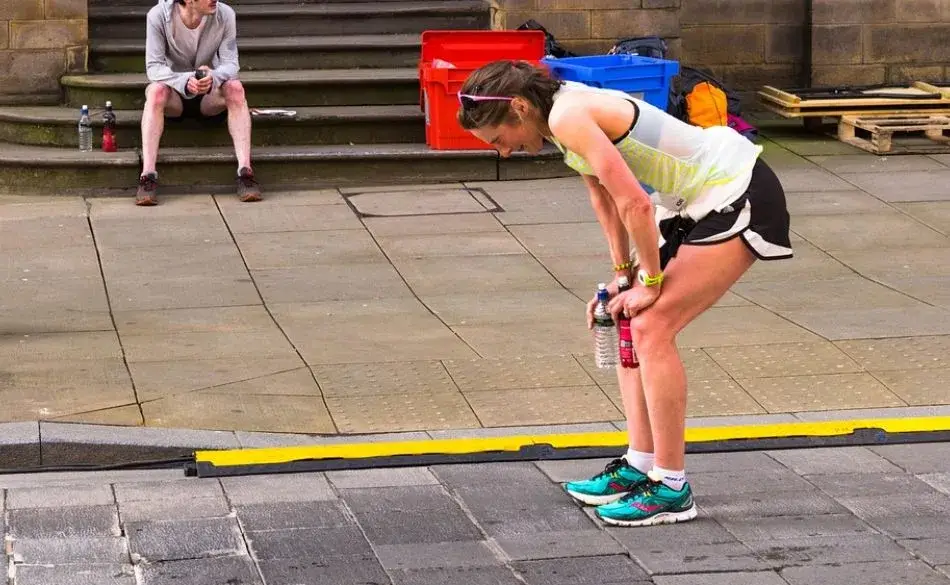
Bend slightly forward while tightening the abdominal muscles. This changes the mechanical relationship between the visceral organs and the peritoneum, reducing the friction and pulling sensation. It’s counterintuitive — most runners tense up and run taller when they feel a stitch — but leaning forward actively is one of the fastest ways to interrupt it.
Breathe out on the opposite footstrike. If the stitch is on the right side, exhale as the left foot hits the ground. This breaks the breathing rhythm pattern that was allowing the diaphragm to be repeatedly pushed in the same direction by the footstrike impact. Switching your exhale to the opposite side redistributes the mechanical load.
The Ivy Rehab physiotherapy guidance adds a useful manual technique: press two fingers gently but firmly into the stitch site, apply slight upward pressure, and breathe steadily. Hold for 10 seconds. This provides enough counter-pressure to interrupt the irritation cycle. Combined with slow, deep belly breathing (expanding the abdomen on the inhale rather than just the chest), most stitches resolve within two to three minutes without stopping entirely.
Attempting to relax the abdominal muscles — the intuitive response of going loose and floppy — was found to have little effect in the clinical study. The active interventions (forward lean, abdominal tightening, altered breathing) were consistently more effective than passive relaxation.
The lower gut cramps that runners describe as “runner’s stomach” have a different mechanism from stitches. During running, the body diverts blood away from the digestive system to supply the working muscles. At higher intensities, gut blood flow can drop by 50–80%. The digestive tract, suddenly short on oxygen and working on whatever was eaten before the run, can cramp, churn, and in more severe cases produce urgency and diarrhoea.
The impact forces of running compound this. Unlike cycling, each footstrike physically jostle the contents of the stomach and intestines. Over a long run this mechanical irritation, combined with reduced blood flow and whatever processing the gut is trying to do, can produce the kind of sustained deep cramping that makes the final miles of a marathon particularly unpleasant for some runners.
Several factors make this significantly worse. High-fat and high-fibre foods before running require more gut work and take longer to clear the stomach — they keep the digestive system active precisely when the body is trying to redirect resources away from it. Dehydration thickens the gut contents, slowing transit and increasing fermentation. And running at intensities well above easy pace dramatically increases the blood-flow diversion — easy runs rarely cause GI distress, while race-pace efforts frequently do. If you mostly get GI cramps in races or hard sessions but not on easy runs, intensity is probably the primary driver. Our guide on easy run effort covers why getting the intensity right on training runs matters for gut adaptation as well as for everything else.
The timing and content of what you eat and drink before a run is where most runners have the most immediate control. The clinical guidelines are fairly consistent across the research:
| Timing before run | What's safe | What to avoid |
|---|---|---|
| 3–4 hours before | Full balanced meal — carbohydrate, moderate protein, low-moderate fat | Very high fat; very high fibre; large volumes of fluid |
| 1–2 hours before | Small carbohydrate-dominant snack: banana, toast, small bowl of oats | High-fat foods; high-fibre foods; large meals; fizzy drinks |
| 30–60 min before | Small, simple carbohydrate if needed: banana, sports gel, small amount of fruit | Concentrated juice; hypertonic sports drinks; anything unfamiliar |
| During (for long runs) | Small sips of water or isotonic sports drink; test gels and chews in training before racing them | Hypertonic beverages; large volumes at once; cold carbonated drinks |
The hypertonic beverage point deserves particular emphasis. Concentrated fruit juice, some commercial sports drinks, and fizzy drinks pull water into the gut through osmosis, increasing distension and dramatically increasing both stitch and GI distress risk. If you’ve been drinking orange juice or a sugary sports drink before runs and getting cramps, this is almost certainly a significant contributor. Isotonic drinks (with salt and carbohydrate at roughly body-fluid concentration) are much better tolerated. Our sweat test guide covers how to assess your individual hydration needs — relevant for longer runs and races where fluid strategy matters most.
For racing and long runs over 90 minutes, the rule is simple: test every food and fluid strategy in training first. Nothing new on race day. Gels that work perfectly at 8:00/km effort may cause problems at 5:30/km because gut blood flow is lower at higher intensity. Most GI disasters in races come from runners using nutrition strategies they’ve never properly tested under effort. Our marathon training plans and half marathon training plans build long runs progressively specifically so you have the opportunity to test nutrition strategy at increasing distances before race day.
Starting too fast is one of the most reliable ways to get a stitch. Going out hard immediately forces rapid, shallow breathing that doesn’t allow the diaphragm to settle into a comfortable rhythm. The visceral organs haven’t had time to adjust to the mechanical demands of running. Blood flow patterns are still shifting. Everything is happening at once, and a stitch is often the result.
A proper warm-up — even 5 to 10 minutes of very easy jogging before picking up pace — allows the body to make these transitions gradually. The diaphragm finds its rhythm, blood flow redistributes, and the parietal peritoneum adapts to the repeated movement before any real intensity is applied. Research doesn’t show a dramatic effect on stitches from warm-ups alone, but the consistent coaching observation is that runners who warm up properly get far fewer stitches than those who start hard from cold.
Breathing technique matters throughout the run, not just at the start. Shallow chest breathing — where only the upper lungs fill — creates faster, less efficient respiratory cycles that put more strain on the diaphragm. Deep belly breathing, where the abdomen visibly expands on the inhale, fills the lungs more completely, requires fewer breaths per minute, and reduces diaphragmatic fatigue. If you’ve never practised belly breathing while running, it feels awkward at first and then becomes natural. It’s worth developing on easy runs where there’s cognitive bandwidth to focus on it, so it becomes automatic on harder efforts. Our Zone 2 running guide covers the kind of easy running where this practice is most accessible.
Pacing matters for GI cramps specifically. At easy to moderate effort, the gut handles running reasonably well. As intensity climbs toward and above lactate threshold, gut blood flow drops sharply and the risk of cramping increases proportionally. If you consistently get GI cramps in races but not in training, you’re probably racing at an intensity your gut hasn’t been adequately prepared for. Training the gut — running at race effort regularly, practising race nutrition — is as important as training the legs for runners who experience this pattern. Our guide on building aerobic base covers why consistent easy volume is the foundation that allows higher race intensities to be tolerated — both metabolically and gastrointestinally.
The connection between core strength and stitches is real but often overlooked. A stronger core provides better support for the abdominal organs during the repetitive up-down movement of running, reducing the mechanical stress on the parietal peritoneum that triggers stitches. A small study on runners found that those with stronger trunk muscles experienced stitches less frequently. The thoracic spine study finding — that rounded upper-back posture increases ETAP susceptibility — points to the same underlying principle: the structural stability of the torso affects how much irritation the abdominal lining experiences with every stride.
For runners who get stitches consistently and have ruled out food/fluid timing as the cause, adding core work and addressing thoracic mobility is often what finally makes the difference. Two focused core sessions per week over 8–12 weeks produces meaningful improvements in stitch frequency for this group. This doesn’t need to be complex — dead bugs, planks, bird dogs, and thoracic extension over a foam roller cover most of what’s needed.
For older runners, thoracic stiffness tends to be more pronounced and can be a significant contributor to recurring stitches. Our guide for older athletes covers how postural and mobility work should be built into training at every level, not treated as an optional extra.
For triathletes managing gut issues across both running and cycling, the challenge is compounded — the gut needs to process nutrition on the bike and then continue performing on the run. Racing with impaired gut function late in a triathlon is extremely common and almost always a nutrition strategy and intensity management issue. Our Ironman 70.3 training guide covers race nutrition planning across both disciplines, including how to sequence fuelling so the gut is supported through the bike-to-run transition.
The most reassuring fact about running stomach cramps is that they improve with fitness and experience. Beginners get stitches far more often than trained runners, and trained runners who address their food timing, breathing, and pacing typically see dramatic reductions. It’s rarely a permanent problem — it’s usually a signal about something that can be adjusted.
Build Fitness That Makes Running More Comfortable
SportCoaching's running coaches build your training around the fundamentals that reduce problems like cramping — proper pacing, progressive loading, and the aerobic base that makes every run easier. AUD $143/month, no lock-in, 90-day performance guarantee.
Why do I get stomach cramps when running?
Most commonly a side stitch — irritation of the parietal peritoneum from the repeated mechanical movement of running, made worse by eating or drinking too close to the run. Deeper GI cramps lower in the abdomen are typically caused by reduced blood flow to the gut during exercise and food/fluid timing errors. Location tells you which problem you’re dealing with.
How do I stop a stitch when running?
Bend forward slightly while tightening your abs, exhale as the foot on the stitch side strikes the ground, and press two fingers gently into the stitch site. Deep belly breathing rather than shallow chest breathing. Most stitches resolve within two minutes with these techniques. Trying to relax and go limp doesn’t work well — the active interventions do.
What should I eat before running to avoid stomach cramps?
Full meal 3–4 hours before. Small easy-to-digest snack if eating closer than that. Avoid high-fat, high-fibre foods within 2–3 hours. Avoid hypertonic beverages (concentrated juice, fizzy drinks) before and during runs — they pull water into the gut and significantly increase cramp risk.
Does running fitness reduce stomach cramps?
Yes — consistently. Beginners get stitches far more than experienced runners. A stronger diaphragm, better core stability, improved pacing control, and a gut adapted to exercise all reduce cramp frequency. Most runners find stitches become much less common over 6–12 months of consistent training.
When should stomach cramps during running be a concern?
See a doctor if pain radiates to the left shoulder tip (cardiac red flag), if cramps are progressively worsening over multiple weeks, if pain occurs at rest, or if there’s any rectal bleeding. Occasional stitches and post-run GI upset are normal and harmless. A consistent worsening pattern needs professional review.
Ready to put your training to the test? Here are some upcoming running events matched to this article.
Head Coach & Founder, SportCoaching
Graeme is the founder of SportCoaching and has coached more than 750 athletes from 20 countries, from beginners to Olympians, in cycling, running, triathlon, mountain biking, boxing, and skiing. His coaching philosophy and methods form the foundation of SportCoaching's training programs and resources.
No matter your goals, SportCoaching offers tailored training plans to suit your needs. Whether you’re preparing for a race, tackling long distances, or simply improving your fitness, our expert coaches provide structured guidance to help you reach your full potential.
Smart, progressive training from 5km to marathon with weekly guidance.
What’s included
Browse upcoming Australian running, cycling, and triathlon events in one place. Filter by sport, check dates quickly, and plan your training around something real on the calendar.
Choose your plan to get started with personalized training plans designed to help you reach your goals.


Minna Backman
When you’re new, feedback is especially important, and Graeme is highly skilled at both analyzing numbers and understanding the importance of mental strength.