What’s Really Happening Inside Your Tendon
Most runners know the burn of a tough hill climb, but few realize what’s happening deep inside their legs when they perform eccentric heel drops. This exercise isn’t just about lowering your heel; it’s about teaching your tendons how to rebuild and handle stress again.
When you slowly drop your heel below the step, your Achilles tendon and calf muscles work under tension. This controlled stretch creates micro-adaptations inside the tendon, sparking a process called tendon remodeling. Over time, those tiny fibers realign, grow stronger, and become better at absorbing impact with every stride.
For runners dealing with Achilles tendinopathy, this is where the magic happens. Eccentric loading helps restore structure and tendon load tolerance. In other words, it trains your tendon to handle more miles without pain. Even cases of insertional Achilles tendinopathy, which occur near the heel bone, often respond well to modified heel drop angles or floor-based versions of the exercise.
You can think of this as tendon strength training. Instead of building big muscles, you’re toughening the connective tissue that powers every push-off. It’s slow work, but it’s what keeps you running when others are sidelined.
How Your Tendon Adapts to Eccentric Heel Drops
👉 Swipe to view full table
| Phase | What’s Happening | Benefit for Runners |
|---|---|---|
| Weeks 1–2 | Increased blood flow and light soreness | Starts tendon repair and builds early strength |
| Weeks 3–6 | Collagen fibers realign and stiffen | Pain reduces and load tolerance improves |
| Weeks 7–12 | Greater elasticity and tendon strength | Boosts running power and reduces injury risk |
In one study, after performing sets of eccentric heel drops, the stiffness of the Achilles tendon and medial and lateral gastrocnemius muscles increased significantly. Demonstrating how mechanical load immediately alters tissue properties. If you’d like to dig deeper, check out the research: Sonographic evaluation of eccentric heel drop effects.
Every slow, steady repetition is teaching your tendon to become more durable and responsive. Think of it as coaching your Achilles to move from fragile to unbreakable. For runners who want to dive deeper into the research and exact structure of this method, check out the detailed breakdown of Alfredson’s Eccentric Heel Drop Protocol to see how it’s used in professional rehabilitation programs.
Take your training to the next level with our Running Coaching program. Whether you’re training for your first 5K or chasing a marathon PB, our expert coaches design personalized plans that fit your goals, experience, and lifestyle. Each plan includes detailed workouts, performance tracking, and weekly feedback to keep you progressing safely and consistently.
- Custom training plans: built around your goals, schedule, and fitness level
- Expert feedback: ongoing analysis of pacing, heart rate, and form
- Structured progressions: improve speed, endurance, and recovery
- Ongoing support: regular communication with your coach to stay motivated
Work one-on-one with a professional coach who understands how to turn smart training into lasting results.
Start Personal Coaching Today →

How to Do Eccentric Heel Drops the Right Way
Doing eccentric heel drops correctly makes all the difference between healing and frustration. Many runners rush through the motion or skip the small details that make it effective. The goal is slow, controlled lowering, not speed or brute strength.
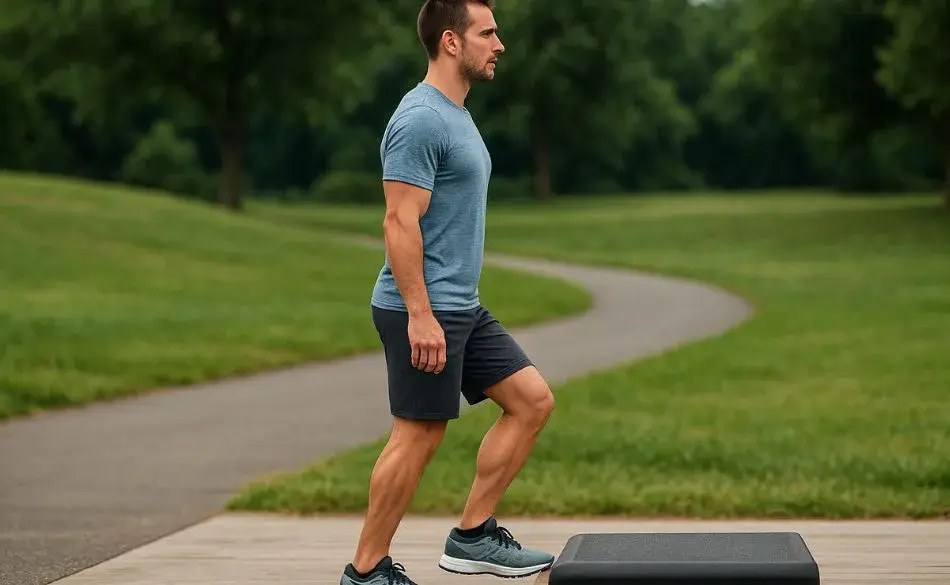
You’ll need a step or a low ledge and something stable to hold for balance. The standard version uses both legs to rise and one leg to lower, allowing you to target your Achilles tendon and calf without overloading it.
Here’s how to perform the classic version safely and effectively:
Step-by-Step Guide
- Stand on the edge of a step with your heels hanging off.
- Hold a wall or railing for support.
- Rise up on both feet so your heels are lifted.
- Shift your weight to one leg, then slowly lower your heel below the step.
- Take about 3–5 seconds to lower down.
- Use both feet to return to the starting position.
- Repeat 10–15 times per leg, 2–3 sets daily.
The exercise should feel like a stretch, not a sharp pain. Mild soreness is normal (it’s part of the tendon remodeling process). If you feel strong discomfort, reduce the range of motion or perform the movement on flat ground, especially if you’re managing insertional Achilles tendinopathy.
As you improve, you can add resistance with a backpack or dumbbell. Many athletes I coach start by holding a 5 kg weight after two weeks of pain-free movement. Over time, this gradual loading helps build stronger, more elastic tissue and improves calf strengthening far beyond what typical stretches achieve.
The key is consistency. One minute of perfect form is better than five rushed sets. Every slow rep teaches your tendon patience and power. Two traits every successful runner needs.
Common Mistakes and How to Avoid Them
Even though eccentric heel drops look simple, a few common errors can slow your progress or make pain worse. These mistakes often come from rushing, skipping progressions, or ignoring your body’s signals. As a coach, I’ve seen runners delay recovery for months by pushing too hard too soon.
Here’s what you’ll want to avoid:
Mistakes Runners Often Make
- Moving too quickly. Lowering the heel fast removes the eccentric benefit. Take at least three seconds per drop.
- Bouncing at the bottom. This adds unnecessary stress on your Achilles tendon and reduces the smooth tension needed for tendon remodeling.
- Ignoring soreness. Mild discomfort is normal, but sharp or stabbing pain means your tendon isn’t tolerating the load yet.
- Skipping warm-ups. Start with light calf raises or ankle circles to get blood flowing before loading the tendon.
- Neglecting balance. Holding a wall or railing ensures your calf muscles do the work instead of your stabilizers compensating.
- Doing too much, too soon. If you have Achilles tendinopathy, volume overload can irritate the area. Gradual loading is essential.
Smart Ways to Fix These Mistakes
- Keep the focus on controlled lowering – the slower, the better.
- Start with bodyweight only, then add resistance once pain levels stay low for several days.
- Alternate between the gastrocnemius-focused (straight leg) and soleus-focused (bent knee) versions to strengthen both parts of the calf.
- Add heel drops into your regular calf strengthening routine two to three times per week once symptoms ease.
Each repetition should feel deliberate and smooth, like lowering yourself on an invisible spring. Think of it as retraining your tendon to trust movement again. Runners who focus on form over speed recover faster and come back stronger, ready for the next long run. If you often struggle with pain or tightness in your lower leg, it’s worth reading Why Your Achilles Hurts When You Run for a deeper look at what causes that discomfort and how to prevent it from returning.


Progressions, Loading, and When to Return to Running
Once you’ve mastered the basic eccentric heel drops with good control and minimal pain, it’s time to level up. Your goal now is to increase the tendon’s ability to handle greater forces, much like adding mileage slowly during run training. The secret is progressive overload, that means adding just enough challenge to stimulate growth without tipping into irritation.
Start by adding light resistance. A small dumbbell or a backpack with a few books can make the exercise more effective. For runners recovering from Achilles tendinopathy, gradual loading is essential. The tendon strengthens as it adapts to higher tension, which improves both durability and performance over time.
Here’s a simple guide to progress safely:
- Increase load slowly – about 5–10% per week if pain stays low.
- Reduce reps as you add weight to focus on quality over quantity.
- Switch between bent-knee and straight-leg versions to hit both the soleus and gastrocnemius.
- Perform single-leg eccentric calf raises for more advanced loading once both legs feel balanced.
During this phase, monitor your body closely. If stiffness returns or pain spikes more than 24 hours after training, ease back slightly. Recovery time is when tendon remodeling occurs, so rest days are part of the plan, not a setback.
As you near pain-free strength, integrate a return to running protocol. Start with walk-run intervals on flat ground before adding hills or speed. By week eight to ten, most runners notice smoother push-offs and less tension through the calves. It’s a gradual return, but one that rebuilds confidence with every stride. For more ways to build lower leg strength and stability, check out Best Calf Exercises for Runners to complement your heel drop training and improve performance.
Take control of your health with the Running Weight Loss Plan from SportCoaching. This structured 20-week program helps you lose weight safely while improving endurance, fitness, and running efficiency. Each workout is designed around your heart rate and fitness level, so every run brings you closer to your goals without burning out.
- Personalized training schedule: created around your lifestyle and experience level
- Fat-burning sessions: designed to target the right heart rate zones for sustainable results
- Expert support: includes a 1-hour consultation and a fully customized running plan
- One-time purchase: lifetime access with no hidden fees or subscriptions
Achieve lasting weight loss through smart, structured training built by professional running coaches.
View the Running Weight Loss Plan →

Beyond Rehab: Performance Benefits for Runners
While eccentric heel drops are best known for treating injuries, their benefits go far beyond recovery. For runners, they’re one of the most underrated tools for improving power, stability, and running economy. Strengthening the calf and Achilles complex doesn’t just prevent problems, it helps you run faster and more efficiently.
Every time your foot hits the ground, your Achilles tendon stores and releases energy like a spring. The stronger and stiffer that spring becomes, the less energy you lose during each stride. Over weeks of consistent heel drop protocol training, runners often notice lighter foot strikes and smoother acceleration on hills or during tempo efforts.
Better yet, **tendon remodeling** through eccentric work creates a more resilient structure that can handle higher training loads. That means fewer setbacks and more time spent building fitness instead of managing pain. This resilience becomes especially valuable during marathon or triathlon prep when volume climbs and recovery windows shrink.
Here’s how improved tendon strength translates into real-world performance:
- Increased power return: Each push-off uses less energy, improving running economy.
- Better fatigue resistance: Stronger calves delay form breakdown late in races.
- Improved balance and control: Stability at the ankle helps reduce compensations that lead to overuse injuries.
- Reduced recovery time: Healthy tendons bounce back faster between sessions.
Many elite coaches now include eccentric work during base and strength phases (not just for injury prevention, but as part of performance programming). Even adding heel drops two or three times per week can improve force efficiency and running rhythm. It’s proof that sometimes the simplest exercises create the most lasting gains.


Troubleshooting Pain and Plateaus
Even with the right technique, it’s normal to hit small setbacks when performing eccentric heel drops. The key is learning to listen to your body and adjust before discomfort turns into regression. Every runner’s Achilles behaves differently, so patience and awareness are crucial parts of the process.
If your tendon feels worse after a few sessions, don’t panic. It usually means your load increased too quickly or recovery time wasn’t long enough. Most runners find success by dialing back volume for a few days, then gradually returning once symptoms settle. Remember, tendon remodeling happens slowly, not overnight.
Here are a few ways to troubleshoot common problems:
- Persistent pain near the heel bone: Try the flat-ground version to reduce compression in insertional Achilles tendinopathy.
- Stiffness in the morning: Add gentle ankle mobility before your first set to increase blood flow.
- Sharp pain during lowering: Shorten the range of motion and avoid dropping below step level.
- No improvement after 8–10 weeks: Check your form or consult a physiotherapist to reassess your heel drop protocol.
Another common issue is plateauing (when progress stalls even though pain has improved). This is often a sign your tendon is ready for more challenge. Adding a small load or switching to single-leg eccentric calf raises can reignite adaptation and build even greater calf strengthening benefits.
The journey isn’t always linear, but that’s part of rebuilding a healthy, strong tendon. A few smart adjustments can turn a frustrating plateau into the next breakthrough in your running performance. If you’re still struggling with tightness or soreness during recovery, read Calf Pain When Running for expert insight into causes, treatments, and prevention strategies to keep you running comfortably.


Making Eccentric Heel Drops Part of Long-Term Injury Prevention
Once your pain is gone, it’s tempting to stop doing eccentric heel drops. But the real secret to staying injury-free is turning them into a long-term habit. Runners who maintain these exercises two or three times a week build stronger, more adaptable tendons that resist breakdown even under heavy training loads.
The Achilles tendon acts like a power cable between your calf and foot. The stronger that connection, the more efficiently force transfers during every stride. Regular calf strengthening not only reduces the risk of Achilles tendinopathy returning but also protects against shin splints, plantar fasciitis, and calf strains. All common issues linked to weak or overloaded lower legs.
Think of eccentric heel drops as maintenance for your running engine. Just as you wouldn’t skip oil changes in your car, you shouldn’t skip tendon care once it’s healthy. A few minutes after a run or during strength sessions is all it takes to keep your legs resilient.
Here’s how to maintain the benefits long term:
- Do 2–3 sets of 10–15 slow reps twice per week during training seasons.
- Add light load or vary foot positions to keep stimulating tendon remodeling.
- Pair heel drops with gentle mobility and foam rolling for full recovery.
- Use them as part of your heel drop protocol whenever early stiffness returns.
Many of the best endurance athletes treat eccentric training like brushing their teeth (small, consistent, and non-negotiable). Keeping it simple and regular is what prevents old aches from creeping back and keeps your stride feeling light and powerful all year round.
Take the guesswork out of your training with our expertly designed Running Training Plans . Each plan is built by professional coaches to help you reach your running goals—whether that’s completing your first 5K, setting a marathon personal best, or simply running stronger and more efficiently. You’ll train with structure, balance, and purpose every week.
- Structured programs: tailored to every distance and ability level
- Expert coaching design: built using proven endurance and speed-building principles
- Balanced training: combines intervals, tempo runs, and recovery to maximize progress
- Flexible scheduling: adapt each plan to fit your lifestyle and running experience
Follow a proven plan, stay consistent, and watch your speed, endurance, and confidence grow with every run.
Explore Running Training Plans →

Real Results: One Athlete’s Journey
When one of the runners I coach, Sarah, came to me, she could barely jog without her Achilles tightening up halfway through. She’d tried stretching, massage, even complete rest, nothing worked for long. We added eccentric heel drops into her daily routine, starting with bodyweight only. It wasn’t glamorous work, but she stayed consistent.
By week four, the pain she felt during her morning runs began to fade. She noticed more spring in her step and less tension after long sessions. Around week eight, we introduced small weights and alternating bent-knee and straight-leg variations. That combination helped her rebuild both her calf strength and tendon load tolerance. Within three months, Sarah was not only pain-free but running better than before her injury.
Her story isn’t unusual. I’ve seen countless athletes return stronger after committing to the process. It takes patience and awareness, but that’s what running is all about. The small, steady steps that lead to breakthroughs.
If you’ve been struggling with Achilles tendinopathy or tight, sore calves, take this as your sign to start. The heel drop protocol is simple, proven, and backed by science. It’s not a quick fix, but it’s one of the most reliable ways to rebuild confidence in your stride.


Every Heel Drop Counts - Your Path to Pain-Free Running
Eccentric heel drops may look simple, but for runners, they’re one of the most powerful tools for staying strong, healthy, and pain-free. This small, controlled movement builds more than just calf strength, it rebuilds trust between your mind and body. Each slow drop teaches your tendons how to handle pressure, recover from stress, and perform at their best.
Whether you’re overcoming Achilles tendinopathy or just looking to prevent it, this exercise belongs in every runner’s toolkit. The science behind it is clear: consistent, slow eccentric loading leads to effective tendon remodeling, stronger connective tissue, and long-term resilience. Think of it as quiet strength training for your running foundation.
Over time, those steady sessions add up. Your steps feel lighter, your push-offs more powerful, and your confidence returns with every stride. The heel drop protocol isn’t a quick fix, it’s a commitment to better movement and lasting strength.
So make it part of your routine. Find a step, take your time, and focus on the quality of each repetition.