

Quick Answer
RPE is a subjective measure of exercise intensity. The original Borg scale runs 6–20; the modified scale runs 0–10. On the 1–10 scale: 2–3 = easy/recovery; 4–5 = aerobic/long run; 6–7 = marathon/tempo pace; 7–8 = threshold; 8–9 = VO2max intervals; 10 = maximal sprint. RPE is most valuable in heat, during racing, when technology fails, and as a daily recovery indicator.

The Two RPE Scales: Borg 6–20 and the Modified 0–10
There are two versions of the RPE scale in common use, and understanding the difference matters for applying the right one in the right context.
The Original Borg Scale (6–20) was developed by Swedish physiologist Gunnar Borg in the 1960s. The unusual range — starting at 6 rather than 0 — was deliberate: the numbers were designed to correlate with heart rate when multiplied by 10. A score of 6 represents approximately 60 beats per minute (resting heart rate in a healthy adult), and a score of 20 represents approximately 200 beats per minute (near-maximal effort). The scale was validated in laboratory settings and remains the standard in clinical exercise testing and research. A 2024 PMC large cross-sectional study using cardiopulmonary exercise testing found that ≤11 corresponds to light intensity, 12–14 to moderate intensity, and 15–17 to vigorous intensity on the Borg scale.
The Modified CR10 Scale (0–10) was introduced by Borg around 1982 as a simpler, more intuitive alternative for clinical and sporting use. It runs from 0 (nothing at all) to 10 (maximal, absolute maximum effort). Most coaches and athletes now use the 0–10 or 1–10 version because the numbers feel more natural: 5 means “moderately hard” in everyday language, and 10 means “as hard as possible.” When training plans or coaches prescribe “RPE 7,” they almost always mean the 1–10 scale rather than the 6–20 original.
Both scales measure the same phenomenon. The choice between them is practical rather than scientific. The 6–20 scale remains the standard in clinical settings and research because of its established validation literature; the 1–10 scale is more practical for training prescription and athlete self-monitoring. This article uses the 1–10 scale throughout.


How Accurate Is RPE? What the Research Shows
RPE is often treated as either unimpeachably reliable or hopelessly subjective. The research places it between these extremes: a moderately accurate measure of intensity that is more valid than many athletes assume, but less accurate than many articles claim.
A meta-analysis by Chen and colleagues (2002) examined the criterion-related validity of the Borg RPE scale against physiological measures across multiple studies. The weighted mean validity coefficients were 0.62 for heart rate, 0.57 for blood lactate, 0.64 for %VO2max, and 0.72 for respiration rate. These are moderate correlations — statistically meaningful and practically useful, but short of the r=0.80–0.90 previously assumed in popular treatments of the scale. The authors noted that RPE validity varied significantly depending on fitness level, exercise type, and the specific physiological measure used.
What this means practically: RPE is a reliable enough measure of intensity to prescribe training zones and monitor daily effort, but it should not be treated as a precise substitute for objective measurement when objective measurement is available. An experienced runner who rates a tempo run as RPE 7–8 will be close to their threshold intensity; a complete beginner may not accurately calibrate the same effort. RPE improves with experience — the more an athlete trains and develops body awareness, the more accurately their RPE correlates with actual physiological markers.
Cleveland Clinic notes an important limitation: “Someone new to exercise may believe they’re working out harder than their heart or breathing rate shows. Similarly, extremely fit athletes may think they’re going at a moderate pace when they’re actually at their maximum.” This calibration gap narrows with training experience but never disappears entirely, which is why RPE works best alongside objective metrics rather than instead of them.


The RPE Scale for Runners
| RPE (1–10) | Effort description | Talk test | Session type | Approx. heart rate |
|---|---|---|---|---|
| 1–2 | Minimal — walking or very slow movement | Normal conversation | Warm-up, cool-down, rest day walk | <60% max HR |
| 3–4 | Easy — comfortable, barely working | Full sentences effortlessly | Easy run, recovery run | 60–70% max HR |
| 5–6 | Moderate — aerobic, sustainable for long durations | Comfortable sentences, deeper breathing | Long run, aerobic base | 70–80% max HR |
| 6–7 | Comfortably hard — focused but manageable | Short sentences, noticeable effort | Marathon pace, steady state | 80–85% max HR |
| 7–8 | Hard — threshold, lactate accumulating | A few words only | Tempo run, threshold intervals | 85–90% max HR |
| 8–9 | Very hard — approaching maximum | Cannot talk, gasping | VO2max intervals, race efforts | 90–95% max HR |
| 10 | Maximal — all-out sprint, unsustainable | Impossible | Short sprints (under 60 seconds) | Near 100% max HR |
The most common mistake recreational runners make is running easy days too hard. A genuine recovery run or easy aerobic run should feel like RPE 3–4 — the kind of effort where you could run for several more hours without significant fatigue if you wanted to. Many runners routinely run easy days at RPE 5–6, which means they never fully recover between hard sessions and accumulate fatigue over weeks. Learning to run at a true RPE 3–4 — even if that means a pace that initially feels embarrassingly slow — is one of the most important skills in distance running. Our guide to running training zones maps RPE directly onto heart rate zones and pace zones for a complete picture of intensity across all session types. Our tempo run guide covers the specific feel and execution of RPE 7–8 threshold training in detail.


The RPE Scale for Cyclists
| RPE (1–10) | Effort description | Talk test | Session type | Approx. % FTP |
|---|---|---|---|---|
| 1–2 | No effort — spinning, coasting | Normal conversation | Warm-up, cool-down | <55% FTP |
| 3–4 | Easy — recovery ride, barely taxing | Full conversation | Recovery ride, active recovery | 55–65% FTP |
| 5 | Moderate — aerobic endurance | Comfortable talking | Endurance ride, long base ride | 65–75% FTP |
| 6–7 | Comfortably hard — tempo/sweet spot | Short sentences | Tempo intervals, sweet spot | 76–95% FTP |
| 7–8 | Hard — threshold | A few words maximum | FTP intervals, threshold sets | 96–105% FTP |
| 8–9 | Very hard — VO2max efforts | Cannot talk | VO2max intervals, race climbs | >106% FTP |
| 9–10 | Maximal — anaerobic, all-out | Impossible | Sprint intervals, max efforts | >150% FTP |
The SportCoaching team notes that power meters make RPE more important than ever, not less: “While it’s true that 200 watts today is the same workload as 200 watts tomorrow, RPE provides valuable context to power files. When you’re fresh, 200 watts may feel like a moderate spin. When you’re fatigued, you may feel like you’re working harder than normal.” If your RPE at a given power number is consistently higher than it should be, that’s an early signal of accumulated fatigue — a signal a power meter alone cannot provide. Our cycling power zone calculator lets you establish your training zones by power and pair them with the RPE descriptors in the table above for a complete training intensity framework.Sport

RPE in Swimming and Triathlon
Swimming presents a unique RPE calibration challenge: breathing is constrained by stroke mechanics, making it harder to use the talk test as a guide. Most swimmers gauge effort by breathing rhythm — comfortable bilateral breathing (every three strokes) corresponds to approximately RPE 4–6, while needing to breathe every stroke on one side signals RPE 7–9. At maximal sprint RPE 9–10, some swimmers hyperventilate on turns to support the effort.
Open water swimming adds another layer: sighting (lifting the head to navigate) increases energy cost compared to pool swimming, and the absence of walls means no push-off recovery. The same pace in open water typically feels 0.5–1 RPE point harder than in a pool — something triathletes should account for when pacing their swim start. Starting too fast in the swim raises the RPE immediately, and the cost accumulates across the bike and run legs that follow.
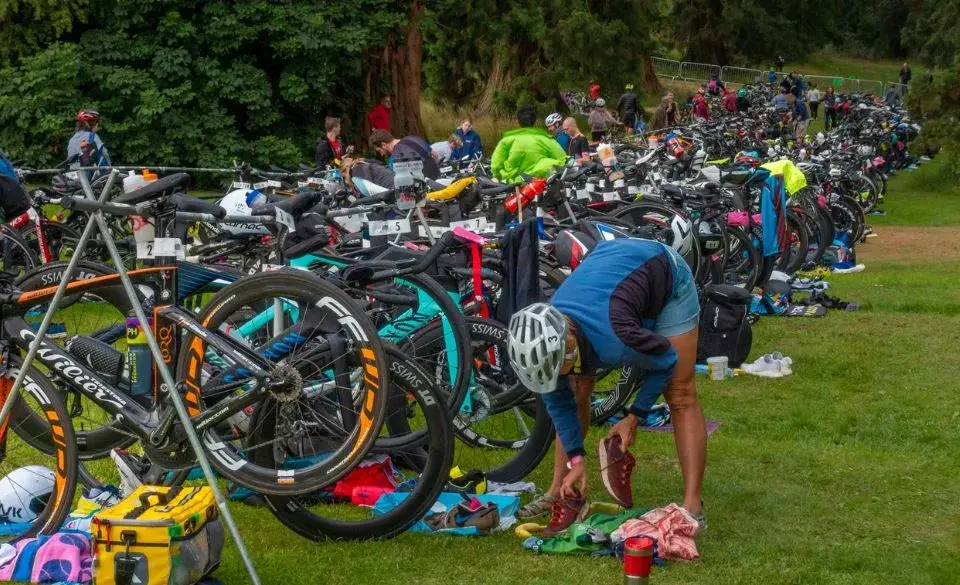
In triathlon, RPE is particularly valuable during brick sessions (cycling immediately followed by running) where the physiological shift between disciplines confuses both heart rate response and perceived pace. A runner transitioning off the bike typically feels RPE 6–7 in the first 10–15 minutes even at an easy pace — the “brick legs” sensation — before normalising to a more accurate effort perception. Training the body to recognise this normal post-bike running feel prevents the common mistake of starting the run leg too fast in a race because it initially feels deceptively easy. Our warm-up and cool-down guide covers how to prime the body for each training session so that early RPE readings are more representative of actual sustained effort.


When to Use RPE vs Heart Rate vs Power
The most effective training uses all three sources of information in context. Each has distinct advantages and limitations:
Power (cycling) and pace (running) are the most objective and consistent measures of workload. They don’t fluctuate based on fatigue, temperature, sleep, or stress — the numbers are the numbers. They are the best primary metric for structured interval training where precise workload control is the goal. Their limitation: they measure what you’re doing, not how your body is responding to it.
Heart rate measures cardiovascular response. It’s more responsive to recovery status than power or pace — a higher-than-expected HR at a given pace or wattage signals fatigue or physiological stress. However, heart rate is affected by temperature (cardiovascular drift in heat can raise HR by 10–20 BPM at constant workload), caffeine, alcohol, poor sleep, and medications. Heart rate also lags behind effort during short intervals, making it less useful for intensity prescription in sessions under 3–4 minutes per interval.
RPE captures the integrated experience of all these factors simultaneously. It reflects not just physical intensity but recovery status, environmental conditions, fatigue accumulation, and readiness to train. A useful daily practice: before starting a structured workout, note the RPE of a standardised warm-up effort. If a pace or wattage that usually feels like RPE 4 is feeling like RPE 6, something has changed — and adjusting the planned session accordingly is usually the right decision. Our beginner running guide introduces RPE as the primary intensity measure for new runners, precisely because pace and heart rate targets are less meaningful before a fitness baseline is established.
The CTS coaching team also notes RPE’s specific value during competition: “In many cases, RPE is the best metric to use during competition” because data reading while racing is impractical, and the athlete’s experience of effort is the most responsive real-time guide available. The ability to race by feel — to know instinctively what RPE 7 versus RPE 8 feels like and hold the right number across a long event — is a skill that takes months to develop but represents a meaningful competitive advantage.


How to Calibrate Your RPE
RPE accuracy improves with deliberate practice. Most athletes who think they use RPE are actually guessing — they assign a number after a session based on a vague impression of how hard they worked. Accurate RPE requires checking in with the body during exercise and understanding the specific sensations that correspond to each level.
A practical calibration approach: on a structured training ride or run, start the session with a known easy effort (2–3 minutes at a pace you’ve confirmed is easy from pace or HR data) and assign that an RPE number. Then systematically increase intensity in steps, noting the RPE at each level and cross-referencing it with your heart rate or power data. After 6–8 sessions of this practice, most athletes develop a much more reliable internal calibration that holds up across different conditions.
The talk test is the most reliable standalone calibration tool. If you can speak full sentences without pausing for breath, you’re at RPE 3–5. If you can manage short sentences but breathing is clearly elevated, you’re at RPE 5–7. If only a few words are possible before needing another breath, you’re at RPE 7–8. If talking is impossible, you’re at RPE 8–10. Practise consciously noting breathing state and correlating it with effort numbers during every training session.
Train With Structured Intensity — Running and Cycling
SportCoaching's running and cycling training plans prescribe effort by RPE, heart rate, and pace or power — so every session has a clear intensity target and a framework for reading your body's response on the day.


FAQ: Rate of Perceived Exertion Scale
What is the rate of perceived exertion scale?
A subjective measure of exercise intensity based on how hard the effort feels. Developed by Gunnar Borg in the 1960s. Two versions: original Borg scale (6–20, correlating × 10 to heart rate in BPM) and modified CR10 scale (0–10, simpler and more commonly used in training). Both measure the same thing: perceived effort based on breathing rate, heart rate, muscle fatigue, and overall strain.
What RPE should easy running feel like?
RPE 2–4 on the 1–10 scale. Full conversation without breathlessness. Most recreational runners run their easy days too hard — if easy running feels like RPE 5–6, the pace is too fast and recovery is being compromised. 70–80% of weekly running volume should be at true easy effort, RPE 3–4.
What is the difference between the Borg 6-20 scale and the 1-10 RPE scale?
The 6–20 original correlates numbers to heart rate (number × 10 = approximate BPM). The 0–10 modified scale is simpler and more intuitive for daily training use. Most coaches and training plans now use the 1–10 scale. The 6–20 scale remains standard in clinical and research settings.
How accurate is RPE compared to heart rate and power?
Moderate accuracy. A meta-analysis found validity coefficients of ~0.62 for heart rate and ~0.64 for %VO2max — meaningful but imperfect. RPE’s advantage over objective metrics: it captures fatigue and recovery context those metrics miss. Best used alongside heart rate and power rather than instead of them.
When is RPE most useful for endurance athletes?
During racing (data reading is impractical); in heat (heart rate drifts upward independently of workload); when technology is unavailable; and as a daily recovery indicator. If an effort that normally feels like RPE 5 feels like RPE 7, under-recovery is likely regardless of what the heart rate monitor shows.















