


Quick Answer
The best single psoas stretch is the kneeling hip flexor lunge — half-kneeling position, glute of back leg squeezed, hips pressed forward, held 45–60 seconds. The best strengthening exercise is the seated leg raise or dead bug. Both stretching and strengthening are needed; most people who sit a lot need both.
All 10 Psoas Exercises at a Glance
| Exercise | Type | Best for | Sets × Reps / Hold |
|---|---|---|---|
| Kneeling hip flexor lunge | Stretch | Primary psoas stretch — most effective | 2–3 × 45–60 sec per side |
| Low lunge (runner's lunge) | Stretch | Pre/post-run hip flexor release | 2–3 × 45–60 sec per side |
| Thomas stretch | Stretch | Passive gravity-assisted release | 3 × 30–60 sec per side |
| Standing hip flexor stretch | Stretch | Quick desk break; accessible anywhere | 2–3 × 30–45 sec per side |
| Couch stretch | Stretch | Deeper release for flexible athletes | 2–3 × 60–90 sec per side |
| Standing march | Strengthen | Beginner — psoas activation pattern | 3 × 10 per side |
| Seated leg raise | Strengthen | Isolated psoas loading; runners | 3 × 12–15 per side |
| Lying leg raise | Strengthen | Psoas + lower abdominal co-activation | 3 × 10–12 per side |
| Dead bug | Strengthen | Psoas + deep core; running-specific | 3 × 10 per side |
| Step-up with knee drive | Strengthen | Functional strength; running mechanics | 3 × 10–12 per side |

The Psoas: What It Is and Why It Matters
The psoas major originates from the lateral surfaces of the 12th thoracic vertebra (T12) and all five lumbar vertebrae (L1–L5), along with the intervertebral discs between them. It runs diagonally downward through the pelvis and inserts at the lesser trochanter — a small bony prominence on the inner side of the upper femur. Together with the iliacus (which originates from the inner bowl of the pelvis), it forms the iliopsoas complex, most commonly called the psoas for short.
This anatomy makes the psoas uniquely significant: it is the only muscle in the body that directly connects the lumbar spine to the lower limb. No other muscle crosses from the vertebrae to the leg. This means that psoas tightness doesn’t just affect the hip — it directly loads the lumbar vertebrae themselves. A chronically shortened psoas pulls the lumbar spine forward and downward, increasing lumbar lordosis, compressing the posterior facet joints, and loading the intervertebral discs asymmetrically. This is one of the primary mechanisms by which prolonged sitting causes lower back pain that persists even during exercise.
The psoas also controls hip flexion — the movement of lifting the thigh toward the chest — and contributes significantly to lumbar spine stabilisation during standing, walking, and running. During running, it is the primary muscle that drives the forward swing of the leg. A restricted psoas limits hip extension during push-off (the leg cannot travel fully behind the body), which shortens stride length and forces the lower back to compensate. Our guide to lower back pain when running covers this psoas–lumbar connection and how it produces some of the most common running-related back complaints.


Tight vs Weak Psoas: Understanding the Difference
Most people in desk-based jobs have a psoas that is simultaneously tight and weak — this combination is so common it is nearly universal in adult populations who sit more than 6 hours per day. Sitting keeps the psoas in a shortened position (hip flexed, lumbar spine moderately loaded) but provides no resistance through its full range of motion, preventing the full hip extension needed for genuine muscular load. The result: the muscle adapts by shortening and losing strength at longer lengths.
Self-test for tightness: Kneel in a half-kneeling position (one knee on floor, one foot forward). Keeping your back straight and glute of the rear leg contracted, press the hips forward gently. A deep pulling sensation in the front of the rear hip — not the front thigh or knee — indicates psoas tightness. If you feel it in the quad above the knee rather than deep in the hip flexor, the rectus femoris is tighter than the psoas.
Self-test for weakness: Stand tall and lift one knee toward 90 degrees. If the pelvis tilts backward on the standing leg side, or the lower back rounds to help the knee rise, the hip flexors (including psoas) are weak on the lifting side. A strong psoas should lift the knee cleanly with a neutral pelvis.

5 Psoas Stretches for a Tight Psoas
1. Kneeling Hip Flexor Lunge (Half-Kneeling)
The most effective single psoas stretch.
How: Start in a half-kneeling position — right knee on the floor, left foot planted in front with left knee directly over the left ankle. Keep the torso upright, core braced. Squeeze the glute of the right (rear) leg deliberately — this is critical for isolating the psoas stretch rather than loading the lumbar spine. Maintaining this glute contraction and a neutral spine, gently press the hips forward until a deep stretch is felt in the front of the right hip. Do not lean the torso forward — the movement comes from the pelvis, not the trunk. For a deeper stretch, tuck the tailbone slightly under (posterior pelvic tilt).
Hold: 45–60 seconds per side. 2–3 sets. The glute contraction must be maintained throughout — as soon as it relaxes, the stretch migrates from the psoas to the lower back.
Our runner’s lunge guide covers the same stretch in the low-lunge (hands-on-floor) variation used in yoga and running warm-up routines. Our tight hip stretches guide covers additional hip flexor and hip mobility exercises that complement this stretch.
2. Low Lunge (Runner’s Lunge)
How: From standing or a downward dog position, step one foot forward between the hands. Lower the back knee toward the floor (or keep it elevated for more intensity). Both hands rest on the floor or on blocks beside the front foot. Sink the hips downward and forward, breathing deeply. The back leg’s hip flexors — primarily the psoas — are stretched in this position. Keep the spine long rather than rounding.
Hold: 45–60 seconds per side. Dynamic version (rocking forward and back gently) is appropriate for pre-run warm-up; static hold is for post-run or recovery sessions.
3. Thomas Stretch (Supine Edge-of-Table)
Best for: passive, gravity-assisted psoas release.
How: Lie on your back on a firm surface (bed or table) near the edge. Pull both knees toward the chest. Slowly lower the right leg off the edge of the surface, allowing gravity to passively stretch the right hip flexors. Keep the left knee pulled to the chest to prevent the lower back from arching. The right leg hangs freely — do not actively pull it down. You should feel a deep stretch in the front of the right hip. If no stretch is felt, shift closer to the edge so the right hip flexor is more extended.
Hold: 30–60 seconds per side. Particularly effective for runners with very tight hip flexors who find the active kneeling lunge difficult to hold.
4. Standing Hip Flexor Stretch
Best for: accessible, can be done anywhere.
How: Stand with feet together. Take a large step back with the right foot, ball of foot on the floor. Bend both knees slightly. Squeeze the right glute and tuck the pelvis posteriorly (tailbone under). You should feel a stretch in the front of the right hip. This is the least intense of the psoas stretches and works well as a quick office break or between training sets.
Hold: 30–45 seconds per side. Useful for regular breaks during desk work — frequency of short stretches throughout the day is more effective for reducing chronic tightness than one long stretching session.
5. Couch Stretch
Best for: deeper hip flexor release for more flexible athletes.
How: Kneel in front of a wall or couch. Place the right shin and foot flat against the wall (toes pointing up), with the right knee on the floor near the wall. Step the left foot forward so the left knee is at 90 degrees. Keep the torso upright and squeeze the right glute. The closer the right knee is to the wall, the more intense the stretch. If this is too intense initially, start with the knee further from the wall and progress over weeks.
Hold: 60–90 seconds per side. This is an advanced stretch — do not attempt if the knee-to-wall position causes any knee joint pain.


5 Psoas Strengthening Exercises
6. Standing March (Psoas Activation)
Best for: beginners; learning psoas activation with neutral pelvis.
How: Stand tall with feet hip-width apart and a neutral spine. Lift the right knee toward 90 degrees — thigh parallel to the floor — without allowing the pelvis to tilt backward or the lower back to round. Hold for 3–5 seconds, feeling the deep hip flexor engagement. Lower and repeat on the left. This exercise establishes the neuromuscular connection to the psoas before loading it further.
Sets/Reps: 3 × 10 each side. Progress by adding a resistance band above the knees and marching against the band’s resistance.
7. Seated Leg Raise
Best for: isolated psoas loading; excellent for runners.
How: Sit upright on the edge of a firm chair with feet flat on the floor, hands lightly on the seat beside the hips for balance. Keeping the right leg straight (or nearly so), lift the right foot off the floor and raise the thigh as high as possible without the pelvis tilting or the lower back rounding. Hold at the top for 2–3 seconds, then lower slowly. This exercise specifically loads the psoas through its full concentric range — from the hip-flexed seated position into maximum hip flexion — in a way few other exercises replicate.
Sets/Reps: 3 × 12–15 each side. Add ankle weights to progress once bodyweight feels easy.
8. Lying Leg Raise
Best for: psoas strength + lower abdominal co-activation.
How: Lie flat on your back with both legs straight and hands flat beside the hips. Press the lower back gently into the floor by contracting the abdominals. Lift the right leg to approximately 45 degrees, keeping the knee straight. Hold briefly, then lower slowly under control — the eccentric (lowering) phase is the most important for strength development. Avoid allowing the lower back to arch away from the floor as the leg approaches the ground. If the back arches, bend the knee slightly or reduce the range of motion.
Sets/Reps: 3 × 10–12 each side. Both legs simultaneously is a progression — only attempt once single-leg control is solid.
9. Dead Bug
Best for: psoas + deep core integration; running-specific stability.
How: Lie on your back with both arms extended toward the ceiling and both knees bent at 90 degrees, shins parallel to the floor (tabletop position). Press the lower back firmly into the floor and maintain this throughout. Slowly lower the right arm overhead and simultaneously lower the left leg toward the floor — keeping the knee bent — without allowing the lower back to lift. Return to start and repeat on the opposite side. The psoas of the lowering leg is eccentrically loaded; the core maintains the lumbar neutral position against the load of the moving limbs.
Key cue: If the lower back lifts, the weight being moved (arm or leg) is too far from the body. Reduce the range of motion until core control is established. This is the most running-specific psoas exercise because it trains the muscle to work within a stable lumbar spine — exactly the coordination running demands at every stride.
Sets/Reps: 3 × 10 each side. Our strength training programme for runners covers the dead bug in the context of a full runner’s strength programme.
10. Step-Up with Knee Drive
Best for: functional psoas strength; running-specific power.
How: Stand facing a box or step (40–50cm height). Step the right foot onto the box and drive through the right heel to stand. At the top of the movement, drive the left knee forward and upward toward 90 degrees — a deliberate knee drive that maximally activates the left psoas against the load of the step-up. Hold the knee drive for 1–2 seconds, then lower the left foot back to the floor under control. This combines single-leg strength (right leg) with functional psoas activation (left leg) in the same movement, closely replicating the hip mechanics of running push-off followed by leg swing.
Sets/Reps: 3 × 10–12 per side. Hold dumbbells to increase load.
How to Use These Exercises for Runners
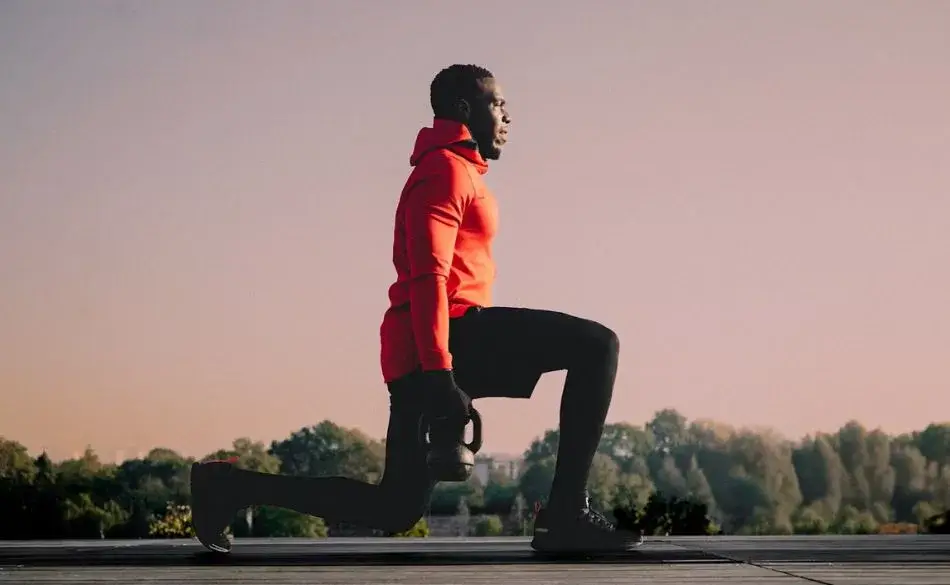
The psoas is particularly important for runners because it is the primary muscle driving the forward leg swing phase of each stride. A restricted psoas limits hip extension (the rear leg cannot travel fully behind the body at push-off), which shortens stride length and shifts compensatory load to the lower back. A weak psoas reduces hip flexion power and proprioceptive control of the swinging leg, particularly under fatigue.
A practical runner’s psoas protocol looks like this. Before running: 2–3 repetitions of the kneeling hip flexor lunge held 10–15 seconds (dynamic, not static), followed by 10 standing marches per leg. This activates and mobilises without fatiguing the muscle. After running: Kneeling hip flexor lunge held 45–60 seconds per side (static). This is the optimal time for flexibility work — the muscle is warm and relaxed. Twice weekly in the gym: Seated leg raise, lying leg raise, and dead bug — 3 sets each. These strengthen the psoas through the full range of motion and in the stability patterns that transfer directly to running.
Our warm-up and cool-down guide covers how to structure the full pre- and post-run routine that these psoas exercises slot into. Our tight hip stretches guide covers the complete hip flexibility programme that complements psoas-specific work. And our psoas workout for runners, cyclists and triathletes provides a complete session structure specifically designed for endurance athletes.
Train With a Plan That Builds the Strength and Mobility You Need
SportCoaching's running training plans and coaching include structured warm-up, mobility, and strength guidance — so the psoas work you do in training translates directly into better running mechanics and fewer injuries.


FAQ: Psoas Exercises
What is the psoas muscle and where is it?
The psoas major originates from the lumbar vertebrae (T12–L5) and inserts at the inner femur. With the iliacus, it forms the iliopsoas (commonly called the psoas). It is the only muscle connecting the lumbar spine directly to the lower limb — making it central to hip flexion, lumbar stabilisation, and running mechanics.
How do I know if my psoas is tight or weak?
Tight: deep pull in the front of the hip during a kneeling lunge stretch; lower back stiffness from sitting; reduced hip extension when running. Weak: pelvis tilts when lifting the knee above 90 degrees; instability in single-leg stance. Most desk workers have both simultaneously — sitting shortens and underloads the psoas, producing tightness and weakness together.
What is the best stretch for the psoas?
The kneeling hip flexor lunge — half-kneeling position, glute of the rear leg squeezed, hips pressed forward (not the torso), spine neutral. Adding a posterior pelvic tilt deepens the stretch on the psoas specifically. Hold 45–60 seconds per side, 2–3 sets.
Does a tight psoas cause lower back pain?
Yes — a tight psoas attaches directly to the lumbar vertebrae and pulls them forward when shortened, increasing lumbar compression and anterior pelvic tilt. This is a primary mechanism of desk-worker lower back pain. Consistent psoas stretching is a meaningful part of managing it, though rarely sufficient alone.
How often should I do psoas exercises?
Stretching: daily or 5× per week, 45–60 sec holds, 2–3 sets per side — consistency over months produces lasting flexibility change. Strengthening: 2–3× per week, 3 sets of 10–15 reps. Both are needed — stretching without strengthening, or strengthening without stretching, produces incomplete results.















