


Quick Answer
Key signs of tight hamstrings include posterior thigh stiffness, difficulty touching your toes, pain at the sit bone, reduced stride length in running, and behind-knee discomfort during or after cycling. Cyclists are particularly vulnerable because cycling never uses hamstrings through their full range. Fix requires both stretching and strengthening — strengthening is the more important and more neglected component.

Hamstring Anatomy: What You're Actually Dealing With
The hamstrings are a group of three muscles running down the back of the thigh from the pelvis to below the knee: the biceps femoris (long and short head), semitendinosus, and semimembranosus. They attach proximally at the ischial tuberosity — the sit bone — and distally at the top of the tibia and fibula, crossing both the hip and the knee joint.
This dual-joint crossing is what makes the hamstrings complex and prone to problems in endurance sport. They perform two functions simultaneously: hip extension (driving the leg backward, which powers running push-off and the cycling downstroke) and knee flexion (bending the knee, which drives the upstroke phase of cycling). When the hip is flexed — as in cycling or sitting — the hamstrings are in a shortened position. When they are then asked to contract powerfully during running, they must rapidly transition from a shortened, compressed state to a loaded, working one — which is precisely the condition under which hamstring strains occur.


Signs of Tight Hamstrings
1. Stiffness or Pulling in the Back of the Thigh
The most direct sign — a sensation of tension, tightness, or mild pulling along the back of the thigh, particularly during hip flexion movements (bending forward, lifting the knee, extending the stride). This may present as general background tightness throughout the day, or specifically during and after exercise. In runners, this often feels most pronounced in the first kilometre of a run before the muscles warm up, and again in the 24 hours after a long or fast effort.
2. Difficulty Touching Your Toes
The sit-and-reach test is the most widely used indicator of hamstring flexibility. Stand with feet together, knees straight, and bend forward from the hips. Inability to touch the toes — or significant effort required to do so — indicates hamstring tightness. Normal range allows most adults to touch the floor. Runners and cyclists with tight hamstrings often reach only to mid-shin or the ankle. Note that this test also reflects lower back mobility, so it is most reliable when combined with the straight leg raise test.
3. Pain or Ache at the Sit Bone (Proximal Hamstring)
Pain directly at the ischial tuberosity — the bony prominence you sit on — is a sign of proximal hamstring tendinopathy, a common overuse injury in both runners and cyclists. This presents as a deep, localised ache at the upper hamstring attachment that is aggravated by sitting (particularly on hard surfaces), hill running, and the early phase of running after cycling. Proximal hamstring tendinopathy is one of the slower-healing endurance sport injuries and is almost always preceded by a period of unaddressed hamstring tightness. Recognising the warning signs early is critical.
4. Tightness or Pain Behind the Knee
The lower hamstring attaches just below the back of the knee. Tightness in this region — a feeling of pulling or aching behind the knee during knee extension — indicates the biceps femoris or semitendinosus is shortened. In cyclists, this is a common presentation of incorrect saddle height (typically too low, forcing the hamstrings to work hard through the upstroke in a compressed position). In runners, it can contribute to pain that is mistaken for popliteal injury or posterior knee syndrome.
5. Lower Back Pain
The hamstrings attach to the ischial tuberosity at the base of the pelvis. When tight, they pull the pelvis into posterior tilt — rotating the bottom of the pelvis backward and flattening the lumbar curve. This changes lumbar spine mechanics, increases load on the posterior structures of the lower back, and is a significant contributor to lower back pain in runners and cyclists. Lower back stiffness after long rides or runs, particularly when it presents alongside posterior thigh tightness, is strongly associated with hamstring dysfunction rather than a primary back problem.
6. Reduced Stride Length in Running
The hamstrings’ role in hip extension means that when they are tight, the leg cannot drive as far behind the body during the push-off phase of each stride. The result is a shorter, choppier stride — a measurable reduction in stride length that directly increases the number of steps required to cover any given distance and reduces running economy. Runners with tight hamstrings often notice their pace becomes harder to maintain at what previously felt like an easy effort, and their cadence increases slightly without a corresponding increase in speed.
7. Discomfort When Sitting Prolonged
Sitting places the hamstrings in a shortened, compressed position for extended periods — with the hips flexed to approximately 90 degrees and the knees also flexed. Endurance athletes who train hard and also work desk jobs spend many hours per day with their hamstrings in this compressed state. The characteristic symptom is increasing tightness or aching along the back of the thighs after 30–60 minutes of continuous sitting, which eases temporarily when standing but returns. This is a reliable indicator that the muscles have adaptively shortened beyond their functional range.
Why Cyclists Are Particularly at Risk
Cycling is uniquely problematic for hamstring health in ways that are not immediately obvious. Unlike running, where the hip moves through close to full extension with each stride, cycling confines the hip to a limited arc of motion — the leg never extends fully behind the body. The hamstrings are therefore never taken through their full range of motion during training, regardless of how many hours are ridden.
The consequence of training repeatedly in this restricted range is adaptive shortening. Over weeks and months, the hamstrings adjust to the range they are consistently used in, shortening their functional length. As the muscle shortens, it tolerates less stretch before generating tension — meaning the first sign of hamstring tightness after a long cycling block is often not during cycling (where the limited range isn’t challenged) but during a subsequent run or even simple bending movements.
Saddle height compounds the problem significantly. When the saddle is too high, the hamstring is excessively lengthened at the bottom of the pedal stroke — the contractile units are spread too far apart to generate force efficiently, creating strain with each revolution. When the saddle is too low, the hamstrings are forced to work harder through the upstroke in a mechanically disadvantaged position, accelerating fatigue and tightening. The correct saddle height produces approximately 145–150° of knee extension at the bottom of the pedal stroke — a measurement worth verifying via a professional bike fit if hamstring symptoms persist.
Cycling hamstring pattern: The upper hamstring (at the hip/sit bone) tends to become loose and weak from being held in a compressed position. The lower hamstring (behind the knee) tends to become tight and shortened from the repetitive knee flexion of the upstroke. This imbalance within the same muscle group is what makes cycling-related hamstring problems difficult to self-diagnose and resolve with simple stretching alone.
For a deeper understanding of how cycling affects the muscles used in running — and how to structure training to complement rather than compromise both — our cycling for runners guide covers the muscle activation differences between the two sports and how to manage them.

Why Runners Are Particularly at Risk
In running, the hamstrings perform a different but equally demanding role. During the swing phase, they decelerate the forward motion of the lower leg. At footstrike, they absorb force eccentrically. During push-off, they drive hip extension. This combination of eccentric loading, force absorption, and powerful concentric contraction — repeated thousands of times per run — creates significant cumulative demand on the hamstrings even when running appears comfortable.
Runners are particularly prone to hamstring tightness for three reasons. First, running tends to be quadriceps dominant in athletes who have not specifically trained the posterior chain — the quads generate the primary propulsive force while the hamstrings remain relatively undertrained. When the hamstrings are weaker than the quads, they tighten protectively to provide the stability that strength would otherwise supply. Second, most running training involves large volumes of one specific movement pattern, which over time can produce the same adaptive shortening seen in cycling. Third, hill running — particularly downhill running — places extreme eccentric load on the hamstrings. Our hill running guide covers how to manage this loading progressively.
The downstream effects of hamstring tightness in running are significant: reduced stride length, increased lower back stress, altered foot-strike pattern, and elevated risk of hamstring strain — particularly at the proximal attachment near the sit bone, which is one of the more serious and slow-healing running injuries. Surface choice matters here too — softer surfaces like grass reduce the eccentric hamstring loading with each footstrike; our running on grass vs concrete guide covers how to use surface rotation to manage cumulative load. For injury resources specific to running, our running injuries and pain library covers the full range of hamstring and posterior chain presentations.


Why Triathletes Face a Double Challenge
Triathletes combine the two sports most likely to produce tight hamstrings. The cycling block shortens and weakens the hamstrings in the specific pattern described above. The running block then loads those shortened, inadequately prepared muscles through a demanding pattern of eccentric and concentric contraction. Without deliberate intervention — specific hamstring stretching and strengthening that neither cycling nor running provides — the cumulative effect is progressive tightening across the triathlon season.
The transition from bike to run in triathlon (T2) puts additional acute stress on the hamstrings. After extended time in the cycling position with hip flexors shortened and hamstrings compressed, the body is immediately asked to begin running — requiring rapid hip extension and hamstring loading. This is one of the reasons that the first 1–2km of the triathlon run frequently feel heavy and unresponsive: the hamstrings are transitioning from a shortened, passive state to a loaded, active one without adequate time to adapt. Athletes who specifically include brick sessions and post-ride stretching in their training manage this transition more effectively. Our half Ironman training plans incorporate brick sessions specifically designed to prepare the body for this transition.


How to Test Your Hamstring Flexibility
| Test | How to perform | Normal result | Tight hamstring result |
|---|---|---|---|
| Straight leg raise | Lie on back, raise one straight leg keeping lower back flat | 70–90° of hip flexion | Less than 60–70° before back lifts or knee bends |
| Active knee extension | Sit on chair edge, thigh supported, knee at 90°. Straighten knee | Within 10–20° of full extension | Significant limitation before discomfort begins |
| Sit-and-reach | Sit, legs straight, reach forward from hips (not back) | Fingertips reach or pass toes | Reach stops at ankle or mid-shin |
| Standing forward fold | Stand, feet together, knees soft, fold forward from hips | Hands touch or near floor | Significant pull stops movement well short of floor |
The straight leg raise test is the most reliable for distinguishing true hamstring tightness from lower back stiffness — because it isolates the hamstrings while keeping the lumbar spine in a neutral position.


Stretches for Tight Hamstrings
Static stretching post-session is the appropriate time to target hamstring flexibility — not before training, where dynamic warm-up is more effective. Hold each stretch 30–45 seconds, repeat 2–3 times per side, 4–5 times per week for meaningful adaptation. Avoid overstretching — a moderate tension is the target, not discomfort or pain.
Supine hamstring stretch (most effective for isolated flexibility): Lie on your back. Loop a towel or band around the foot of one leg and raise the leg with the knee straight until you feel moderate tension in the back of the thigh. Keep the lower back flat on the floor throughout. Hold 30–45 seconds. This isolates the hamstring without involving lumbar spine flexion.
Seated forward fold: Sit on the floor with both legs straight ahead. Hinge forward from the hips — not the lower back — reaching toward the feet. The distinction between bending from the hips (correct) and rounding the lower back (incorrect) is important: hip-hinge forward folding stretches the hamstrings; lumbar rounding stretches the back. Hold 30–45 seconds.
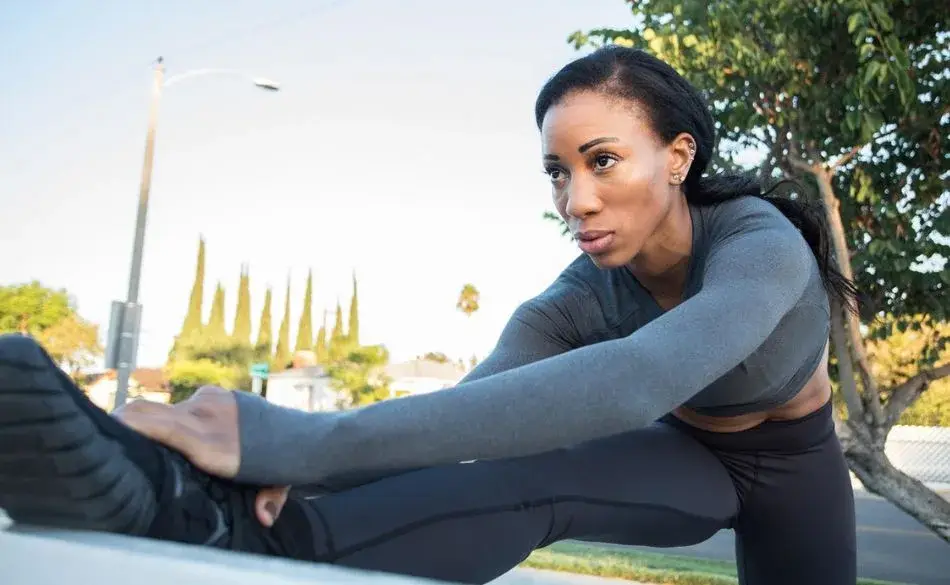
Standing single-leg hamstring stretch: Place one heel on a surface (bench, step, fence rail) with the leg straight. Keeping the back tall and hinging from the hips, lean gently forward until tension is felt in the back of the elevated thigh. This stretch is particularly accessible post-run or ride and can be performed without any equipment.
Dynamic leg swings (pre-session only): Hold a wall or fence for balance. Swing one leg forward and back in a controlled arc, progressively increasing range over 10–15 swings. Dynamic swings prepare the hamstrings for load without inducing the inhibition that static stretching produces before exercise.


Strengthening for Tight Hamstrings: The More Important Fix
Stretching addresses the symptom — tightness — but not the underlying cause in most endurance athletes, which is hamstring weakness relative to the quadriceps. When the hamstrings lack the strength to manage the loads placed on them by running and cycling, they tighten protectively. No amount of stretching reverses this pattern — only strengthening does. The exercises below address hamstring strength through the full range of motion, including the end ranges that neither cycling nor road running adequately trains. These complement the broader strength programme in our gym exercises for runners guide and our core exercises for runners guide, both of which address the posterior chain strength that underpins hamstring health.
Romanian deadlift (RDL): The single most effective hamstring strengthening exercise for endurance athletes. Hold dumbbells or a barbell in front of the thighs, feet hip-width apart. Hinge from the hips with a soft knee, pushing the hips back until the weight is at mid-shin level — maintaining a neutral spine throughout. Drive through the heels to return to standing. The hamstrings undergo significant eccentric loading through the lowering phase. 3 × 8–10 reps. Progress weight over 8–12 weeks.
Nordic hamstring curl: Kneel on a padded surface with feet anchored (under a couch, or with a partner holding the ankles). Keeping the hips extended, lower your body slowly toward the floor by straightening the knees — resisting with the hamstrings throughout the eccentric phase. Catch yourself with the hands before hitting the floor, then use the hands to push back to the starting position. 3 × 5–8 reps. This exercise has the strongest research support for reducing hamstring strain risk of any exercise in the literature — particularly relevant for runners.
Glute bridge with feet on a Swiss ball: Lie on your back, heels on a Swiss ball, hips lifted. Curl the ball toward the hips by bending the knees — extending the hips while the hamstrings work concentrically. Slowly return. 3 × 8–10 reps. Targets the lower hamstring (behind the knee) specifically — the section most shortened in cyclists.
Single-leg deadlift: Stand on one leg, hinge from the hip with a soft knee, reaching the free leg back as a counterbalance while the hands reach toward the floor. The hamstring of the standing leg works eccentrically through a full range of hip extension. Also trains the hip abductors and core, making it a highly efficient exercise for endurance athletes. 3 × 8 per leg.
Also relevant is addressing hip flexor tightness — tight hip flexors and tight hamstrings are frequently co-occurring because tight hip flexors pull the pelvis forward into anterior tilt, placing the hamstrings under increased passive stretch that the nervous system responds to with protective tension. Our psoas exercises guide covers the hip flexor work that should accompany any hamstring programme in cyclists and runners.

Summary: Signs, Sports, and Solutions
| Sign | Most common in | Primary cause | Solution |
|---|---|---|---|
| Posterior thigh stiffness | All endurance athletes | Repetitive motion in limited range | Stretching + full ROM strengthening |
| Sit bone pain | Runners, cyclists | Proximal hamstring tendinopathy | Load management + eccentric strengthening |
| Pain behind knee on bike | Cyclists | Saddle too low; shortened lower hamstring | Bike fit + lower hamstring stretching |
| Reduced stride length | Runners, triathletes | Limited hip extension from tight hamstring | Hamstring stretching + RDL / Nordic curls |
| Lower back pain | All endurance athletes | Posterior pelvic tilt from tight hamstrings | Hamstring + hip flexor mobility work |
| Heavy legs in T2 | Triathletes | Transition from shortened cycling position | Brick sessions + post-ride hamstring stretching |
| Can't touch toes | Cyclists, desk workers | Adaptive shortening from prolonged sitting | Daily supine hamstring stretch |
Train Around Your Weaknesses, Not Through Them
SportCoaching's running, cycling, and triathlon training plans are built around injury prevention as well as performance — incorporating the strength and recovery work that keeps athletes healthy through full training blocks.


FAQ: Signs of Tight Hamstrings
What are the signs of tight hamstrings?
Posterior thigh stiffness or pulling, difficulty touching your toes, sit bone pain or aching, tightness behind the knee, lower back pain from posterior pelvic tilt, reduced stride length in running, and discomfort after prolonged sitting. In cyclists, tight hamstrings most commonly present as sit bone or behind-knee pain during or after long rides.
Why do cyclists get tight hamstrings?
Cycling never uses the hamstrings through their full range — the hip never reaches full extension on the bike. Repeated pedalling in this restricted range causes the hamstrings to adaptively shorten over time. Incorrect saddle height compounds the problem. The lower hamstring (behind the knee) typically shortens, while the upper hamstring (at the hip) weakens — creating an imbalance within the muscle group itself.
How do tight hamstrings affect running?
They reduce stride length by limiting hip extension, pull the pelvis into posterior tilt causing lower back pain, alter foot-strike pattern, and increase the risk of hamstring strains — particularly at the proximal attachment near the sit bone. The most common performance sign is reduced running economy at what previously felt like a manageable effort.
How do you test for tight hamstrings?
The straight leg raise is the most reliable: lie on your back, raise one leg straight. Normal is 70–90°. Less than 60–70° before the back lifts or the knee bends indicates tightness. The sit-and-reach (standing) and active knee extension (seated) are useful supporting tests. The straight leg raise best isolates hamstrings from lower back stiffness.
Should you stretch or strengthen tight hamstrings?
Both — but strengthening is more important and more often missed. Hamstrings tighten protectively when they are weak. Stretching provides temporary relief but doesn’t address the cause. Strengthening through Romanian deadlifts, Nordic curls, and single-leg deadlifts produces lasting improvement in both flexibility and injury resilience. Static stretching post-session is appropriate; stretching without strengthening will not solve chronic hamstring tightness in endurance athletes.















