Want help turning consistency into progress? Coaching keeps your training simple, structured, and sustainable.
Start Coaching →
Man using an exercise bike with arm workout in a home gym next to a woman lifting weights.

Last updated:

Exercise Bike With Arm Workout: Your Complete Full-Body Cardio Guide

Most exercise bikes work your legs while your arms do nothing. Add a moving arm mechanism — whether that is the fan-driven handles of an air bike, the push-pull bars of a dual-action recumbent, or a standalone upper body ergometer — and the equation changes completely. You engage more muscle mass, burn significantly more calories per minute, and build cardiovascular fitness across both halves of your body simultaneously. This guide covers the main types of exercise bike with arm workout, the muscles they target, how much you can burn, and how to structure your training for the best results.

Chat with a SportCoaching coach

Not sure where to start with training?

Tell us your goal and schedule, and we’ll give you clear direction.

No obligation. Quick, practical advice.

Article Categories:

Explore our fitness training resources for more helpful articles and resources.

Quick Answer

The most effective exercise bikes with arm workouts are air bikes (fan bikes/assault bikes), which use moving handlebars and fan resistance to engage the entire body. They burn approximately 20–30 calories per minute at moderate-to-high intensity — roughly double a standard stationary bike — and target the quads, hamstrings, glutes, calves, chest, biceps, triceps, shoulders, upper back, and core. Air bikes are ideal for HIIT, conditioning, and cross-training. Dual-action recumbent bikes are a lower-intensity alternative suited to rehabilitation and beginners.

Types of Exercise Bike With Arm Workout

Air Bike (Fan Bike / Assault Bike)

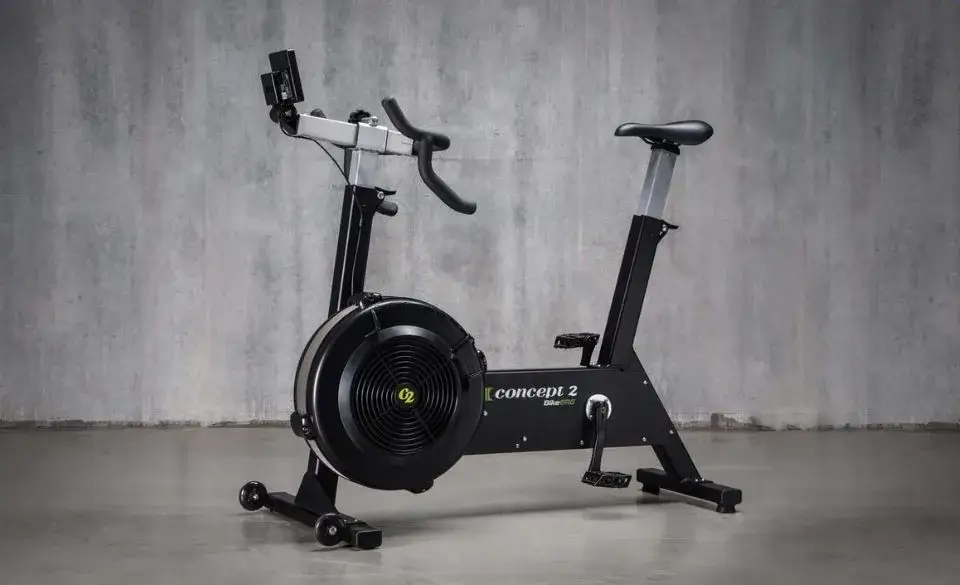
The air bike is the most popular and most effective exercise bike with arm workout. It uses a large front-mounted fan for resistance — there are no resistance settings to adjust because the fan generates more resistance the harder you push. When you pedal faster, resistance increases automatically. When you ease off, it drops. The handlebars move back and forth in conjunction with your pedalling, requiring you to push and pull with your arms as your legs cycle — similar to a cross-country skiing motion on a bike. Air bikes are commonly seen in CrossFit boxes (where they are nicknamed “the Devil’s Tricycle”), sports conditioning facilities, and increasingly in home gyms. The most well-known brands are Assault Fitness AssaultBike, Rogue Echo Bike, and Bells of Steel Blitz Air Bike.

Dual-Action Recumbent Bike

A dual-action recumbent bike adds elliptical-style push-pull arm levers to a standard recumbent (reclined) bike. The seated, reclined position reduces strain on the lower back and makes this type of machine well-suited to older adults, those in rehabilitation, and people with joint issues. Resistance is typically magnetic and manually adjustable. Calorie burn and intensity are lower than an air bike, but the supported posture and controllable resistance make this a safe, accessible option for extended lower-intensity sessions.

Upper Body Ergometer (UBE)

An upper body ergometer (sometimes called a hand cycle ergometer or arm bike) is a standalone machine designed purely for upper body pedalling — you rotate arm cranks in a cycling motion. UBEs are standard equipment in physiotherapy clinics and rehabilitation centres because they allow athletes with lower-body injuries to maintain cardiovascular fitness without loading the legs. They are also used by para-athletes for training and competition. Most air bikes also function as a UBE when you rest your feet on the static footrests and pedal with arms only.

Muscles Worked by an Exercise Bike With Arms

The specific muscles engaged depend on the type of machine and how much arm effort you apply, but a well-used air bike activates essentially the entire body in every session.

👉 Swipe to view full table

Muscle Group Muscles Action During Ride
Quads Rectus femoris, vastus lateralis/medialis Downstroke of pedalling
Hamstrings Biceps femoris, semimembranosus Upstroke of pedalling
Glutes Gluteus maximus Hip extension through pedal stroke
Calves Gastrocnemius, soleus Ankle stabilisation during pedalling
Chest Pectoralis major Push phase of handlebar movement
Shoulders Anterior/medial deltoid Push and pull of handlebars
Biceps Biceps brachii Pull phase of handlebar movement
Triceps Triceps brachii Push phase of handlebar movement
Upper back Rhomboids, posterior deltoid, lats Pull phase of handlebar movement
Core Rectus abdominis, obliques, erector spinae Stabilisation throughout

Calorie Burn: How Much More Does Adding Arms Make?

Engaging more muscle mass directly increases calorie expenditure. At moderate intensity on an air bike, most users burn approximately 20–30 calories per minute — roughly double the output of a standard exercise bike at equivalent perceived effort. A vigorous 30-minute air bike session can burn 400–600 calories depending on body weight and intensity. For context, Harvard Health data shows a standard stationary bike at vigorous pace burns approximately 315–441 calories per 30 minutes for a 70–90 kg person — the air bike exceeds this significantly by adding upper body work.

Additionally, high-intensity air bike sessions generate significant EPOC (excess post-exercise oxygen consumption) — the “afterburn” effect where your metabolism remains elevated for hours after the session ends. This makes short, intense air bike sessions disproportionately effective for calorie management compared to moderate-intensity steady-state exercise on a standard bike. For more on how cycling compares to other cardio for calorie burn, see our guide on cycling vs running calories.

Air Bike vs Standard Exercise Bike

👉 Swipe to view full table

Feature Air Bike (moving arms) Standard Exercise Bike (fixed bars)
Upper body engagement High (pushing + pulling) Minimal (grip only)
Calorie burn (30 min vigorous) ~400–600+ kcal ~315–441 kcal
Resistance adjustment Automatic (effort-based) Manual dial/button
HIIT suitability Excellent Good
Low-intensity steady state Good Excellent
Rehabilitation use Good (arm-only mode available) Limited (legs only)
Noise level Moderate (fan noise) Low (magnetic) to moderate (friction)
Technology / screen Basic LCD Basic to advanced touchscreen

Five Air Bike Workouts to Try

1. Tabata Protocol (4 minutes). 8 rounds of 20 seconds maximum effort followed by 10 seconds rest. Maximises intensity and EPOC in a very short session. Best used as a conditioning finisher rather than a standalone workout for most athletes.

2. 30/30 Intervals (15–20 minutes). 30 seconds hard effort followed by 30 seconds easy pedalling, repeated for 15–20 minutes. The equal work/rest ratio allows you to sustain higher intensity than Tabata. A solid entry point for air bike HIIT. For a full framework of interval training workouts, see our cycling interval training for beginners guide.

3. Calorie Ladder. Set the calorie display active. In minute 1, burn 10 calories then rest for the remainder of the minute. In minute 2, burn 12 calories. In minute 3, burn 14 calories. Continue adding 2 calories per minute until you cannot complete the target within the minute. This format self-regulates intensity as fatigue accumulates.

4. Zone 2 Steady State (30–60 minutes). Keep effort conversational — you should be able to speak in full sentences. This is not the air bike’s primary use case, but sustained lower-intensity sessions build aerobic base and active recovery is valuable after harder training days. Nasal breathing is a useful cue to stay in the aerobic zone. For how Zone 2 training builds your cardio foundation, see our guide on how long it takes to build a cardio base.

5. Arms-Only UBE Intervals. Rest your feet on the static footrests and drive the machine purely with your arms. Do 3–5 rounds of 30 seconds arms-only effort followed by 90 seconds recovery. This is an excellent upper body cardio tool for runners or triathletes managing a lower-body injury, and works the chest, shoulders, and triceps intensely. For more upper body cardio options without leg loading, see our guide to upper body cardio without using your legs.

Who Benefits Most from Exercise Bikes With Arm Workout

Athletes cross-training. Runners, triathletes, and cyclists use air bikes to build aerobic fitness and conditioning without accumulating additional running or cycling load. The full-body nature means one session covers both cardio and upper body work efficiently. See our article on treadmill vs bike for a broader comparison of cardio machine options.

People with lower-body injuries. Air bikes and UBEs allow athletes to maintain cardiovascular fitness while an ankle, knee, or hip injury heals. Arms-only mode eliminates all lower-body loading while still providing a genuine aerobic stimulus.

Anyone seeking calorie-efficient cardio. The combination of high calorie burn, EPOC, and time efficiency makes air bikes particularly useful for people with limited training time. A 20-minute HIIT session on an air bike can deliver comparable cardiovascular adaptation to a much longer steady-state session.

Home gym users. Air bikes are compact (roughly 1.2 × 0.6 m footprint), require no electricity, have no moving parts to maintain other than fan bearings, and can be used by the whole household regardless of fitness level. For home gym setup advice, see our guide to designing the ultimate home gym.

Older adults and rehabilitation patients. Dual-action recumbent bikes provide a supported, low-impact, adjustable full-body workout that is easy on the joints and suitable for all fitness levels. The reclined position removes spinal loading and the arm levers improve upper body mobility alongside cardiovascular fitness.

Getting Started: Form Tips for Air Bike

Keep your back upright and avoid hunching over the handlebars — poor posture increases spinal loading and reduces power transfer from the arms. Adjust the seat height so there is a slight bend at the knee at the bottom of the pedal stroke (around 25–30 degrees). Keep your elbows slightly bent rather than locking out during the push phase. Drive the handlebars through a full range of motion — a truncated arm stroke leaves upper body power on the table. For the first few sessions, keep intensity moderate to let your upper body adapt to the pushing and pulling load, which will feel unfamiliar if you have only ridden standard bikes previously. For broader getting started guidance, see our coaching and training starting point.

Want a structured training plan that uses every tool available?

Our coaches build personalised programmes that integrate gym cardio, cycling, running and strength work around your goals and schedule.

Get Started → Cycling Coaching →

FAQ: Exercise Bike With Arm Workout

What is an exercise bike with arm workout?
Any stationary bike with moving handlebars or an arm-drive mechanism — including air bikes, dual-action recumbent bikes, and upper body ergometers — that engages the arms, shoulders, chest, and back in addition to the legs during cycling.

Does an exercise bike work your arms?
Standard exercise bikes with fixed handlebars do not meaningfully work the arms. Air bikes and dual-action bikes with moving handles actively engage the biceps, triceps, shoulders, chest, and upper back through pushing and pulling movements.

How many calories does an air bike burn?
At moderate-to-high intensity, most users burn approximately 20–30 calories per minute — roughly double a standard exercise bike. A vigorous 30-minute session typically burns 400–600 calories. HIIT on an air bike also generates significant afterburn (EPOC) that extends calorie expenditure post-session.

What muscles does an air bike work?
An air bike engages the quads, hamstrings, glutes, calves (legs), chest, biceps, triceps, shoulders, upper back (arms/upper body), and core for stabilisation — essentially every major muscle group in a single session.

Can you do arm-only exercise on a bike?
Yes. On an air bike, place your feet on the static footrests and pedal with arms only — this is the upper body ergometer (UBE) mode. It is widely used in rehabilitation and for athletes maintaining fitness during lower-body injuries.

Graeme - Head Coach and Founder of SportCoaching

Graeme

Head Coach & Founder, SportCoaching

Graeme is the founder of SportCoaching and has coached more than 750 athletes from 20 countries, from beginners to Olympians, in cycling, running, triathlon, mountain biking, boxing, and skiing. His coaching philosophy and methods form the foundation of SportCoaching's training programs and resources.

750+
Athletes
20+
Countries
7
Sports
Olympic
Level

Start Your Fitness Journey with SportCoaching

No matter your goals, SportCoaching offers tailored training plans to suit your needs. Whether you’re preparing for a race, tackling long distances, or simply improving your fitness, our expert coaches provide structured guidance to help you reach your full potential.

  • Custom Training Plans: Designed to match your fitness level and goals.
  • Expert Coaching: Work with experienced coaches who understand endurance training.
  • Performance Monitoring: Track progress and adjust your plan for maximum improvement.
  • Flexible Coaching Options: Online and in-person coaching for all levels of athletes.
Learn More →

Choose Your Next Event

Browse upcoming Australian running, cycling, and triathlon events in one place. Filter by sport, check dates quickly, and plan your training around something real on the calendar.

View Event Calendar