








Find Your Next Running Race
Ready to put your training to the test? Here are some upcoming running events matched to this article.
 Coach Graeme
Last updated:
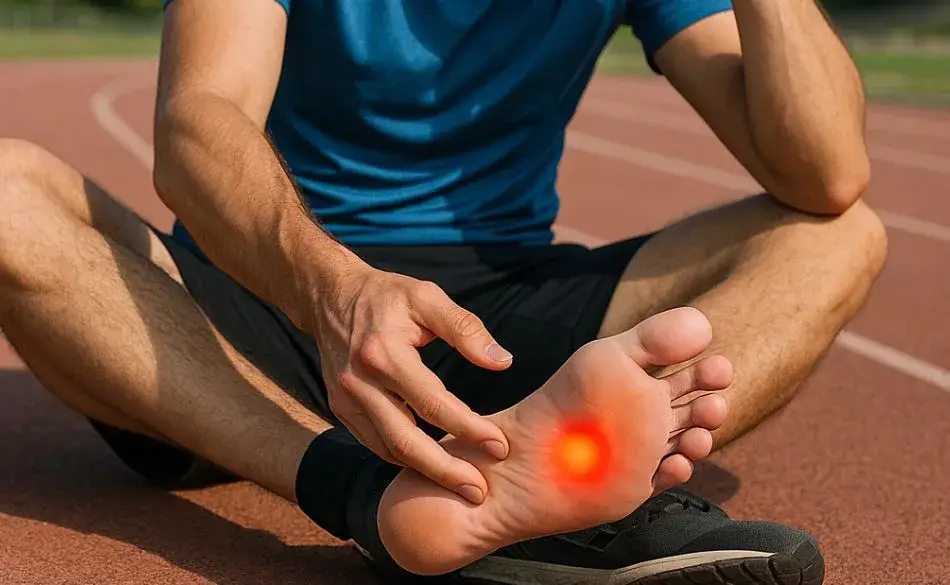
A hot spot is your foot's early warning system. That warm, burning patch you feel mid-run is your skin telling you friction is building and a blister is coming — unless you do something about it now. Most runners either push through it and pay the price later, or they stop and don't know what to do. This guide covers every cause of hot spots while running, how to prevent them before you lace up, how to fix them mid-run if they appear, and what to do at home if one develops into something worse.
Not sure where to start with training?
Tell us your goal and schedule, and we’ll give you clear direction.
No obligation. Quick, practical advice.
Explore our running training content for more helpful articles and resources.
A hot spot is a pre-blister. The skin is being damaged by repeated friction, the area heats up and turns slightly red, but the outer layer hasn’t separated yet. It feels warm and tender — not yet painful. That’s your window.
If you ignore it and keep running, friction continues, and the epidermis (outer skin layer) begins to separate from the dermis beneath it. Fluid fills that gap to protect the tissue — that’s the blister. The moment you feel a sharp sting rather than warmth, the separation has likely already started. Within an hour or two of that sting, you’ll have a full blister.
The difference in practical terms: a hot spot you catch early can be covered, protected, and run through with minimal damage. A blister that forms on a long run or race can mean hobbling home, days off training, and risk of infection if it opens.
This is the number one cause, and it covers more ground than most runners realise. A shoe that’s too tight digs into the foot and creates pressure hot spots, usually on the toes, the sides of the forefoot, or across the top. A shoe that’s too loose lets the foot slide forward and back with each stride, creating friction at the heel, toes, and ball of foot.
But “fit” also means shape. A shoe with a narrow toe box will crush the pinky toe or the bunion area even if the length is perfect. A heel counter that doesn’t match your heel shape will cause the heel to slip regardless of how tight you lace. A shoe with a midsole arch that doesn’t correspond to your foot’s arch will create a pressure point every single stride.
The most common fit errors are: buying the same size as your street shoes (running feet swell — you need a thumb’s width in front of your longest toe), buying new shoes and jumping straight into long runs, and assuming your size hasn’t changed (feet change shape over years of running).
Cotton socks absorb sweat and hold it against your skin. Wet skin is softer, softer skin generates more friction, and more friction means hot spots develop faster and more severely. On a short run, cotton socks may be fine. On anything over 45 minutes, especially in warm weather, cotton dramatically increases your blister risk.
The fix is moisture-wicking synthetic or merino wool running socks. These pull sweat away from the skin surface, keeping the outer skin firmer and more resistant to friction. Merino wool has the added advantage of regulating temperature and resisting odour, which matters on long training days.
Beyond material, fit matters. A sock that’s too big bunches at the toe or heel — each wrinkle in a sock is a friction point. A sock that’s too small pulls tight across the foot and restricts movement. Running-specific socks are sized properly for a reason.
How you lace your shoes directly controls how much your foot moves inside them. Heel lift — the heel rising away from the shoe with each step — is one of the most common lacing problems and causes hot spots and blisters directly on the back of the heel and Achilles area. The fix is heel-lock lacing: using the top eyelets to create a loop before tying, which locks the heel firmly in place.
Conversely, lacing that’s too tight across the forefoot creates pressure hot spots across the top of the foot and can compress the toes. The solution there is either loosening the forefoot or skipping the eyelet directly above the pressure zone.
Moisture is the accelerant. On a dry day, your skin can handle moderate friction without issue. Add sweat, rain, or a river crossing (for trail runners), and the same level of friction creates a hot spot in a fraction of the time. This is why hot spots that never appear on your regular 10 km can show up 40 minutes into a marathon, or immediately on a hot race day.
Moisture management is about material choice (socks and shoe uppers), anti-friction products (BodyGlide, Vaseline, or friction-specific balms applied to hot-spot-prone areas before running), and for long events, changing socks at aid stations when feet are wet.
Your foot structure determines where pressure concentrates during your stride, and pressure concentration is a precondition for hot spots. Flat feet (low arches) tend to overpronate — the foot rolls inward — which creates repetitive friction on the arch and inner forefoot. High arches concentrate impact on the heel and ball of foot, often creating hot spots in those areas. A wide forefoot in a narrow shoe creates lateral friction on every step.
The solution isn’t always a new shoe — sometimes it’s an insole or orthotic that gives your arch the support it needs to stop the excessive movement. For runners with flat feet, a structured support insole can eliminate hot spots that no sock or shoe adjustment could fix.
Your stride pattern affects how your foot contacts and leaves the ground, and therefore where friction builds. Overstriding — landing with your foot well ahead of your body — jams the toes into the front of the shoe on impact and creates hot spots at the toe tips and under the forefoot. Heel pounding creates repetitive friction at the back of the shoe. Significant overpronation or supination changes where and how the foot moves inside the shoe, often creating hot spots in locations that shoe fit adjustments can’t fully eliminate.
If you’re getting hot spots in the same place on every run and you’ve addressed shoes, socks, and lacing, a gait analysis is the next logical step. A running coach or physio can identify the form issue causing it.
👉 Swipe to view full table
| Location | Most Likely Cause | First Fix to Try |
|---|---|---|
| Back of heel | Heel slip from loose lacing or poorly fitting heel counter | Heel-lock lacing; check heel counter fit |
| Little toe / pinky | Toe box too narrow; toe being pushed inward | Try wider toe box or half size up |
| Big toe tip | Shoe too short; downhill running | Leave a thumb's width in front of big toe |
| Under ball of foot | Thin insole, hard surface, forefoot striking pattern | More cushioned insole; check midsole wear |
| Arch area | Flat feet / overpronation; insole mismatch | Supportive insole or orthotic; check sock bunching |
| Between toes | Toes rubbing together; moisture | Toe socks (Injinji); anti-friction balm between toes |
| Top of foot | Lacing too tight; high instep with low volume shoe | Loosen middle laces; try window lacing |
| Outer forefoot | Supination; too-narrow shoe | Wider shoe; check pronation pattern |
The single most effective thing you can do. Visit a specialty running store for a proper fitting — they’ll assess your foot width, arch type, and gait pattern to match you to the right shoe. When trying shoes, do it in the afternoon or after a run, when feet are at their largest. There should be roughly a thumb’s width between your longest toe and the end of the shoe. The heel should feel locked in without needing to over-tighten the laces. The toe box should allow your toes to splay slightly — not be jammed together.
New shoes need breaking in. Even a perfect shoe fit will cause hot spots if you go from zero to a 20 km long run. Build up over 2–3 shorter runs before using new shoes for long efforts or races.
Switch from cotton to technical running socks if you haven’t already — this single change eliminates hot spots for many runners. For long runs, merino wool or a quality synthetic like Balega, Darn Tough, or Feetures keeps feet driest. Match sock thickness to your shoe: if your shoe fits snugly, a thin sock; if there’s a little room, a slightly thicker one. Avoid doubling up on socks unless you’re specifically using a double-layer system designed for it (like Wrightsock), since random doubling can create more bunching, not less.
👉 Swipe to view full table
| Problem | Lacing Fix | How It Works |
|---|---|---|
| Heel slipping / heel blisters | Heel-lock lacing | Thread lace through top eyelet to create a loop; pass opposite lace through loop before tying. Locks heel firmly. |
| Pressure / hot spot on top of foot | Skip the eyelet above the pressure point | Removes direct lace pressure over the hot spot while maintaining tension elsewhere. |
| High instep / tight across middle | Window (box) lacing | Lace horizontally across the high-pressure zone instead of criss-crossing, reducing compression. |
| Wide forefoot / bunion area | Widen the forefoot by loosening bottom 2 eyelets | Creates more room for toe splay without loosening the heel lock. |
| Toe hot spots from downhill running | Surgeon's knot at the ankle | Extra half-knot before tying locks the foot back in the heel and stops forward slide on descents. |
Applied before a run to known hot-spot areas, anti-friction balms reduce friction and provide a protective layer between skin and shoe. BodyGlide, Vaseline, and 2Toms Blistershield are popular options. Apply to heels, ball of foot, between toes, and any area that has given you trouble in the past. On ultra-distance events or races lasting several hours, reapplication at aid stations is worthwhile. For runners with chronic hot spots in specific locations, ENGO blister prevention patches — which stick inside the shoe rather than to the skin — can be highly effective.
If you have a known hot-spot location — the same blister-prone spot that shows up on every long run — tape it before you start. Paper tape (such as Fixomull Stretch or Leukopor) applied smoothly over the area reduces friction directly. Moleskin cut in a donut shape around (not over) a tender area reduces pressure without adding friction. For the most durable protection, kinesiology tape applied with no stretch stays in place even through sweat and long distances.
The moment you feel that localised warmth — even faint — act immediately. Waiting until it hurts is waiting until a blister has started forming.
Step 1: Stop. Find a spot to sit. Don’t try to manage this while standing on one foot.
Step 2: Remove shoe and sock. Shake out any grit or debris from inside the shoe — a tiny piece of trail dirt is enough to cause a hot spot. Check for sock seams, bunching, or wet fabric at the affected spot.
Step 3: Dry and inspect. Pat the area dry with your sock or shirt. Look at the skin — is it just red, or has a bubble already started forming? If it’s still flat and red, you have time to fix it. If it’s already raised, treat it as a blister.
Step 4: Protect. Apply a blister prevention patch (Compeed, Band-Aid Friction Block, or similar) directly over the hot area. In the absence of patches, smooth sports tape or a strip of kinesiology tape works. Even a folded piece of tissue held in place by your sock can reduce friction enough to finish a shorter run.
Step 5: Re-lace. Before putting your shoe back on, re-lace to reduce movement at the problem area. If the hot spot is at the heel, use heel-lock lacing. If it’s at the forefoot, loosen slightly.
Step 6: Continue carefully. The patch or tape buys you time, but monitor it. If the hot spot returns or spreads, the fix wasn’t sufficient and you need to reassess — shoe fit, sock thickness, or lacing may need a more fundamental change after this run.
If you’re racing and have no supplies, the minimum is to remove the shoe, shake it out, check the sock, and re-lace. Even reducing movement slightly can be enough to prevent the hot spot progressing to a full blister for the remaining distance.
Sometimes you miss the window. The blister has formed. What now?
Small, unbroken blisters that aren’t causing significant pain: leave them alone. The fluid is sterile and the intact skin provides the best protection against infection. Cover with a blister pad (Compeed is ideal — it provides cushioning and maintains a moist healing environment) and you can usually continue training on easy runs.
Large or painful blisters that restrict your gait: draining is often necessary. Use a sterilised needle, pierce the edge of the blister (not the centre — you want to preserve as much of the roof as possible), let the fluid drain completely, apply antibiotic ointment, and cover with a blister dressing. Keep the roof of the blister intact — it continues to protect the raw tissue beneath it.
Do not run through a blister that has already opened. Broken skin in a warm, moist shoe environment is at high risk of infection. Clean the area thoroughly, apply antibiotic ointment, and either take a day off or cross-train until the skin has partially closed.
Signs of infection — increasing redness spreading beyond the blister edge, pus, significant swelling, or warmth that continues after you stop running — require medical attention. Don’t self-manage an infected blister.
Hot spots that never appear on training runs can develop on race day because of several compounding factors: increased distance, higher pace and therefore more heat, new or race-day shoes that haven’t been broken in under race conditions, and nerves that make you start faster than planned (increasing friction from overstriding).
For marathons and longer events, carry a small blister kit in your race vest or check drop bag: a few Compeed patches, a small roll of sports tape, a sachet of BodyGlide or Vaseline, and a safety pin. The weight is negligible and the ability to intervene mid-race is invaluable.
For ultra-distance events, plan for sock changes at aid stations if feet get wet, apply anti-friction balm before the start and again at mid-race, and brief your crew on what to have ready if you report foot issues. Many DNFs in ultras trace back to blisters that were preventable or manageable if addressed early.
If you’re building toward a marathon or ultra and want structured training that accounts for gear testing and race preparation, our beginner marathon training plan and running coaching programmes include guidance on race-day preparation. Foot care is part of race prep — not an afterthought.
If you address shoes, socks, and lacing and still get hot spots in the same spot on every long run, there’s usually a structural or biomechanical cause that hasn’t been addressed.
Chronic ball-of-foot hot spots despite good shoe fit often point to foot strength deficits — the intrinsic muscles that support the arch are weak, so the arch collapses under load and the foot moves more inside the shoe than it should. Building foot strength with short-foot exercises and toe gripping drills can reduce this over time.
Chronic heel hot spots that persist despite heel-lock lacing often indicate a heel counter that simply doesn’t match your heel shape. Different brands shape their heel counters differently — a shoe swap to a brand that fits your specific heel geometry is sometimes the only real fix.
Recurring toe blisters in runners who’ve already tried wider shoes and toe socks sometimes respond to a gait change — specifically reducing overstriding, which stops the toes jamming into the front of the shoe on landing. Our guide to running on different surfaces covers how surface type affects foot strike and impact, which relates directly to how much toe-jamming happens on each landing. For runners struggling with recurring forefoot or toe issues, building mileage gradually before increasing pace or surface difficulty gives your feet time to adapt.
Hot spots are almost always preventable. Get the shoe fit right, switch to technical socks, lace for your specific foot, and apply anti-friction protection to your known trouble spots before every long run. If one develops mid-run, act immediately — a two-minute stop to fix a hot spot is far cheaper than three days off with a deep blister. Know your feet, carry the right supplies, and don’t let a small friction problem turn into a training setback.
Want Training That Accounts for the Details?
Good coaching goes beyond the session plan — it covers gear, pacing, race-day prep, and recovery so nothing catches you out on the day that matters.
What causes hot spots while running?
Friction between skin and shoe or sock, made worse by heat and moisture. The most common causes are shoes that are too loose or too tight, cotton socks that hold sweat, poor lacing that allows the foot to slide, foot structure mismatches, and gait issues like overstriding or overpronation.
What is the difference between a hot spot and a blister?
A hot spot is the pre-blister stage — localised warmth and redness, but no raised fluid yet. Keep running and friction separates the skin layers, which fill with fluid to form a blister. A hot spot caught early can usually be stopped. Once the sting is sharp, the blister has likely started forming.
How do I stop a hot spot mid-run?
Stop immediately. Remove shoe and sock. Wipe away grit and moisture, check for sock bunching. Apply a blister patch or smooth sports tape over the area. Re-lace to reduce movement at the problem site, then continue carefully.
What socks are best for preventing hot spots while running?
Moisture-wicking synthetic or merino wool socks — not cotton. Look for a snug anatomical fit, flat toe seams, and no excess fabric. For blister-prone runners, double-layer socks shift friction between sock layers instead of against skin. Match sock thickness to your shoe fit.
Can lacing technique prevent hot spots?
Yes. Heel-lock lacing eliminates heel slip and Achilles hot spots. Skipping an eyelet above a pressure zone relieves top-of-foot hot spots. Window lacing reduces pressure across a high instep. Getting lacing right for your foot shape can resolve recurring hot spots without changing shoes.
Ready to put your training to the test? Here are some upcoming running events matched to this article.

Head Coach & Founder, SportCoaching
Graeme is the founder of SportCoaching and has coached more than 750 athletes from 20 countries, from beginners to Olympians, in cycling, running, triathlon, mountain biking, boxing, and skiing. His coaching philosophy and methods form the foundation of SportCoaching's training programs and resources.
No matter your goals, SportCoaching offers tailored training plans to suit your needs. Whether you’re preparing for a race, tackling long distances, or simply improving your fitness, our expert coaches provide structured guidance to help you reach your full potential.
Smart, progressive training from 5km to marathon with weekly guidance.
What’s included
Browse upcoming Australian running, cycling, and triathlon events in one place. Filter by sport, check dates quickly, and plan your training around something real on the calendar.
Choose your plan to get started with personalized training plans designed to help you reach your goals.


Minna Backman
When you’re new, feedback is especially important, and Graeme is highly skilled at both analyzing numbers and understanding the importance of mental strength.











