



Find Your Next Cycling Race
Ready to put your training to the test? Here are some upcoming cycling events matched to this article.
 Coach Graeme

Last updated:
Cycling speed is one of the most variable things in sport. The same road, same gradient, same conditions can produce wildly different speeds depending on who's riding, what they're riding, how fit they are, and which direction the wind is blowing. A beginner on a hybrid bike might average 18 km/h. A club cyclist on a road bike might average 35 km/h. A professional in a peloton might average 48 km/h. And at the extreme end, the fastest recorded speed on a bicycle is 296 km/h — approaching 300 km/h on a purpose-built machine behind a dragster.
This guide covers realistic speeds across all rider levels, what limits speed on hills, what the world records actually involved, and the specific changes that produce the biggest real-world speed gains.
Not sure where to start with training?
Tell us your goal and schedule, and we’ll give you clear direction.
No obligation. Quick, practical advice.
Explore our cycling training content for more helpful articles and resources.
These averages apply to flat, smooth tarmac in calm conditions on a road bike. Mountain bikes typically run 3–5 km/h slower for the same rider due to rolling resistance; hybrids 2–4 km/h slower; e-bikes vary widely depending on assist level. All figures are averages over a sustained ride, not peak sprint speeds.
| Rider level | Average flat speed | Typical range | Notes |
|---|---|---|---|
| Complete beginner | 15–18 km/h | 13–20 km/h | Cardiovascular fitness and pedalling efficiency still developing |
| Beginner (3–6 months) | 20–25 km/h | 18–27 km/h | Significant gains from early training and improved bike handling |
| Recreational (regular riding) | 25–32 km/h | 22–35 km/h | Most casual cyclists who ride consistently land here |
| Experienced / club cyclist | 33–42 km/h | 30–45 km/h | Training regularly; likely using road bike in a competitive or fast group |
| Competitive amateur | 40–48 km/h | 38–52 km/h | Structured training; racing at club or state level |
| Professional (peloton) | 45–50 km/h | 43–55 km/h | Aided significantly by drafting; solo effort would be 40–45 km/h |
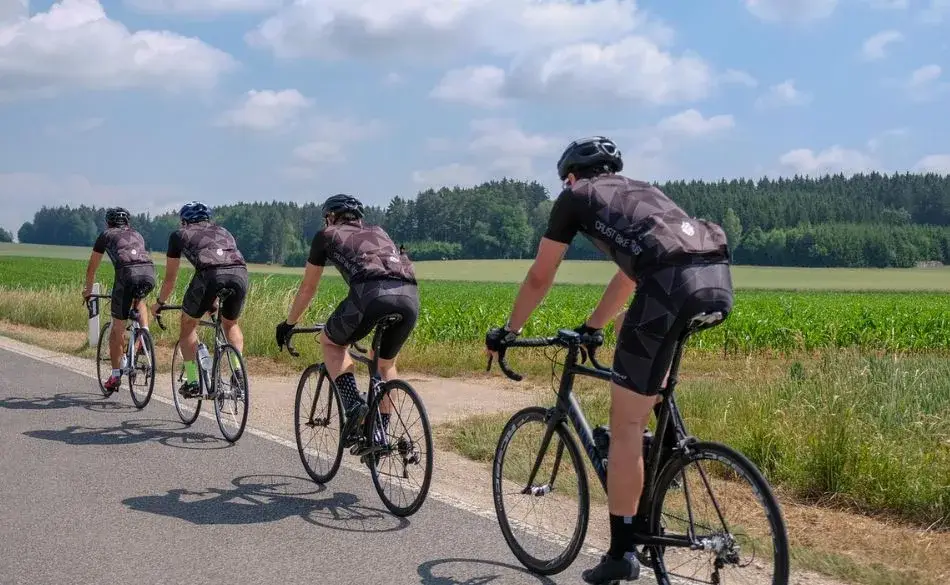
One important distinction: peloton speeds are heavily influenced by drafting. A professional rider sitting comfortably in a peloton of 150 riders at 48 km/h may be producing 250–300 watts — roughly the same power a strong amateur produces solo at 35–38 km/h. The aerodynamic shelter of the group is responsible for most of the speed difference, not raw power. Riding closely behind another cyclist saves 20–40% of the energy required at the same speed; in the middle of a large peloton, savings can reach 50%.
Our guide on typical cycling speeds covers what’s normal at different fitness levels in more detail — including how your Strava average compares to what’s achievable, and why route, wind, and elevation make direct speed comparisons between riders unreliable.
Gradient is the variable that most dramatically affects cycling speed. The physics are unforgiving: every percentage of gradient adds significant resistance that must be overcome with power. At the same time, descending even a gentle gradient produces significant free speed that requires no pedalling effort.
| Terrain / gradient | Typical speed (recreational) | Typical speed (experienced) | Notes |
|---|---|---|---|
| Flat (0–1%) | 25–30 km/h | 33–42 km/h | Aerodynamics dominate at these speeds |
| Gentle incline (3%) | 18–22 km/h | 28–36 km/h | Long Hill-type gradient; noticeable effort increase |
| Moderate climb (5%) | 14–18 km/h | 22–30 km/h | Box Hill-type; most riders feel this clearly |
| Steep climb (8–10%) | 10–14 km/h | 16–22 km/h | Major alpine col gradient; very hard sustained effort |
| Very steep (12–15%+) | 8–12 km/h | 13–18 km/h | Short sharp punchy climbs; Hardknott Pass type |
| Gentle descent (3–5%) | 40–55 km/h | 50–65 km/h | Free speed with no pedalling; gravity-assisted |
| Steep descent (8–12%+) | 55–80 km/h | 70–100+ km/h | Technical; requires confidence and skill to control |
The gradient data above is consistent with CyclingUphill’s real-world measurements: a 3% gradient produces approximately 36 km/h average, 5% approximately 31 km/h, 10% approximately 22 km/h. These numbers assume a reasonably fit recreational cyclist on a standard road bike.
Downhill speeds are limited not by power but by confidence, road conditions, and aerodynamic drag at high velocity. Without pedalling on a 5% descent, most cyclists reach 40–60 km/h through gravity alone. With pedalling on steeper sections, experienced cyclists regularly exceed 80 km/h. In race conditions, the fastest recorded descent in a Tour de France stage was 101.5 km/h by Nils Politt on the Col de Vars in 2019 — the first rider to officially break 100 km/h in the race’s tracked data.
Getting tyre pressure right plays a measurable role in both climbing and descending efficiency. Our road bike tyre pressure guide covers how the right pressure reduces rolling resistance on flat roads and improves control at higher speeds on descents — one of the few free speed gains available to any rider.
Three forces resist forward motion on a bike. Understanding which dominates at different speeds explains why different interventions produce different returns.
Aerodynamic drag is by far the most significant force at typical road cycling speeds. Drag increases with the square of velocity — double your speed and you quadruple the drag force. At 25 km/h, aerodynamic drag accounts for roughly 70% of total resistance. At 40 km/h, it rises to approximately 85–90%. This is why professional riders in a peloton go so much faster than recreational riders at the same power — the group aerodynamics eliminate the dominant resistance force. It also explains why riding position matters enormously: a rider crouched on drop handlebars facing into the wind presents a much smaller frontal area than one riding upright, and the speed difference is significant at the same power output.
Rolling resistance is the friction between tyre and road surface, plus internal friction within the tyre as it deforms. It’s a relatively constant force regardless of speed — unlike aerodynamic drag, it doesn’t increase dramatically as you go faster. At low speeds (below 20 km/h), rolling resistance is proportionally more significant. For most cyclists on smooth tarmac, correct tyre pressure, quality tyres, and clean drivetrain components are the controllable variables.
Gravity is either your best friend or worst enemy depending on direction. On an uphill gradient, gravity adds a significant opposing force — which is why climbing is so much harder than flat riding and why lightweight riders have an advantage on ascents. On descents, gravity provides free propulsive force that requires no power from the rider.
The practical implication: at the speeds most cyclists ride (25–40 km/h), improving aerodynamics produces larger speed gains than improving rolling resistance, and both are more impactful than minor changes to bike weight on flat ground. Weight matters most on climbs. Our guide on cycling cadence covers how pedalling efficiency — a separate variable from raw power — interacts with speed, and why the same watt output at different cadences can feel very different.
The world records for bicycle speed sit in a completely different category to anything achievable on a standard road bike. They require specialised equipment, specific conditions, and in the case of paced records, assistance from a motorised vehicle.
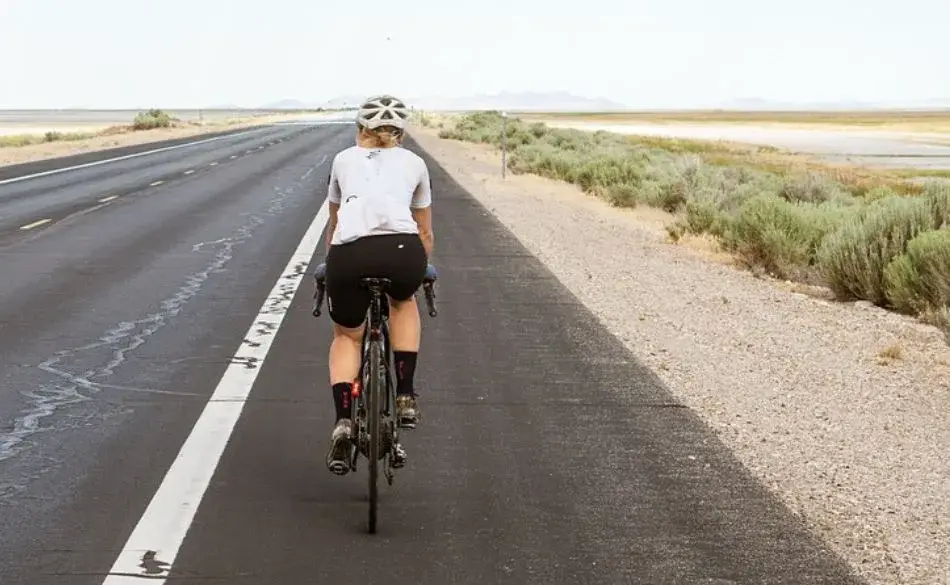
Fastest paced speed (all time): Denise Mueller-Korenek, 296.009 km/h (183.932 mph), Bonneville Salt Flats, Utah, USA — 16 September 2018. Mueller-Korenek achieved this on a custom-built carbon KHS bicycle equipped with gearing so high that she had to be towed to approximately 160 km/h by a purpose-built dragster before casting off the tow rope and pedalling under her own power. The dragster’s aerodynamic fairing eliminated wind resistance, which at this speed would be physically impossible to overcome without assistance. The run required extraordinary technical skill — the slightest error at 296 km/h behind a dragster would be fatal. Mueller-Korenek shattered the previous record of 268.831 km/h held since 1995 by Dutch cyclist Fred Rompelberg.
Fastest unpaced human-powered speed: Todd Reichert, 144.17 km/h (89.59 mph), 17 September 2016. Reichert achieved this on a streamlined recumbent bicycle — an enclosed, aerodynamic vehicle shaped like a bullet. This record represents the fastest speed achievable through pure human power with no motorised pacing assistance. It is fundamentally different to riding a standard upright road bicycle, as the streamlined fairing eliminates virtually all aerodynamic drag.
Fastest downhill on snow: Éric Barone (France), 222 km/h (138 mph), Les Arcs, France, 21 April 2000. Achieved on a specially designed mountain bike on groomed snow with purpose-built aerodynamic equipment.
Fastest Tour de France stage (team time trial): Orica GreenEDGE, 57.7 km/h over 25 km, Stage 4 of the 2013 Tour de France — the fastest stage result of any kind in Tour de France history.
Fastest Tour de France individual time trial: Rohan Dennis, 55.45 km/h over 13.8 km, Stage 1 of the 2015 Tour de France in Utrecht.
Fastest Tour de France downhill: Nils Politt, 101.5 km/h on the Col de Vars during Stage 18 of the 2019 Tour de France — first rider to officially break 100 km/h in the race’s GPS-tracked data.
Our Tour de France average speed guide covers how these peak speeds fit within the context of the race’s full average speed, including how the 2025 Tour became the fastest ever at 42.85 km/h over 3,302 km.
Most cyclists want to go faster. The variables that produce the biggest real-world speed gains are not always the ones that cycling brands most prominently market. In approximate order of impact for a recreational or club cyclist:
1. Fitness and training. The single largest determinant of cycling speed is the power the rider can produce and sustain. A fitter rider produces more watts for longer, and watts directly produce speed. Structured training — intervals, tempo rides, progressive overload — produces larger speed gains than any equipment upgrade. Our road cycling training plan guide covers how to structure training to produce consistent speed improvements. Our FTP test guide covers how to measure the power threshold that determines sustained speed, and how to use it to set training zones.
2. Riding position (aerodynamics). At 35 km/h, roughly 80% of your resistance is aerodynamic. Moving from a relaxed upright position to a lower, more aggressive position on drop handlebars can save several kilometres per hour at the same power output. This requires no new equipment — just flexibility and practice. Lowering the front end of the bike, tucking elbows in, and reducing frontal area are the highest-return aerodynamic changes available to most cyclists without buying new equipment.
3. Drafting. Riding directly behind another cyclist reduces aerodynamic drag by 20–40%. In a group ride or race scenario, this produces some of the largest speed gains available — equivalent to a significant fitness improvement — at zero additional effort. Learning to ride safely in a group, hold a wheel, and take turns at the front is one of the highest-value skills a cyclist can develop for speed.
4. Tyre pressure and rolling resistance. Correctly inflated tyres on a quality road compound reduce rolling resistance meaningfully compared to under-inflated, worn, or inappropriate tyres. This is one of the few free gains available — correct tyre pressure costs nothing and takes two minutes. Quality road tyres also produce measurably lower rolling resistance than cheap or old tyres. Our tyre pressure guide covers the correct pressure by rider weight and tyre width, including why maximum pressure is not always fastest on real road surfaces.
5. Cadence optimisation. Most beginners push too low a cadence (60–70 rpm), producing muscular fatigue before cardiovascular fatigue and limiting sustainable speed. Developing a higher, more efficient cadence (85–100 rpm for most road cyclists) distributes effort across the cardiovascular system rather than the muscles, allowing higher average speeds to be sustained for longer. Our cycling cadence guide covers how to find your optimal cadence and develop it through training.
6. Training volume and consistency. How many hours per week you ride significantly affects aerobic fitness development, and aerobic fitness is the primary driver of sustained speed. Our guide on weekly cycling training hours covers how to progressively build volume in a way that produces fitness without injury or burnout.
7. Equipment. Road bike vs hybrid makes a significant difference (3–5 km/h). Aero wheels, skinsuits, and helmet choice produce real but smaller gains. Carbon vs aluminium frame makes very little difference on flat roads. Bike weight matters most on climbs, where a 1 kg reduction produces meaningful time savings over long ascents.
Our cycling training week structure guide covers how to organise training sessions through the week to develop each of these attributes systematically. Our guide on cycling gear for beginners covers the equipment decisions that actually matter for new cyclists looking to ride faster — a properly fitting road bike with appropriate tyres makes a larger difference than almost any later equipment upgrade.
Get Faster With a Plan That Works
SportCoaching's cycling training plans are built around your current fitness and your specific speed goals — structured sessions that develop the fitness, technique, and power that actually make you faster on the bike.
How fast can you go on a bike?
On flat roads: beginners 15–20 km/h; recreational cyclists 25–32 km/h; experienced club riders 33–42 km/h; professionals 45–50 km/h in a peloton. Downhill, most cyclists reach 50–70 km/h without pedalling on steep gradients. The absolute world record is 296 km/h, requiring a pacing dragster and specially built equipment.
What is the fastest speed ever recorded on a bicycle?
296.009 km/h (183.932 mph) by Denise Mueller-Korenek, Bonneville Salt Flats, 16 September 2018. This was achieved while drafting behind a dragster. The fastest purely human-powered speed (no pacing vehicle) is 144.17 km/h by Todd Reichert in 2016 on a streamlined recumbent bicycle.
How fast can a beginner cyclist go?
Typically 15–20 km/h on flat roads. After a few months of consistent riding this increases to 20–25 km/h. The biggest early gains come from cardiovascular fitness improvements and more efficient pedalling, not equipment changes.
How much does aerodynamics affect cycling speed?
It’s the dominant force above about 25 km/h — at 40 km/h, roughly 80–90% of total resistance is aerodynamic drag. Riding position, drafting behind other riders, and reducing frontal area produce the largest speed gains at typical cycling speeds. Equipment upgrades (aero wheels, skinsuits) produce real but smaller gains.
How fast do cyclists go downhill?
On a gentle 5% gradient without pedalling: 40–60 km/h. On steep descents with pedalling: 70–100+ km/h for experienced riders. The fastest recorded Tour de France descent was 101.5 km/h. The fastest speed cycling downhill on snow is 222 km/h. On a standard road descent, most recreational cyclists reach 50–65 km/h.
Ready to put your training to the test? Here are some upcoming cycling events matched to this article.
Head Coach & Founder, SportCoaching
Graeme is the founder of SportCoaching and has coached more than 750 athletes from 20 countries, from beginners to Olympians, in cycling, running, triathlon, mountain biking, boxing, and skiing. His coaching philosophy and methods form the foundation of SportCoaching's training programs and resources.
No matter your goals, SportCoaching offers tailored training plans to suit your needs. Whether you’re preparing for a race, tackling long distances, or simply improving your fitness, our expert coaches provide structured guidance to help you reach your full potential.
Structured cycling coaching to build power, endurance, and speed.
What’s included
Browse upcoming Australian running, cycling, and triathlon events in one place. Filter by sport, check dates quickly, and plan your training around something real on the calendar.
Choose your plan to get started with personalized training plans designed to help you reach your goals.


Minna Backman
When you’re new, feedback is especially important, and Graeme is highly skilled at both analyzing numbers and understanding the importance of mental strength.