




Find Your Next Cycling Race
Ready to put your training to the test? Here are some upcoming cycling events matched to this article.
 Coach Graeme

Last updated:
The Tour de France is 3,300–3,500 km of racing across mountains, cobbles, and flat plains — sustained over 21 stages in three weeks. The speeds involved are genuinely extraordinary: modern winners average over 40 km/h across the entire race, climbing the same mountain passes that recreational cyclists struggle to ascend at any pace, then sprinting at 70+ km/h in bunch finishes hours later.
This guide covers exactly how fast Tour de France riders go — across the full race, by stage type, historically, and in comparison to what an amateur cyclist can expect to achieve.
Not sure where to start with training?
Tell us your goal and schedule, and we’ll give you clear direction.
No obligation. Quick, practical advice.
Explore our cycling workouts and tips for more helpful articles and resources.
The pace of the Tour de France has increased significantly since the early 2000s, with recent editions consistently faster than the historical average. The table below covers the modern era from 2019 onward, along with key reference points.
| Year | Winner | Average speed | Distance | Notes |
|---|---|---|---|---|
| 2025 | Tadej Pogačar | 42.85 km/h | 3,302 km | Fastest Tour de France ever |
| 2024 | Tadej Pogačar | 41.80 km/h | 3,498 km | Second consecutive win for Pogačar |
| 2023 | Jonas Vingegaard | 41.12 km/h | 3,406 km | One of three fastest ever at time |
| 2022 | Jonas Vingegaard | 42.10 km/h | 3,328 km | Second fastest Tour ever |
| 2021 | Tadej Pogačar | 41.17 km/h | 3,414 km | Pogačar's first Tour win |
| 2020 | Tadej Pogačar | 39.90 km/h | 3,470 km | Four summit finishes |
| 2019 | Egan Bernal | 40.07 km/h | 3,366 km | First Colombian winner |
| 2017 | Chris Froome | 41.01 km/h | 3,540 km | Route favoured speed; multiple TTs |
| Modern era average (1999–2019): ~40.15 km/h | ||||
| All editions average (1903–present): ~34.8 km/h | ||||
| 1924 (slowest) | Ottavio Bottecchia | 23.97 km/h | 5,425 km | Slowest edition; roads unpaved, stages over 400 km |
| 1903 (first) | Maurice Garin | 25.68 km/h | 2,428 km | Only 6 stages; dirt roads throughout |
The 2022 and 2025 editions stand out as the two fastest in history. Both featured relatively shorter courses (under 3,350 km) and dominant winners who produced exceptional performances. The 2025 race in particular was remarkable — Pogačar covered 3,302 km in 76 hours, 0 minutes and 32 seconds, averaging 42.85 km/h across all 21 stages including the mountain stages that would slow most professional riders dramatically.
Note on the Armstrong era: the 1999–2005 editions were statistically faster than anything in the modern era — Armstrong’s 2005 Tour averaged 41.65 km/h over 3,608 km. However, following Armstrong’s doping confession, the UCI stripped his titles from all seven victories, leaving those editions without official winners. Any comparison with the Armstrong era carries this significant asterisk.
The single average speed figure for a Tour de France winner obscures enormous variation across different stage types. A flat sprint stage and a mountain stage finishing atop Alpe d’Huez are almost unrecognisably different events in terms of pace.
| Stage type | Typical average speed | Sprint finish speed | Notes |
|---|---|---|---|
| Flat stages | 45–50 km/h | 65–75 km/h | Peloton aerodynamics keep pace very high throughout |
| Cobbled stages | 38–44 km/h | N/A — no bunch sprint | Rough surface reduces speed; chaos affects tactics |
| Hilly / intermediate stages | 38–44 km/h | 60–70 km/h | Short climbs break up peloton without slowing overall average drastically |
| Mountain stages | 30–38 km/h | N/A — summit or reduced field finish | Major climbs pull average down significantly |
| Major climbs (within stages) | 20–25 km/h | N/A | Steepest sections can drop to 15–18 km/h |
| Descents | 70–90 km/h average | Up to 101.5 km/h recorded | Nils Politt, Col de Vars, 2019 — first rider to break 100 km/h in race data |
| Individual time trials | 50–56 km/h (flat) | N/A | Rohan Dennis, 2015 stage 1: 55.45 km/h over 13.8 km |
| Team time trials | 55–58 km/h | N/A | Orica GreenEDGE, 2013: 57.7 km/h — fastest stage ever in TdF |
The contrast between stage types explains why the overall average speed can sometimes be misleading. A Tour route with multiple summit finishes and few flat stages will produce a lower overall average speed than one with time trials and flat sprint stages — even if the same level of rider quality is present. Chris Froome’s 2017 victory at 41.01 km/h partly reflected a course with two time trials and favourable flat stages; Pogačar’s 2020 win at 39.90 km/h came on a route with four summit finishes.
Fastest flat stage (clean era): Stage 9 of the 2025 Tour de France, won by Tim Merlier from Chinon to Châteauroux — 50.01 km/h over 174 km. The stage was aided by a favourable cross-tailwind and only 1,400 metres of elevation, keeping the peloton together and driving the pace throughout. It was the second fastest stage in Tour history — just 0.35 km/h short of the all-time record.
Fastest flat stage (all time): Stage 4 of the 1999 Tour de France, won by Mario Cipollini — 50.35 km/h over 194.5 km from Laval to Blois. The stage was aided by 15–25 km/h tailwinds, and the peloton covered 52 km in each of the first two hours. However, the 1999 Tour was deeply embedded in the EPO era, and Armstrong — who won that edition’s overall — was subsequently stripped of his title. The result stands in the record books with the doping context firmly attached.
Fastest team time trial: Orica GreenEDGE, Stage 4 of the 2013 Tour de France — 57.7 km/h over 25 km. This remains the fastest stage result of any kind in Tour de France history.
Fastest individual time trial: Rohan Dennis, Stage 1 of the 2015 Tour de France in Utrecht — 55.45 km/h over 13.8 km.
Fastest downhill: Nils Politt on the descent of the Col de Vars during Stage 18 of the 2019 Tour de France — 101.5 km/h, the first rider to officially break the 100 km/h barrier according to the Tour’s official data. The section had a negative 7% gradient.
Fastest Alpe d’Huez ascent: Marco Pantani, 1997 Tour de France — 23.1 km/h. Pogačar set a new fastest time up Mont Ventoux during the 2025 Tour, completing the 20.74 km climb (average 8.31% gradient) in 52 minutes 47 seconds — five minutes faster than his previous record on the same climb.
Slowest Tour de France ever: The 1924 edition, won by Ottavio Bottecchia at 23.97 km/h over 5,425 km. Stages regularly exceeded 400 km on unpaved roads with single-speed or basic gear bicycles — a fundamentally different physical challenge. Many websites incorrectly list 1919 as the slowest; according to Pro Cycling Stats and CyclistsHub, the 1924 edition was slower at 23.97 km/h vs 24.06 km/h in 1919.
The steady increase in Tour de France speeds — from ~28 km/h in the interwar years to 42+ km/h today — reflects a convergence of equipment, science, and race design.
Aerodynamics. Modern road bikes, skinsuits, aero helmets, and deep-section carbon wheels are dramatically more aerodynamic than equipment from even 10–15 years ago. Cycling Weekly’s analysis of the 2025 Tour found that at race speed (42.85 km/h), approximately 90% of a rider’s total effort on flat stages goes to overcoming air resistance. Every marginal aerodynamic gain — frame shape, handlebar position, sock height — compounds across hundreds of kilometres. Pogačar and Vingegaard both rode aero bikes (Colnago Y1RS and Cervelo S5 respectively) exclusively throughout the 2025 race, abandoning their climbing bikes entirely — a data-driven decision that reflects how aerodynamics now dominate even in the mountains.
Nutrition science. BikeRadar’s reporting on the 2023 Tour quoted Australian pro Luke Durbridge: “For me, on-the-bike nutrition has been the greatest evolution since I started racing. In the past, we consumed 60g of carbohydrate an hour.” Modern Tour de France riders now consume 90–120g of carbohydrate per hour during racing — a doubling of fuel intake that was previously thought impossible due to gut limitations. Purpose-built high-carbohydrate formulations have changed how riders fuel stages, reducing the fatigue accumulation across three weeks.
Shorter stages. The average Tour de France stage in 2025 was 157 km — down from 286 km in the 1909–1939 era and 197 km in the 1949–1979 era. Shorter stages allow riders to sustain higher intensities throughout. A 250 km stage forces conservation; a 160 km stage allows sustained racing from the gun. BikeRadar notes this trend: “A shorter course — another trend of recent times — usually results in ever-faster times and average speeds.”
Training and recovery science. Power-based training using precise zones has replaced intuitive training. Riders now know exactly what intensity each day of training should be, and recovery is as structured as the training itself. Our guide on training with power meters covers the same principles that professional teams have used to systematically eliminate wasted training load. Our heart rate zone guide covers the physiological foundations of the intensity management that has compressed the gap between mediocre and exceptional professional performances.
Exogenous ketones. Legal since their introduction around 2012, exogenous ketones provide an additional energy source that riders can use alongside carbohydrates. According to BikeRadar’s reporting citing ketone researcher Professor Kieran Clarke, ketones were first used at the Tour de France and Olympics around 2012. Their widespread adoption in the peloton has added a legal performance tool that contributes to higher sustainable power outputs.
AI and data optimisation. Pogačar’s UAE Team Emirates-XRG team reportedly uses an AI system that analyses data to recommend recovery protocols, training adjustments, and even tyre pressure recommendations. Lotto-Dstny used AI monitoring during the 2024 Tour to identify when rider Victor Campenaerts was showing fatigue markers — they had him ease off, and days later he won a stage. Data-driven decision making at this level eliminates the guesswork that previously cost riders watts and time.
The speed gap between Tour de France professionals and experienced amateur cyclists is significant — but understanding it puts both in perspective.
| Rider type | Typical flat road average | Climbing speed (major col) | Sprint peak |
|---|---|---|---|
| Tour de France pro (overall) | 45–50 km/h (in peloton) | 20–25 km/h | 65–75 km/h |
| Tour de France pro (solo) | 40–45 km/h | 20–25 km/h | 60–70 km/h |
| Strong club cyclist / A-grade | 35–42 km/h | 14–18 km/h | 55–65 km/h |
| Experienced recreational cyclist | 28–35 km/h | 10–15 km/h | 45–55 km/h |
| Casual / beginner cyclist | 18–25 km/h | 8–12 km/h | 35–45 km/h |
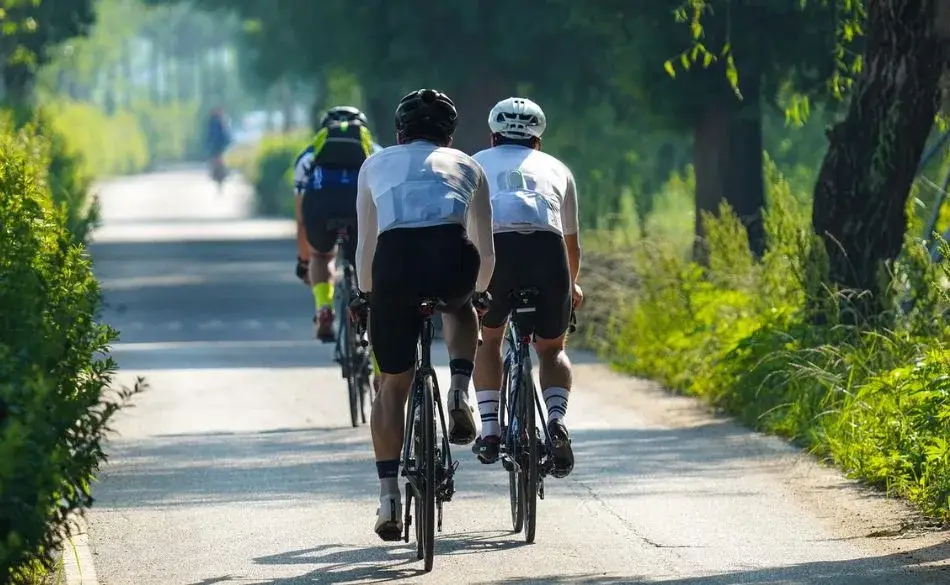
A key factor in professional peloton speeds that no amateur ride replicates is drafting at scale. Riding in the peloton of 150+ riders reduces aerodynamic drag by 30–40% compared to solo riding — allowing riders to sustain much higher speeds for the same power output. A Tour de France rider sitting in the peloton on a flat stage may be producing 250–300 watts while averaging 48 km/h; the same rider solo at the same power would average perhaps 40 km/h.
The climbing comparison is the most humbling for most cyclists. Tour de France professionals climb Alpe d’Huez — a 13.8 km climb averaging 8.1% gradient — in under 40 minutes. Strong amateur cyclists take 60–80 minutes. The difference reflects not just absolute power output but the ability to sustain near-maximum power for extended periods after already having raced for hours.
Our guide on typical cycling speeds covers where recreational and club cyclists typically sit, and what average speeds across different fitness levels look like on standard road rides. Our FTP testing guide covers how to measure the power output that underpins cycling speed — the same metric professionals use to quantify their performance advantage. And our road cycling training plan covers how to systematically build toward faster cycling through structured training.
With all the advantages of technology, nutrition, and training science, why don’t Tour de France riders average 50 km/h? Several factors provide a ceiling:
Mountains. The Tour de France deliberately includes major Alpine and Pyrenean climbs that bring average speeds down to 20–25 km/h for extended periods. This is a course design choice that defines the race’s character. A Tour de France without major mountains would be significantly faster but unrecognisable as the same race.
Fatigue accumulation. Three weeks of racing at high intensity accumulates fatigue that eventually suppresses power output. A professional cyclist can produce higher average power on a single day than they can sustain as an average across 21 days. The later stages of the Tour are generally slower than the early stages, partly reflecting this accumulated fatigue.
Tactics. Not every stage is raced at maximum speed. On stages where the GC contenders agree (implicitly or explicitly) that no time gaps need to be opened, the peloton can cruise at a relatively relaxed pace — sometimes as low as 35–38 km/h — until the final kilometres. This is part of professional racing strategy, not a reflection of the riders’ maximum capability.
Weather. Crosswinds, headwinds, rain, extreme heat, and cold all affect speed. The 2025 Tour’s exceptional average speed was partly aided by favourable conditions on key stages. A Tour with persistent headwinds and rain would produce materially lower average speeds from the same riders on the same course.
Understanding these factors — and the training principles behind professional speed — is directly applicable to amateur riding. Our cycling training week structure guide covers how to balance intensity, volume, and recovery in the way professionals do at scale. Our cadence guide covers one of the fundamental efficiency variables that professionals optimise and recreational riders often overlook. And our guide on weekly training hours covers how training volume — one of the largest gaps between amateur and professional cyclists — can be managed effectively within real-life constraints.
Train Smarter, Ride Faster
You won't average 42 km/h over three weeks — but SportCoaching's cycling training plans are built on the same principles professional teams use: structured intensity, progressive overload, and properly managed recovery. The gap to your best cycling is smaller than you think.
What is the average speed of the Tour de France?
Modern winners average 40–43 km/h over the full race. The 2025 edition (Pogačar) was the fastest ever at 42.85 km/h over 3,302 km. The all-editions average since 1903 is approximately 34.8 km/h.
What is the fastest Tour de France ever?
The 2025 Tour de France at 42.85 km/h — Tadej Pogačar over 3,302 km. Second fastest is 2022 at 42.10 km/h. The Armstrong-era editions (1999–2005) were statistically faster but have no official winners following doping disqualification.
How fast do Tour de France riders go on flat stages?
The peloton averages 45–50 km/h on flat stages. Sprint finishes reach 65–75 km/h. The fastest flat stage in the clean era was Stage 9 of the 2025 Tour — Tim Merlier at 50.01 km/h over 174 km.
How fast do Tour de France riders climb mountains?
Lead climbers average 20–25 km/h on major cols. Alpe d’Huez record: Marco Pantani 1997, 23.1 km/h. Steepest gradient sections can slow riders to 15–18 km/h. Descents can exceed 100 km/h.
How does Tour de France speed compare to amateur cyclists?
Tour de France professionals average 45–50 km/h in the peloton on flat stages; experienced amateurs average 28–35 km/h. On climbs, pros hold 20–25 km/h where strong amateurs manage 14–18 km/h. The peloton’s drafting advantage, professional power output, and race-specific nutrition account for most of the gap.
Ready to put your training to the test? Here are some upcoming cycling events matched to this article.
Head Coach & Founder, SportCoaching
Graeme is the founder of SportCoaching and has coached more than 750 athletes from 20 countries, from beginners to Olympians, in cycling, running, triathlon, mountain biking, boxing, and skiing. His coaching philosophy and methods form the foundation of SportCoaching's training programs and resources.
No matter your goals, SportCoaching offers tailored training plans to suit your needs. Whether you’re preparing for a race, tackling long distances, or simply improving your fitness, our expert coaches provide structured guidance to help you reach your full potential.
Structured cycling coaching to build power, endurance, and speed.
What’s included
Browse upcoming Australian running, cycling, and triathlon events in one place. Filter by sport, check dates quickly, and plan your training around something real on the calendar.
Choose your plan to get started with personalized training plans designed to help you reach your goals.


Minna Backman
When you’re new, feedback is especially important, and Graeme is highly skilled at both analyzing numbers and understanding the importance of mental strength.