How Indoor Rowing Supports Weight Loss in Real Terms
Indoor rowing supports weight loss by increasing total energy use while keeping physical stress manageable. In simple terms, it allows you to work hard enough to create change without placing unnecessary strain on your body. This balance is important, because weight loss depends more on what you can sustain than on what you can tolerate once or twice.
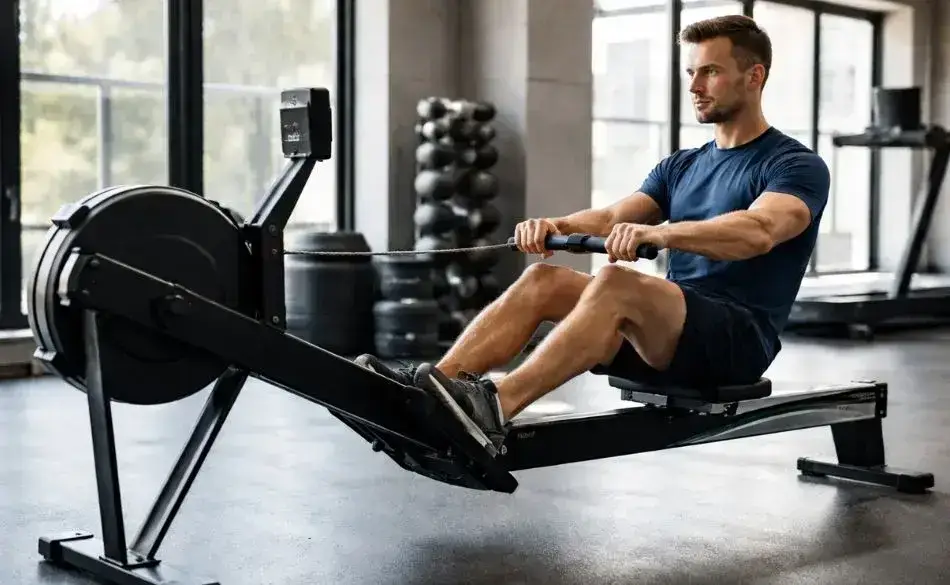
At the centre of this is how rowing uses the body. Every stroke begins with the legs, moves through the hips, and finishes with the upper body and arms. Because so many muscles are involved at once, energy demand rises even when pace stays controlled. As a result, rowing often feels purposeful rather than frantic. You are not chasing speed or impact, but maintaining steady effort across the whole body.
Just as importantly, rowing makes it easy to regulate intensity. You can sit just below the point where breathing becomes uncomfortable and hold that effort for extended periods. This kind of steady aerobic work underpins many effective endurance approaches, which is explored further in our guide to cardiovascular fitness workouts. From a weight-loss perspective, this matters. Sessions that feel “hard but manageable” are far more repeatable than workouts that leave you exhausted.
This is where low impact becomes a practical advantage rather than a selling point. Because rowing avoids repeated pounding through the feet and joints, recovery demands are lower than with many forms of cardio. That does not mean rowing is easy, but it does mean you are more likely to tolerate frequent training. When you can train four or five days a week without soreness accumulating, total weekly energy use becomes more meaningful.
I have seen this play out with clients who turned to rowing after running became unreliable due to joint pain. By keeping sessions steady and gradually increasing time rather than intensity, they were able to train most days without setbacks. The weight change was slow, but it was predictable and easier to maintain.
Taken together, indoor rowing supports weight loss because it allows consistent training, controlled effort, and whole-body involvement. Those fundamentals matter far more than chasing extremes or short-term results.


Why Technique and Efficiency Matter More Than Speed
When people begin using indoor rowing for weight loss, the natural tendency is to focus on rowing faster or pushing harder. While that instinct makes sense, technique and efficiency usually have a greater influence on results. How you move on the rower shapes how much useful work you can sustain, how quickly fatigue builds, and whether training feels manageable enough to repeat week after week.
At a basic level, good rowing technique spreads effort across the body. The legs initiate the stroke, the hips transfer force, and the upper body finishes it. When this sequence is rushed or out of order, smaller muscle groups take over too early. As a result, the arms or lower back often fatigue before the larger muscles have been properly used. The session may feel hard, but it is rarely productive in a way that supports consistent weight loss.
Efficiency also affects how your breathing and heart rate respond. With a smooth stroke and a stable rhythm, breathing tends to settle into a predictable pattern that matches the effort being applied. This makes it easier to hold a moderate intensity for longer periods. From a weight-loss perspective, that ability to stay steady matters. Longer, controlled sessions usually contribute more to weekly energy use than short bursts followed by long recovery.
Another consideration is how hard the session feels subjectively. Poor technique often makes rowing feel chaotic or uncomfortable, even when the actual workload is modest. Over time, that feeling discourages consistency. Efficient movement, on the other hand, tends to make rowing feel purposeful. You finish feeling worked, but not depleted, which supports regular training.
Technique does not need to be perfect to be effective. Small changes often make a noticeable difference. Slightly lowering stroke rate, focusing on pushing through the legs, and keeping the upper body relaxed can improve efficiency quickly. In the context of weight loss, speed itself is largely irrelevant. What matters is moving well enough that rowing remains something you can use consistently rather than something you need to recover from.


How Often and How Long You Should Row for Weight Loss
When using indoor rowing for weight loss, frequency and duration tend to matter more than how hard any single session feels. The aim is to build enough weekly training volume to support gradual change without overwhelming your recovery or motivation. In practice, that balance usually sits somewhere in the middle rather than at either extreme.
For most people, a sensible starting point is three to four rowing sessions per week. This frequency helps establish routine while leaving room for rest and other activities. As consistency improves, adding an extra session later is often more effective than trying to make individual workouts longer or more intense. The body adapts better to steady increases in exposure than sudden jumps in difficulty.
Session length does not need to be excessive to be useful. Many assume weight loss requires long, exhausting workouts, but that approach is rarely sustainable. For beginners, 20 to 30 minutes of steady rowing is enough to create a meaningful training stimulus. Over time, extending sessions toward 40 or 50 minutes can increase total weekly energy use without dramatically increasing fatigue, provided intensity remains controlled.
Intensity should support duration rather than compete with it. Most rowing aimed at weight loss works best at a pace where breathing is elevated but still manageable. You should be able to maintain effort without constantly watching the clock. If sessions consistently feel overwhelming, it is usually a sign that intensity is too high to repeat often.
Recovery between sessions also deserves attention. Although rowing is low impact, it still places demands on muscles and connective tissue. Spacing sessions across the week helps maintain quality and reduces the risk of fatigue accumulating. In real terms, weight loss comes from stacking manageable sessions over time. When rowing fits into your week without disrupting everything else, it becomes a tool you can rely on rather than a routine you eventually abandon.


How Intensity Influences Fat Loss Without Needing Extremes
Once frequency and duration are established, intensity becomes the next piece to consider. This is often where confusion creeps in, because intensity is commonly presented as the main driver of fat loss. In practice, intensity only helps when it supports consistency and allows you to accumulate enough work across the week.
For indoor rowing, most weight-loss work tends to sit at a moderate intensity. This is the effort level where breathing is clearly elevated and focus is required, but the pace still feels controlled. Physiologically, this kind of rowing relies on a mix of fat and carbohydrate for fuel. More importantly, it can be sustained long enough to contribute meaningfully to total weekly energy use without creating excessive fatigue.
Higher-intensity rowing does have a place, but it is not essential. Short interval sessions can improve fitness and add variety, which some people enjoy. However, they also increase recovery demands. When hard sessions are used too often, they frequently lead to skipped workouts later in the week. When that happens, overall training volume drops, and progress slows despite good intentions. This pattern is especially common among people who feel every session must be pushed to feel worthwhile.
Another consideration is how intensity affects appetite and recovery outside the session itself. Very hard rowing efforts can suppress appetite briefly, but they often lead to increased hunger later in the day or the following day. For some people, this makes managing overall food intake more difficult rather than easier. Moderate sessions tend to produce more predictable recovery and appetite responses, which helps support sensible eating habits without strict rules.
Intensity also needs to match your starting point. Someone new to rowing, or returning after time away, will often make progress at relatively low effort levels. As fitness improves, intensity can rise gradually without changing the basic structure of sessions. The aim is not to chase exhaustion, but to apply enough stress to stimulate adaptation while remaining repeatable.


Indoor Rowing Compared With Other Common Cardio Options
When considering indoor rowing for weight loss, it helps to place it alongside other common cardio options rather than viewing it in isolation. No single exercise method is universally better than the rest. Instead, effectiveness depends on how well a particular option fits your body, your schedule, and your ability to train consistently over time.
Indoor rowing stands out because it combines full-body muscle involvement with relatively low impact. Unlike running, there is no repeated foot strike, which reduces joint loading while still allowing heart rate to rise quickly. Compared with cycling, rowing spreads effort across both the lower and upper body. As a result, sessions can feel demanding without requiring high speed, steep resistance, or long durations.
Running remains popular because it is simple and time-efficient. However, the higher impact means recovery often becomes a limiting factor, particularly for people with joint sensitivity or higher body weight. If you want a more detailed breakdown of how these two options compare in practice, this guide on rowing vs running explores the differences in impact, sustainability, and training demands in more depth. Cycling, by contrast, is joint-friendly and well suited to longer sessions, but because the upper body contributes less, some people need more time to achieve the same overall training load.
Machines such as ellipticals tend to sit somewhere in between. They are low impact and accessible, which can be helpful for some users. At the same time, effort control is often less precise, and it is easy to drift through sessions without a clear sense of intensity, which can reduce their long-term usefulness.
From a coaching perspective, the most effective option is usually the one you can return to week after week without friction. Rather than focusing on theoretical calorie numbers, the comparison below highlights practical differences that influence consistency, recovery, and sustainability.
👉 Swipe to view full table
| Category | Indoor Rowing | Running | Cycling | Elliptical |
|---|---|---|---|---|
| Muscle Involvement | Full body: legs, hips, back, arms, and core contribute each stroke. | Mainly lower body with stabilising core involvement. | Lower body dominant with limited upper-body contribution. | Lower body with light upper-body assistance depending on design. |
| Impact on Joints | Low impact with minimal joint loading. | Higher impact due to repeated ground contact. | Low impact and joint friendly. | Low impact and generally well tolerated. |
| Intensity Control | Very precise control through stroke rate and power. | Controlled mainly by pace and terrain. | Adjusted through resistance and cadence. | Often less precise, especially at lower settings. |
| Session Repeatability | High when technique and intensity are managed well. | Moderate, often limited by impact and recovery needs. | High, particularly for steady endurance riding. | Moderate to high depending on effort and engagement. |
| Best Fit For | Those seeking full-body work with low joint stress. | People who enjoy simplicity and outdoor movement. | Those who prefer longer, steady endurance sessions. | People prioritising very low joint stress or variety. |


Common Mistakes That Limit Weight Loss on the Rower
Indoor rowing can be an effective tool for weight loss, but progress is often limited by how sessions are approached rather than by the equipment itself. In most cases, setbacks come from reasonable intentions that gradually make training harder to sustain. Recognising these patterns early helps prevent frustration and stalled progress.
One frequent issue is rowing too hard too often. It is easy to assume that if a session is not exhausting, it is not worthwhile. Over time, however, constant high intensity increases fatigue faster than fitness improves. As fatigue builds, sessions are more likely to be shortened, skipped, or followed by extended breaks. Since weight loss relies on consistency, this pattern tends to undermine results rather than accelerate them.
Pacing is another area where problems commonly arise. Starting a session aggressively and fading quickly can feel productive in the moment, but it usually limits total work. By contrast, a steadier approach allows effort to be maintained for longer and sessions to end feeling controlled. From a coaching perspective, even pacing almost always supports better long-term outcomes than repeated surges.
Technique is also often overlooked, particularly as fatigue sets in. When form breaks down, effort shifts toward smaller muscle groups, especially the arms and lower back. This increases local fatigue without improving the overall training effect. Over time, discomfort or recurring niggles may appear, further disrupting consistency. Small technical adjustments early on can prevent these issues from accumulating.
Some people also rely too heavily on the performance monitor. While data can be useful, focusing excessively on pace or calorie readouts can distract from how the session actually feels. Calorie estimates on rowing machines are imprecise and vary widely between individuals. Using breathing, rhythm, and perceived effort as primary guides often leads to more consistent training habits.
Finally, rowing in isolation without considering the rest of your week can be limiting. If sessions clash with work demands, family responsibilities, or other physical activity, they become difficult to maintain. In practical terms, the rower works best when sessions are paced sensibly, technique is respected, and training fits naturally into your routine. Avoiding these common pitfalls helps turn rowing into a reliable long-term tool rather than a short-term experiment.


What Realistic Progress Looks Like Over Time
One reason people move away from indoor rowing for weight loss is unrealistic expectations about how quickly results should appear. In reality, weight loss rarely follows a straight line, and rowing is no exception. Understanding what progress typically looks like helps you stay patient and avoids unnecessary changes that disrupt consistency.
In the early weeks, improvements are often subtle. You might notice that sessions feel more controlled, breathing settles sooner, or you can row slightly longer at the same effort. While these changes may not show up on the scale immediately, they are meaningful. Early progress is usually driven by better coordination, cardiovascular adaptation, and growing tolerance to regular training rather than fat loss alone.
As consistency builds over several weeks, changes often become more noticeable. Clothing may begin to fit differently, daily energy levels can improve, and body composition may gradually shift. When weight changes do occur, they tend to happen slowly rather than all at once. Importantly, this slower pace is not a drawback. Gradual change is more likely to reflect sustainable fat loss than short-term fluctuations in water or glycogen.
It is also normal for progress to feel uneven. Some weeks show clear signs of change, while others appear flat. Factors such as sleep, stress, hydration, and nutrition all influence short-term weight readings. For this reason, judging progress solely by the scale can be misleading. Looking at trends over several weeks usually provides a more accurate picture than reacting to daily numbers.
Rowing performance itself can offer useful feedback. Being able to complete sessions with less perceived effort, maintain steadier pacing, or recover more quickly between workouts often signals positive adaptation. These improvements suggest your body is becoming more efficient, which supports higher training volume over time. That increase in sustainable volume is what ultimately contributes to weight loss.
From a coaching perspective, the clearest sign of progress is steady adherence rather than rapid change. When rowing becomes part of your normal routine instead of a temporary project, results tend to follow. Indoor rowing supports weight loss best when expectations are realistic, progress is viewed over time, and short-term fluctuations are treated as normal rather than as failures.


How Indoor Rowing Fits With Nutrition and Recovery
Indoor rowing can support weight loss effectively, but its impact depends on how it fits alongside nutrition and recovery. Training rarely drives change on its own. Instead, results tend to reflect how rowing interacts with what you eat, how you sleep, and how well your body recovers between sessions.
From a nutrition standpoint, rowing does not require extreme dietary changes. In fact, overly restrictive eating often undermines progress by reducing energy, increasing fatigue, and making training feel harder than it needs to be. When rowing sessions are regular and moderately intense, appetite signals often become more predictable over time. This can make it easier to eat in a way that supports training without relying on rigid rules. For most people, focusing on regular meals, adequate protein, and enough carbohydrate to fuel sessions is more effective than chasing aggressive restriction.
Timing also matters, though not in a complicated way. You do not need to row fasted or manipulate meals aggressively to lose weight. What matters more is feeling fueled enough to row with control and consistency. If sessions consistently feel flat or excessively difficult, it is often a sign that overall intake is too low rather than that training needs to be harder.
Recovery plays a similar role. Although rowing is low impact, it still places demands on muscles, connective tissue, and the nervous system. Poor sleep or high life stress can amplify fatigue from otherwise reasonable sessions. When recovery is compromised, people often compensate by training harder less often, which reduces total weekly volume. By contrast, adequate sleep and sensible spacing between sessions make it easier to train frequently at a manageable effort.
Rowing can also complement other activity rather than replace it. Walking, light strength work, or mobility sessions often support recovery instead of interfering with it. When these elements work together, rowing becomes part of a broader routine rather than a standalone solution. More broadly, regular physical activity supports a wide range of outcomes beyond weight change, which we outline in our overview of the benefits of exercise.


Who Indoor Rowing Is Most Suitable For and Who Should Be Cautious
Indoor rowing can be an effective option for weight loss, but, like any form of exercise, it tends to suit some people better than others. Understanding where rowing fits best helps set realistic expectations and reduces the risk of frustration or unnecessary discomfort.
Rowing often works well for people who value structure and control in their training. Because the machine provides immediate feedback on pace, effort, and rhythm, it suits those who prefer clear boundaries around sessions. In addition, it is particularly well suited to people looking for a low-impact form of cardio. For individuals with joint sensitivity, a history of running-related issues, or higher body weight, rowing offers a way to train the cardiovascular system without repeated impact through the legs. This often makes consistent training more achievable.
People with limited time may also find rowing practical. Because large muscle groups are involved, heart rate rises relatively quickly, even in shorter sessions. As a result, a well-paced 25–30 minute row can still contribute meaningfully to weekly training volume. This efficiency makes rowing easier to fit around work, family, and other commitments.
At the same time, rowing may require extra care for some individuals. Those with existing lower back issues, hip restrictions, or shoulder problems should approach rowing cautiously, particularly if the movement pattern is unfamiliar. Poor posture or aggressive pulling can place unnecessary stress on these areas. In many cases, this does not mean rowing should be avoided altogether, but that conservative intensity and technique guidance are important starting points.
Motivation style also plays a role. People who enjoy outdoor movement or social exercise sometimes struggle with the repetitive nature of indoor rowing. For them, rowing often works best as one part of a broader routine rather than as the sole form of activity.


Using Indoor Rowing for Sustainable Weight Loss
Indoor rowing can support weight loss effectively when it is used with realistic expectations and in the right context. Its value does not come from extremes, novelty, or chasing short-term fatigue. Rather, it comes from how well it allows you to train consistently, manage effort, and recover well enough to keep returning to sessions.
When you step back and look across the key elements, a clear pattern emerges. Rowing works best when sessions are paced sensibly, technique is respected, and intensity is kept at a level you can repeat week after week. Over time, moderate and steady work accumulates far more benefit than sporadic hard efforts. This holds true whether you are new to structured exercise or returning after time away.
At the same time, rowing does not operate in isolation. Nutrition that supports training, adequate sleep, and realistic scheduling all influence whether rowing becomes a sustainable habit or a short-lived experiment. When these pieces are aligned, rowing tends to feel absorbable rather than draining. That sense of manageability often separates steady progress from stalled efforts, and it reflects broader principles that apply across many forms of training, which we cover throughout our fitness articles.
It is also worth remembering that weight loss rarely unfolds in a straight line. Improvements in fitness, movement efficiency, and daily energy often appear before visible changes on the scale. These early adaptations matter because they make higher training volume possible later. Over time, that increased capacity supports gradual, sustainable change.
Indoor rowing can support weight loss, but results depend on how it fits alongside your lifestyle, recovery, and other activity. Without guidance, it’s easy to train inconsistently or apply effort in ways that are hard to sustain.
Through our personalised coaching approach, we help people make sense of their training as a whole — placing workouts in context so progress feels manageable rather than forced. If you’re unsure where to start, you can learn more about how we work here: Getting Started with SportCoaching .
Learn More →