



Quick Answer
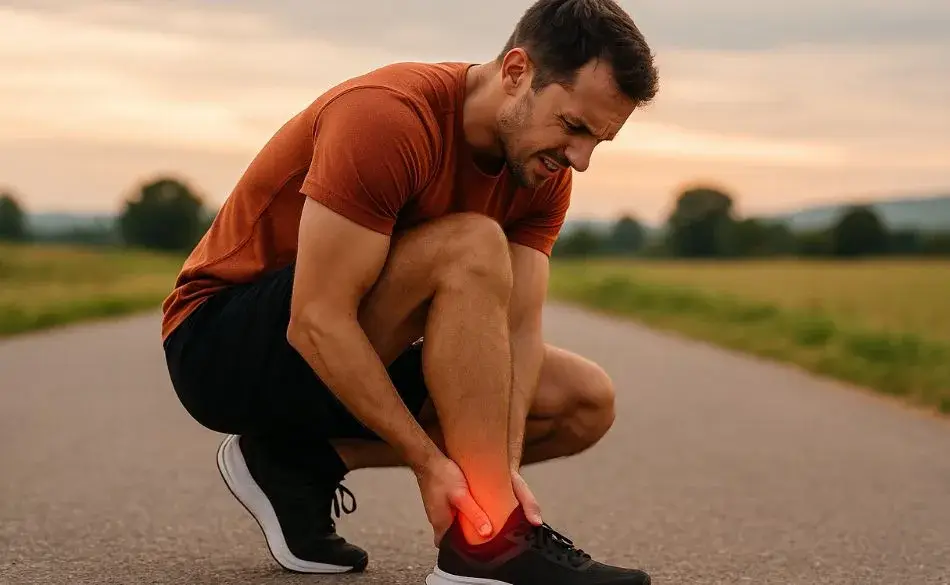
Achilles soreness when running is almost always caused by overload — mileage increased too fast, hills or speed work added without adaptation time, or shoe heel-drop changed. Two types: mid-portion (2–6cm above heel, most common) treated with eccentric heel drops off a step; insertional (at the heel bone) treated with flat-ground eccentric exercises. The gold-standard treatment — the Alfredson eccentric protocol (3×15 reps twice daily, 12 weeks) — produces 80%+ success rates for mid-portion cases. Most runners can continue easy running during rehab if pain is below 3/10 and resolves within 24 hours.What Is Achilles Tendinopathy? (And Why "Tendinitis" Is the Wrong Term)
Most runners call it “Achilles tendinitis” — but the research established decades ago that the word “tendinitis” (implying inflammation) is inaccurate for chronic tendon pain. Studies consistently show that chronically painful Achilles tendons do not contain the inflammatory cells associated with tendinitis. What they do contain is degenerated collagen — disorganised, thickened tendon fibres that have failed to properly remodel in response to load. The correct term is tendinopathy, and it matters because it explains why anti-inflammatory drugs (NSAIDs like ibuprofen) have limited effect on Achilles pain that has been present for more than a few days — there is no active inflammation to suppress.
The tendon fails to adapt to load for a predictable reason: the area of the Achilles with the poorest blood supply — approximately 2–6cm above the heel bone — is also the area most commonly injured. Low blood flow means slow adaptation and slow recovery. When training load exceeds the tendon’s current capacity, micro-damage accumulates faster than the tendon can repair itself, producing the characteristic pain pattern of Achilles tendinopathy.
The Two Types: Mid-Portion vs Insertional — Why It Matters for Treatment
This distinction is the single most important thing most “sore Achilles” articles miss, and getting it wrong leads to the wrong treatment — which can actively worsen insertional tendinopathy.
| Feature | Mid-portion tendinopathy | Insertional tendinopathy |
|---|---|---|
| Location | 2–6cm above the heel bone — often a thickened nodule you can feel | At or very close to where the tendon meets the heel bone |
| Common in | Most runners; the more common of the two types | Older runners, those with a prominent heel bone (Haglund deformity) |
| Blood supply | Poorest — explains slow healing | Slightly better — but bursa complications common |
| Pain with dorsiflexion | Usually not | Often — stretching the tendon over the heel bone aggravates it |
| Eccentric exercise (step) | Highly effective — 80%+ success rate | Can worsen it — compresses tendon against heel bone |
| Eccentric exercise (flat) | Less optimal but acceptable | The recommended modification — avoids painful compression |
| Research success rate | 80%+ for eccentric protocol | ~32% — often needs additional treatment |
How to tell which one you have: Press along the tendon. If the most tender point is 2–6cm above the heel bone and you can feel a thickening there, it’s mid-portion. If the most tender spot is right at the heel bone — where the tendon meets the bone — it’s insertional. With insertional tendinopathy, stretching the calf with the foot dorsiflexed (toes pulled upward) typically reproduces or worsens the pain because it compresses the tendon against the heel. With mid-portion tendinopathy, that same stretch is usually tolerable.
What Causes a Sore Achilles When Running
Achilles tendinopathy is an overuse injury — the tendon was loaded beyond its current capacity, repeatedly, without sufficient recovery. The specific triggers follow a consistent pattern:
Mileage increased too quickly. The most common cause. The Achilles tendon adapts more slowly than cardiovascular fitness or muscle — a runner can feel aerobically ready for more mileage before the tendon has adapted to the load. The commonly cited 10% rule (increase weekly mileage by no more than 10% per week) exists specifically because tendon adaptation lags behind aerobic adaptation. A runner going from 30km to 50km per week over four weeks is applying far more load than the tendon can remodel.
Adding hills or speed work without adaptation. Uphill running significantly increases the load on the Achilles because the push-off phase generates greater tendon force on a gradient. Speed work (intervals, tempo runs) produces higher peak forces per stride than easy running. Adding either to training too quickly after a period of steady mileage is a common trigger. Our guide to interval training covers how to introduce speed work progressively — the same principles apply to managing Achilles load.
Shoe heel-drop change. A shoe’s heel-to-toe drop is the height difference between the heel and forefoot. Moving from a 10–12mm drop shoe to a 4–6mm or zero-drop shoe increases the range of motion required from the Achilles on every stride. This is not inherently harmful, but rapid transitions — switching shoe types in a week rather than over months — frequently trigger tendinopathy. The tendon needs time to adapt to the new demand.
Return to running after a break. After any period of reduced activity (illness, holiday, injury), the tendon loses load tolerance faster than fitness. Runners who return to previous mileage immediately after a two or three-week break routinely develop Achilles problems within the following two to four weeks.
Tight or weak calf complex. The Achilles connects to both the gastrocnemius (superficial calf, loaded with a straight knee) and the soleus (deep calf, loaded with a bent knee). When these muscles are chronically tight, they transfer increased force to the tendon. When they are weak, the tendon compensates for the reduced muscular absorption. Both create Achilles overload. This is why calf strengthening — not just stretching — is central to treatment and prevention.
Symptoms and Pain Pattern: What's Normal, What's Not
Achilles tendinopathy has a characteristic pain pattern that distinguishes it from other causes of heel and ankle pain:
Morning stiffness that eases with movement. The most universal symptom. Tendons receive less blood flow than muscles, so stiffness accumulates overnight. The first few minutes of walking or running feel worse, then the pain partially or fully resolves as the tendon warms up. This “warm-up phenomenon” is strongly diagnostic for tendinopathy.
Pain during the first kilometre that eases. The running equivalent of morning stiffness. Many runners with early Achilles tendinopathy experience this and interpret it as the tendon “loosening up” — which it is, temporarily. The problem is that running through this pattern without addressing load allows the underlying degeneration to progress.
Pain after sitting for extended periods. After being sedentary for an hour or more, standing up produces the same stiffening effect as morning — a dull ache that eases after a minute of movement.
Pain that returns after running stops. The post-run soreness that sets in 30–60 minutes after finishing is another characteristic pattern. Many runners feel fine during the run but notice a dull ache in the evening — this is a sign the tendon was overloaded during the session.
Red flags requiring immediate medical attention: A sudden pop or snap during activity, inability to bear weight on the affected leg, inability to rise on the toes, or severe bruising and swelling. These indicate a possible tendon rupture — a completely different and serious injury requiring urgent assessment.
Can You Keep Running With a Sore Achilles?
This is the question most runners actually want answered, and most articles give vague non-answers. Here is a practical framework based on the research:
| Pain pattern | Decision | Modification |
|---|---|---|
| Mild stiffness first km, fully resolves, no soreness within 24 hrs after run | Can run with load reduction | Cut mileage 30–50%, no hills, no speed, easy pace only |
| Pain 2/10 or less during run, resolves during warm-up, back to baseline within 24 hrs | Can run with load reduction | Easy pace only, reduce mileage, add eccentric protocol |
| Pain 3/10 or higher during run, or persists throughout run without warming up | Stop running temporarily | Cross-train (cycling, swimming), begin eccentric protocol immediately |
| Pain still elevated 24+ hours after running | Stop running | Rest from running, begin eccentric protocol, see physiotherapist |
| Pain worsening session-to-session despite load reduction | Stop running, seek assessment | Physiotherapist or sports medicine review required |
The key principle: a tendon that is painful at 2/10 or less and returns to baseline within 24 hours can tolerate loading — in fact, graduated loading is part of the treatment. A tendon that is being pushed beyond its tolerance (pain above 3/10, prolonged post-run soreness) will not adapt — it will continue to degrade. Running through pain above this threshold is one of the primary reasons Achilles tendinopathy becomes chronic.
For runners who need to maintain cardiovascular fitness during recovery, slow jogging or brisk walking at genuinely easy effort places significantly less tendon load than faster running. Cycling is the best cross-training substitute — it maintains aerobic fitness while keeping Achilles load minimal, particularly relevant for runners whose training volume makes complete rest impractical.
The Eccentric Heel Drop Protocol: The Evidence-Based Treatment
The Alfredson eccentric heel drop protocol is the most researched treatment for Achilles tendinopathy and remains the first-line recommendation from physiotherapists and sports medicine physicians. A landmark 1998 study by Alfredson et al. took 30 runners who had not responded to any previous treatment (rest, NSAIDs, physical therapy, orthotics) and randomised them to either eccentric calf strengthening or surgical repair. Fifteen of the 15 in the eccentric group returned to previous running levels within 12 weeks. The surgical group outcomes were similar — but the eccentric exercise protocol was non-invasive and produced equivalent results.
A subsequent study by the same group confirmed the mechanism: it wasn’t simply strength gains that drove recovery. Runners assigned concentric calf raises (going up only) showed significantly lower return to activity rates than those doing eccentric work (going down only). Eccentric loading triggers collagen remodelling — the disorganised tendon fibres gradually realign into stronger, more functional tissue. This remodelling is what resolves the pain and restores load tolerance, and it only occurs with this specific type of loading.
Our dedicated guide on eccentric heel drops for runners covers the full Alfredson protocol, progression, and common mistakes in detail. The summary:
Mid-portion tendinopathy — standard eccentric heel drop off a step:
Stand on a step with the heel hanging over the edge. Use both feet to rise onto your toes. Shift weight to the affected leg. Slowly lower the heel below the level of the step over 3–5 seconds. Use the good leg to return to the starting position. 3 sets of 15 repetitions, twice daily, for 12 weeks. Both straight-knee (loads gastrocnemius) and bent-knee (loads soleus) versions — both are necessary. Pain during the exercise is normal and expected; discontinue only if pain becomes severe.
Insertional tendinopathy — flat eccentric heel drop:
Stand on flat ground (no step). Rise onto both toes. Shift weight to the affected leg. Slowly lower the heel to the ground over 3–5 seconds. Use both feet to return to start. 3 sets of 15, twice daily, 12 weeks. Avoid lowering the heel below neutral (no step) — this compresses the tendon against the heel bone and aggravates insertional pain.
Common mistakes that reduce effectiveness: Lowering too fast (the eccentric phase must be 3–5 seconds — rushing destroys the remodelling stimulus). Doing only straight-knee (misses the soleus, which contributes significantly to Achilles load). Starting at full volume immediately (begin with 2 sets and assess 24–48 hour response before progressing). Stopping at week 6 when pain reduces (12 weeks of consistent loading is required for full tendon remodelling, even if pain improves earlier).
Return to Running: A Practical Week-by-Week Framework
Most articles say “return gradually” without specifying what that means. Here is a practical framework based on the 24-hour pain rule and progressive loading principles:
| Week | Running | Condition to progress |
|---|---|---|
| 1–2 | No running. Walk, cycle, swim. Begin eccentric protocol. | Walking pain-free before introducing any running |
| 3–4 | Walk-run intervals: 1 min run / 2 min walk × 10. Every other day. | Pain ≤2/10 during session, back to baseline within 24 hrs |
| 5–6 | 20–25 min easy continuous run. Every other day. | Same 24-hour rule. Continue eccentric protocol throughout. |
| 7–8 | 30–35 min easy run. Can run on consecutive days if 24-hr rule met. | No pain increase over multiple consecutive days |
| 9–10 | 35–45 min easy runs. Begin reintroducing gentle hills. | Hill introduction on one session only; assess 48-hour response |
| 11–12 | Building toward previous mileage at easy pace. No speed work yet. | Consistent 24-hour baseline over 2+ weeks |
| 13+ | Introduce speed work gradually (one session/week). Maintain eccentric maintenance protocol. | No pain flare-up with introduction of faster running |
Two rules that override this framework: if pain rises above 3/10 at any point, return to the previous stage. If pain is still elevated 24 hours after a session, that session was too much — reduce the next one. Runners who try to accelerate through this progression by “testing” their readiness with hard sessions typically extend their recovery by weeks. Even short daily runs like a 3km daily habit should be assessed through the 24-hour pain rule before being reintroduced — what feels minor the same day may show up as elevated soreness the following morning.
The eccentric protocol continues throughout return to running and ideally becomes a permanent maintenance habit (2–3 sets twice per week) after full recovery. Our guide on running frequency covers how to structure the overall training week around recovery during this period.
Additional Management: What Helps, What Doesn't
What helps:
Load management. Reducing the total stress on the tendon — cutting mileage, removing hills and speed work, avoiding back-to-back hard days — is the most immediately effective intervention. The tendon cannot remodel if it continues to be overloaded.
Slightly higher heel-drop shoes. Temporarily switching to a shoe with a 10–12mm heel-to-toe drop reduces the range of motion required from the Achilles on every stride, decreasing load at the injury site. This is a management strategy during acute phases, not a permanent solution.
Calf strengthening broadly. Eccentric heel drops are the primary exercise but isometric calf holds (holding the calf under load without movement) can help in very acute phases when even eccentric loading is too painful. Standing calf raises (concentric) should be added alongside eccentrics once pain allows — for full return to running, the tendon needs to handle both types of loading.
Warm up before running, ice after. Applying warmth (warm water, heat pack) to the tendon before running reduces initial stiffness and may reduce the sharp loading response on the first few steps. Ice after running helps manage any localised discomfort — though it has minimal effect on underlying tendon remodelling.
What doesn’t help (or has limited evidence):
NSAIDs (ibuprofen etc.). May provide short-term pain relief but do not address the underlying tendon degeneration and, taken long-term, may actually impair collagen synthesis. Short-term use (first few days of an acute flare) is reasonable; prolonged use is not.
Static calf stretching. Counter-intuitively, aggressive calf stretching — particularly of the insertional type where the foot is dorsiflexed against a wall — can aggravate Achilles pain rather than resolve it. Gentle mobility is acceptable; aggressive stretching into pain is not.
Complete rest. Resting from all loading for weeks does not resolve tendinopathy — the tendon needs graduated loading to remodel. Complete rest reduces pain temporarily but leaves the tendon as weakened and reactive as before. This is why runners who take two weeks off and then return to training at previous volumes typically see the pain return within days.
Corticosteroid injections. May reduce pain short-term but do not produce long-term improvement in outcomes compared to eccentric loading alone, and carry a small risk of tendon weakening. Generally not recommended as a first-line treatment by current sports medicine guidelines.
Prevention: Keeping the Achilles Healthy Long-Term
Once you’ve had Achilles tendinopathy, the risk of recurrence is meaningful — particularly in the first year after recovery. The runners who stay injury-free are those who build preventive habits into their regular training:
Permanent eccentric maintenance. 2–3 sets of 15 slow eccentric heel drops, twice per week, after an easy run or strength session. This takes under five minutes and maintains the tendon load tolerance that training volume alone doesn’t provide.
Respect the 10% mileage rule. The Achilles is the tendon most likely to be the limiting factor when mileage builds faster than tendon adaptation. Our guide on training frequency covers minimum effective volume thresholds — the principle is the same in reverse for maximum safe progression.
Transition shoe heel-drop slowly. Any move toward lower-drop shoes should take at least 3–6 months: wear the new shoe for 10–15% of weekly mileage initially, increasing gradually over months while monitoring Achilles response.
Integrate regular strength training. Strong calves, glutes, and hip stabilisers distribute load more effectively across the kinetic chain, reducing the proportion that falls on the Achilles. Our strength training programme for runners covers the most relevant exercises for injury prevention alongside running.
For older runners, Achilles tendinopathy risk increases with age as tendon elasticity and blood flow decline. Our guide to running over 60 covers the specific load management and recovery adjustments that reduce injury risk as training age increases.
Training Smart to Prevent and Recover From Injury
Most running injuries including Achilles tendinopathy are training load errors — too much, too soon, too fast. A structured coaching programme manages your progression so the tendon adapts alongside your fitness.
FAQ: Sore Achilles When Running
Why is my Achilles sore when running?
Almost always overload — mileage increased too fast, hills or speed work added too quickly, shoe heel-drop changed, or returning to training after a break without appropriate progression. The Achilles adapts more slowly than cardiovascular fitness, making it the most common victim of enthusiastic training increases.
Can I keep running with a sore Achilles?
If pain is 2/10 or less, resolves within the first kilometre, and is back to baseline within 24 hours after the run — yes, with reduced mileage, no hills, and no speed work. If pain is 3/10 or higher during the run, persists throughout, or is still elevated 24 hours later — stop running and begin rehabilitation.
What is the difference between mid-portion and insertional Achilles tendinopathy?
Mid-portion is the more common type, located 2–6cm above the heel bone. Insertional is at the heel bone attachment. The treatment differs: mid-portion uses eccentric heel drops off a step; insertional uses flat-ground eccentric exercises because lowering the heel below the step compresses the tendon against the bone. Getting the wrong treatment can worsen insertional tendinopathy.
How long does Achilles tendinopathy take to heal?
Most mid-portion cases show significant pain reduction in 6–8 weeks of the Alfredson eccentric protocol, with full return to activity by 12 weeks. Insertional cases take longer. Starting treatment at the first signs (morning stiffness, mild running pain) dramatically reduces recovery time compared to running through it for months first.
What are the red flags for Achilles rupture?
Sudden pop or snap during activity, inability to bear weight, inability to rise on the toes, and severe bruising and swelling. These are emergency signs — seek medical assessment immediately. Tendinopathy is gradual onset, dull, and aching; rupture is sudden, severe, and functionally limiting.
Find Your Next Running Race
Ready to put your training to the test? Here are some upcoming running events matched to this article.
Newcastle Cross Country 12: Botanic Gardens
Wondai Country Running Festival 2026