Want help turning consistency into progress? Coaching keeps your training simple, structured, and sustainable.
Start Coaching →
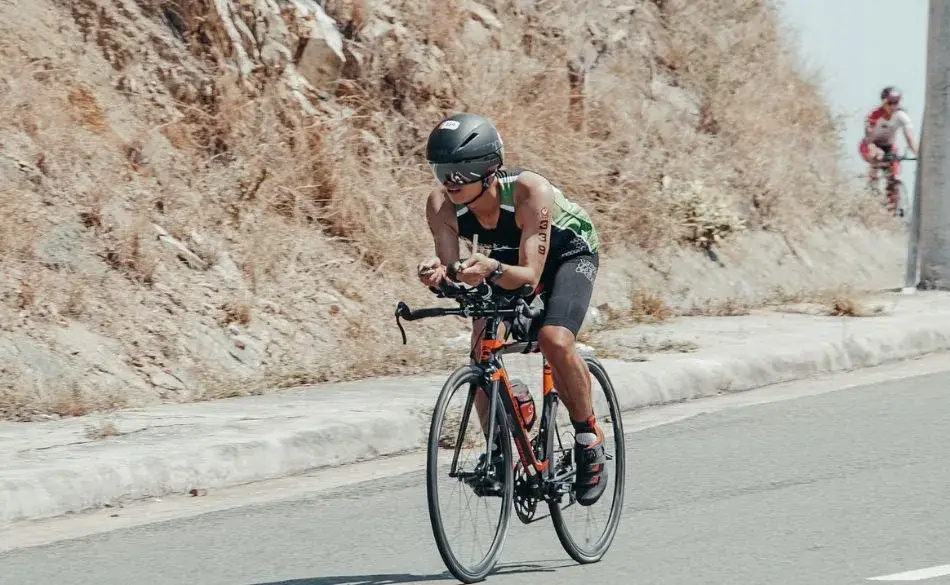
Triathlete in aero position on a road bike during the cycling leg of an Ironman 70.3 race

Last updated:

Ironman 70.3 Training Guide: The Complete Plan

Signing up for an Ironman 70.3 is the most ambitious training commitment most amateur athletes will ever make — and the most rewarding. The combination of 1.9km of open water swimming, 90km of cycling, and a half marathon run demands something different from sprint and Olympic-distance triathlon: a structured periodisation plan, genuine long-session endurance in all three disciplines, specific brick training, and a race-day nutrition strategy that has been tested in training. This guide covers everything from training phases and weekly structure to nutrition, brick sessions, taper management, and race-day pacing — for both the Ironman 70.3 and the full Ironman 140.6.

Chat with a SportCoaching coach

Not sure where to start with training?

Tell us your goal and schedule, and we’ll give you clear direction.

No obligation. Quick, practical advice.

Article Categories:

Explore our triathlon training resources for more helpful articles and resources.

Quick Answer

70.3: 1.9km swim, 90km bike, 21.1km run. 16–20 weeks prep, 8–12 hrs/week. Full Ironman: 3.8km swim, 180km bike, 42.2km run. 24–30 weeks prep, 12–16 hrs/week. Training structure: Base (aerobic foundation) → Build (volume + intensity) → Peak (race-specific) → Taper (2–3 weeks). Most important sessions: long bike, brick workouts, open water swims. Most common mistake: riding too hard on the bike, blowing up on the run.

Distances and What to Expect on Race Day

Understanding exactly what you are training for helps you plan your preparation and set realistic expectations.

👉 Swipe to view full table
DistanceSwimBikeRunCut-off timeTypical finish range
Ironman 70.31.9 km90 km21.1 km8 hrs 30 min4:30 – 7:30
Full Ironman 140.63.8 km180 km42.2 km17 hours9:30 – 15:00

The 70.3 is the world’s most popular long-course triathlon distance. It is long enough to require genuine periodisation and race-day strategy, but achievable by any athlete willing to train consistently for 16–20 weeks. Most amateur athletes finish a 70.3 in 5–7 hours. For a detailed breakdown of what the 70.3 distance involves and how it compares to other distances, our Ironman vs standard triathlon comparison covers the full picture.

The full Ironman doubles every distance and roughly triples the training commitment. The marathon run at the end — after 180km of cycling — is the defining challenge of the distance. Pacing patience on the bike is everything: athletes who ride too hard in the first 90 minutes typically walk significant portions of the run regardless of their standalone marathon fitness. Most coaches strongly recommend completing at least one 70.3 before attempting a full Ironman.

How Long Does It Take to Train? Timeline by Experience Level

👉 Swipe to view full table
Athlete background70.3 prep timeFull Ironman prep timeTypical peak hours/week
Complete triathlon beginner20–24 weeks30–36 weeks10–12 hrs (70.3), 14–16 hrs (IM)
Sprint/Olympic triathlete16–20 weeks24–30 weeks12–14 hrs (70.3), 14–18 hrs (IM)
Experienced 70.3 finisher12–16 weeks20–26 weeks10–14 hrs (70.3), 12–16 hrs (IM)
Time-crunched athlete (under 10 hrs/week available)20 weeks minimumNot recommended8–10 hrs (70.3 only)

For time-crunched athletes who can only dedicate 8–10 hours per week, a 70.3 is achievable with smart session prioritisation. A full Ironman on under 10 hours per week is possible but will produce a significantly harder race experience — expect to spend the final hours managing rather than racing. Our dedicated guide on training for a triathlon when you’re short on time covers the minimum effective session structure for different distances and time budgets.

The Four Training Phases: Base, Build, Peak, Taper

Every successful 70.3 training plan is structured around four phases. Each phase has a different objective, intensity distribution, and session profile. Understanding what each phase is trying to achieve prevents the most common training mistake: doing the wrong kind of training at the wrong time.

Phase 1 — Base (Weeks 1–6 of a 20-week plan)

Objective: Build aerobic foundation, develop technique, establish training consistency.

The base phase is not glamorous but it is the most important. All three disciplines are trained at Zone 2 intensity — a genuinely easy, conversational effort that builds mitochondrial density, capillarisation, and the aerobic infrastructure that supports everything that follows. The 80/20 principle applies throughout: 80% of training time at easy effort, 20% at harder effort. Resist the temptation to go harder — athletes who skip a proper base phase by training at medium intensity throughout accumulate fatigue without building the aerobic foundation the rest of the plan requires.

Session targets in the base phase: build to 2km continuous swim, 2–2.5 hour comfortable bike ride, 10–12km easy run. Strength training 2× per week to address muscular weaknesses before volume increases. Our Zone 2 guide covers exactly what easy effort should feel like — the most common base phase error is running and riding too hard.

Phase 2 — Build (Weeks 7–12)

Objective: Increase training volume, introduce race-specific intensity, develop brick-session tolerance.

The build phase raises both volume and intensity. Long rides extend toward 3–4 hours. Long runs build to 15–18km. One quality session per discipline per week is introduced: threshold intervals on the bike, tempo runs, swim speed sets. Brick sessions become weekly fixtures — bike followed immediately by a run to train the neuromuscular transition. Every 4th week is a recovery week at 50–60% of normal volume.

The build phase is where most athletes feel their 70.3 fitness truly developing — session completion times improve, easy pace becomes genuinely comfortable, and the endurance required for race day starts to feel plausible. Interval running introduced at this phase develops the aerobic ceiling that determines how fast the run leg can be.

Phase 3 — Peak (Weeks 13–17)

Objective: Race-specific preparation, longest sessions of the plan, confidence-building.

The peak phase contains the hardest and longest training of the entire plan. The long bike reaches 4–4.5 hours (slightly longer than the race bike leg) to build comfort and resilience for race-day demands. The long run builds to 18–20km. Race-rehearsal brick sessions — 3.5–4 hour bike followed immediately by 40–50 minute run — are the single most important sessions of the plan. These simulate the race-day bike-to-run transition under conditions approaching race effort and duration.

Aim to do one race-rehearsal brick wearing your exact race kit, executing your exact race nutrition (gel every 30 min, specific sports drink), and timing your T2 transition. The first time you step off a 4-hour bike and immediately run should not be on race day. The peak phase typically has two or three weeks of high volume before the taper begins.

Phase 4 — Taper (Weeks 18–20)

Objective: Reduce fatigue, sharpen fitness, arrive at race day fresh and confident.

The taper is counterintuitive for most athletes — reducing volume while maintaining intensity feels like losing fitness, but the opposite is true. The adaptations from months of training are still occurring during the taper; fatigue is being shed while fitness is preserved. Training volume drops to 50–60% of peak in the first taper week, then 40% in the second. Session intensity is maintained in short efforts — two or three short quality sessions per week prevent the legs from going flat.

Taper week before the race: no long sessions after Tuesday. Short, easy swim and run Wednesday. Easy 30-minute bike with a few race-pace efforts Thursday. Rest Friday. Very easy 15-minute swim/jog Saturday. Race Sunday. The common taper mistake: doing too much in the final week out of anxiety. Trust the training.

Structuring Your Training Week

A typical 70.3 training week on approximately 10 hours covers all three disciplines with one brick, two quality sessions, and adequate recovery.

👉 Swipe to view full table
DaySessionDurationPurpose
MondayRest + optional strength20–30 minRecovery anchor — never train hard Monday after a big Sunday brick
TuesdaySwim (intervals) + easy run45 min + 40 minSwim quality + run frequency without load
WednesdayBike — tempo or threshold intervals60–75 minQuality bike session — the key speed session of the week
ThursdaySwim (endurance) + tempo run45 min + 45 minSwim endurance + run quality
FridayRest or very easy 30 min spin30 min maxActive recovery before weekend long sessions
SaturdayLong bike ride2.5–4 hrs (phase-dependent)Anchor session — most important training of the week
SundayBrick: bike + run90–150 min totalRace-specific transition training; long run builds here in peak phase
Coach’s tip: The bike leg accounts for roughly 45–55% of your total 70.3 race time. Yet many athletes undertrain on the bike and overtrain on the run. If your training time is limited, protect the Saturday long bike above all other sessions — it has the single biggest impact on your finish time and race-day experience.

For athletes curious about what training frequency and structure looks like for other triathlon distances before committing to a 70.3, our guide on triathlon training frequency covers the session-per-week benchmarks by distance from sprint through Ironman.

Training Each Discipline

Swimming

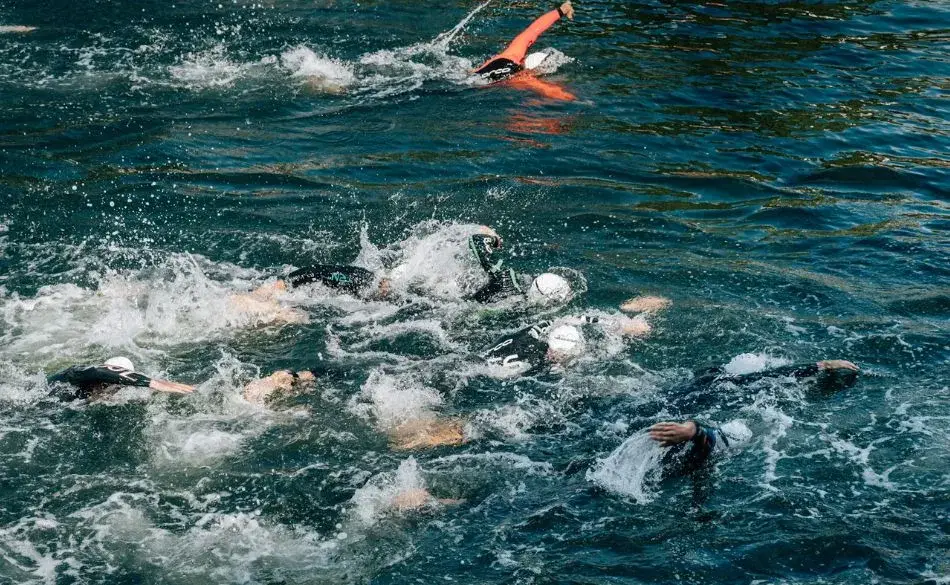
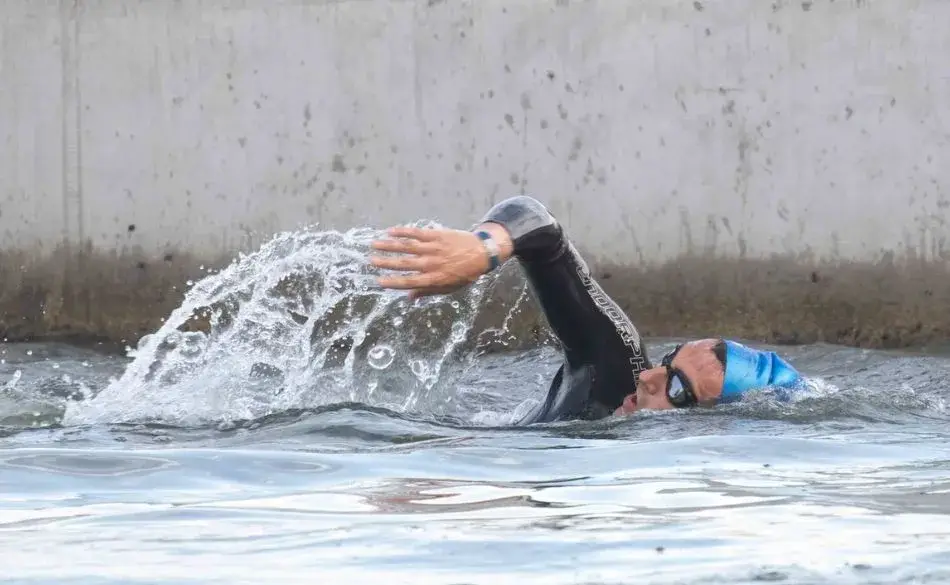
The swim is the shortest leg — typically 25–45 minutes for most age-groupers — but causes the most race-day anxiety. The key: swim quality over quantity. Two focused pool sessions per week with technique work (drills, catch work) will develop your 70.3 swim fitness more effectively than high-volume easy laps. Target two to three open water swims in the 6 weeks before race day — the experience of sighting, mass starts, and managing pace in choppy water cannot be replicated in the pool.

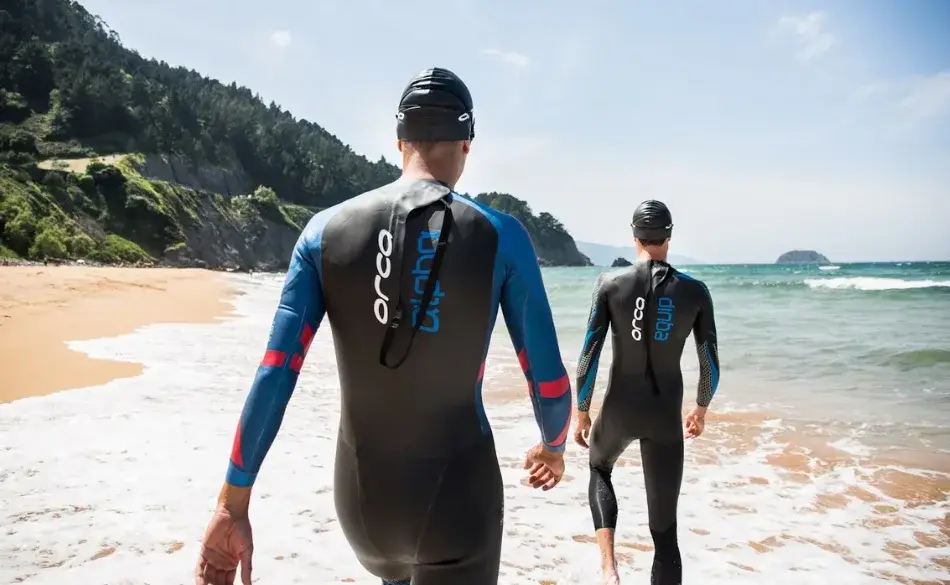
For a 70.3, you need to comfortably swim 2.5km in training (more than the race distance) to ensure the 1.9km race swim is well within your comfort zone. A time of 35–45 minutes for the race swim is typical for recreational age-groupers; under 35 minutes indicates strong swim fitness. Wetsuit practice is essential — the buoyancy changes your stroke position and breathing rhythm. Race in the same wetsuit you train in.

Cycling

The 90km 70.3 bike leg takes most athletes 2.5–3.5 hours and is where the race is largely decided. Athletes who ride too hard in the first 60km pay severely on the run; those who pace conservatively and arrive at T2 with legs intact will have a far better race experience regardless of their bike split.

The training priority: build your long ride to 4–4.5 hours (longer than the race distance) by the peak phase. This means the 90km race bike is well within your training comfort zone on race day. Our cycling base training guide covers how to structure the long ride progression through a season. Race-day target: ride at a heart rate or power that is approximately 75–80% of your threshold effort — this feels conservative in the first hour, which is precisely correct.

For indoor training options during the build phase, structured turbo/Zwift sessions 30–45 minutes long can substitute for outdoor midweek rides when time or weather prevents outdoor cycling. They are especially effective for threshold and tempo work.

Running

The 70.3 run is a half marathon on legs already worked by 3+ hours of swim and bike. It is not a standalone half marathon. Standalone half-marathon fitness does not guarantee a strong 70.3 run — brick-session tolerance and pacing discipline are more important than run fitness alone.

Build your long run to 18–20km in the peak phase. Most of this run should be genuinely easy — Zone 2 effort — with occasional race-pace kilometres in the final weeks. Our guide on running off the bike covers the specific adaptation that brick sessions develop and the typical pacing strategy for the first 5km of the run leg (conservative start, gradual build). The most important race-day running rule: start the run at a pace that feels almost embarrassingly easy for the first kilometre. Athletes who start conservatively almost always negative-split; those who start at race feeling typically positive-split dramatically.

Brick Sessions: The Most Important 70.3 Workouts

No training element separates prepared 70.3 athletes from underprepared ones more clearly than brick session history. The transition from cycling to running is physiologically unlike any standalone training — the legs feel heavy and uncoordinated, heart rate is dysregulated, and pace feels wildly inconsistent with actual effort. These sensations disappear with repeated practice. Brick sessions are the practice.

👉 Swipe to view full table
PhaseBrick formatRun off the bikePurpose
Early build (week 4–7)45 min bike + 15–20 min runEasy pace, Zone 2Introduce the sensation — legs learning the transition
Mid-build (week 8–11)75–90 min bike + 25–35 min runEasy with brief race-pace surgesBuild brick tolerance, practice nutrition timing
Peak (week 13–16)3–4 hr bike + 40–50 min runZone 2–3, race pace in final 20 minRace simulation — full confidence-building effort
Race rehearsal (week 15–16)3.5–4 hr bike + 45 min runRace effort throughoutExact race-day conditions, kit, nutrition, transitions

The race rehearsal brick in weeks 15–16 is the single most important training session in the plan. Execute it wearing your exact race kit, eating exactly your planned race nutrition (first gel at 20 minutes on the bike, then every 30–35 minutes), timing your T2 transition, and running at your planned race effort. Make notes on anything that felt wrong — kit discomfort, nutrition issues, pacing problems — and address them before race day. Our transition guide covers the specific T1 and T2 sequences to practice during these sessions.

Nutrition: The Fourth Discipline

Nutrition is where 70.3 and full Ironman races are lost. Athletes who complete race-day nutrition correctly will typically have a far better run than their training peers who haven’t practised it. The gut is a trainable system — long training sessions are the opportunity to develop your ability to absorb carbohydrate and fluid at race pace.

Carbohydrate targets: 60–80g per hour on the bike; 30–45g per hour on the run. The bike gut is more tolerant (lower impact, more blood flow available for digestion); the run gut is stressed and absorbs carbohydrate less efficiently. Most athletes fuel the bike with gels + sports drink and the run with gels only.

Sodium: Sodium loss varies dramatically between individuals — up to 10-fold. Athletes who are heavy or salty sweaters need significantly more sodium than generic sports drinks provide. Our sweat test guide covers how to measure your personal sodium loss and build a race-specific hydration strategy. Muscle cramping during a 70.3 is almost always a sodium depletion issue, not dehydration alone.

Fluid intake: Target approximately 500–800ml per hour on the bike (adjust for conditions and your measured sweat rate). Do not drink to schedule if not thirsty in cool conditions — the risk of hyponatremia from over-drinking is real. In hot conditions, prioritise sodium as much as fluid volume.

Pre-race nutrition: Consume a carbohydrate-rich meal 2.5–3 hours before the race start — typically 60–90g of carbohydrate. A gel or small snack 30 minutes before the swim start tops up blood glucose. Do not experiment with new food on race morning — eat what you tested in your race rehearsal sessions.

Train your nutrition in every long session from Week 8 onwards. By race day, your nutrition plan should feel completely routine — nothing new, nothing uncertain. Our triathlon recovery guide also covers post-race rehydration and refuelling which matters significantly for athletes planning multiple races in a season.

Race Day Pacing Strategy

The most common 70.3 race-day mistake is racing the bike too hard. The result is almost always the same: a strong bike split followed by a walk-jog run that takes 30–60 minutes longer than the athlete planned. Conservative bike pacing is not about going slow — it is about arriving at T2 with enough energy left to run the half marathon you trained for.

Swim Pacing

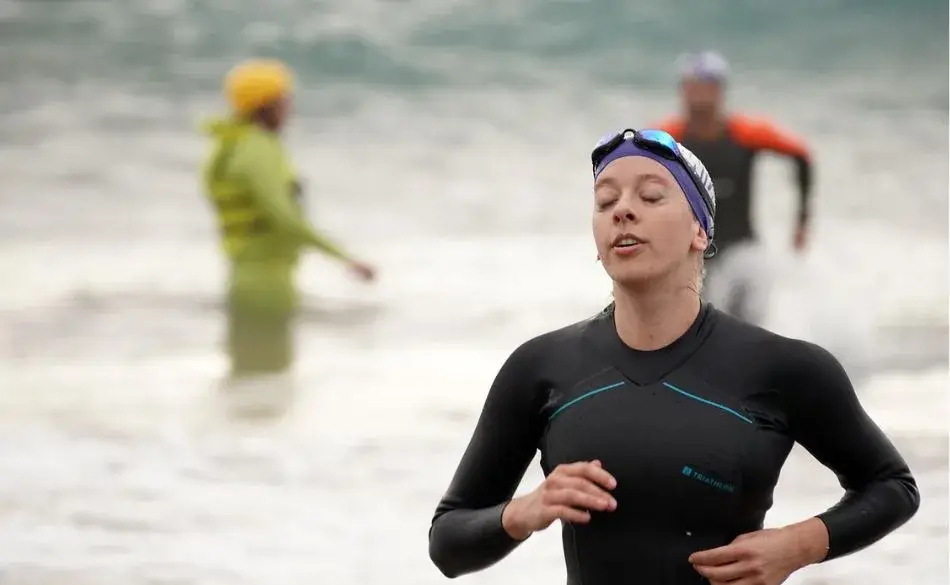
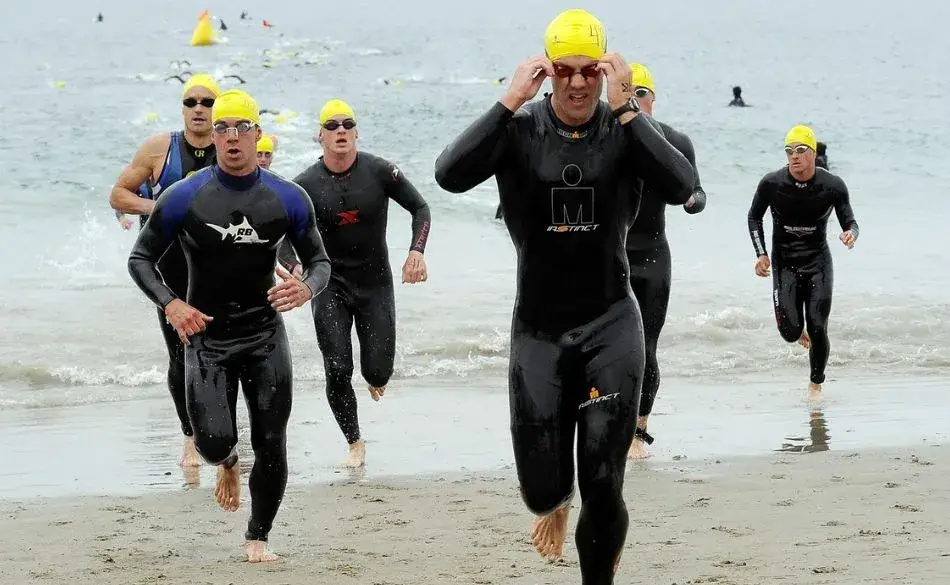
Seed yourself in the correct start wave based on your expected swim time. Start slightly wide of the direct line to avoid the most congested water. Find your rhythm in the first 200m rather than sprinting into the pack — adrenaline will naturally push you faster than intended. Sight every 8–10 strokes in open water. Exit the swim smoothly and run (do not walk) to T1.

Bike Pacing

If you have a power meter: target 70–75% of FTP for the first 60km, adjusting for hills and wind but not chasing the effort up climbs. If using heart rate: stay at 75–80% of threshold heart rate. The first 30 minutes of the bike will feel very easy — this is correct. Athletes who feel they are going too slowly at 45 minutes are typically pacing well. Build effort slightly in the final 20km of the bike if legs feel good. Eat every 30–35 minutes starting from the 15-minute mark regardless of hunger.

Run Pacing

The first kilometre off the bike should feel actively easy. This is not a standalone half marathon — it is a half marathon after a 3-hour bike ride. Expect the first 2km to feel strange; this is normal and resolves with brick session practice. Build effort gradually through the first 5km before settling into target race effort. Walk through aid stations if needed — this is not failure, it is race execution. Elite age-groupers walk through aid stations.

Am I Ready? Prerequisites for Your First 70.3

Before starting a 70.3 training plan, you should be able to:

Swim 1,500m continuously (not quickly — continuously). Ride comfortably for 90 minutes. Run comfortably for 60 minutes. Train 5–6 sessions per week without excessive fatigue. Have at least one triathlon of any distance completed, ideally a sprint or Olympic.

If you cannot yet swim 1,500m, run 60 minutes, or ride 90 minutes, you need 4–6 weeks of foundational fitness building before starting a structured 70.3 plan. Our guide on whether you need a coach for your first triathlon covers the decision framework for choosing between a self-directed plan and coached preparation — 70.3 is the distance where coaching adds the most value for most athletes. The affordable triathlon coaching guide covers what to expect and what quality coaching costs at the 70.3 distance.

Key Training Resources and Tools

Building on your 70.3 training: our Ironman training books guide (3,411 impressions, pos 4.9) covers the best reference resources used by experienced long-course triathletes. The best triathlons in Australia guide covers the full race calendar to help you select your target event with appropriate lead time for the training plan. And for athletes who have completed their 70.3 and are planning their next training block, our triathlon recovery guide covers the 3–5 week recovery timeline before normal training resumes.

Prepare for Your 70.3 With Expert Coaching and Plans

SportCoaching provides fully personalised triathlon coaching for 70.3 and Ironman preparation — structured phases, weekly adjustments, brick session guidance, race-day nutrition planning, and direct coach communication via WhatsApp. AUD $143/month, no lock-in, 90-day performance guarantee.

FAQ: Ironman 70.3 Training

How long does it take to train for an Ironman 70.3?
16–20 weeks for most athletes. Beginners need the full 20 weeks; experienced triathletes can prepare in 12–16 weeks. Weekly training volume: 8–12 hours, peaking at 12–14 hours. Structured phases: base (Zone 2 foundation) → build (volume + intensity) → peak (race-specific) → taper (2–3 weeks).

What is the difference between an Ironman 70.3 and a full Ironman?
70.3: 1.9km swim, 90km bike, 21.1km run, 8.5 hour cut-off. Full Ironman: 3.8km swim, 180km bike, 42.2km run, 17 hour cut-off. The full Ironman requires roughly double the training commitment and 24–30 weeks of preparation. Complete at least one 70.3 before attempting a full Ironman.

How many hours a week do you need to train for a 70.3?
Minimum 8 hours per week for a comfortable finish. 10–12 hours for a more competitive result. Peak weeks typically reach 12–14 hours. Five to six sessions per week covering all three disciplines plus one brick is the minimum effective structure.

What are brick sessions and why are they essential for 70.3 training?
Bike immediately followed by a run with no rest. Essential because the run-off-bike sensation is unlike standalone running until practised repeatedly. Begin weekly from Week 4, building to 4-hour bike + 45-minute run race-rehearsal sessions in the peak phase. Without adequate bricks, athletes commonly blow up on the run regardless of standalone run fitness.

What should you eat during a 70.3 race?
60–80g carbohydrate per hour on the bike; 30–45g per hour on the run. Begin fuelling in the first 20–30 minutes of the bike. Practice exact race nutrition in every long training session — nothing new on race day. Sodium replacement is critical for longer events — see our sweat test guide for individual sodium targets.

Find Your Next Triathlon Race

Ready to put your training to the test? Here are some upcoming triathlon events matched to this article.

Graeme - Head Coach and Founder of SportCoaching

Graeme

Head Coach & Founder, SportCoaching

Graeme is the founder of SportCoaching and has coached more than 750 athletes from 20 countries, from beginners to Olympians, in cycling, running, triathlon, mountain biking, boxing, and skiing. His coaching philosophy and methods form the foundation of SportCoaching's training programs and resources.

750+
Athletes
20+
Countries
7
Sports
Olympic
Level

Start Your Fitness Journey with SportCoaching

No matter your goals, SportCoaching offers tailored training plans to suit your needs. Whether you’re preparing for a race, tackling long distances, or simply improving your fitness, our expert coaches provide structured guidance to help you reach your full potential.

  • Custom Training Plans: Designed to match your fitness level and goals.
  • Expert Coaching: Work with experienced coaches who understand endurance training.
  • Performance Monitoring: Track progress and adjust your plan for maximum improvement.

  • Flexible Coaching Options: Online and in-person coaching for all levels of athletes.
Learn More →

Choose Your Next Event

Browse upcoming Australian running, cycling, and triathlon events in one place. Filter by sport, check dates quickly, and plan your training around something real on the calendar.

View Event Calendar