Quick Answer
Most flat-footed runners do best in stability shoes, which provide medial post support to reduce inward roll. Runners with severe overpronation may need motion control shoes. The right choice depends not just on your arch shape but on how much you actually overpronate — which is why a gait assessment or treadmill video review is worth doing before you buy.What Flat Feet Mean for Running
Flat feet — also called fallen arches — means your arch makes full or near-full contact with the ground when you stand. For most people this is simply a structural variation, not a medical problem. The issue for runners is what happens in motion. When the arch collapses, the foot tends to roll inward more than usual during the push-off phase of the stride. This is called overpronation.
Overpronation is not inherently dangerous, but when it is excessive and uncontrolled, it can create a chain of load issues through the ankle, shin, knee, and hip. The foot absorbs force inefficiently, and the extra inward roll transfers stress to structures that were not designed to manage it. This is why shoe choice matters: the right shoe does not fix flat feet, but it can reduce the degree of overpronation and allow the body to absorb force more efficiently.
Importantly, not all flat-footed runners overpronate to the same degree. Some have strong foot muscles that control inward roll well despite low arches. Others have significant collapse and heavy overpronation on every stride. This variation is why “just buy a stability shoe” is an oversimplification — you need to match the shoe to your actual gait, not just your arch shape.
The Three Shoe Categories for Flat Feet
👉 Swipe to view full table
| Shoe Category | Best For | Key Features | Typical Weight |
|---|---|---|---|
| Stability | Mild–moderate overpronation | Medial post (firmer inner foam), guiderails or sidewall support, moderate cushioning | 280–320g |
| Motion Control | Severe overpronation, heavy runners | Dense midsole, reinforced heel counter, wide base, maximum medial support | 320–380g |
| Neutral + Orthotics | Flat feet with controlled gait, or prescribed orthotics | Cushioned midsole, no corrective post, roomy fit for insert | 260–300g |
| Neutral (no insert) | Flat feet with no significant overpronation | Even cushioning, flexible forefoot, no stability features | 240–280g |
The vast majority of flat-footed runners fall into the stability category. Motion control shoes are genuinely needed by a smaller group — those with very severe arch collapse who find that stability shoes still leave their feet rolling in significantly. If you are unsure which category applies to you, start with stability and only move to motion control if you continue to experience arch or knee discomfort after several weeks.
As an Amazon Associate, SportCoaching earns from qualifying purchases.
How to Know How Much You Overpronate
The most reliable method is a gait analysis at a specialist running store or sports physio. They film your stride on a treadmill and can show you exactly how your foot lands and rolls. If that is not accessible, there are two practical alternatives.
The wet foot test
Wet the bottom of your foot and step onto paper or cardboard. A flat footprint — showing the entire sole with little or no gap along the inner edge — indicates low arches. This tells you about arch shape but not gait. It is a useful starting point, not a complete answer.
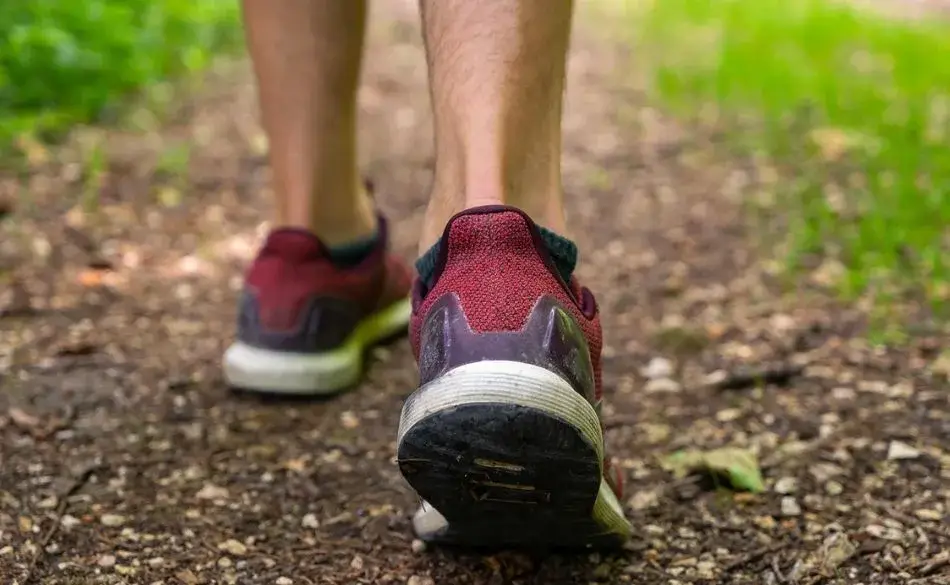
Shoe wear pattern
Check the soles and midsole of your current shoes. If there is heavy wear along the inner heel and ball of the foot, and the midsole is compressed on the inner side, you are likely overpronating noticeably. If wear is more even, your gait may be more controlled than your arch shape suggests.
Treadmill video
Film yourself running from behind at a moderate pace. Watch the ankle — if it collapses inward significantly on each landing, that is overpronation visible enough to guide shoe choice. This is the same approach used in professional gait analysis, just with a phone rather than a lab setup.
Key Features to Look For
👉 Swipe to view full table
| Feature | Why It Matters for Flat Feet | What to Look For |
|---|---|---|
| Medial post | Prevents arch from collapsing inward | Firmer foam on inner midsole; often visible as a darker section |
| Heel counter | Holds the heel in place, reducing ankle roll | Firm, structured back of shoe; press it — should resist compression |
| Midsole firmness | Too soft allows arch to sink further | Moderate firmness; avoid ultra-plush foams if you have severe overpronation |
| Base width | Wide base = more stable platform | Check midsole width at forefoot — wider is more stable |
| Heel drop | Higher drop reduces Achilles and calf load | 8–12mm drop suits most flat-footed runners; avoid zero-drop initially |
| Toe box width | Flat feet often also mean wider feet | Look for wide-fit options if your toes feel cramped in standard widths |
Overpronation Severity Guide
Matching your shoe to your actual degree of overpronation is more useful than matching it to your arch shape alone. Use this guide as a starting framework, then confirm with a gait assessment if possible.
👉 Swipe to view full table
| Overpronation Level | What It Looks Like | Recommended Shoe Type | Common Injuries If Unmanaged |
|---|---|---|---|
| Mild | Slight inward roll, mostly controlled | Neutral or light stability | Minor arch fatigue, occasional shin soreness |
| Moderate | Noticeable inward roll on landing | Stability shoe | Plantar fasciitis, shin splints, medial knee pain |
| Severe | Ankle collapses significantly inward | Motion control or stability + orthotics | Posterior tibial tendon issues, knee pain, hip imbalance |
If you are experiencing sore arches after running, the pattern of when and where the soreness appears is often a useful clue. Pain along the inner arch that builds across a run points toward overpronation stress. Pain that is worse first thing in the morning and eases with movement suggests plantar fasciitis, which has a significant overlap with flat feet and under-supported footwear.
Flat Feet vs High Arches: Choosing the Opposite
It is worth understanding that the shoe requirements for flat feet are essentially the opposite of those for high arches. Runners with high arches typically underpronate — the foot stays on the outer edge rather than rolling in — and need neutral, cushioned shoes with no stability features. If you have flat feet and accidentally buy a neutral shoe designed for high arches, the lack of medial support can make overpronation worse. For a full explanation of underpronation and the shoe features that address it, see our guide on underpronation in runners.
AU Budget Guide for Flat Feet Running Shoes
👉 Swipe to view full table
| Budget (AUD) | What to Expect | Best For |
|---|---|---|
| Under $120 | Entry-level stability; adequate support but simpler foam and construction | Beginners, occasional runners under 30 km/week |
| $120–$180 | Mid-range stability; better foam quality, more durable outsole | Regular runners, 30–50 km/week |
| $180–$250 | Premium stability; dual-density foams, guiderail systems, superior comfort | Consistent runners, half marathon to marathon training |
| $250+ | Top-tier stability or motion control; advanced materials, plated options | High-mileage runners, those with significant biomechanical needs |
You do not need to spend $250 to get a good stability shoe. The $150–$200 range covers a wide selection of well-proven models from major brands. Spending more typically gets you improved foam responsiveness and durability rather than meaningfully better support — the support structure in a $160 stability shoe is often comparable to a $220 version of the same model.
As an Amazon Associate, SportCoaching earns from qualifying purchases.

Should You Use Orthotics Instead of Stability Shoes?
This is a reasonable question, and the honest answer is: it depends on the individual. Custom orthotics prescribed by a podiatrist can be highly effective for flat feet, particularly for runners with asymmetrical arch collapse or specific injury histories. They can be used inside neutral or lightly cushioned shoes, which some runners find more comfortable than the corrective feel of stability midsoles.
Over-the-counter arch supports are less precise but still useful for mild to moderate flat feet. If you already have orthotics or are considering them, look for a shoe with a removable insole and a roomy toe box to accommodate the insert without making the fit tight.
The disadvantage of relying solely on orthotics in a neutral shoe is that you lose the wider base and heel counter support that stability shoes provide. For many runners, a combination of a stability shoe and a mild over-the-counter orthotic gives the best of both approaches.
How to Test Shoes Before You Buy
When trying on running shoes for flat feet, do not judge them standing still — walk and jog in them if the store allows it. Pay attention to whether the inner midsole feels like it is actively supporting your arch, or whether your foot still rolls in noticeably. The shoe should guide your stride, not feel stiff or force your foot into an unnatural position.
Check that the heel counter holds your heel firmly without pinching. Wiggle your toes — there should be roughly a thumb’s width between your longest toe and the end of the shoe. And check the midfoot fit: the shoe should feel snug through the arch without compressing the ball of the foot.
For more guidance on what to look for when buying running shoes generally — including heel drop, cushioning levels, and surface suitability — see our full guide to choosing running shoes as a beginner.
When Shoes Are Not Enough
Shoes are one input into how your foot moves — not the whole system. If you have been wearing appropriate stability shoes and still experiencing arch soreness, knee pain, or recurring injuries, it is worth looking at what else might be contributing. Weak foot intrinsic muscles, tight calves, and poor hip strength all affect how the foot behaves on landing. A running coach or sports physio can review your gait and identify whether the issue is footwear, strength, running form, or load management.
If you are building your running from scratch, a structured plan helps ensure you are not increasing mileage faster than your feet and connective tissue can adapt. Our guide to starting running covers the approach that reduces injury risk for new runners, regardless of foot type. And if you are already training consistently and dealing with recurring foot issues, our broader resource on why feet hurt after running covers the most common causes and fixes.
Want coaching that accounts for your foot mechanics?
Our running coaches consider your gait, injury history, and shoe setup when building your training plan — so you train in a way that keeps you running consistently and pain-free.
Start Running Coaching → View Training Plans →FAQ: Best Running Shoes for Flat Feet
What type of running shoes are best for flat feet?
Most flat-footed runners do best in stability shoes, which use a firmer inner midsole to reduce overpronation. Runners with severe arch collapse may need motion control shoes. A gait analysis is the most reliable way to confirm which category suits your specific mechanics.
Do flat feet always need stability shoes?
No. Flat feet describes arch shape, not gait. Some flat-footed runners have strong foot muscles and controlled pronation, meaning they run comfortably in neutral shoes. The key factor is whether you actually overpronate when running, not just whether your arch is low at rest.
What is overpronation and how does it relate to flat feet?
Overpronation is the excessive inward rolling of the foot after landing. Flat feet often cause overpronation because the collapsed arch allows greater ankle inward roll. The degree of overpronation varies — from mild to severe — and should guide your shoe category choice.
Can flat-footed runners use orthotics instead of stability shoes?
Yes. Custom orthotics can provide targeted arch support inside neutral shoes. Over-the-counter insoles can also help in mild cases. Some runners do best with a combination of a stability shoe and a mild orthotic for maximum support.
How often should flat-footed runners replace their shoes?
Every 600–800 km, or when the midsole no longer feels supportive. Flat-footed runners often wear through medial support faster than neutral runners due to higher inner-edge loading. Press the midsole with your thumb — if it feels dense and flat rather than springy, it is time to replace.
Find Your Next Running Race
Ready to put your training to the test? Here are some upcoming running events matched to this article.

Run Wollongong 2026
Ballarat Marathon 2026