





Find Your Next Cycling Race
Ready to put your training to the test? Here are some upcoming cycling events matched to this article.
 Coach Graeme
Last updated:
Shin pain during or after cycling catches most riders off guard. Cycling is low-impact — there's no ground strike, no repetitive pounding — so where is the pain coming from? The short answer: cycling cannot cause true shin splints in the clinical sense, but it absolutely can cause shin pain through a different mechanism that feels identical. Understanding the distinction matters because the cause determines the fix, and the fix for cycling-specific shin pain is different from the approach for shin splints from running. This guide explains what cycling actually does to the lower leg, what causes shin pain specifically in cyclists, how to fix the most common causes through technique and bike fit, and when the pain might indicate something more serious.
Not sure where to start with training?
Tell us your goal and schedule, and we’ll give you clear direction.
No obligation. Quick, practical advice.
Explore our cycling training resources for more helpful articles and resources.
Can cycling cause shin splints? Not technically — true shin splints require impact loading that cycling doesn’t produce. But cycling causes tibialis anterior overuse that feels the same. Most common cycling cause: saddle too high, forcing the foot to toe-point at the bottom of the stroke and overloading the tibialis anterior on every revolution. Fix sequence: reduce training load → check saddle height → improve pedal stroke → strengthen tibialis anterior → return gradually.
True shin splints — medically termed medial tibial stress syndrome (MTSS) — are caused by the repetitive impact forces of activities like running, jumping, or marching. Each footstrike transmits compressive and bending forces through the tibia (shin bone), which over time causes stress reaction in the bone and periosteum (the connective tissue wrapping the bone). This is why shin splints are so common in runners, military recruits, and basketball players — and why cycling physiotherapy analysis consistently notes that cycling, as a non-impact activity, cannot produce true MTSS.
What cycling does cause is tibialis anterior overuse. The tibialis anterior is the muscle that runs from just below the knee, along the front and outer edge of the shin bone, and wraps under the arch of the foot. Its primary function is dorsiflexion — lifting the toes toward the shin. In the cycling pedal stroke, the tibialis anterior activates repeatedly, particularly during the upstroke phase as the foot is lifted and repositioned for the next downstroke. In cyclists using clipless pedals who actively pull up on the upstroke, the tibialis anterior contracts with meaningful force thousands of times per ride. Add a technique error or saddle height problem, and the muscle is asked to work far beyond what it is conditioned for.
The symptoms of tibialis anterior overuse are pain, tenderness, and sometimes swelling along the front of the shin — essentially identical to how shin splints feel. The practical distinction: cycling-specific shin pain is located in the muscle belly alongside the shin bone, not in the bone itself. If pressing along the shin bone produces sharp, focal bone tenderness, medical assessment for a stress fracture is appropriate. Diffuse tenderness in the soft tissue along the front of the shin is the typical presentation of tibialis anterior overuse.
| Cause | How it produces shin pain | How to identify it | Primary fix |
|---|---|---|---|
| Saddle too high | Forces the toe to point downward at the bottom of the stroke to reach the pedal; this active plantarflexion reciprocally overloads the tibialis anterior, which must decelerate the motion | Pain at the bottom of the pedal stroke; visible toe-pointing; hips may rock slightly | Lower the saddle — knee should have 25–35° bend at bottom of stroke |
| Heel drop on downstroke | Excessive heel lowering at 5–7 o'clock on the pedal stroke creates a lengthening eccentric contraction of the tibialis anterior that overloads it under load | Pain develops gradually through longer rides; may not be present on short rides | Keep foot flat through the stroke; avoid deliberately scraping the heel down |
| Active pull-up on upstroke | Pulling the foot upward with clipless pedals maximally contracts the tibialis anterior against resistance thousands of times per ride | Shin pain in clipless pedal users who focus on "full-circle" pedalling technique | Reduce active pull-up force; focus on pushing the down-pedal rather than pulling the up-pedal |
| Sudden training load increase | The tibialis anterior adapts slowly; a rapid increase in ride duration, intensity, or a new bike fit overloads the muscle before it has adapted | Shin pain appearing within 1–2 weeks of a training change or new equipment | Reduce volume; build at no more than 10% per week; address any simultaneous fit change |
| Cadence too high for conditioning | Very high cadence (100+ rpm) at low-to-moderate intensity increases tibialis anterior contraction frequency without allowing adequate relaxation time between each | Pain on high-cadence indoor rides or after switching to a different cadence style | Reduce cadence temporarily; build tibialis anterior endurance gradually |
For triathletes, there is an additional mechanism: shin pain from running transferring to cycling. A tibialis anterior already irritated from run training is not recovered by cycling — cycling loads the same muscle, adding to cumulative stress. If shin pain occurs in both running and cycling, the running load is almost certainly the primary driver and needs to be addressed first. Our guide on calf pain in triathlons covers how lower leg overuse patterns compound across disciplines.
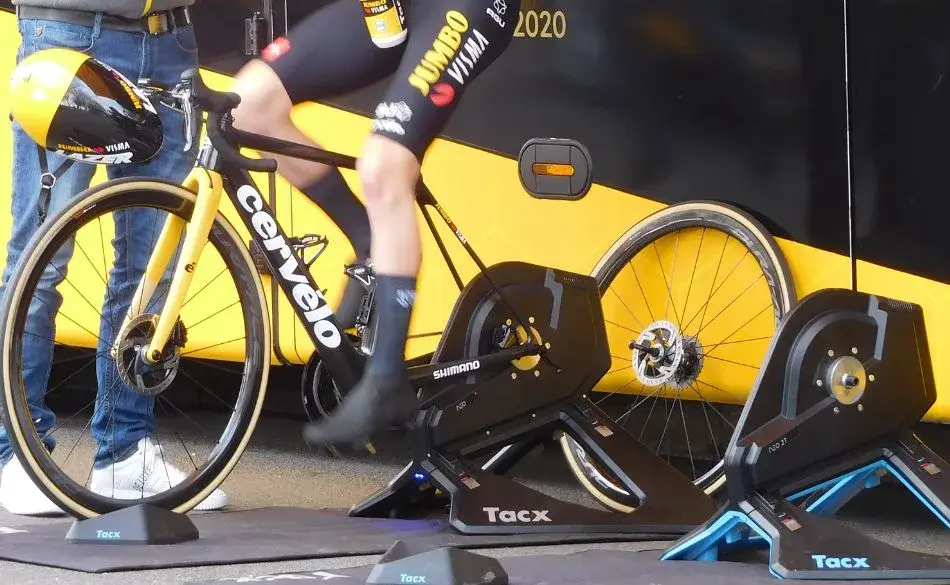
Saddle height is the single most impactful bike fit variable for shin pain. A saddle that is too high is the most common cause: the rider reaches for the pedal at the bottom of the stroke by pointing the toes down, which eccentrically loads the tibialis anterior. The target: at the very bottom of the pedal stroke, the knee should have approximately 25–35 degrees of bend, with the foot in a neutral position — neither toe-pointing nor heel-dropping. Check this with someone watching from the side, or use a video on a stationary trainer. If the heel drops significantly below the pedal axle at the bottom of the stroke, the saddle is likely too low. If the hips rock or the toes visibly point down, the saddle may be too high.
Adjust saddle height in 5mm increments and ride 20–30 minutes after each change before assessing. Our hip pain when cycling guide covers saddle height in the context of hip pain — the same 25–35° rule applies across both shin and hip pain prevention.
Cleats positioned too far forward (toward the toe) reduce the mechanical advantage the tibialis anterior has on the pedal and require more muscle force to control ankle position through the stroke. Moving cleats rearward toward the mid-foot reduces the leverage demand on the tibialis anterior per stroke. This is a modest adjustment but relevant for cyclists with persistent anterior shin pain who have already corrected saddle height. Clinical guidance: the ball of the foot should be positioned directly over the pedal axle as a starting point; for cyclists with anterior shin pain, experiment with cleats 2–5mm behind this position.
A saddle set too far forward increases the hip flexion angle at the top of the stroke, which can increase tibialis anterior activation as the rider works to control ankle position through the top of the stroke. Physiotherapy analysis suggests moving the saddle rearward as a secondary intervention for anterior shin pain when saddle height has already been optimised. Try 5mm rearward and assess over two to three rides. Our cycling cadence guide covers how pedalling mechanics — including foot position — change with cadence and saddle position.
For cyclists who cannot immediately access a bike fit, two technique changes produce immediate improvement in tibialis anterior loading.
Keep the foot flat throughout the stroke. The most reliable cue: imagine the bottom of the shoe staying parallel to the floor at every point in the pedal circle. This means not dropping the heel down at 5–7 o’clock (which eccentrically loads the tibialis anterior) and not pointing the toes downward at 6–7 o’clock (which concentrically overloads it on the reverse movement). A neutral, flat foot position through the full circle minimises the demand on the tibialis anterior for ankle position control.
Reduce active pull-up force on the upstroke. The “pull up hard on the upstroke” cue that many cyclists learn for clipless pedal efficiency is a significant contributor to tibialis anterior overuse. Tibialis anterior activation increases substantially when the upstroke involves active pulling rather than passive return. For cyclists with shin pain, reduce the pull-up effort — focus on pushing down harder with the descending foot rather than pulling up with the ascending foot. The net power output is essentially the same; the tibialis anterior load is substantially reduced.
Cadence management. If pain is associated with high-cadence efforts, reduce cadence to 80–90 rpm until symptoms settle. Very high cadence (100+ rpm) at submaximal intensity increases tibialis anterior contraction frequency. A physiotherapy-informed approach to return to higher cadence: build in increments of 5 rpm per week once pain-free at the lower cadence. Our calf exercises for cyclists guide covers lower leg conditioning that complements cadence work.
The tibialis anterior, like any muscle, strengthens through progressive loading. Two exercises directly address the underconditioning that allows cycling shin pain to develop:
Heel walks (tibialis anterior raises): Stand tall. Lift the balls and toes of both feet off the floor so you are balanced only on your heels. Walk forward for 20–30 steps in this position, maintaining upright posture. Alternatively: sit in a chair, feet flat on the floor, and repeatedly lift the front of both feet while keeping heels down (seated tibialis raise). 3 × 20 reps, 2–3 times per week. This directly strengthens the tibialis anterior in a low-load, progressive way. Our calf and ankle exercises guide includes the full lower leg strengthening approach that addresses tibialis anterior alongside calf and ankle stability.
Eccentric tibialis lower: Stand with both heels on a step edge (toes hanging off). Using both feet, rise onto the toes. Then shift to one foot and slowly lower the heel below the step level over 3–4 seconds. This eccentrically loads the entire lower leg, including the tibialis anterior. 2 × 10 per leg, building to 3 × 15 over 3–4 weeks. Introduce this exercise carefully — it causes DOMS when new.
Two sessions per week of 15 minutes is sufficient to produce meaningful tibialis anterior strength improvement over 4–6 weeks. The timing principle: do strengthening after rides, not before, and not on the day before a hard ride session. Our core and stability guide for cyclists covers how to fit lower leg strengthening into a week already structured around cycling training. For a broader perspective on managing overuse injuries within a cycling training programme, our cycling training week structure guide covers how to balance training load and recovery to avoid the accumulation that leads to these injuries in the first place.
Anterior compartment syndrome is a condition where the muscles of the anterior lower leg (tibialis anterior and surrounding muscles) swell within the fibrous compartment that contains them. Increased pressure within the compartment impairs blood flow, causing progressively worsening pain, pressure, and potentially neurological symptoms. There are two forms relevant to cyclists:
Chronic exertional compartment syndrome is exercise-induced and typically presents as pain and tightness in the front of the lower leg that builds gradually during cycling (usually starting 10–20 minutes into a session) and resolves within 20–30 minutes of stopping. Unlike tibialis anterior overuse, which is diffuse and aches, compartment syndrome tends to produce a tighter, pressure-like sensation that may include numbness or tingling in the foot. The pain typically resolves completely with rest — only to return on the next ride at the same point. Cycling clinical analysis notes compartment syndrome can be misdiagnosed as shin splints — the treatment is very different and often requires medical intervention.
Acute compartment syndrome is a medical emergency and typically follows significant trauma (a fall onto the lower leg). The leg becomes extremely painful, swollen, tight, and may develop numbness or weakness. This requires emergency assessment.
Once tibialis anterior overuse is identified, recovery follows a consistent pattern:
Acute phase (days 1–5): Reduce cycling volume by 40–50%. No hills. No high resistance. Ride at a comfortable cadence on flat terrain only. Ice the anterior shin for 15 minutes after rides. No active pull-up on the upstroke. Address saddle height and cleat position immediately.
Settling phase (days 5–14): Resume normal volume only if pain has settled to a 1/10 or lower. If pain is still present at rest, continue reduced volume. Introduce tibialis anterior strengthening (heel walks, seated raises) at low load. Physiotherapy guidance states: increase session duration by no more than 10 minutes per ride once comfortable, and monitor for 24 hours after each session for pain increase.
Return to full training (weeks 2–6): Gradually reintroduce hills, higher cadence, and longer rides. Do not exceed 10% volume increase per week. Maintain tibialis anterior strengthening 2×/week indefinitely. A sudden training load increase is the most common reason shin pain recurs — the 10% rule applies here as it does to any overuse injury.
For triathletes managing shin pain across cycling and running simultaneously, the approach requires balancing load across both disciplines. Running places far higher load on the tibialis anterior than cycling, so run volume should be reduced more aggressively than cycling volume during recovery. Our Ironman 70.3 training guide covers how to redistribute training load across disciplines when an injury temporarily limits one of them.
Ride Without the Pain That Keeps Cutting Sessions Short
A SportCoaching cycling coach addresses training load, technique, and bike fit to help you build consistently without the overuse injuries that come from unstructured volume increases. AUD $143/month, no lock-in, 90-day performance guarantee.
Can cycling cause shin splints?
Not in the strict clinical sense — true shin splints (MTSS) require impact loading that cycling doesn’t produce. Cycling can cause tibialis anterior overuse that produces identical symptoms. The mechanism is different: overloaded anterior shin muscle from poor technique, saddle height, or training load increase rather than bone stress from impact.
Why do my shins hurt after cycling?
Almost always tibialis anterior overuse. Most common causes: saddle too high forcing toe-pointing; dropping the heel on the downstroke; actively pulling up on the upstroke with clipless pedals; sudden training load increase. Check saddle height first — it’s the most frequently implicated factor.
How do I fix shin pain from cycling?
Reduce training load by 30–50% immediately. Check saddle height (25–35° knee bend at the bottom of the stroke). Keep foot flat through the pedal stroke — no heel drop or toe-pointing. Reduce upstroke pull-up force. Add heel walks and seated tibialis raises 2–3×/week. Return to full training gradually, no more than 10% volume increase per week.
Can I cycle with shin splints?
Yes, carefully — cycling is non-impact and is one of the best cross-training options during shin splint recovery. For cycling-specific shin pain, start with short, flat rides at moderate cadence, no hills. If pain does not increase during or within 24 hours, gradually increase duration by up to 10 minutes per session.
What is the difference between shin splints and compartment syndrome?
Shin splints: dull, diffuse ache along the shin that may ease once warmed up; worsens over training weeks. Compartment syndrome: pressure and tightness that builds during exercise, may include numbness or tingling; resolves after stopping but recurs predictably. Any numbness, tingling, or foot weakness with shin pain requires medical assessment.
Ready to put your training to the test? Here are some upcoming cycling events matched to this article.
Head Coach & Founder, SportCoaching
Graeme is the founder of SportCoaching and has coached more than 750 athletes from 20 countries, from beginners to Olympians, in cycling, running, triathlon, mountain biking, boxing, and skiing. His coaching philosophy and methods form the foundation of SportCoaching's training programs and resources.
No matter your goals, SportCoaching offers tailored training plans to suit your needs. Whether you’re preparing for a race, tackling long distances, or simply improving your fitness, our expert coaches provide structured guidance to help you reach your full potential.
Structured cycling coaching to build power, endurance, and speed.
What’s included
Browse upcoming Australian running, cycling, and triathlon events in one place. Filter by sport, check dates quickly, and plan your training around something real on the calendar.
Choose your plan to get started with personalized training plans designed to help you reach your goals.


Minna Backman
When you’re new, feedback is especially important, and Graeme is highly skilled at both analyzing numbers and understanding the importance of mental strength.