The Purpose of a Cycling Calendar in Season Planning
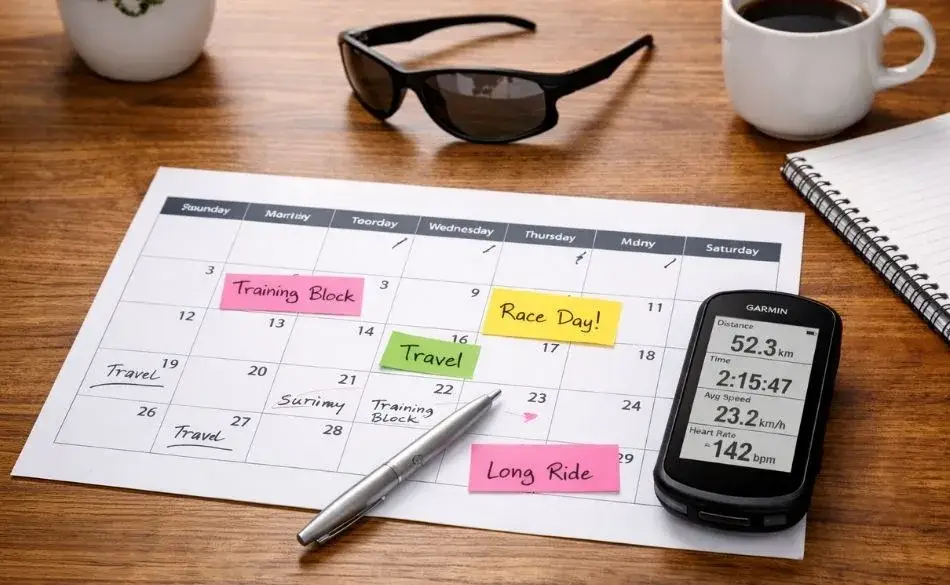
A cycling calendar serves a purpose beyond simply showing what events are available. More importantly, viewing a cycling event calendar laid out by date and format helps organise a season in a way that balances training, racing, and recovery rather than letting those elements compete with each other. When used properly, a cycling calendar becomes a planning tool that supports better decisions over time.
For most cyclists, time and energy are limited. Training has to fit around work, family, and other commitments, which means not every ride or race can be treated the same way. With this in mind, a cycling calendar allows you to see how events are spaced across the year and whether that spacing realistically supports preparation and recovery. Without this broader view, it is easy to enter events that look manageable on their own but create problems once combined into a full schedule.
From a coaching perspective, the calendar helps establish structure early on. It makes it easier to identify which events should act as anchors for the season and which can be treated as supporting rides or lower-pressure races. This distinction matters because fitness develops through cycles of training stress and recovery. When events are planned too close together, those cycles are interrupted and progress can stall.
A cycling calendar also plays an important role in managing expectations. When the full season is visible, it encourages a more measured approach where not every event needs to be a peak performance. Some rides may be used to build endurance, others to practise pacing or group riding skills, with only a small number reserved for focused performance goals. As a result, training quality tends to remain more consistent.
Another benefit of using a calendar is that it highlights opportunities rather than just obligations. Gaps between events often signal where meaningful training blocks can fit, while busier periods suggest a need for consolidation rather than progression. Over time, this perspective helps prevent the common pattern of rushing preparation early in the season and struggling with fatigue later on.

How Cyclists Actually Use a Cycling Calendar Across a Season
Once the season is laid out, a cycling calendar begins to function as more than a simple reference. Instead, it becomes a way to understand how the year flows and how different periods should feel. Rather than focusing on individual rides or races in isolation, cyclists use the calendar to see how effort, recovery, and progression fit together over time.
Early in the process, the calendar helps establish priorities. Most cyclists naturally have one or two events that stand out, whether due to distance, terrain, or personal goals. These events become the anchor points for the season. With those key dates identified, everything else can be viewed in relation to them. Supporting rides, local races, or organised events are then placed around those anchors rather than competing with them for equal attention. As a result, it becomes easier to decide where full preparation is realistic and where a more relaxed approach makes sense.
As the season develops, cyclists continue to use the calendar to manage spacing. Seeing events laid out across weeks makes it clearer whether there is enough time to recover and train effectively between efforts. A single long ride or race may feel manageable on its own. However, repeated efforts without sufficient gaps often lead to accumulating fatigue. By checking spacing ahead of time, cyclists can adjust expectations, reduce intensity where needed, or skip events that would compromise the bigger picture.
The calendar also shapes how training emphasis changes through the year. When longer gaps exist between events, they often signal opportunities to focus on endurance, strength, or specific weaknesses. Busier periods, on the other hand, usually require a shift toward maintenance and recovery rather than chasing further fitness gains. In this way, the calendar helps prevent the common mistake of trying to build fitness when the season structure does not allow it.


Understanding Event Types and Formats When Using a Calendar
When using a calendar, the type of event matters just as much as the date it falls on. While it is easy to focus on timing, different formats place very different demands on your body, your training time, and your recovery. For this reason, simply counting how many events fit into a season can be misleading. Looking at event types in context helps clarify what each one realistically requires.
Road races, criteriums, gran fondos, gravel events, and mountain bike races all appear on most cycling calendars, but they serve different purposes within a season. Shorter events such as criteriums are typically high intensity and require sharp fitness and careful recovery, even though the total duration may be relatively brief. These events can be repeated more often, but only if fatigue is managed well. Longer events like gran fondos or endurance gravel races may not demand the same intensity, but they carry a higher overall load due to duration, fueling demands, and recovery time.
Terrain and format also influence preparation. A flat road race places very different stresses on the body compared with a hilly gravel event or a technical mountain bike race. Because these demands vary so widely, following structured cycling training plans that reflect the specific format can help ensure preparation stays targeted rather than generic. When these events are viewed side by side on a calendar, it becomes easier to see when preparation needs to shift and when continuity can be maintained. Without that awareness, cyclists often underestimate how much adjustment is required when moving between formats.
Another important consideration is how events are typically used within a season. Some rides or races are well suited as development opportunities, where the goal is to gain experience or test fitness rather than perform at a peak level. Others may be clear priority events that require more focused preparation and recovery. A cycling calendar helps separate these roles by showing how events relate to one another across the season.


Selecting Events That Fit Your Cycling Season
Once event types are understood, the next step is deciding which rides or races actually belong in your season. A cycling calendar can make it seem as though opportunities are endless, but the challenge is rarely a lack of options. More often, it comes down to choosing events that fit your current fitness, available preparation time, and recovery capacity rather than reacting to what looks appealing on paper.
A season calendar helps with this by showing how events sit in relation to one another. An individual ride may feel manageable on its own, yet when several demanding events appear close together, the cumulative load becomes clearer. Travel time, terrain difficulty, and event duration all add stress across a season, even when weekly training volume does not change. In this context, understanding how many hours per week you should train can help ensure event choices align with what can realistically be supported.
One practical way to approach event selection is to start with intent rather than availability. Some events may align well with your goals for the year, such as building endurance, gaining bunch-riding experience, or targeting a specific race format. Others may simply be enjoyable rides that fit around those priorities. When intent guides selection, the calendar becomes a tool for checking whether choices are realistic rather than something that needs to be filled.
Course characteristics also play an important role. Two events of similar distance can require very different preparation depending on elevation, surface, and technical demands. A hilly road race, a flat criterium, and a gravel fondo may all sit in the same month, but preparing for all three at once is rarely practical. Viewing these demands across a calendar helps highlight where focus needs to narrow.
Equally important is recognising which events to leave out. Skipping a ride that sits too close to a key goal or disrupts an important training block is often a positive decision rather than a missed opportunity. Over time, cyclists who become more selective tend to train more consistently and arrive at priority events in better condition.


Using Your Cycling Event Calendar to Plan Training Blocks
Once events are selected, the cycling calendar starts to act as the framework for how training is organised across the season. Rather than training in a continuous, unstructured way, cyclists use the spacing between events to shape training blocks with a clear purpose. At this stage, the calendar shifts from being informative to genuinely useful.
Early in the season, the calendar often reveals longer gaps with few or no events. These periods are well suited to foundational work, such as building aerobic endurance, improving basic strength, or addressing technical weaknesses. Because there is no immediate pressure to perform, training can progress steadily and consistently. In many cases, this is where the most meaningful fitness gains are made, even though race results are still some distance away.
As key events begin to approach, the calendar naturally signals a change in emphasis. Training blocks become more specific, with sessions that better reflect the demands of upcoming rides or races. This is also where understanding how to choose a cycling training plan that matches your event schedule and recovery capacity becomes important. Volume may gradually reduce while intensity becomes more focused, allowing fitness to be expressed rather than continually accumulated. Without a clear view of the calendar, these transitions are often mistimed, leading either to tapering too early or carrying unnecessary fatigue into important events.
Between events, the calendar also helps define what is realistic. Short gaps may only allow for recovery and maintenance, while longer gaps create space for another focused development phase. Seeing this ahead of time helps prevent the common mistake of trying to push fitness forward when the season structure only supports consolidation. In this way, the calendar quietly protects training quality.
Importantly, the calendar provides context when plans need adjusting. Illness, missed sessions, or unexpected fatigue are easier to manage when the broader structure is visible. Instead of reacting day by day, cyclists can look ahead and decide whether to protect a key training block, modify an upcoming event, or allow extra recovery without derailing the season.


Comparing Cycling Event Types by Distance and Commitment
When planning a season, not all cycling events carry the same training and recovery cost, even if they appear similar on a calendar. While distance is one factor, overall commitment is shaped just as much by intensity, terrain, technical demands, and how often an event can be repeated without disrupting training. For that reason, viewing these differences side by side adds important context.
Shorter, high-intensity events can look easy to slot into a season. However, they often place a heavy load on the nervous system and recovery, especially when raced frequently. Longer events may feel steadier on the day, but their impact tends to extend well beyond the finish due to fueling demands and accumulated fatigue. Over time, these differences influence how much training quality can be maintained across a season.
Comparing event types also helps clarify expectations. Some events work well as regular training stimuli or experience builders, while others are better treated as clear focus points. Without this perspective, it is easy to underestimate how quickly fatigue can accumulate or to overestimate how often peak performances are realistic. The table below provides a practical reference, grouping common cycling event types by their typical role, preparation demands, and planning risks.
👉 Swipe to view full table
| Category | Criterium | Road Race | Gran Fondo | Gravel / MTB Marathon |
|---|---|---|---|---|
| Typical Duration | 30–90 minutes | 2–4 hours | 4–8+ hours | 3–7+ hours |
| Season Role | Speed development or short-term focus event | Primary race or mid-season goal | Endurance challenge or experience ride | Major endurance or technical goal |
| Preparation Demand | High intensity, shorter build | Balanced endurance and intensity | Extended endurance preparation | Endurance plus technical skills |
| Recovery Impact | Lower overall, but accumulates quickly | Moderate recovery required | High recovery needs | High to very high recovery needs |
| Typical Frequency | Multiple per season with spacing | Several with selective prioritisation | One or two per season | Usually one key event |
| Planning Risk | Overuse and cumulative fatigue | Trying to peak too often | Underestimating recovery time | Overcommitting to multiple long events |

Common Mistakes Cyclists Make When Relying on a Calendar
Even with a well-organised cycling calendar, planning errors are common. In most cases, the issue is not the calendar itself, but how it is interpreted. When cyclists focus more on what is available than what is appropriate, a season can quietly become too crowded, and training quality is often the first thing to suffer.
One frequent mistake is treating every event as equally important. When multiple rides or races are entered with the same expectations, training rarely has time to settle into a productive rhythm. As a result, fitness gains are interrupted by repeated tapering and recovery, leading to inconsistent workloads. Over time, performances may plateau, not because effort is lacking, but because the season does not allow sustained development.
Another common error involves underestimating recovery needs. It is easy to assume that if events are spaced a few weeks apart, full recovery will happen naturally. In reality, fatigue from racing, long rides, travel, and regular training load can linger longer than expected. When the calendar is packed tightly, cyclists often return to structured training before they are ready. In these situations, experienced cycling coaching can help interpret signals from training and adjust plans before fatigue becomes a bigger issue.
Overcommitting early in the season is another pattern that appears frequently. Riders may enter several events months in advance, driven more by motivation than readiness. As the season unfolds, those early commitments can become obligations that no longer match current fitness or life circumstances. At that point, the calendar stops acting as a planning tool and begins to feel like a fixed schedule that cannot be adjusted.
There is also a tendency to overlook event demands when scanning a calendar. Two events that look similar in distance can differ significantly in terrain, technical difficulty, and intensity. Choosing events without accounting for these differences can result in mismatched preparation and unexpected fatigue, particularly when formats change within short periods.

Long-Term Value of a Well-Planned Calendar
A well-planned cycling calendar does more than organise a single season. Over time, it supports steady development by creating continuity from one year to the next rather than forcing repeated resets. When seasons are planned with intent, each year can build on the last, allowing fitness, skills, and experience to progress in a more sustainable way.
One of the main long-term benefits of this approach is consistency. By avoiding overcrowded schedules and poorly spaced events, cyclists spend more time training productively and less time recovering from avoidable fatigue. As a result, a steadier rhythm develops, allowing fitness to accumulate gradually rather than rising and falling sharply. Across multiple seasons, that consistency becomes one of the strongest contributors to improvement, particularly for amateur riders balancing training with other commitments.
A cycling calendar also helps refine goal-setting over time. When events are chosen and reviewed within a broader seasonal framework, cyclists gain a clearer understanding of which formats suit them and which may require more preparation. Instead of chasing results in every event, progress is measured by how well training quality, recovery, and performance align across the year. This often leads to more realistic expectations and fewer frustration-driven decisions.
Looking across several seasons, a calendar can also reveal patterns that might otherwise go unnoticed. Some cyclists realise they repeatedly target the same types of events, while others avoid certain formats altogether. Recognising these patterns makes it easier to introduce variety, address weaknesses, or gradually step up to more demanding challenges without abrupt changes that increase risk.
Equally important is how a calendar supports decision-making when setbacks occur. Illness, injury, or changes in life circumstances are inevitable over the long term. When a calendar is built with flexibility in mind, it becomes easier to adjust priorities without abandoning structure altogether. Rather than viewing disruptions as failures, cyclists can adapt plans and carry lessons forward into the next phase.

Pulling a Cycling Season Together
A cycling calendar is most useful when it is treated as a planning tool rather than simply a list of events to complete. While it may start as an overview of rides and races, its real value lies in how it helps organise training, recovery, and priorities across an entire season.
When used thoughtfully, a cycling calendar supports better decision-making over time. It helps clarify which events matter most, where development fits best, and when recovery needs to take precedence. Just as importantly, it reduces the pressure to do everything. By stepping back and viewing the season as a whole, cyclists are better able to space efforts, manage fatigue, and avoid the common pattern of rushing preparation early and struggling later on.
Over time, this approach becomes more than seasonal planning. Patterns begin to emerge, expectations become more realistic, and each year builds more smoothly on the last. Rather than reacting to dates as they appear, cyclists can plan with intent and adjust when circumstances change.
A cycling calendar helps you see what is coming, but turning that into the right balance of training blocks, recovery, and realistic event choices is where many riders struggle. Small planning errors can quietly build across a season and affect consistency.
If you want support applying these principles to your own schedule, cycling coaching at SportCoaching provides structured guidance based on your goals, available time, and event calendar so your season stays consistent and sustainable.
Learn more about cycling coaching