






Find Your Next Cycling Race
Ready to put your training to the test? Here are some upcoming cycling events matched to this article.
 Coach Graeme
Last updated:
Cycling activates the glutes — EMG research confirms it. But for most cyclists, the glutes are significantly underutilised compared to the quadriceps, and that imbalance costs watts and causes injury. How much cycling actually builds your glutes depends on how you ride, your bike fit, and what you do off the bike. For the vast majority of riders, cycling alone won't adequately develop the glutes. This guide covers why cycling is quad-dominant by design, the three reasons most cyclists underfire their glutes, how to fix it through bike position and technique, and the specific exercises that build glute strength for cyclists.
Not sure where to start with training?
Tell us your goal and schedule, and we’ll give you clear direction.
No obligation. Quick, practical advice.
Explore our cycling training resources for more helpful articles and resources.
The gluteal complex consists of three muscles, each with a distinct role in cycling performance:
Gluteus maximus — the largest muscle in the human body. Primarily responsible for hip extension (straightening the hip from a flexed position) and external rotation of the thigh. In cycling, the glute max is most active during the downstroke — roughly from the 12 o’clock to 5 o’clock position of the pedal stroke, as the leg extends and the hip straightens. It is the primary power-producing glute muscle and, when properly activated, produces significant watts in every pedal stroke.
Gluteus medius — the primary hip abductor (moves the leg away from the midline) and a major contributor to hip and pelvic stability. In cycling, the glute medius prevents the pelvis from dropping or tilting side-to-side during the single-leg loading phase of each pedal stroke. Cycling Weekly’s physiotherapy analysis identifies glute medius weakness as the primary cause of knee tracking problems in cyclists — when the glute med fails to stabilise the hip, the knee collapses inward toward the frame, creating medial knee pain.
Gluteus minimus — the smallest of the three, assists the medius in hip stabilisation and rotation. Less commonly discussed but functionally important for efficient pelvic control over long rides.
| Muscle | Primary function | Role in cycling | Consequence when weak or inactive |
|---|---|---|---|
| Gluteus maximus | Hip extension, external rotation | Downstroke power (12–5 o'clock); primary force producer at the hip | Lost power; quads and hamstrings overloaded; faster fatigue |
| Gluteus medius | Hip abduction, pelvic stability | Prevents pelvic drop; stabilises knee tracking throughout pedal stroke | Knee pain (medial); ITB issues; hip shift under load |
| Gluteus minimus | Hip stabilisation, rotation | Assists medius; controls thigh rotation in the pedal stroke | Subtle hip instability; knee tracking problems |
EMG research consistently shows that the quadriceps — particularly the rectus femoris — are the most heavily activated muscles during cycling, more so than the glute max. Live Science’s review of the EMG literature explains the biomechanical reason: the rectus femoris is both a knee extensor (straightening the knee during the downstroke) and a hip flexor (preparing for the upstroke). It is therefore active across a larger proportion of the pedal stroke than the glute max, which is primarily active during the hip extension phase of the downstroke only.
The deeper problem is the Law of Reciprocal Inhibition. Since the rectus femoris flexes the hip and the glute max extends it, these muscles are functional antagonists. When the rectus femoris contracts strongly (as it does throughout most of the pedal stroke in quad-dominant cyclists), it neurologically suppresses the glute max — reducing the glutes’ ability to contribute force even during the phase of the stroke where hip extension is occurring.
The practical implication: Cyclists who default to quad-dominant pedalling over time progressively reduce the neuromuscular pathway to the glutes. The brain learns to call on quads and hamstrings for cycling power, and the glutes become bystanders — present but underutilised. CTS (Carmichael Training Systems) coaches identify this as the primary cause of underdeveloped and underutilised glutes in experienced cyclists.
Furthermore, cycling does not use the full range of hip extension. Unlike running — where each stride includes a full hip extension at toe-off — the cycling pedal stroke keeps the hip in a partially flexed position even at the bottom of the stroke. The glute max produces its maximum force at longer muscle lengths (greater hip flexion), but cycling’s constrained range means the muscle never reaches the full extension that would produce peak activation.
The cycling biomechanics problem is compounded by modern life. Cyclists who sit at desks for 8 hours before riding are arriving at the bike with already-compromised glute function. Prolonged sitting produces two specific problems:
Hip flexor tightening: The hip flexors (particularly the iliopsoas) shorten in the seated position. Tight hip flexors cause anterior pelvic tilt — a forward tilting of the pelvis that simultaneously lengthens the glutes beyond their optimal length-tension relationship. When a muscle is passively lengthened beyond its optimal point, its contractile force drops. The glutes sitting in a lengthened position from tight hip flexors literally cannot produce as much force — even when the brain tries to activate them. Biomechanics Zone’s analysis identifies tight hip flexors as one of the primary causes of reduced glute activation in cyclists.
Reduced neuromuscular connectivity: Muscles that are not regularly activated lose the quality of their neural pathways to the motor cortex. BikeRadar describes this phenomenon as ‘gluteal amnesia’ — the glutes become progressively less responsive to neural activation signals because sitting does not require them to fire. Cycling Weekly’s physiotherapists report that this is endemic among desk-based cyclists: the glutes are present and structurally capable, but the brain has learned not to call on them, and the signal has become weak from disuse.
The combination — quad-dominant pedalling pattern reinforced by reciprocal inhibition, plus compromised neural pathways from extended sitting — means many cyclists are producing significantly less power than their glute mass would theoretically allow, while simultaneously increasing injury risk from the compensatory overloading of quads and hamstrings.
Lost watts. The gluteus maximus is the largest muscle in the body. When it contributes adequately to the downstroke, it produces meaningful power in every pedal revolution. TrainerRoad’s coaching analysis notes that proper glute activation during the downstroke can “dramatically increase power.” Cyclists who activate their glutes effectively access a larger muscle mass for force production — directly translating to higher FTP and sustainable power. Our cycling intervals guide covers how power output from all muscle groups is the target of structured interval training.
Anterior knee pain. When the glutes fail to stabilise the hip and knee, the quadriceps take on dual roles: power production and knee stabilisation. This is not what the quads were designed for, and the result is anterior knee pain from patellofemoral stress. Cycling Weekly’s physio Nichola Roberts is explicit: the glutes stabilise the hip, and without that stabilisation, “knee problems follow.” This is the most common knee complaint among cyclists and is often attributed to the knee itself when the root cause is at the glute.
Lower back pain. The glutes stabilise the pelvis and lower back. Inadequate glute activation causes the lower back muscles to overcompensate for pelvic instability over long rides. Many cyclists who experience lower back pain after long rides — particularly at the lumbar spine — are experiencing the consequence of inadequate glute function, not a back problem per se.
Faster fatigue on long rides. Quads and hamstrings were not designed to carry the entire power production load through a 4-hour ride. When glutes are underactivated, the muscles that are working fatigue sooner — particularly on climbs where hip extension demand increases.
Bike fit is one of the most direct levers for improving glute activation without any off-bike training. Small adjustments can significantly change how much the glutes contribute to each pedal stroke.
Saddle height: A saddle that is too low prevents full hip extension at the bottom of the pedal stroke, limiting the range through which the glute max can contract. A saddle that is too high forces the hips to rock side-to-side, destabilising pelvic position and reducing glute med contribution. The correct saddle height allows a slight knee bend at the bottom of the stroke (25–35°) with a level pelvis.
Saddle fore/aft position: Moving the saddle slightly rearward increases the hip extension demand at the top of the stroke, recruiting more glute max activity. BikeRaceInfo coaches note that sitting back in the saddle and pushing the hips back is one of the most immediate cues for improving glute activation on the bike.
Cleat position: Cycling Weekly physiotherapists note that badly fitting shoes or thick insoles can break the co-contraction between foot push-through and glute activation. The ball of the foot should be positioned over the pedal axle. Cleat alignment that causes the knee to track inward specifically reduces glute med activation.
Pelvic tilt: Rotating the pelvis slightly forward (flattening the back slightly) on the bike brings the glutes into a better length-tension relationship for force production. This is counterintuitive for many cyclists who habitually round the lower back. Grabbing the drops rather than the hoods can cue this position change. Our cycling cadence guide covers how pedalling mechanics — including pelvic position — affect force application across the stroke.
Drop the heel at the bottom of the stroke: Instead of pointing toes downward at 5–7 o’clock, actively flattening the foot and dropping the heel engages the posterior chain — including the glutes — more effectively during the downstroke completion. TrainerRoad coaching analysis identifies this as one of the most accessible cue changes for improving glute contribution without off-bike work.
Increase resistance and tackle climbs: Higher resistance demands greater hip extension force, which increases glute activation. A flat, easy spin at low cadence requires minimal glute contribution; a climb at threshold effort recruits the glutes far more substantially. Including regular hill work or high-resistance intervals is one of the most practical ways to train glute contribution within normal cycling sessions. Our cycling training plan covers how to structure interval and climbing sessions.
Stand out of the saddle: Seated cycling keeps the hips in a flexed position throughout, limiting glute max range. Standing out of the saddle for climbs and sprint efforts dramatically increases hip extension range and glute activation. Including regular standing efforts in training builds glute-specific cycling strength.
Conscious glute cues: BikeRaceInfo coaches note that the first time many cyclists deliberately activate their glutes on the bike — mentally cueing “push from the hip” at the top of the downstroke — they feel a qualitatively different sensation and often report immediately higher power output. This neurological reconnection is real: the brain-muscle pathway to the glutes can be strengthened through deliberate attention during riding.
Off-bike strength training is the most reliable way to actually build glute mass and neuromuscular connectivity for cycling. CTS coaches recommend these as starting exercises because they target the specific glute activation patterns most relevant to cycling — hip extension and hip stabilisation — rather than maximum force production for its own sake.
| Exercise | Primary target | Cycling relevance | Sets × Reps |
|---|---|---|---|
| Single-leg hip thrust | Glute max | Hip extension at the hip angle experienced in cycling; most direct glute max training for cyclists | 3 × 10–12 per leg, 2–3×/week |
| Romanian deadlift / hip hinge | Glute max, hamstrings | Posterior chain loading through hip extension range; builds glute max and strengthens glute-hamstring connection | 3 × 8–10, 2×/week |
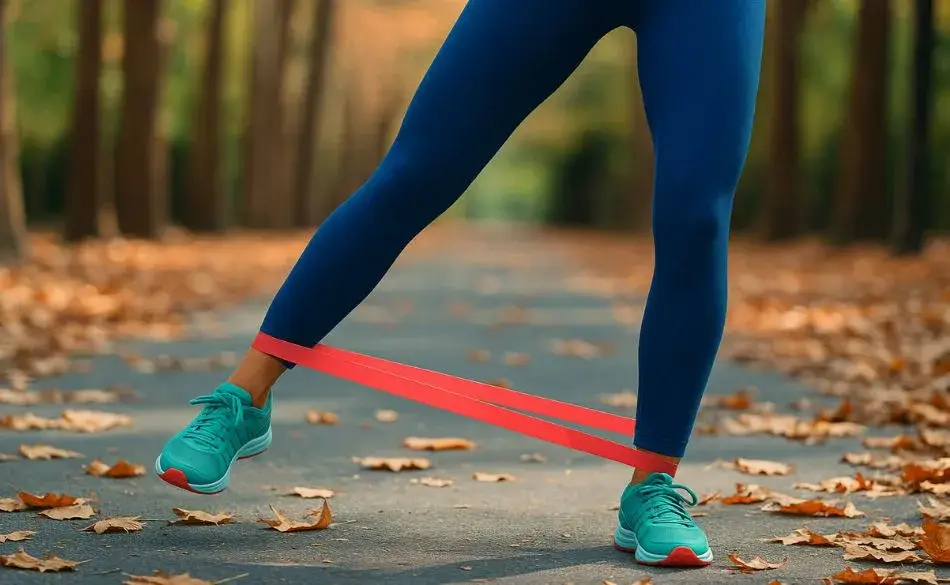
| Clamshell (with resistance band) | Glute medius | Hip abduction and external rotation; directly addresses the glute med weakness causing knee tracking problems | 3 × 15–20 per side, 3×/week |
| Bulgarian split squat | Glute max, quads | Single-leg loading pattern replicating cycling; posterior glute bias with more hip flexion at depth | 3 × 8–10 per leg, 2×/week |
| Glute bridge (progressing to single-leg) | Glute max | Entry-level glute activation; suitable for cyclists new to glute training before progressing to hip thrusts | 3 × 15 both legs → 3 × 10 single leg |
| Monster walks (resistance band) | Glute medius, minimus | Lateral glute activation; builds the stabilisers that prevent knee collapse during the pedal stroke | 2 min continuous, 2–3×/week |
Two focused sessions per week of 20–30 minutes is sufficient to produce meaningful glute strength and neuromuscular improvement in cyclists. More important than volume is specificity and consistency — the goal is to rebuild the brain-to-glute pathway that sitting and quad-dominant cycling have weakened. Start with bodyweight or light resistance and focus on genuinely isolating the glutes rather than allowing the hamstrings or lower back to compensate. Our calf exercises for cyclists guide covers the complementary lower-leg work that pairs effectively with this programme. For cyclists also running or doing triathlon, our runner’s strength training guide includes lower body work that targets glutes and hamstrings alongside calf and ankle strength.
For masters cyclists, glute strength work is especially important — sarcopenia (age-related muscle loss) preferentially affects the glute max, and the neural pathways that connect to the glutes weaken faster with inactivity as we age. Our guide on maintaining FTP with age covers the off-bike strength work that preserves cycling power through the decades. Athletes who do dedicated leg strength work and cycling should also read our cycling after a leg workout guide — timing strength sessions relative to riding sessions matters for recovery when adding glute work to a cycling programme.
Pre-ride glute activation exercises — bridges, clamshells, bodyweight squats — are commonly recommended to “wake up” the glutes before a ride. The evidence is nuanced. Cycling Weekly’s physiotherapist Roberts notes that for long rides (2+ hours), pre-ride activation exercises make relatively little difference — the neural pathway reset they provide doesn’t survive the first 10–15 minutes of riding at the intensity most cyclists default to. However, for short intense sessions — time trials, criterium races, high-intensity intervals — pre-ride activation can meaningfully improve glute recruitment during the effort by increasing the neural readiness of the muscle group immediately before demand is placed on it.
The practical recommendation: include 5 minutes of glute activation (bridges, clamshells, hip hinges) before short intense sessions. For long base rides, the more valuable investment is the regular off-bike strength programme (2×/week) that rebuilds the underlying neuromuscular pathway over weeks and months. Our cycling base training guide covers how to structure long Zone 2 rides — including the technique cues for improving posterior chain engagement during endurance rides.
Unlock More Power With Structured Cycling Coaching
A SportCoaching cycling coach addresses the full picture — training zones, interval structure, off-bike strength work, and riding technique — to help you produce more power from the muscles you already have. AUD $143/month, no lock-in, 90-day performance guarantee.
Does cycling build glutes?
Yes, but primarily tones rather than significantly builds them. Cycling is quad-dominant — EMG research shows the quadriceps are more heavily activated than glutes across the full pedal stroke. Cycling alone won’t correct a quad-glute imbalance or build meaningful glute mass without targeted off-bike strength training.
Why do cyclists have weak glutes?
Three compounding factors: cycling’s limited hip extension range reduces peak glute activation; reciprocal inhibition from quad dominance suppresses the glute max; and prolonged sitting causes hip flexor tightness and ‘gluteal amnesia’ — reduced neuromuscular connectivity to the glutes. All three are addressable with bike fit, technique, and off-bike training.
How do I activate my glutes while cycling?
Drop the heel at 5–7 o’clock (don’t point toes down), sit back in the saddle, increase resistance or tackle climbs, stand out of the saddle for efforts, and use a conscious “push from the hip” cue at the top of the downstroke. A bike fit check for saddle height and fore-aft position is the highest-impact single intervention.
What happens if your glutes don’t fire when cycling?
Lost watts, anterior knee pain from quad overloading, lower back pain from pelvic instability, and faster muscle fatigue on long rides. The glutes are the largest muscle group in the body — underactivated, significant performance is left unrealised and injury risk increases substantially.
What are the best glute exercises for cyclists?
Single-leg hip thrust (most cycling-specific), Romanian deadlift, clamshells with resistance band (glute medius for knee stability), Bulgarian split squat, and glute bridges for beginners. Two focused sessions per week of 20–30 minutes consistently rebuilds the neuromuscular pathway that cycling and sitting have weakened.
Ready to put your training to the test? Here are some upcoming cycling events matched to this article.
Head Coach & Founder, SportCoaching
Graeme is the founder of SportCoaching and has coached more than 750 athletes from 20 countries, from beginners to Olympians, in cycling, running, triathlon, mountain biking, boxing, and skiing. His coaching philosophy and methods form the foundation of SportCoaching's training programs and resources.
No matter your goals, SportCoaching offers tailored training plans to suit your needs. Whether you’re preparing for a race, tackling long distances, or simply improving your fitness, our expert coaches provide structured guidance to help you reach your full potential.
Structured cycling coaching to build power, endurance, and speed.
What’s included
Browse upcoming Australian running, cycling, and triathlon events in one place. Filter by sport, check dates quickly, and plan your training around something real on the calendar.
Choose your plan to get started with personalized training plans designed to help you reach your goals.


Minna Backman
When you’re new, feedback is especially important, and Graeme is highly skilled at both analyzing numbers and understanding the importance of mental strength.