










Want help turning consistency into progress? Coaching keeps your training simple, structured, and sustainable.
Start Coaching →
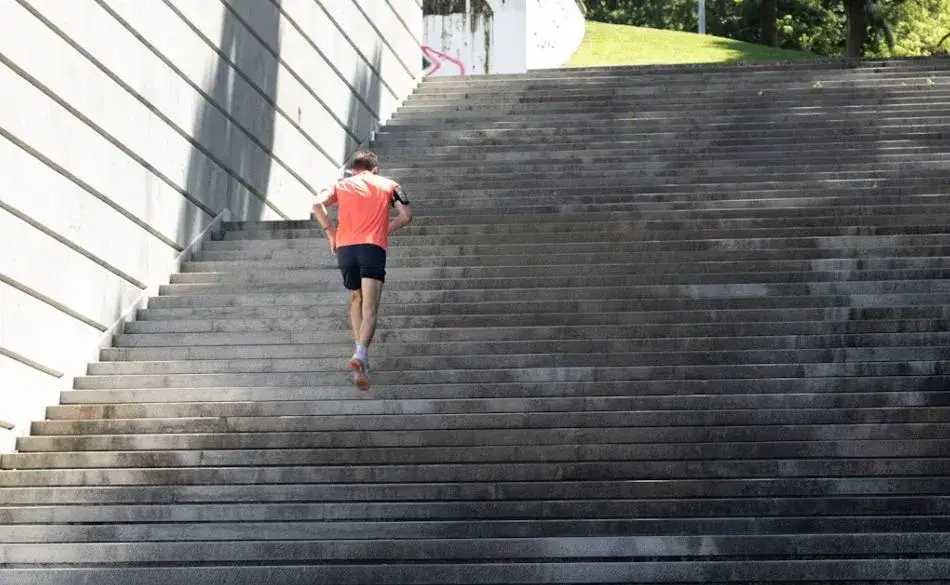
Runner doing stair running workout outdoors

Last updated:

Stair Running: Benefits, Workouts and How to Do It Right

Stair running is one of the oldest, most accessible, and most underused tools in an endurance athlete's training kit. It requires no gym membership, no specialist equipment, and barely 20 minutes of focused work. Yet the physiological returns are disproportionate — multiple peer-reviewed studies show it improves VO2 max, lower-body strength, running economy, and speed in ways that flat running alone cannot replicate. Whether you're training for a 5km personal best, a mountain race, or simply looking for a time-efficient way to build fitness, this guide covers the science, the mechanics, the workouts, and the technique details that separate effective stair training from just running up some steps.

Chat with a SportCoaching coach

Not sure where to start with training?

Tell us your goal and schedule, and we’ll give you clear direction.

No obligation. Quick, practical advice.

Article Categories:

Explore our running advice and tips for more helpful articles and resources.

Quick Answer

Stair running builds strength, power, VO2 max, and running economy simultaneously — making it one of the most time-efficient training tools available. The steep angle forces greater hip flexion and knee drive than flat running or even most hills, developing the fast-twitch muscle fibres that improve speed. Run 1–2 sessions per week, treat ascent as the work interval, and walk or jog down for recovery. Keep early sessions to 5–10 minutes of quality work and build gradually — the eccentric load on the quads from descending is higher than most runners expect.

The Science: What Stair Running Actually Does to Your Body

VO2 Max and Cardiovascular Fitness

Multiple controlled studies confirm that stair climbing — even in modest doses — produces significant cardiovascular adaptations. A 2005 British Journal of Sports Medicine study (Boreham et al.) tracked sedentary women through 8 weeks of progressive stair climbing (starting from one ascent per day and building to five) on a 199-step public staircase. The result: a 17.1% increase in VO2 max alongside a 7.7% reduction in LDL cholesterol. A separate PubMed study comparing 9 weeks of stair-climb training to conventional run training found the stair group improved VO2 max by 12% and reduced 1.5-mile run time by 8% — results that came within close range of the run-training group (16% VO2 max gain, 11% run time improvement). Another study on middle-aged women showed stair training improved VO2 max by 11.1% and increased quadriceps strength simultaneously — an adaptation that running alone rarely produces with the same efficiency.

A PMC scoping review of stair climbing interventions found that studies lasting more than 8 weeks consistently produced VO2 max increases of 2–5 ml/kg/min. For context, a 2–5 ml/kg/min improvement in VO2 max is a meaningful performance gain — the kind that translates to visible improvements in race times and training pace tolerance. This places stair running in the same effectiveness tier as interval training for cardiovascular development. Our guide on interval running benefits covers how stair work fits within a broader high-intensity training framework.

Strength and Power Development

What distinguishes stair running from most cardiovascular training is that it simultaneously produces strength adaptations. The steep angle (typically 55–70 degrees) means each step requires significant hip extension and knee extension force against gravity — similar in many ways to a loaded split squat or step-up, but performed at running speed. The glutes, quadriceps, hamstrings, and calves are all heavily recruited on the ascent. The hip flexors and core are engaged to drive the knee up to each step.

This plyometric quality — rapid eccentric loading followed by explosive concentric contraction — is what builds fast-twitch muscle fibres. These are the fibres responsible for speed and power output. Steady-state easy running is predominantly slow-twitch work and doesn’t sufficiently stimulate the fast-twitch system. Stair running does — which is why athletes who add stair sessions to an easy-run-dominated training week often notice improved sprint speed, better hill running, and improved ground contact time relatively quickly. Our sprint training guide explains how the plyometric stimulus from stair work activates the same neuromuscular pathways as speed work.

The Descent: Eccentric Loading and Its Benefits

Most stair running articles focus entirely on the ascent. The descent deserves more attention. When you descend stairs, your quadriceps work eccentrically — contracting while lengthening — to control the step down against gravity. This eccentric load is the same mechanism behind exercises like eccentric heel drops for Achilles management and Nordic hamstring curls for hamstring injury prevention. Controlled research shows the descent component of stair training improves blood glucose management more than ascent alone, and develops the quad strength needed for downhill trail running and the terminal swing phase of the running stride.

The practical implication: don’t skip descents, but don’t run them hard until your muscles have adapted. Walking or easy jogging down in the early weeks of stair training serves two purposes — it provides recovery between ascent intervals, and it progressively loads the quads eccentrically without overdoing it before the tissue is prepared. Our guide on eccentric training for runners explains the broader principle of controlled eccentric loading and its injury-prevention applications.

Muscles Worked: Stair Running vs Flat Running

👉 Swipe to view full table
Muscle GroupFlat RunningStair Running (Ascent)Stair Running (Descent)
GlutesModerateVery high — each step requires powerful hip extensionModerate — stabilisation role
QuadricepsModerateHigh — knee extension against gravityVery high — eccentric control of each step
HamstringsModerateModerate — assists hip extensionModerate
Calves (gastrocnemius/soleus)High — propulsionHigh — plantarflexion at push-offModerate
Hip flexorsModerateHigh — knee drive to each stepLow
CoreModerateHigh — stabilisation under increased loadModerate
Stabiliser muscles (peroneals, tibialis)Low-moderateHigh — narrow stair surface demands balanceHigh — lateral stability critical on descent

The standout difference is the glutes and hip flexors. Stair running demands a far more exaggerated knee drive than flat running — lifting the leg high enough to clear the next step requires significant hip flexor activation, while the push-off into full hip extension loads the glutes more than any other form of running. Runners with glute weakness (a surprisingly common issue) often find stair running reveals this deficiency immediately — hips drop, lower back compensates, pace collapses. Stair running both diagnoses and corrects the problem simultaneously.

Stair Running vs Hill Running: Which Is Better?

Both produce overlapping benefits, but they’re not interchangeable. Hills are running-specific — the muscles, biomechanics, and energy systems used are closely aligned with road or trail running. For runners specifically training for performance on hills or for race fitness, hill running is the more specific choice.

Stairs are steeper — typically 55–70 degrees versus 5–15 degrees for most accessible hills — which means a greater training stimulus per unit of distance covered. The shorter stride length and higher step frequency on stairs also builds cadence and foot-speed in a way that hill running doesn’t replicate. Stairs are available almost everywhere: stadium bleachers, park steps, office building stairwells, car parks. And stair running sessions, because they’re higher intensity per minute, can be effective in 15–20 minutes — a significant practical advantage for time-constrained athletes.

👉 Swipe to view full table
FactorStair RunningHill Running
AngleVery steep (55–70°)Moderate (5–15° typical)
Muscle emphasisQuads, glutes, hip flexors (exaggerated)Similar to flat running with greater glute demand
Plyometric stimulusHighModerate
Running specificityModerateHigh
AccessibilityAlmost everywhereGeography-dependent
Session efficiencyHigh — 15–20 min of quality workDepends on hill length
Descent managementWalk or jog down (required recovery)Run or jog down (more recovery running)
Best forPower, speed, VO2 max, time efficiencyRunning-specific endurance, hill racing

The practical recommendation: use both when possible, but if you only have one option, stair running provides a higher training stimulus per minute in an urban setting. For runners training specifically for trail racing or mountain events, hill running should be the priority. For road runners looking to add power without extending session length, stairs are excellent. Our guide on running surfaces covers how surface variation affects training adaptation.

Stair Running Technique

Good technique on stairs is more important than on flat running because the consequences of poor form — trips, falls, injuries — are more immediate.

Ascending: Form Points

Forward lean. Lean slightly forward from the ankles (not the hips) as you ascend. This positions your centre of mass over the working leg and allows the glutes and hip extensors to drive the movement efficiently. Staying too upright shifts load onto the lower back and reduces glute engagement.

Drive the knee, not the foot. Think of the movement as a knee drive upward rather than a toe push-up. The hip flexors are what lift the leg to the next step — if you’re thinking “push the foot down,” you’re focusing on the wrong phase. The push-down comes naturally; the conscious cue should be the knee drive and the forward lean.

Stay on the ball of the foot. Land on the ball of the foot or mid-foot on each stair, not the heel. Heel-striking on stairs reduces propulsion efficiency and increases impact on the knee. The shorter contact time on the ball of the foot also builds better cadence mechanics that transfer to flat running — the same high-cadence, light-contact pattern that improves running economy. Our running cadence guide explains why this foot-contact pattern matters for flat running performance too.

Arm drive. Use your arms actively — the same alternating arm-drive as running. Arms contribute to balance and momentum, and an active arm swing on stairs reinforces the same coordination that improves running form on flat ground. See our running form guide for how arm mechanics connect to lower-body efficiency.

Eyes ahead, not down. Keep your gaze directed two to three steps ahead, not directly at your feet. This keeps the head position neutral and reduces the tendency to hunch forward from the upper back. Hunching compresses breathing mechanics and increases upper back fatigue.

Descending: Safety First

Descend slowly, particularly in the early weeks of stair training. Walk or jog down — never sprint down. The forces on the knee during fast stair descent are significant, and the proprioceptive demands (narrow step surface, abrupt direction changes) create injury risk if form breaks down under fatigue. As descent tolerance builds over weeks of training, a light jog down is appropriate. Use the descent as active recovery — get your breathing back, reset, then go again on the next ascent. For runners with existing knee pain, our guide on hip and lower limb pain from running covers how to manage lower-limb loading during high-impact training.

5 Stair Running Workouts for Every Level

Workout 1: Beginner Foundation (Level 1)

Purpose: Build base tolerance for stair running without overdoing it on the first session.

Warm-up: 10 minutes easy flat running or brisk walking.

Main set: Run up the stairs at 60–70% effort. Walk down. Repeat for 6–8 total ascents. Focus entirely on form — lean, knee drive, ball of foot. Stop if form degrades significantly.

Cool-down: 5 minutes easy walking.

Total quality time: ~8–10 minutes of ascent work.

Frequency: Once per week for the first 2–3 weeks.

Workout 2: Aerobic Stair Intervals (Level 2)

Purpose: Build aerobic capacity and running-specific endurance. Equivalent to a moderate tempo session.

Warm-up: 10–15 minutes easy running.

Main set: Run continuously up and down stairs for 2 minutes at moderate effort (70–75% max HR). Rest 60 seconds (standing or slow walk). Repeat 5–6 rounds. Build to 8 rounds over 3–4 weeks.

Cool-down: 10 minutes easy jogging.

Notes: This format builds aerobic capacity without the high neural demand of sprint work. It’s the most accessible stair workout for runners who want volume without excessive fatigue.

Workout 3: Power Sprint Intervals (Level 3)

Purpose: Build explosive power and fast-twitch muscle fibres. Equivalent to a track sprint session.

Warm-up: 15 minutes easy running, including 4 × 20-second strides.

Main set: Sprint up the stairs at 90–95% maximum effort. Walk down completely (2–3 minutes recovery). Repeat 6–8 times. Quality is everything — each ascent should be a near-maximal effort. Stop the session when ascent time degrades noticeably.

Cool-down: 10 minutes very easy jogging.

Notes: This session produces the highest plyometric and speed stimulus. Schedule it with at least 48 hours before or after any other hard session. Our guide on interval vs continuous running explains how to balance high-intensity sessions within a training week.

Workout 4: Pyramid Intervals (Level 3–4)

Purpose: Develop both speed and aerobic endurance in a single session through varied interval lengths.

Warm-up: 10–15 minutes easy running.

Main set (each effort is a continuous ascent):

Sprint 15 seconds, walk down, rest 15 seconds → Sprint 30 seconds, walk down, rest 30 seconds → Sprint 45 seconds, walk down, rest 45 seconds → Sprint 60 seconds, walk down, rest 60 seconds → Reverse back down to 15 seconds.

That is one full pyramid. Complete 2 full pyramids with 3 minutes of easy walking between pyramids.

Cool-down: 10 minutes easy jogging.

Notes: The pyramid structure develops both anaerobic power (short sprints) and aerobic capacity (60-second efforts). It’s one of the most efficient stair formats for runners targeting 5km to half marathon performance improvements. Our sub-24-minute 5km plan uses a similar intensity structure to develop speed-endurance.

Workout 5: Double-Step Power Session (Level 4)

Purpose: Maximum hip extension, glute, and stride-length development. Best for trail runners and athletes targeting explosive power.

Warm-up: 15 minutes easy running + single-step stair warm-up (2–3 easy ascents).

Main set: Ascend taking two steps at a time (skipping every other stair). Walk or jog down single-step. Each double-step ascent emphasises full hip extension and maximum glute contraction. Perform 6–8 ascents at 75–80% effort.

Superset option: After every 2 double-step ascents, perform 10 alternating reverse lunges at the base of the stairs before the next ascent. This extends the glute and hip flexor stimulus beyond what stairs alone provide.

Cool-down: 10 minutes easy jogging + calf stretching.

Notes: Double-step running requires significantly more hip flexibility and glute strength than single-step. Do not attempt this workout until you have completed at least 4 weeks of single-step stair training.

How to Fit Stair Running Into Your Training Week

Stair running is an intensity session — treat it as such. Most runners benefit from 1–2 stair sessions per week as part of a broader training programme, not as a replacement for all other running. The typical positioning within a week:

👉 Swipe to view full table
Runner TypeStair Sessions/WeekBest PlacementOther Sessions
Beginner (3 days/week)1Middle session (e.g. Wednesday)Easy run each side + rest days
Intermediate (4–5 days/week)1–2Tuesday + Friday (separated by easy days)Long run, easy runs, one additional quality session
Advanced (5–6 days/week)1–2After warm-up jog (as part of a session) or standaloneLong run, intervals/tempo, easy recovery runs

An important note on placement within a session: stair running is best performed when fresh — early in a session after a warm-up, not bolted onto the end of a long run when fatigue is high and technique is compromised. Running coach and DPT Dr. Caitlin Glenn Sapp recommends performing stair work “prior to being fatigued” whether that’s before a strength session or within the first half of a run. This principle maximises both safety and training quality — form breaks down quickly under fatigue on stairs, and staircase injuries (twisted ankles, trips) are largely a consequence of tired, careless movement. Our running frequency guide explains how to position intensity sessions within a weekly schedule.

Who Benefits Most from Stair Running?

Stair running is valuable across a wide range of runner profiles, but the return on investment is particularly high for specific groups.

Time-constrained runners who can only commit to 30–45 minutes of training per session get a disproportionate fitness return from 15–20 minutes of focused stair work versus the same time on easy flat running. The cardiovascular and strength stimulus is significantly higher per minute.

Urban runners without easy access to hills can replicate many of the benefits of hill training through stair running. A car park stairwell, a stadium, or even a large public park with terraced stairs provides the same training effect as a natural hill.

Trail and mountain runners benefit enormously from the hip flexion and hip extension emphasis of stair running. The movement pattern closely mirrors the exaggerated knee drive and push-off required for steep ascents. Our 15km training guide covers how to structure sessions around race-specific terrain demands.

Plateau-breaking runners who have been running the same routes at the same paces for months often find that adding stair sessions disrupts the adaptation plateau rapidly. The novel stimulus — a different movement pattern, a higher plyometric demand, a new energy system emphasis — is often what’s needed to restart progress. Our guide on why running suddenly feels harder covers other plateau-breaking interventions alongside stair work.

Runners returning from injury who need cardiovascular training but need to reduce flat-ground impact can use stair climbing (walking or jogging, not sprinting) as a lower-impact aerobic substitute during recovery phases. The vertical plane of movement distributes force differently from flat running, making it tolerable for some knee and shin conditions. Always get clearance from a physio or sports medicine doctor before using stairs in injury recovery.

Safety, Common Mistakes and When to Hold Back

The most common mistakes that reduce effectiveness or cause injury in stair running are consistent across all experience levels:

Too much too soon. Stair running is significantly more demanding than the same duration of flat easy running. Runners who are fit on flat ground often overestimate their stair capacity in the first session and do far too much, resulting in extreme DOMS (particularly in the quads from eccentric descent loading) that disrupts an entire week of training. Start with less than you think you need.

Running down too fast. Descending quickly on stairs demands both significant eccentric quad strength and precise footwork. Neither develops without progressive training. Walk or jog down in the first month of stair training regardless of fitness level.

Skipping the warm-up. The calf and Achilles tendon are under substantially more load during stair running than flat running due to the higher step frequency and ball-of-foot contact. Running cold stairs without a warm-up is one of the most reliable ways to aggravate an Achilles. Warm up with at least 10 minutes of easy jogging before any stair session. Our guide on eccentric heel drops covers Achilles tendon conditioning that supports stair training.

Stair running as the only training. Stair running complements a running programme; it doesn’t replace it. Runners who substitute all flat running with stair sessions lose the running-specific adaptations (ground contact mechanics, flat-ground economy, race pacing sense) that only come from actual running. Use stair running as 10–20% of total training volume, not 100%.

Slippery or wet stairs. Wet stone or metal stairs are a trip hazard. If stairs are wet, either skip the session or treat it as a walking-pace workout. Trail shoes or shoes with good grip are preferable to racing flats on outdoor stairs. Our guide on running surfaces includes advice on grip and surface selection.

Want Stair Running Built Into Your Training Plan?

A running coach can design sessions that integrate stair work at the right frequency and intensity to target your specific race goals — without overloading your recovery.

FAQ: Stair Running

What does stair running do for your body?
It simultaneously builds VO2 max (research shows 10–17% increases in 8–12 weeks), lower-body strength, fast-twitch muscle fibres, and running economy. The steep angle and plyometric nature of stair running develops glutes, quads, and hip flexors more intensely than flat running and delivers a cardiovascular stimulus similar to interval training.

Is stair running good for distance runners?
Yes. It builds the glute and hip flexor strength that supports running posture, the fast-twitch fibres that improve race-pace speed, and cardiovascular fitness — all in a shorter session than most flat running workouts. A PubMed study found stair training improved 1.5-mile run time by 8% in 9 weeks. See our interval running benefits guide for how stair work fits within a broader speed development programme.

How often should you do stair running?
1–2 sessions per week is optimal for most runners. It’s a high-intensity session that needs at least 48 hours of recovery between it and other hard efforts. See our running frequency guide for how to position intensity sessions within a weekly schedule.

Is stair running bad for your knees?
Ascending is generally low impact and safe. Descending places significant eccentric load on the quads and patellofemoral joint. Walk or jog down (don’t sprint) and build descent tolerance gradually over several weeks. Runners with existing knee pain should consult a physiotherapist before adding stair running.

What is the difference between stair running and hill running?
Stairs are steeper (55–70° vs 5–15° for most road hills) and provide a higher plyometric stimulus. Hills are more running-specific and better for endurance. Both are valuable — use stairs for power and time efficiency, hills for race-specific conditioning.

How many stairs should I run for a good workout?
For beginners, 6–8 controlled ascents of a stadium-length staircase (50–80 steps) is sufficient. For intermediate runners, 8–12 ascents including some sprint efforts provides a serious training stimulus. Effective stair sessions take 15–20 minutes of quality work — brief but concentrated.

Find Your Next Running Race

Ready to put your training to the test? Here are some upcoming running events matched to this article.

Graeme - Head Coach and Founder of SportCoaching

Graeme

Head Coach & Founder, SportCoaching

Graeme is the founder of SportCoaching and has coached more than 750 athletes from 20 countries, from beginners to Olympians, in cycling, running, triathlon, mountain biking, boxing, and skiing. His coaching philosophy and methods form the foundation of SportCoaching's training programs and resources.

750+
Athletes
20+
Countries
7
Sports
Olympic
Level

Start Your Fitness Journey with SportCoaching

No matter your goals, SportCoaching offers tailored training plans to suit your needs. Whether you’re preparing for a race, tackling long distances, or simply improving your fitness, our expert coaches provide structured guidance to help you reach your full potential.

  • Custom Training Plans: Designed to match your fitness level and goals.
  • Expert Coaching: Work with experienced coaches who understand endurance training.
  • Performance Monitoring: Track progress and adjust your plan for maximum improvement.
  • Flexible Coaching Options: Online and in-person coaching for all levels of athletes.
Learn More →

Choose Your Next Event

Browse upcoming Australian running, cycling, and triathlon events in one place. Filter by sport, check dates quickly, and plan your training around something real on the calendar.

View Event Calendar