

Quick Answer
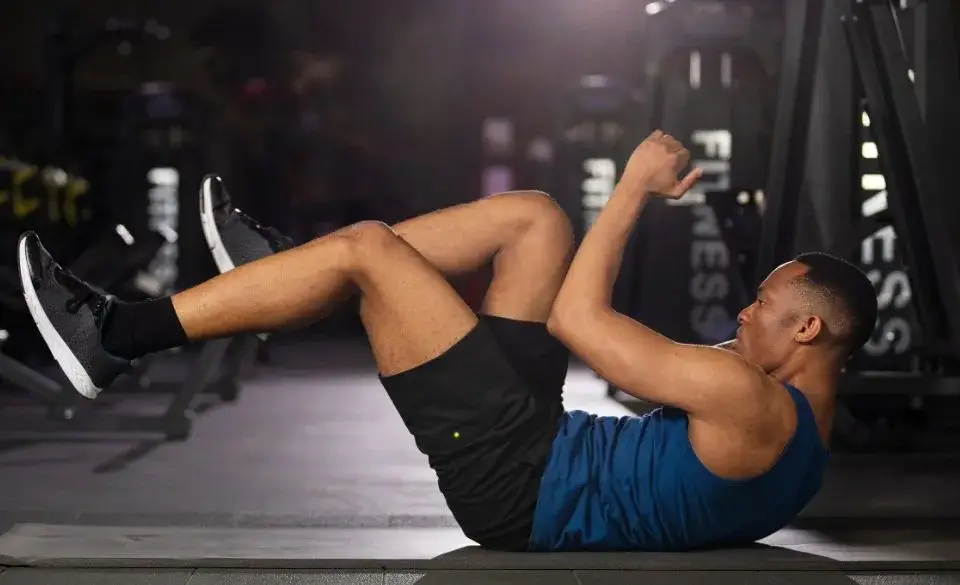
The civilian/athletic version: lie on your back with ankles crossed and knees at 90°, then curl the hips off the ground using your lower abs — keeping the movement slow and controlled. The Air Force PT test version (CLRC): lie flat with arms crossed on chest, bring knees to chest while alternating left elbow to right thigh, then right elbow to left thigh — each elbow-thigh touch is one rep. Both versions primarily target the lower rectus abdominis and obliques, and both are performed without equipment, making them excellent options for home and travel training.

The Two Versions: What's the Difference?
Because the term “cross-leg reverse crunch” applies to two genuinely different exercises, it’s worth being explicit about which is which before getting into technique.
| Feature | Civilian / Athletic Version | Air Force PT Test Version (CLRC) |
|---|---|---|
| Starting position | Back flat, knees bent 90°, ankles crossed, arms by sides | Back flat, legs straight, arms crossed over chest touching opposite shoulders |
| Movement | Curl hips off floor by contracting lower abs; knees draw toward chest | Bring both knees to chest while reaching alternate elbow to opposite thigh |
| Rotation element | None — pure sagittal plane hip curl | Yes — alternating elbow-to-opposite-thigh |
| Primary target | Lower rectus abdominis | Lower rectus abdominis + obliques |
| Rep tempo | Slow and controlled (2–3 sec up, 2–3 sec down) | Faster — scored by reps in 2 minutes |
| Used for | General strength and hypertrophy, endurance athlete core training | US Air Force Fitness Assessment scoring |
The rest of this guide covers both. Each section specifies which version is being addressed where relevant.

Muscles Worked
Primary: Rectus Abdominis (Lower Emphasis)
The rectus abdominis is the long, vertically oriented muscle running from the pubic bone to the lower ribs — the muscle responsible for the visual “six-pack” when body fat is low. It’s a single muscle, not two, but EMG research consistently shows differential activation along its length: the upper portion fires more during traditional crunches (where the ribcage moves toward the pelvis), while the lower portion fires more during reverse crunch movements (where the pelvis moves toward the ribcage).
A landmark study published in Physical Therapy (Escamilla et al., 2006) measured EMG activity across 12 abdominal exercises and found that the reverse crunch inclined at 30 degrees produced among the highest lower and upper rectus abdominis activation of all exercises tested — ranking alongside the hanging knee-up with straps and the Power Wheel. This makes the reverse crunch family of exercises among the most research-supported choices for comprehensive rectus abdominis training, particularly for the lower region that traditional crunches and sit-ups underwork. Our guide on why abs get sore after running explains why this muscle group matters specifically for distance runners.
Secondary: Obliques
The internal and external obliques run diagonally across the abdomen and are responsible for trunk rotation and lateral flexion — key for running gait efficiency and cycling power transfer. In the standard civilian version, the obliques act as stabilisers during the hip-curl movement, keeping the pelvis from tipping to one side. In the Air Force CLRC version, the rotational elbow-to-thigh movement significantly increases oblique demand — particularly the external oblique on the side of the rotating arm and the internal oblique on the opposite side. This makes the CLRC a more complete core exercise from a rotational stability perspective.
Assisting: Hip Flexors and Transverse Abdominis
The hip flexors (primarily the iliopsoas and rectus femoris) assist in drawing the knees toward the chest. Proper form minimises their contribution and maximises the ab demand — the common error of swinging the legs uses momentum and turns the movement into a hip flexor exercise rather than a core exercise. The transverse abdominis — the deep “corset” muscle that wraps horizontally around the abdomen — is engaged throughout as a stabiliser, particularly at the end range when the hips are curled toward the chest. This deep engagement contributes to the core stability benefits that transfer to running posture and lower back health.


How to Do the Civilian / Athletic Version: Step-by-Step
Setup. Lie on your back on a flat surface. Use a mat for comfort. Bend both knees to approximately 90 degrees and lift your feet off the floor so your shins are roughly parallel to the ground. Cross your right ankle over your left (or left over right — either works). Arms can rest extended alongside the body for stability, or crossed over the chest if you want to reduce the temptation to push off the floor.
Initiate from the pelvis. This is the most important technical point. Before moving, actively tilt the posterior pelvis by pressing your lower back into the mat and pulling your navel toward your spine. The movement initiates from this pelvic position — you are curling the hips upward, not swinging the legs. The distinction feels subtle but is the difference between a core exercise and a hip flexor exercise.
Curl up. Exhale and draw the knees toward your chest by contracting the lower abs. The hips should lift 5–10 cm off the mat at the top of the movement. Pause briefly at the top and feel the lower ab contraction before returning.
Lower with control. Inhale and lower the hips back down slowly — resist gravity rather than letting the legs drop. Stop with the shins still parallel to the floor (feet don’t touch the ground between reps) to maintain continuous tension on the abs.
Repeat. Perform 3 sets of 12–20 reps with a controlled tempo of approximately 2 seconds up and 2 seconds down. Quality of contraction matters more than speed.
Common Mistakes in the Civilian Version
Swinging the legs for momentum. If the hips “bounce” upward using the momentum of a leg swing rather than a controlled muscular contraction, the abs are doing very little. Fix: start from a dead stop at the bottom of each rep, pause for a half-second, then initiate the curl deliberately.
Lower back arching off the mat. If the lower back lifts off the mat during the movement, the hip flexors are taking over. Fix: actively press the lower back into the mat before initiating each rep. If arching persists, reduce the range of motion until the core strength improves.
Hips lifting too high. Trying to bring the knees all the way to the face uses momentum and loses the ab contraction. The target is controlled hip flexion of 30–45 degrees — enough to feel the lower abs work, not a full inversion.
Holding the breath. Bracing without breathing reduces intra-abdominal pressure management and can cause head rushes. Exhale on the way up, inhale on the way down — consistent breathing supports the contraction quality.


How to Do the Air Force PT Test Version (CLRC): Step-by-Step
The US Air Force introduced the cross-leg reverse crunch (CLRC) as an optional core assessment component in 2022, replacing the traditional sit-up as an alternative for airmen. It is now scored over 2 minutes in the USAF Fitness Assessment, worth up to 20 points toward the 100-point composite score.
Starting position. Lie on your back on a flat surface with legs fully extended and feet on the floor. Cross your arms over your chest with open hands or fingers touching the opposite shoulder or upper chest. You cannot grab your shirt — hands must remain in contact with the shoulders/upper chest throughout, including in the rest position.
Rep 1 — left elbow to right thigh. Bring both knees toward your chest simultaneously while reaching your left elbow across your body to touch your right thigh. Your lower back must remain on the floor throughout. Return to the starting position with legs fully extended.
Rep 2 — right elbow to left thigh. Bring both knees toward your chest while reaching your right elbow across your body to touch your left thigh. Return fully to start.
Each successful elbow-thigh contact is one repetition. Alternating sides means you complete reps on both sides in sequence. A rep does not count if the lower back lifts off the ground, the elbow doesn’t touch the opposite thigh, or the legs don’t fully extend on the return.
USAF PT Test Scoring Standards
| Age Group | Men — Max (20 pts) | Men — Minimum pass | Women — Max (20 pts) | Women — Minimum pass |
|---|---|---|---|---|
| Under 25 | 49+ | 21 | 47+ | 11 |
| 25–29 | 48+ | 21 | 40+ | 10 |
| 30–34 | 45+ | 19 | 37+ | 9 |
| 35–39 | 42+ | 17 | 34+ | 8 |
| 40–44 | 39+ | 15 | 32+ | 8 |
| 45–49 | 36+ | 13 | 29+ | 7 |
| 50–54 | 33+ | 12 | 27+ | 7 |
| 55–59 | 30+ | 11 | 25+ | 7 |
| Over 60 | 35+ | 7 | 32+ | 5 |
Scores between the minimum and maximum are prorated on the 20-point scale. To pass the full assessment, airmen must achieve at least 75 composite points and meet the minimum standard in each component. The CLRC is worth 20 points — the same as the strength components.
Tips for Maximising CLRC Score
Pace yourself — the 2-minute window is deceptively long. Many airmen burn out in the first 45 seconds by moving too fast and lose technique, resulting in uncounted reps. A steady rhythm of approximately 25–30 reps per minute in the first minute, maintaining form throughout, produces better scores than a sprint-and-collapse approach. Practice the exact movement pattern in training, not just general ab exercises — the specific elbow-to-thigh coordination needs to become automatic before a scored assessment.


Benefits of the Cross-Leg Reverse Crunch for Endurance Athletes
Lower Core Strength for Running Posture
The lower rectus abdominis plays a critical role in maintaining pelvic position during running. When these muscles fatigue, the pelvis tips into anterior tilt — hips forward, lower back arching — which increases compressive load on the lumbar spine and reduces hip extension mechanics. The result is shortened stride, increased injury risk, and the characteristic forward-lean-from-the-waist form collapse seen in the late stages of a long run or race. Strengthening the lower core through reverse crunch variations directly addresses this postural vulnerability. Our running form guide covers the link between core strength and sustainable race-pace mechanics in detail.
Neck-Friendly Alternative to Sit-Ups
Traditional sit-ups and crunches require the neck to flex repeatedly against gravity, which can strain the cervical spine — particularly for runners who already accumulate neck tension from training posture. Reverse crunch movements keep the head in a neutral position throughout, removing cervical load entirely. This makes them accessible to athletes who experience neck discomfort during conventional ab training, and appropriate for high-volume core work without accumulating neck fatigue. Our seal walk guide covers another neck-neutral core exercise that pairs well with the reverse crunch in an endurance athlete circuit.
Oblique Stability for Efficiency
Rotational oblique strength — particularly in the CLRC version — directly reduces lateral torso sway during running. Energy spent on sideways movement is energy not going into forward propulsion. Runners with weak obliques visibly “twist” at the shoulders with each stride, a pattern that also increases load on the IT band and hip stabilisers. Strong, functional obliques keep the trunk stable in the transverse plane, improving running economy. Our guide on high knees for runners covers another core-activating drill that builds this stability dynamically.
Equipment-Free, Travel-Friendly
Like all reverse crunch variations, this exercise requires zero equipment, minimal space (a yoga mat and floor space), and no gym access. For runners in training camps, travelling for races, or doing morning hotel-room sessions, the cross-leg reverse crunch is one of the highest-value exercises available. A 10-minute core circuit before or after a run costs almost nothing in time or equipment but contributes meaningfully to the structural strength that keeps form intact under fatigue.

Progressions: From Beginner to Advanced
| Level | Exercise | Key change from previous |
|---|---|---|
| Beginner | Standard reverse crunch (no cross) | Feet on floor between reps; smaller range of motion |
| Beginner+ | Cross-leg reverse crunch (civilian version) | Crossed ankles add mild resistance; feet don't touch floor |
| Intermediate | Cross-leg reverse crunch with 2-second pause at top | Isometric hold increases time under tension significantly |
| Intermediate+ | Air Force CLRC (rotational elbow-to-thigh) | Rotational component adds oblique demand and coordination |
| Advanced | Decline reverse crunch (feet elevated on a bench) | Gravity increases hip flexion load on abs; harder to compensate |
| Advanced+ | Hanging knee raise with twist | Full bodyweight suspension removes floor support entirely |
Progress to the next level only when you can complete 3 sets of 15 reps with full range of motion, controlled tempo, and no lower back lifting. Jumping progressions prematurely typically results in the hip flexors compensating for insufficient lower ab strength, undermining the training effect.
Variations and Alternatives
Windshield Wipers
Lie on your back with legs extended vertically. Lower both legs to one side until they hover just above the floor, then sweep back up and over to the other side — like a windshield wiper. This is a significantly harder oblique and lower ab exercise than the reverse crunch and should be used once the reverse crunch is fully mastered. Our dedicated guide to windshield wipers covers technique and programming in detail.
Dead Bug
Lie on your back with arms extended toward the ceiling and knees at 90 degrees. Slowly lower the right arm overhead while simultaneously extending the left leg — maintaining your lower back pressed flat throughout. Return and repeat on the opposite side. The dead bug trains the same lower core muscles as the reverse crunch but in an anti-extension pattern that more closely mimics the core demands of running (stabilising against extension forces rather than generating flexion forces). It’s an excellent pairing with the reverse crunch in an endurance athlete core programme.
Copenhagen Plank
A side plank variant where the top foot rests on a bench or raised surface and the bottom leg hangs free. The Copenhagen plank is one of the most effective exercises for hip adductor and oblique strength and is strongly recommended for runners working on lateral stability. Our guide on the Copenhagen plank for endurance athletes covers its specific benefits and technique.
Hollow Body Hold
Lie on your back and press the lower back firmly into the floor. Extend both arms overhead and both legs out straight at a low angle (15–30 degrees from the floor). Hold this position for time. The hollow body hold is the foundation of gymnastics core training — it builds the anterior core tension and posterior pelvic tilt that are the prerequisite for all reverse crunch variations, and makes many other exercises easier when practised consistently.
Bicycle Crunch
The bicycle crunch is kinematically similar to the Air Force CLRC — alternating elbow-to-opposite-knee rotation — but involves simultaneous extension of one leg while the other draws toward the chest. It produces high oblique EMG activation and can be paired with the CLRC in the same session. For a broader upper-body and core circuit that includes these movements, our guide on upper-body cardio without leg use covers full-body athletic conditioning options.

Sample Core Circuit for Runners and Cyclists
This 10-minute circuit can be performed before or after any run or ride, or on a rest day as standalone core work. It pairs the cross-leg reverse crunch with complementary exercises to build complete anterior and lateral core strength.
| Exercise | Sets × Reps / Time | Rest | Target |
|---|---|---|---|
| Dead bug | 3 × 8 per side | 30 sec | Deep core / anti-extension |
| Cross-leg reverse crunch | 3 × 15 | 30 sec | Lower rectus abdominis |
| Copenhagen plank | 3 × 20–30 sec per side | 30 sec | Obliques and hip adductors |
| Hollow body hold | 3 × 20–30 sec | 30 sec | Anterior core tension |
| Windshield wipers (beginner: bent knees) | 3 × 8 per side | 30 sec | Obliques and lower abs |
This circuit requires no equipment and takes under 15 minutes. Performed 2–3 times per week consistently over 8–12 weeks, it produces measurable improvements in running posture, lower back resilience, and late-race form maintenance. For a broader stretching and flexibility complement to this strength work, see our 15-minute stretching workout for runners and cyclists.
How Many Cross-Leg Reverse Crunches Should You Do?
For general athletic core strength, 3 sets of 12–20 controlled reps (civilian version) 2–3 times per week is the standard programming. For Air Force CLRC preparation, specificity matters — practising the exact movement for timed 2-minute sets mimics the assessment conditions and builds the local muscular endurance needed to maintain form under fatigue. For endurance athletes, core work is most beneficial when it is consistent and moderate rather than maximal and infrequent. Two dedicated core sessions per week, each 10–15 minutes, outperforms one exhausting session per week in terms of long-term adaptation.
Our 7 exercises to do every day guide includes core movements that can be incorporated into a daily micro-session alongside the reverse crunch.
Want Core Work Built Into Your Training Plan?
A running or cycling coach can programme core exercises like the cross-leg reverse crunch into your weekly schedule at the right frequency, intensity, and timing around your key sessions.

FAQ: Cross-Leg Reverse Crunch
What is a cross-leg reverse crunch?
Two exercises share this name. The civilian/athletic version crosses the ankles and curls the hips off the floor to target the lower abs. The Air Force PT test version (CLRC) lies flat and alternates elbow-to-opposite-thigh as the knees drive toward the chest — scored over 2 minutes.
What muscles does it work?
Primary: lower rectus abdominis. Secondary: internal and external obliques (especially in the rotational CLRC version). Assisting: hip flexors and transverse abdominis. EMG research confirms the reverse crunch produces among the highest lower rectus abdominis activation of any floor exercise.
Is it good for runners?
Yes. It builds the lower core strength needed to maintain pelvic position and running form under fatigue — one of the most important structural adaptations for endurance performance. It’s also neck-neutral, making it preferable to sit-ups for high-volume training. See our running form guide for how core strength connects to sustainable technique.
How do I do the Air Force PT test version?
Lie flat, arms crossed on chest touching opposite shoulders. Bring both knees toward chest while reaching the left elbow to the right thigh. Return fully to start (legs extended, back flat). Repeat with right elbow to left thigh. Each touch = one rep. Lower back must not lift off the floor.
What are the USAF PT test standards?
The CLRC is scored over 2 minutes, worth 20 points. Maximum score for men aged 25–29 requires 48+ reps; for women aged 25–29, 40+ reps. Minimum passing standards vary by age group — as low as 7 reps for men over 60 and 5 for women over 60.
What are the best alternatives?
Dead bug (best for anti-extension core and running transfer), windshield wipers (obliques), hollow body hold (anterior core endurance), bicycle crunch (similar rotational pattern to CLRC), and Copenhagen plank (lateral core and adductors).















