










Find Your Next Cycling Race
Ready to put your training to the test? Here are some upcoming cycling events matched to this article.
 Coach Graeme
Last updated:
A cycling calendar is more than a list of upcoming events. Used properly, it is the planning tool that determines whether your training produces the fitness you want at the moments that matter — or whether you arrive at your biggest events undertrained, overtrained, or simply riding without a clear peak to aim for. Most amateur cyclists approach event selection reactively: they enter rides and races as they come up, train consistently but without periodisation, and hope fitness happens to be good on the day. The approach in this guide is different. It starts with your goal event, works backward to structure training phases around it, and uses other events in the calendar as deliberate training tools rather than random additional commitments. This is how professional and well-coached amateur cyclists use a cycling calendar to plan an entire season.
Not sure where to start with training?
Tell us your goal and schedule, and we’ll give you clear direction.
No obligation. Quick, practical advice.
Explore our cycling training articles for more helpful articles and resources.
Every effective cycling season is built around at least one A event — the single most important ride or race on the calendar. This is the event you specifically train to peak for, the one that determines the shape of your entire preparation. Everything else in the season — other events, training blocks, recovery periods — is structured to serve this goal.
Choosing an A event requires honesty about what is actually achievable given your current fitness, available training time, and timeline. Joe Friel, author of The Cyclist’s Training Bible, describes periodisation as “dividing the year into periods of time and then training in ways that prepare for the specificity of the race or event you’re getting ready for.” The A event determines the specificity: a gran fondo requires different preparation than a criterium, which requires different preparation than an Ironman bike leg.
Most recreational and sportive cyclists should limit A events to 1–3 per season. The body can only sustain peak fitness for 2–4 weeks at a time. Building to a peak takes 8–12 weeks of purposeful training from the previous recovery period. CTS coaches specifically recommend 8–12 weeks minimum between A events — the spacing required to allow recovery from one event, complete a meaningful training block, and taper again for the next. More than 3 A events typically means insufficient preparation time for any of them. Our cycling training plan guide covers what these 8–12 week blocks look like structurally.
Once the A event is identified, every other event in the calendar needs a priority classification. This determines how much preparation and recovery each event warrants.
| Priority | What it means | Taper approach | Typical examples | How many per season |
|---|---|---|---|---|
| A — Goal event | Maximum priority; full training block built around it; arrive at peak fitness | Full taper: 10–14 days of significantly reduced volume | Target gran fondo, key race, personal goal century, major sportive | 1–3 per season; 8–12 weeks between each |
| B — Preparation event | Secondary priority; builds race fitness and tests preparation for A event; should mirror A event demands | Partial taper: 3–5 days reduced training load; schedule near end of a recovery week | Warm-up race, tune-up event 4–8 weeks before A race, smaller version of A event | 2–4 per season; every 4–6 weeks through competition period |
| C — Training event | Low priority; ridden at training effort; no disruption to training block | No taper; normal training week continues | Local group rides, charity rides, small club races, Zwift races | As many as schedule allows; replace a quality training session |
B events as provide “a confidence boost and training stimulus” leading into A events — they should closely mirror the demands of the A event (similar duration, terrain, or intensity profile) so they serve as a genuine dress rehearsal. Scheduling a B event near the end of a recovery week is the recommended approach: you’re relatively fresh from the reduced training load without a full taper that would disrupt the training block’s progression.
C events require no disruption. They substitute for a normal training session — a hard group ride replaces a Thursday interval session, for example — but don’t require any special preparation or extended recovery. Treating C events as A events (resting the day before, taking multiple days off after) wastes recovery capital that should be available for the actual A event preparation.
Once the A event date is fixed, work backward through the calendar to set the start dates of each training phase. This is the core of season planning: the phases are determined by the event date, not by when training feels convenient to start.
| Phase | How far from A event | Duration | Primary focus |
|---|---|---|---|
| Taper | 10–14 days before | 1–2 weeks | Reduce volume 30–50%; maintain intensity; arrive fresh |
| Peak / Specialisation | 6–8 weeks before taper | 4–6 weeks | Event-specific training; race simulations; tune fitness to event demands |
| Build | 12–16 weeks before taper | 6–8 weeks | Threshold and FTP development; sweet spot intervals; increasing intensity |
| Base | ~6 months before taper | 8–16 weeks | Aerobic foundation; Zone 2 volume; strength work; fitness base that supports later phases |
| Off-season / transition | After previous season | 2–4 weeks | Physical and mental recovery; unstructured riding; alternative exercise |
SportCoaching’s annual planning guidance works from the same backward-counting framework: “start the year with defined goals and an annual training plan.” Stages Cycling’s coaching guide gives specific timing: base starts 6 months out, build starts 12–16 weeks out, peak starts 6–8 weeks out. These are guidelines rather than rigid rules — the exact timing depends on current fitness, the nature of the A event, and how many training weeks are genuinely available. Our cycling base training guide covers what the base phase specifically involves and how to structure the Zone 2 foundation correctly.
Most first-year and developing cyclists benefit most from building toward a single A event — one clearly defined peak with the full training progression supporting it. This is the most straightforward application of periodisation and produces the most reliable performance improvement.
As fitness and training experience develop, a two-peak or three-peak season becomes possible. TrainingPeaks’ coaching analysis identifies the requirements for multiple peaks: each peak must have 8–12 weeks of build time between events; the athlete must be experienced enough to recover adequately between demanding competitions; and the off-season recovery period must be preserved at the end of the full season regardless of how many peaks have been reached.
The common multi-peak structure for Australian cyclists (where the Southern Hemisphere calendar places summer events in November–March and autumn events in March–May): a first peak for a late-summer gran fondo or sportive (January–March), an off-season break of 2–3 weeks, a second build for an autumn event (April–May), then full off-season through June–August before beginning preparation for the following summer season. This two-peak structure is achievable for cyclists with solid training consistency and appropriate recovery discipline between peaks.
TrainingPeaks’ multi-peak planning article is explicit about the risk: “If you choose too many A events, you risk having too little time to recover and build form between them, which leads to diminished performance.” Three peaks per season is the practical maximum for most amateur cyclists, and three requires very deliberate management of the transition periods between them.
One of the most common season planning problems is realising, after reviewing the calendar, that the events you want to do are spaced too close together to allow proper preparation for all of them. The event calendar shows four appealing events in eight weeks and the natural response is to enter all four.
The solution is to apply the A/B/C framework decisively: choose which event matters most, classify it A, classify the others B or C, and accept that you will not be at peak for the lower-priority events. This is not a consolation prize — riding a B or C event at training-block fitness rather than tapered peak is still a productive use of that event as a training tool. What it prevents is the alternative: treating all four events as A events, resting and recovering after each one, and producing a fragmented 8-week period with four sub-peak performances and minimal training progression.
If two events of equal importance fall within 3–4 weeks of each other and both feel like A events, this is a sign to step back and reconsider. Events spaced 3–4 weeks apart cannot both receive full preparation and taper — one must be the true A event, or the second must be accepted as a B event that serves the first. Our cycling plan selection guide covers how to match training structure to event goals — relevant when deciding which event to prioritise in a crowded calendar.
The off-season — typically 2–4 weeks of unstructured, reduced-volume riding or alternative exercise between the final event of the season and the start of the following year’s base phase — is the most frequently skipped element of annual planning. Many cyclists treat the off-season as lost fitness time and resist taking it, preferring to maintain training through. The procyclingcoaching.com season structure analysis is direct: “By not including a recovery phase, you risk that your upcoming preparation might not be as effective.”
The off-season provides physical recovery from accumulated season fatigue (particularly connective tissue and hormonal systems that recover more slowly than cardiovascular fitness), psychological reset from the demands of structured training, and the motivational renewal that makes the following season’s base phase feel like a fresh start rather than a continuation of accumulated fatigue. Professional cyclists — including Tour de France stage winner Dylan Teuns — take 3 weeks completely off every season precisely for this reason. The physical fitness cost of 3 weeks off is modest and quickly recovered; the cost of not recovering properly compounds over multiple seasons.
For masters cyclists over 45, the off-season becomes even more important as hormonal recovery from accumulated training stress takes longer with age. Our FTP maintenance for masters cyclists guide covers how recovery periods should be structured differently for older athletes. For century or gran fondo focused cyclists building an annual calendar, our century ride training guide covers the specific 12–16 week preparation block that slots into the build and peak phases of the annual plan.
The process distilled into a repeatable annual sequence:
1. Review the previous season. What went well? What didn’t? Was peak fitness achieved at the right events? Where did the season feel over-scheduled or under-prepared? This assessment shapes the priorities for the next season.
2. Identify 1–3 A events for next season. These are the events you actually want to ride well. Write them on the calendar first, in ink. Everything else fills around them.
3. Count backward to set phase start dates. For each A event: mark the taper start (10–14 days before), the peak phase start (6–8 weeks before taper), the build start (12–16 weeks before taper), and the base start (20–24 weeks before taper). These dates should not conflict with each other or with other A events.
4. Place B events strategically. Schedule B events 4–8 weeks before A events, in formats that mirror the A event demands. Target the end of a recovery week for the best balance of freshness and training continuity.
5. Fill C events opportunistically. Add group rides, club races, and casual events that fit the training block without requiring taper or extended recovery. These are flexible — remove them if the training block demands it.
6. Protect off-season at both ends. Mark the 2–4 week transition period after the final A event of the season and the 2–4 week transition period before the following season’s base phase begins. These are structural elements, not optional additions.
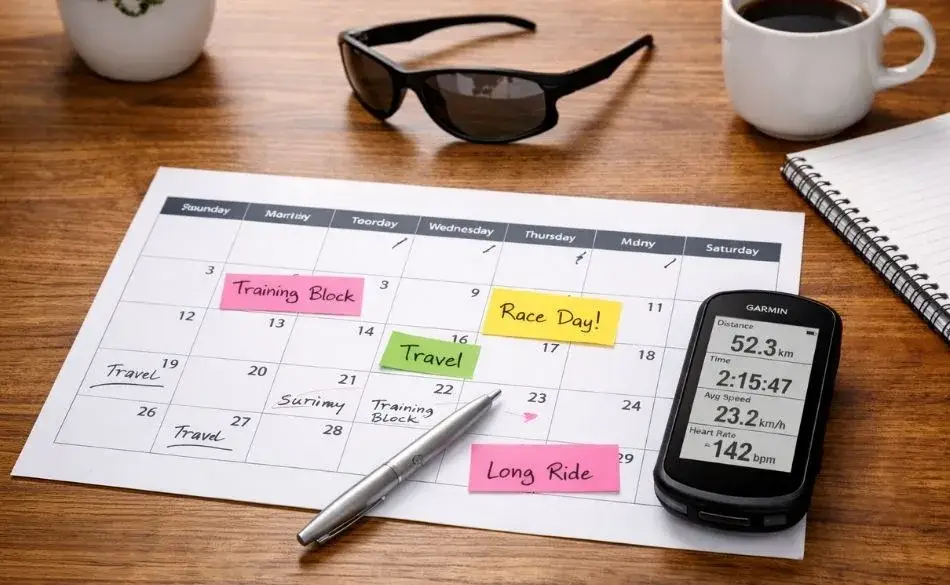
TrainingPeaks’ annual planning guide notes that reviewing the season calendar on paper before committing to events immediately reveals spacing problems that feel manageable in the abstract but obviously unworkable once laid out visually. Do this review before registration closes, not after. SportCoaching’s own cycling events calendar for Australian cyclists provides a starting point for identifying the events available in your target window. Our training week structure guide covers how the weekly rhythm within each training phase is organised once the season plan is set.
Australian cyclists operate on a Southern Hemisphere calendar that inverts the typical Northern Hemisphere planning framework used by most international cycling resources. In Australia:
The primary riding and racing season runs from approximately October through April (spring through early autumn). The weather window for long outdoor rides and major sportives in most Australian states aligns with this period. Gran fondos, major sportives, and most road racing events are concentrated in November–March.
The off-season and base phase typically fall in the Australian winter months of May–August. This is when structured base training and strength work is most appropriately scheduled — cooler weather, lower competitive pressure, and a natural opportunity to reset. Zwift and indoor training become more relevant in winter months for riders who prefer structured sessions over cold morning rides. Our endurance workouts guide covers indoor and outdoor session structures for base phase training regardless of season.
The implication for backward-counting planning: if a target gran fondo is in February, base training begins in August–September, build phase begins in October–November, and the peak phase runs December–January. This timeline aligns well with the Australian weather calendar — base in winter, building through spring, peaking for summer events. Our heart rate zone training guide covers how to set accurate training zones at the start of the base phase — a key step before beginning any structured seasonal training block.
Plan Your Season With Expert Guidance
SportCoaching's cycling coaches build annual training plans around your specific A events — structuring each phase from base to peak to taper so you arrive at your goal events prepared rather than hoping. AUD $143/month, no lock-in, 90-day performance guarantee.
How do I plan a cycling season?
Identify your A event → work backward to set phase start dates (base 6 months out, build 12–16 weeks out, peak 6–8 weeks out, taper 10–14 days out) → place B and C events around this structure. Plan on paper before committing to registrations — spacing problems are easier to resolve early.
What is an A race in cycling?
Your highest-priority event — the one you specifically taper for and build toward. Most cyclists should have 1–3 A events per season, with 8–12 weeks between each to allow adequate preparation and recovery.
What is the difference between A, B and C races?
A races get a full taper (10–14 days reduced volume). B races get a partial taper (3–5 days) and serve as preparation for A events. C races get no taper — they’re ridden at training effort as structured training sessions. Classification determines how much preparation and recovery each event warrants.
How many events should I do in a cycling season?
1–2 major A events for recreational cyclists; 2–3 for competitive cyclists. Supported by B races every 4–6 weeks during the competition period, and C events opportunistically. Over-scheduling is the most common amateur planning error — too many events prevents adequate recovery and build between each.
When should I start training for a cycling event?
Base training: 5–6 months before the event. Build: 12–16 weeks out. Peak: 6–8 weeks out. Taper: 10–14 days out. The earlier you identify your A event, the more purposeful the preparation. Waiting until 8 weeks out and trying to compress all three phases produces incomplete preparation regardless of effort.
Ready to put your training to the test? Here are some upcoming cycling events matched to this article.
Head Coach & Founder, SportCoaching
Graeme is the founder of SportCoaching and has coached more than 750 athletes from 20 countries, from beginners to Olympians, in cycling, running, triathlon, mountain biking, boxing, and skiing. His coaching philosophy and methods form the foundation of SportCoaching's training programs and resources.
No matter your goals, SportCoaching offers tailored training plans to suit your needs. Whether you’re preparing for a race, tackling long distances, or simply improving your fitness, our expert coaches provide structured guidance to help you reach your full potential.
Structured cycling coaching to build power, endurance, and speed.
What’s included
Browse upcoming Australian running, cycling, and triathlon events in one place. Filter by sport, check dates quickly, and plan your training around something real on the calendar.
Choose your plan to get started with personalized training plans designed to help you reach your goals.


Minna Backman
When you’re new, feedback is especially important, and Graeme is highly skilled at both analyzing numbers and understanding the importance of mental strength.