








Find Your Next Cycling Race
Ready to put your training to the test? Here are some upcoming cycling events matched to this article.
 Coach Graeme
Last updated:
Cadence is simply how quickly you turn the pedals — measured in revolutions per minute (RPM). It's one of the most fundamental variables in cycling, and one that most beginners get significantly wrong from the start. The default tendency for new cyclists is to push too heavy a gear too slowly — what's called grinding — which puts excessive force demands on the muscles, accelerates fatigue, and is rough on the knees over time. Improving cadence is one of the most accessible performance gains available to any beginner: it costs nothing, requires no equipment upgrade, and produces noticeable results within a few weeks of deliberate practice.
This guide covers what cadence actually is, why it matters, what RPM to target across different situations, how cadence changes with terrain, and the specific drills used to improve it.
Not sure where to start with training?
Tell us your goal and schedule, and we’ll give you clear direction.
No obligation. Quick, practical advice.
Explore our cycling training articles for more helpful articles and resources.
Cadence is the number of complete pedal revolutions per minute. One revolution means one full 360-degree rotation — both pedals completing a full circle. At 80 RPM, your right pedal completes 80 full revolutions in one minute. Cycling computers, power meters, and most smart trainers display cadence as a real-time readout alongside speed, heart rate, and power.
Cadence is one of the two components of cycling power. The fundamental equation is: Power = Torque × Cadence. Torque is the force you apply to the pedal; cadence is how quickly you turn the pedals. You can produce the same power output in two fundamentally different ways: pushing very hard at low cadence (high torque, low RPM) or spinning faster at lower force per stroke (low torque, high RPM). Understanding this trade-off is the foundation of cadence optimisation.
The two informal terms most cyclists use to describe cadence extremes are spinning (high RPM, lighter gear, less force per stroke) and grinding (low RPM, heavier gear, more force per stroke). Both occur naturally across a ride depending on terrain and effort, but habitually grinding when spinning would be more appropriate is the most common beginner error. Our guide on how to start cycling covers cadence alongside the other fundamental skills new cyclists need to develop in their first months on the bike.
Most beginner cyclists naturally pedal at 60–70 RPM — the lower end of what most coaches recommend. Research confirms this: untrained cyclists self-select cadences 10–20% below their mechanical optimum, while trained cyclists self-select within 5% of optimum. The gap closes with experience, but deliberate practice accelerates it.
For beginners on flat terrain, 70–85 RPM is a practical starting target. This range is more cardiovascularly demanding than grinding at 60–65 RPM, but significantly less taxing on the muscles and much kinder to the knees. The legs fatigue less over the course of a ride because each pedal stroke requires less force. Over time, as the cardiovascular system adapts to sustaining higher cadence, 80–90 RPM becomes achievable as a comfortable cruising range.
The reason many beginners resist higher cadence is that it initially feels breathless. This is normal: shifting demand from muscles to the cardiovascular system means the heart and lungs feel the effort more acutely at first. Most cyclists find this sensation normalises within 2–4 weeks of riding at higher cadence consistently. The legs, which were previously doing most of the work, recover faster between sessions.
| Rider level | Typical flat cadence | Target to work toward | Notes |
|---|---|---|---|
| Complete beginner | 60–70 RPM | 70–80 RPM | Focus on not grinding; use gears |
| Developing beginner | 70–80 RPM | 80–90 RPM | Cadence drills 1–2x per week |
| Recreational / club | 80–90 RPM | 85–95 RPM | Terrain and effort vary naturally |
| Trained / competitive | 85–95 RPM | 90–100 RPM | Higher for attacks and sprints |
| Professional | 90–105 RPM | 110+ for sprints | Highly individual; terrain-dependent |
The core physiological reason cadence matters is that different RPM ranges recruit different muscle fibre types and load different energy systems. This determines how quickly you fatigue and how sustainable your effort is over a long ride.
Low cadence (below 70 RPM): Each pedal stroke requires high force, which recruits fast-twitch (Type II) muscle fibres. Fast-twitch fibres produce power rapidly but fatigue quickly and generate more lactate. Research shows blood lactate concentration is significantly higher at 50 RPM compared to 100 RPM at the same power output. This is why grinding fatigues legs disproportionately quickly — you’re running the engine on a fuel that burns out fast.
Moderate to high cadence (80–95 RPM): Lower force per stroke shifts work toward slow-twitch (Type I) muscle fibres, which are fatigue-resistant and aerobically efficient. The cardiovascular system takes on more of the load, which is what it’s designed to sustain. For endurance riding — any ride over 60–90 minutes — this is the more sustainable physiological balance.
Very high cadence (100+ RPM): At extreme cadences, metabolic efficiency actually decreases — the energetic cost of moving the legs quickly outweighs the efficiency gains of reduced force. This is why research shows the bioenergetically optimal cadence is actually around 60 RPM in laboratory settings — but that ignores the fatigue and injury costs of the extreme muscular force required at such low RPM over real riding durations. In practice, very high cadence is used for sprinting and attacks where maximum power output for a short duration is the goal. Our cycling power zone calculator shows how different training zones correspond to sustainable effort levels at various cadence ranges.
A PMC field study of real-world road cyclists found optimal individual cadences of 83 and 70 RPM respectively for two riders — closely matching their self-preferred ranges — and found that power output dropped by approximately 6% when cadence deviated 20 RPM above or below each rider’s optimum. This is a meaningful performance loss, underscoring why finding a workable individual range matters even for recreational cyclists.
Flat terrain allows the highest sustainable cadence because there is no additional gravitational resistance to overcome. Most recreational cyclists settle into 80–90 RPM on flat roads, using gears to maintain this cadence as speed varies. The practical rule: shift up (bigger gear, harder to push) when cadence rises above 100 RPM and you’re spinning without generating enough force; shift down (smaller gear, easier to push) when cadence drops below 75 RPM and the legs are grinding. Keeping cadence in a consistent window across varying terrain is one of the core skills of efficient cycling.
Cadence naturally drops on climbs because the increased gradient demands more force per pedal stroke, and many cyclists run out of gears before maintaining their flat-road cadence. A typical moderate-gradient climbing cadence is 65–80 RPM; very steep climbs (10%+) often produce 55–70 RPM even in the lowest gear. The key beginner mistake on climbs is staying in too high a gear and grinding to near-standstill at 45–55 RPM. This is extremely taxing on the quads and knees. The correct approach: shift into an easier gear earlier than feels necessary, maintain 65–75 RPM even if that means moving at a slower pace, and save the legs for later in the ride. A slightly breathless 70 RPM in an easy gear is almost always preferable to a quad-burning 50 RPM grind. Our cycling core strength workout covers the stability needed to maintain efficient pedalling technique on steep climbs.
On descents, speed typically outpaces the ability to pedal productively in any reasonable gear. Most cyclists stop pedalling on steep descents — this is normal and correct. On moderate descents where pedalling is beneficial, cadence will naturally rise. If your legs begin to spin out (cadence exceeds 110+ RPM) before you’ve generated meaningful resistance, shift up into a harder gear rather than trying to pedal faster. The same principle applies in reverse to flat riding: the gear should be selected to keep cadence in a productive range, not a cadence that is simply whatever falls out of the gear you’re already in.
A headwind increases aerodynamic resistance, which feels similar to a moderate climb. Maintaining cadence in a headwind typically requires shifting to a slightly easier gear rather than trying to push through the resistance at the same gear and cadence. Riders who attempt to maintain speed into a headwind by grinding a big gear often pay for it with leg fatigue 30–40 minutes later. The tactical choice — give up a little speed, protect the legs — is one of the most important pacing decisions in longer rides and cycling events.
In triathlon and time trial (TT) events, where the bike is followed by a run or a highly paced finish, slightly lower cadence is generally preferred: approximately 80–85 RPM rather than the 85–95 RPM of road racing. The aerodynamic position on a TT or triathlon bike restricts hip flexion, making very high cadence mechanically difficult to sustain. And for triathletes, the priority is minimising muscular fatigue on the bike so that the run leg is not compromised. A slightly lower cadence in a slightly harder gear allows more power per stroke while reducing cardiovascular demand — the right trade-off when a run follows the bike. Our cycling training plans include triathlon-specific guidance on cadence and pacing for each event format.
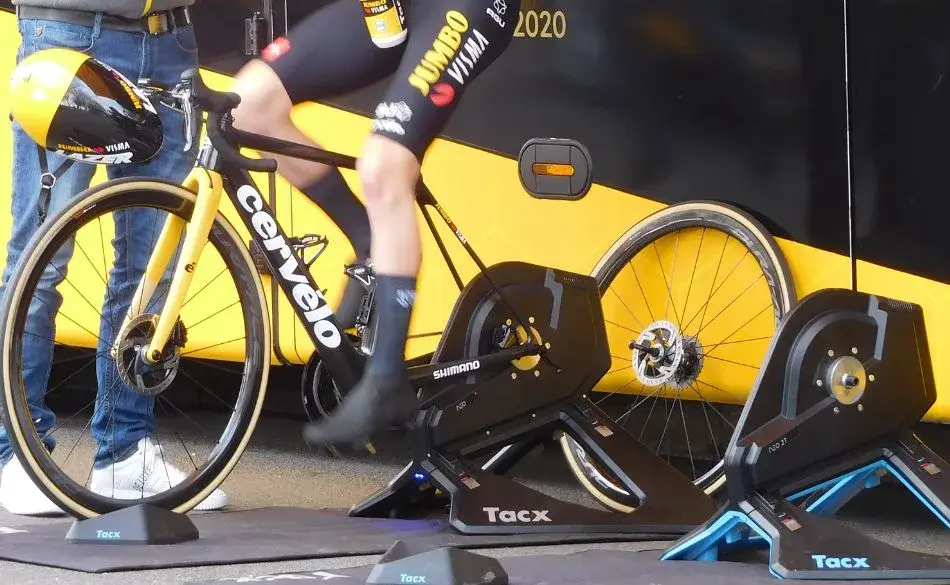
The most reliable method is a cadence sensor — a small device that attaches to the left chainstay with a magnet on the crank arm. It transmits cadence data to a bike computer or cycling app in real time. Most entry-level bike computers support cadence sensors, and many GPS cycling computers include cadence as a standard data field when paired with the sensor. Power meters measure cadence internally, so no separate sensor is needed if you have a power meter. Smart trainers for indoor cycling display cadence without any additional hardware.
Without technology, you can estimate cadence manually: count the number of times your right knee comes up over 15 seconds, then multiply by four. This gives a workable approximation — accurate enough for beginner training purposes. It’s worth practising this occasionally so you develop an internal sense of what 70, 80, and 90 RPM feel like without needing to look at a computer. That internal calibration is valuable for racing and group riding where looking at data during the ride is impractical. Our heart rate training zones calculator pairs well with cadence awareness: at a given heart rate zone, noting what cadence you’re sustaining tells you a great deal about your efficiency on the bike.
Before working on cadence, establish your starting point. Ride at a comfortable moderate effort on flat terrain for 10 minutes without looking at any cadence data. After 10 minutes, check your cadence or count manually. This is your self-selected cadence — the range your body gravitates to without prompting. Most beginners find they are in the 65–75 RPM range. The target is to shift this natural range upward by 5–10 RPM over the following 4–8 weeks through deliberate practice.
Select an easy gear (small chainring, middle of the cassette). On flat terrain, spin up to 95–105 RPM for 90 seconds to 2 minutes. Return to your natural cadence for 2 minutes, then repeat 4–6 times. The goal is to improve neuromuscular coordination at high RPM — to make your legs comfortable moving quickly and smoothly without bouncing on the saddle. Bouncing (excessive vertical movement of the hips) is the key sign that cadence is too high for your current neuromuscular control. Reduce cadence by 5 RPM if bouncing occurs. This drill can be done on any ride; adding 2–3 sets to the middle of a standard easy ride is the most practical approach.
On a moderate gradient or in a heavy gear on flat terrain, ride at 55–65 RPM for 5–10 minutes at a high perceived effort. This drill develops muscular strength and force application at low RPM — useful for steep climbing situations where maintaining a comfortable cadence is simply impossible in the available gears. It also builds the leg strength that supports better cadence control in general. Avoid excessive low cadence work until the knees have adapted — beginners should limit this to 1–2 sets of 5 minutes in the first month. Our guide on strength training for cyclists covers the gym work that complements this on-bike strength development.
Every 2 minutes during a steady ride, increase cadence by 5 RPM without changing gears (which means speed increases). Begin at 70 RPM and ramp up to 90–95 RPM across 5–6 increments, then descend back down. This drill builds cadence range and control, teaches gear-shifting judgment (when increasing cadence requires shifting up), and develops awareness of the cardiovascular shift that occurs as cadence rises. It’s an effective substitute for high-cadence interval training for riders who find sudden RPM jumps uncomfortable.
Pushing too heavy a gear. The most common error. New cyclists equate pushing a big gear with riding hard and going fast. In reality, grinding a heavy gear at 55–65 RPM depletes leg energy faster, accumulates more lactate, and is harder on the knees than spinning at 80 RPM in an easier gear at the same power. Use gears to keep cadence in a productive range rather than staying in one gear and letting cadence fall where it may.
Ignoring gears on climbs. Many beginners resist shifting to easier gears on climbs because it feels like giving up. In fact, shifting to an easier gear and maintaining 70–75 RPM on a climb is the correct technique — it preserves the legs for the rest of the ride and reduces injury risk to the knees. The bike’s gears exist specifically to maintain productive cadence across varying gradients. Using the full range of available gears is a skill, not a compromise. Our KOPS bike fit guide covers how correct saddle position also influences cadence comfort and knee health on climbs.
Bouncing at high cadence. When cadence is higher than the rider’s neuromuscular control allows, the hips rock side to side or bounce vertically. This dissipates energy and creates saddle discomfort. If bouncing occurs, reduce cadence by 5 RPM until smooth pedalling returns. Control at 85 RPM is more valuable than out-of-control spinning at 100 RPM. The neuromuscular coordination to spin efficiently improves with the high cadence drills above over weeks of practice.
Fixating on a specific number. Optimal cadence is a range, not a target number, and it changes with terrain, effort, fatigue, and individual physiology. Riders with strong aerobic systems often spin more naturally; more muscular riders often prefer slightly lower cadences with more force per stroke. Both can work well. The goal is to expand your usable range in both directions — comfortable at 70 RPM on a steep climb, comfortable at 90–95 RPM on flat terrain — rather than chasing a single “correct” RPM.
Build Better Cycling with a Structured Plan
SportCoaching's cycling training plans and coaching give you the session structure, cadence guidance, and progressive training load to improve your efficiency and fitness on the bike — whether you're just starting out or building toward your first event.
What cadence should a beginner cyclist aim for?
70–85 RPM on flat terrain as an initial target, working toward 80–90 RPM as fitness builds. Most beginners default to 60–70 RPM (too low), which fatigues the muscles faster. Research shows untrained cyclists self-select cadences 10–20% below their mechanical optimum — meaning most beginners are already pedalling too slowly.
What is cadence in cycling?
Cadence is the number of complete pedal revolutions per minute (RPM). One revolution = one full 360-degree rotation of the pedals. Power = Torque × Cadence. You can produce the same power by pushing hard at low cadence or spinning faster at lower force — the trade-off between these approaches is the core of cadence optimisation.
What is a good cadence for cycling on climbs?
60–80 RPM on moderate gradients, 55–70 RPM on very steep climbs. The key is shifting to an easy enough gear to maintain some spin rather than grinding to near-standstill. A slightly breathless 70 RPM in an easy gear is far more sustainable than a leg-burning 50 RPM grind in a gear that’s too hard for the gradient.
How do I measure my cycling cadence?
Dedicated cadence sensor (attaches to the chainstay, pairs with a bike computer), power meter (measures cadence internally), or smart trainer. Without technology: count how many times your right knee rises in 15 seconds, multiply by four.
Why does cadence matter for beginners?
Low cadence (grinding) places high force demands on fast-twitch muscles, which fatigue quickly and produce more lactate. Higher cadence shifts load to the cardiovascular system and slow-twitch fibres, which are far more fatigue-resistant. Improving from 65 RPM to 75–80 RPM typically reduces leg fatigue on longer rides significantly, even if it initially feels more cardiovascularly demanding.
Ready to put your training to the test? Here are some upcoming cycling events matched to this article.


Head Coach & Founder, SportCoaching
Graeme is the founder of SportCoaching and has coached more than 750 athletes from 20 countries, from beginners to Olympians, in cycling, running, triathlon, mountain biking, boxing, and skiing. His coaching philosophy and methods form the foundation of SportCoaching's training programs and resources.
No matter your goals, SportCoaching offers tailored training plans to suit your needs. Whether you’re preparing for a race, tackling long distances, or simply improving your fitness, our expert coaches provide structured guidance to help you reach your full potential.
Structured cycling coaching to build power, endurance, and speed.
What’s included
Browse upcoming Australian running, cycling, and triathlon events in one place. Filter by sport, check dates quickly, and plan your training around something real on the calendar.
Choose your plan to get started with personalized training plans designed to help you reach your goals.


Minna Backman
When you’re new, feedback is especially important, and Graeme is highly skilled at both analyzing numbers and understanding the importance of mental strength.











