





Find Your Next Cycling Race
Ready to put your training to the test? Here are some upcoming cycling events matched to this article.
 Coach Graeme

Last updated:
It's one of the most common questions from cyclists who also lift — and from gym-goers who've started riding: can all those kilometres on the bike count as leg training, or do you still need to squat and lunge? The honest answer is nuanced, and it depends heavily on what you're trying to get out of leg training in the first place. This guide breaks down what cycling actually does to your legs, what it misses, and gives you a clear framework for when cycling can substitute leg day and when it can't.
Not sure where to start with training?
Tell us your goal and schedule, and we’ll give you clear direction.
No obligation. Quick, practical advice.
Explore our cycling training content for more helpful articles and resources.
Cycling is an excellent lower-body workout — within specific constraints. The pedal stroke activates the quads, hamstrings, glutes, and calves through thousands of repetitions, at a submaximal load, over extended periods. This combination is ideal for building muscular endurance: the ability of your leg muscles to sustain repeated contractions over time without fatiguing.
Research consistently shows that cycling improves leg muscular endurance, cardiovascular efficiency, and to a moderate degree, functional strength in the primary movers. Regular cycling — particularly with hilly terrain, intervals, or low-cadence strength work — does build quad and hamstring strength meaningfully. Cyclists tend to have well-developed, lean legs because of this combination of high volume and moderate resistance.
What cycling does not do effectively is stimulate hypertrophy (muscle size increase). Muscle growth requires high mechanical tension — heavy loading through a large range of motion, with progressive overload. Cycling provides none of these consistently. The resistance is limited by what a bike can provide, the range of motion is constrained by the fixed pedal stroke, and the movement is submaximal by definition. Studies comparing cycling to resistance training show that strength training produces significantly greater muscle size gains in a fraction of the time.
For cyclists specifically, understanding how cycling develops strength relative to what a leg workout delivers helps inform smarter programming decisions. Our guide to whether squats improve cycling performance covers the evidence for how gym strength transfers to the bike.
👉 Swipe to view full table
| Muscle | Cycling Training Stimulus | Leg Day Stimulus | Gap? |
|---|---|---|---|
| Quadriceps | High — dominant during power phase | High — squats, leg press, lunges | Minimal for endurance; significant for strength/size |
| Hamstrings | Moderate — assist during pull-through | High — deadlifts, leg curls, RDLs | Moderate — cycling underloads hamstrings vs gym work |
| Gluteus maximus | Moderate — hip extension during downstroke | High — squats, hip thrusts, deadlifts | Significant — hip never fully extends on bike |
| Gluteus medius | Very low — minimal lateral demand | Moderate — lunges, lateral work | Large — major gap; key injury prevention muscle |
| Hip abductors | Very low — no lateral movement in cycling | Moderate — lateral lunges, band walks | Large — cycling creates chronic weakness here |
| Calves | Moderate — ankle stabilisation throughout | High — calf raises, loaded movements | Moderate — cycling builds endurance but not strength |
| Hip flexors | Moderate — firing and shortening constantly | Low in most programmes | Cycling often overtightens; needs stretching not loading |
| Adductors (inner thigh) | Low — minimal activation | Moderate — sumo squats, leg press | Significant — often entirely missed by cycling |
| Tibialis anterior (shin) | Low | Low (often missed in gym too) | Both miss this — worth specific attention |
The clearest gap is the gluteus medius and hip abductors. These muscles stabilise the pelvis during single-leg loading and keep the knee tracking correctly. Cycling is a bilateral movement — both legs push and pull simultaneously — which allows the stronger leg to compensate for the weaker one. Over years of riding without targeted glute medius work, many cyclists develop significant lateral hip weakness that contributes to knee pain, IT band issues, and power leaks. Our guide to whether cycling builds glutes covers this distinction in detail.
A barbell back squat or deadlift loads the legs with forces that cycling simply cannot replicate. Heavy loading creates the mechanical tension required for maximal strength gains and muscle hypertrophy. Even the most challenging hill climb, sprint effort, or low-cadence strength ride doesn’t come close to the stimulus of a well-executed set of heavy squats. If maximal strength or muscle size is your goal, there is no cycling substitute.
On a bike, the hip flexes and extends within a limited arc. Even at the lowest point of the pedal stroke, the hip is not fully extended — the saddle position prevents it. Exercises like deadlifts, hip thrusts, and Bulgarian split squats take the hip through a far greater range of extension, fully loading the gluteus maximus and hamstrings through their complete functional range. This is why cyclists who only ride tend to have underdeveloped glutes relative to their quads, regardless of ride volume.
Cycling is a sagittal plane exercise — forward and backward only. Leg day exercises like lateral lunges, sumo deadlifts, and lateral band walks train the hip in the frontal plane, developing the adductors, abductors, and hip stabilisers that cycling chronically neglects. These are the muscles that prevent knee tracking problems and hip instability — and they don’t get trained by riding, regardless of volume or intensity.
Single-leg exercises — Bulgarian split squats, single-leg deadlifts, step-ups — expose and correct left-right strength imbalances. Because cycling always uses both legs simultaneously, the stronger leg can silently compensate for the weaker one over thousands of pedal strokes. This compounds imbalances over time. Unilateral gym work forces each leg to work independently, addressing the asymmetries that bilateral cycling creates.
Cycling is non-weight-bearing — your bodyweight is supported by the saddle, not your skeleton. This makes it joint-friendly, which is a genuine advantage. But it also means cycling provides no bone density stimulus. Research consistently shows that cyclists, particularly those who do little other exercise, have lower bone density than runners or gym-trained athletes of equivalent fitness. Weight-bearing leg exercises like squats, deadlifts, and lunges load the skeleton directly and are one of the most effective tools for maintaining and building bone density. This matters more as cyclists age.
👉 Swipe to view full table
| Goal | Can Cycling Replace Leg Day? | Why |
|---|---|---|
| General fitness and health | Largely yes | Cycling provides excellent cardiovascular fitness, leg endurance, and functional strength for everyday life |
| Muscular endurance | Yes | Cycling is one of the best ways to build leg endurance — equal or superior to high-rep gym work |
| Muscle size (hypertrophy) | No | Insufficient mechanical tension, limited range, and submaximal loading cannot drive significant muscle growth |
| Maximal strength | No | Cycling resistance cannot approach the loading of barbell or machine leg exercises |
| Cycling performance | No — needs supplemental gym work | Strength training improves FTP, sprinting, and climbing power; cycling alone leaves stabilisers underdeveloped |
| Injury prevention | No — cycling creates gaps | Glute medius, hip abductor, and adductor weakness is worsened by cycling-only training |
| Bone density | No | Non-weight-bearing; provides no skeletal loading stimulus |
| Athletic performance (multi-sport) | No | Lateral, rotational, and unilateral strength developed in gym doesn't transfer from cycling |
For cyclists, the question often runs in the other direction: do they even need leg day? The answer from research and coaching practice is clearly yes.
Strength training improves cycling performance through several mechanisms. Greater maximal strength means a higher percentage of leg power is available before fatigue sets in — so a cyclist who can squat 120 kg works at a lower relative intensity when producing 250 watts than one who can only squat 80 kg. Strength training also improves neuromuscular efficiency, tendon stiffness (which improves power transfer), and the resilience to train more consistently without injury.
Studies consistently show that cyclists who add strength training improve their FTP, climbing performance, and sprint power. The combination of cycling for cardiovascular development and strength training for force production is demonstrably more effective than cycling alone. Our full guide to strength and weight training for cyclists covers the research and how to programme it practically.
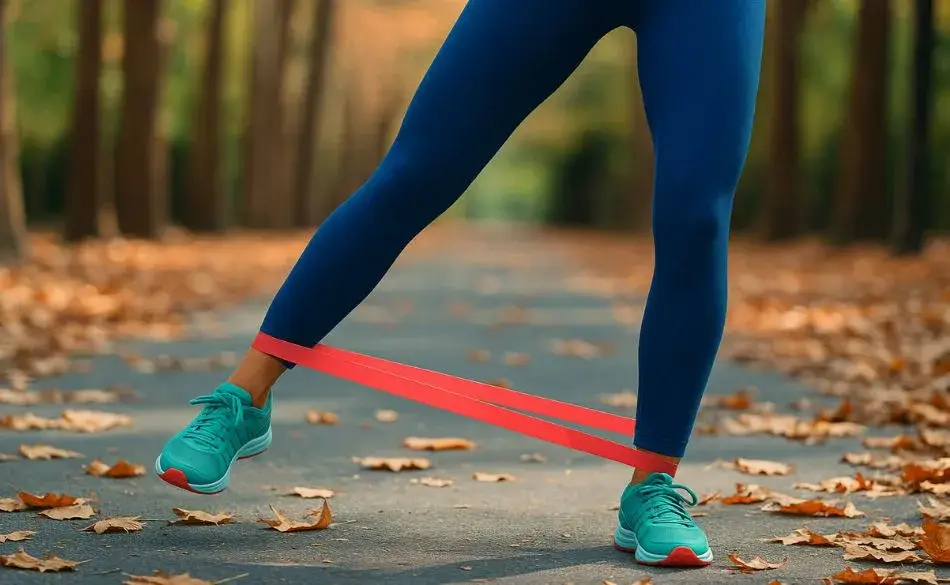
You don’t need a traditional bodybuilder’s leg day. What you need is targeted work on the muscles cycling misses: glute medius and hip abductors (lateral band walks, clamshells), full hip extension (hip thrusts, single-leg deadlifts), and progressive loading for strength (squats or deadlifts). Two sessions of 30–40 minutes per week is sufficient, with the content focused on those gaps rather than trying to replicate a full leg day. Resistance band training for cyclists covers the most efficient off-bike exercises for exactly these gaps.
Frequent cycling (4+ rides per week) can meaningfully reduce how much gym leg volume you need for general fitness, because your legs are already being trained for endurance multiple times a week. You could reasonably reduce leg day from two sessions to one, or reduce volume within sessions. However, the heavy compound movements — squats and deadlifts especially — still provide a stimulus that cycling can’t replicate. Keep at least one quality lower-body gym session per week if strength and size matter to you.
The best approach is a deliberate integration: use the gym for heavy compound lower-body work (squats, deadlifts, hip thrusts) and targeted stabiliser work (lateral movements, single-leg exercises), and use cycling for cardiovascular conditioning and muscular endurance. These two training modalities complement rather than duplicate each other. Schedule heavy leg sessions on the day before a rest day or easy recovery ride — not before your hard cycling sessions. For programming guidance, see our article on cycling after a leg workout.
One nuance worth addressing: high-intensity cycling — sprints, steep climbs, low-cadence strength work — does provide a greater strength stimulus than easy riding. Short, explosive efforts recruit fast-twitch muscle fibres. Heavy gear, slow cadence climbing creates more torque and more mechanical tension per pedal stroke. Indoor cycling at high resistance can temporarily fatigue the legs significantly.
But even these high-intensity efforts don’t match the specificity of gym strength work. The range of motion is still constrained, the loading is still limited by what the rider can sustain, and the lateral and rotational planes are still entirely absent. High-intensity cycling is excellent for improving power output and VO2 max, and it does add a modest strength stimulus beyond easy riding — but it doesn’t close the muscle gap that gym work fills. Our guide on why quads burn during cycling explains how fatigue and load interact during hard efforts. For calves specifically, which cycling develops for endurance but not strength, our best calf exercises for cyclists covers targeted work worth adding.
Cycling is an outstanding exercise for leg endurance, cardiovascular fitness, and functional lower-body strength within the sagittal plane. For general health and fitness goals, regular cycling substantially reduces the need for gym leg work. But cycling cannot fully replace leg day for anyone with goals around muscle size, maximal strength, bone density, lateral hip stability, or balanced athletic performance — and for cyclists themselves, leg day makes them better riders, not worse ones.
The smart approach isn’t to choose one over the other. It’s to use cycling for what it does best — endurance and cardiovascular fitness — and use targeted leg training for what cycling misses: heavy loading, full range of motion, lateral movements, and unilateral strength. Together, they produce a more complete athlete than either training alone.
Want Cycling and Strength Work Properly Integrated?
Our cycling coaching builds strength sessions, interval work, and endurance rides into a single structured plan — so your gym work supports your riding instead of competing with it.
Can cycling replace leg day?
For muscular endurance, partially yes. For muscle size, maximal strength, and full leg development — no. Cycling effectively trains the quads and hamstrings for endurance but misses lateral movements, full range hip extension, heavy loading, and glute medius training.
What leg muscles does cycling work?
Primarily quadriceps (dominant), hamstrings (assisting), gluteus maximus (hip extension), and calves (ankle stabilisation). Significantly undertrained: gluteus medius, hip abductors, and adductors.
Does cycling build leg muscle?
It builds muscular endurance and modest functional strength, particularly in the quads. It does not effectively stimulate hypertrophy because resistance is limited, range of motion is constrained, and loads are submaximal.
Is cycling enough for leg training if I’m not a bodybuilder?
For general fitness, regular cycling is a solid foundation. Adding even one short gym leg session per week (squats, lunges, hip work) significantly improves functional strength, bone density, and injury resilience that cycling can’t provide.
What does cycling miss that leg day covers?
Heavy progressive loading, full range hip extension, lateral and rotational movements, glute medius and hip abductor training, unilateral strength work, and bone density stimulus.
Ready to put your training to the test? Here are some upcoming cycling events matched to this article.
Head Coach & Founder, SportCoaching
Graeme is the founder of SportCoaching and has coached more than 750 athletes from 20 countries, from beginners to Olympians, in cycling, running, triathlon, mountain biking, boxing, and skiing. His coaching philosophy and methods form the foundation of SportCoaching's training programs and resources.
No matter your goals, SportCoaching offers tailored training plans to suit your needs. Whether you’re preparing for a race, tackling long distances, or simply improving your fitness, our expert coaches provide structured guidance to help you reach your full potential.
Structured cycling coaching to build power, endurance, and speed.
What’s included
Browse upcoming Australian running, cycling, and triathlon events in one place. Filter by sport, check dates quickly, and plan your training around something real on the calendar.
Choose your plan to get started with personalized training plans designed to help you reach your goals.


Minna Backman
When you’re new, feedback is especially important, and Graeme is highly skilled at both analyzing numbers and understanding the importance of mental strength.