

Quick Answer
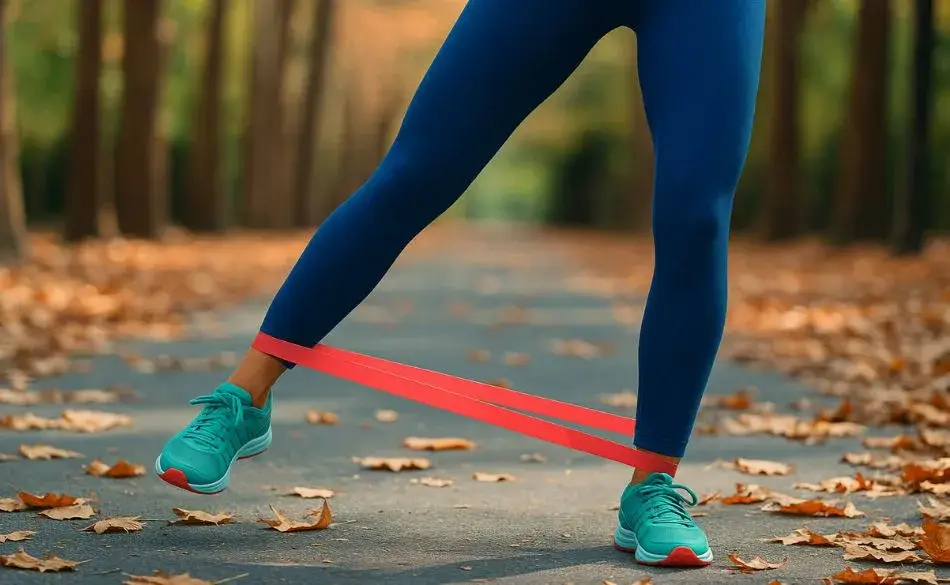
Resistance bands are ideal for cyclists because they train the lateral, rotational, and stability movements that riding ignores — especially glutes, hip abductors, and upper back. Two to three 20–30 minute sessions per week is enough. You need two types of bands: mini loop bands for lower body and hips, and long loop bands or handled bands for upper body pulling movements.

Why Cyclists Need Resistance Band Training
Cycling is a sagittal plane exercise — all movement is forward and backward. Your hips flex and extend. Your quads and hamstrings do most of the work. Your glutes contribute — particularly the gluteus maximus during the power phase — but the gluteus medius, the muscle responsible for keeping the pelvis level and stabilising the knee, does very little during pedalling. Over time, this creates a predictable pattern: quad dominance, weak glute medius, underactive hip abductors, and tight hip flexors from hours in a flexed position.
The consequences show up as knee pain (the knee tracking inward because the hip isn’t stabilising it), lower back pain (the back compensating for weak glutes and a fatigued core), and reduced power — because a chain is only as strong as its weakest link, and for most cyclists the weak links are the stabilisers, not the prime movers.
Resistance bands address this directly. The constant tension through the full range of motion — unlike free weights where tension drops at end range — makes them especially effective for activation and strengthening of stabiliser muscles. A mini band above the knees during a squat or glute bridge forces the hip abductors to resist inward knee collapse, exactly the movement pattern that cycling leaves untrained.
For a deeper look at how strength work translates to cycling performance, our guide on whether squats improve cycling performance covers the evidence behind off-bike training. Resistance bands complement that foundation with targeted stabiliser work that barbells alone can’t provide as efficiently.

What Equipment You Need
You don’t need much. For the full exercise library in this guide:
Mini loop bands (also called hip circle bands or booty bands): Short, flat loops 30–35 cm in diameter. Used around thighs, knees, or ankles for lower body and hip exercises. Get a set of three — light, medium, and heavy. These are the most versatile bands for cyclists and the ones you’ll use most.
Long loop bands or handled resistance bands: For upper body pulling movements — rows, face pulls, and pull-aparts. These can be anchored in a doorframe, around a post, or under your feet. One medium-resistance long band covers most exercises.
A yoga mat or exercise mat completes the setup. Total cost for a good set of bands is $20–$40. They pack flat into a bag, making them ideal for travel and hotel training during cycling events or holidays.


The 12 Best Resistance Band Exercises for Cyclists
Lower Body & Glutes
1. Banded Glute Bridge
Targets: Gluteus maximus, hamstrings, core
Place a mini band just above your knees. Lie on your back, feet flat, knees bent at 90°. Push your knees outward against the band, then drive your hips upward until your body forms a straight line from shoulders to knees. Squeeze the glutes hard at the top. Hold for 2 seconds, lower slowly.
Sets/Reps: 3 × 15. Progress by pausing longer at the top or elevating feet on a bench (single-leg variation for advanced).
2. Banded Lateral Walk
Targets: Gluteus medius, hip abductors, TFL
Place a mini band just above the knees (easier) or around the ankles (harder). Stand with feet hip-width apart, slight bend in knees, slight forward lean at hips. Step sideways 10 steps in each direction while keeping tension on the band at all times. Don’t let the feet come together completely — keep the band taut.
Sets/Reps: 3 × 10 steps each direction. This is the single most important exercise in this guide for cyclists — the glute medius is almost never challenged by pedalling.
3. Clamshell
Targets: Gluteus medius, external hip rotators
Place a mini band just above the knees. Lie on your side, hips stacked, knees bent at 45°. Keeping your feet together, rotate the top knee upward as far as you can without rolling the pelvis backward. Hold at the top for 1 second, lower slowly.
Sets/Reps: 3 × 15 each side. Keep the movement controlled — rushing reduces activation of the target muscle.
4. Banded Squat
Targets: Quads, glutes, hip abductors
Place a mini band just above the knees. Stand with feet shoulder-width apart. Push your knees outward against the band as you squat down to parallel (or as deep as comfortable). Drive through your heels to stand, maintaining outward knee pressure throughout.
Sets/Reps: 3 × 12–15. The band cues proper knee tracking — a key correction for cyclists whose knees tend to cave inward under load.
5. Single-Leg Romanian Deadlift (Banded)
Targets: Hamstrings, glutes, posterior chain, balance
Stand on a mini band with one foot. Hold the opposite end in the same-side hand. Hinge forward at the hip, extending the free leg behind you, keeping the back flat and knee of the standing leg soft. Feel a stretch through the hamstring of the standing leg, then drive back to upright.
Sets/Reps: 3 × 10 each side. Excellent for addressing left-right imbalances common in cyclists from repeated single-leg force application.
6. Banded Monster Walk
Targets: Glutes, hip abductors, hip flexors
Place a mini band around the ankles. Walk forward in a slight squat position, stepping wider than hip width with each step, then walk backward the same way. Keep knees bent and back upright throughout.
Sets/Reps: 3 × 10 steps forward and back. Particularly effective for activating the full glute complex in a pattern that transfers to out-of-saddle climbing.
Core & Anti-Rotation
7. Pallof Press
Targets: Core anti-rotation, obliques, deep stabilisers
Anchor a long band at chest height (door, post, or partner). Stand side-on to the anchor, feet shoulder-width, holding the band with both hands at your chest. Press the band straight out in front of you, hold for 2 seconds, and return. The core works to resist rotation toward the anchor — this is the key mechanism.
Sets/Reps: 3 × 10 each side. One of the best exercises for building the rotational stability needed to hold a powerful position on the bike when fatigued. The seal walk exercise is another excellent companion movement for building anti-rotation core strength.
8. Banded Dead Bug
Targets: Deep core, hip flexors, coordination
Lie on your back. Loop a band around both feet. Hold the band just below your knees with both hands, arms straight. Extend one leg out (heel toward floor) while the opposite arm extends overhead, keeping the lower back pressed flat into the mat. Return and alternate.
Sets/Reps: 3 × 8 each side. Builds the coordinated core-hip flexor stability that maintains an efficient pedal stroke deep into long rides.
9. Banded Plank Hip Extension
Targets: Glutes, core, shoulder stability
Get into a plank position with a mini band around your ankles. Keeping your core braced and hips level, extend one leg straight back against the band resistance. Hold 2 seconds, lower slowly. Don’t let the hips rotate or drop.
Sets/Reps: 3 × 10 each side. Trains the glutes in a position very similar to the hip extension phase of the pedal stroke.
Upper Back & Posture
10. Banded Face Pull
Targets: Rear deltoids, external rotators, mid and lower traps
Anchor a long band at face height. Hold an end in each hand, palms facing down. Pull the band toward your face, separating your hands as you do — elbows travel out and back, ending with hands beside your ears. Squeeze the shoulder blades together at the top.
Sets/Reps: 3 × 15. This is arguably the most important upper body exercise for cyclists, directly counteracting the shoulder rounding and thoracic flexion created by hours on the bike. Our full guide to the face pull exercise for endurance athletes covers technique and variations in detail.
11. Banded Row
Targets: Rhomboids, middle traps, biceps, rear deltoids
Stand on the centre of a long band. Hinge forward from the hips to a 45° angle, back flat. Hold an end of the band in each hand. Pull your elbows back toward your hips, squeezing the shoulder blades together at the top. Lower slowly.
Sets/Reps: 3 × 12. Builds the upper back strength needed to maintain an upright, efficient position on the bike during long climbs and endurance rides.
12. Band Pull-Apart
Targets: Rear deltoids, mid-traps, external rotators
Hold a long band with both hands at shoulder height, arms extended in front of you, palms facing down. Pull the band apart horizontally until your arms are out to the sides, squeezing the shoulder blades together. Control the return.
Sets/Reps: 3 × 15. A simple, effective movement that can be done as a warm-up or between other exercises. Directly counteracts the protracted shoulder position cyclists hold for hours at a time.


Exercise Summary Table
👉 Swipe to view full table
| Exercise | Target Muscles | Band Type | Sets × Reps | Key Cue |
|---|---|---|---|---|
| Banded Glute Bridge | Glute max, hamstrings | Mini loop (above knees) | 3 × 15 | Push knees out; squeeze glutes at top |
| Lateral Walk | Glute med, hip abductors | Mini loop (knees or ankles) | 3 × 10 each way | Stay low; keep band taut throughout |
| Clamshell | Glute med, external rotators | Mini loop (above knees) | 3 × 15 each side | Don't roll the pelvis back |
| Banded Squat | Quads, glutes, hip abductors | Mini loop (above knees) | 3 × 12–15 | Push knees out; sit back |
| Single-Leg RDL | Hamstrings, glutes, balance | Mini loop (under foot) | 3 × 10 each side | Hinge at hip; keep back flat |
| Monster Walk | Full glute complex, hip flexors | Mini loop (ankles) | 3 × 10 forward/back | Stay in squat; wide steps |
| Pallof Press | Core anti-rotation, obliques | Long band (anchored) | 3 × 10 each side | Resist rotation; don't twist |
| Banded Dead Bug | Deep core, hip flexors | Mini loop (around feet) | 3 × 8 each side | Back flat; move slowly |
| Plank Hip Extension | Glutes, core, shoulders | Mini loop (ankles) | 3 × 10 each side | Hips level; don't rotate |
| Face Pull | Rear delts, traps, rotators | Long band (anchored at face height) | 3 × 15 | Elbows out; hands beside ears |
| Banded Row | Rhomboids, mid-traps, biceps | Long band (under feet) | 3 × 12 | Hinge forward; squeeze blades |
| Pull-Apart | Rear delts, mid-traps | Long band (held in hands) | 3 × 15 | Straight arms; controlled return |
Weekly Programme: How to Fit Band Work into Your Cycling Training
The most common mistake cyclists make with off-bike training is treating it as an add-on that competes with riding for recovery. The key is integrating band sessions strategically so they support your riding rather than undermining it.
👉 Swipe to view full table
| Training Phase | Band Sessions per Week | Session Duration | Timing |
|---|---|---|---|
| Base / Off-season | 3 sessions | 25–35 min | After easy rides or on rest days |
| Build phase | 2 sessions | 20–25 min | After easy rides; avoid day before hard sessions |
| Peak / Race phase | 1–2 sessions | 15–20 min | After easy rides only; skip race week if fatigued |
| Recovery week | 1 session | 15 min | Light activation only — glute bridges, lateral walks |
Sample 3-Day Weekly Plan (Base Phase)
Session A — Glutes & Hips (25 min): Banded Lateral Walk × 3, Banded Glute Bridge × 3, Clamshell × 3, Monster Walk × 3, Single-Leg RDL × 3. Rest 45 seconds between sets.
Session B — Core & Upper Back (25 min): Pallof Press × 3, Face Pull × 3, Banded Row × 3, Pull-Apart × 3, Banded Dead Bug × 3. Rest 45 seconds between sets.
Session C — Full Body (20 min): Banded Squat × 3, Lateral Walk × 2, Plank Hip Extension × 3, Face Pull × 2, Banded Glute Bridge × 2. Circuit style with 30 seconds rest between exercises.
During build and peak phases, combine Sessions A and B into a single 30-minute full-body session twice per week. Keep the focus on quality movement rather than fatigue — these sessions shouldn’t leave you too sore to ride.


How Resistance Bands Complement Other Cycling Strength Work
Bands aren’t a replacement for all gym work — they fill a specific gap. Heavy compound lifts like squats and deadlifts build maximal force production and are particularly valuable for cyclists who want to improve sprinting, climbing power, and overall durability. Our guide to strength and weight training for cyclists covers that side of the equation in full.
Bands sit in a different tier: they target the stabilisers and postural muscles that barbell work often underloads. The glute medius, for example, does relatively little during a squat but is the key muscle for preventing knee valgus during cycling. Lateral band walks train it directly. Similarly, face pulls and band pull-aparts address rear deltoid and external rotator weakness that even heavy rows may not adequately develop.
The ideal strength programme for a serious cyclist combines: heavy compound lifts (squats, deadlifts, hip thrusts) for maximum force and power — 2 sessions per week in base phase; resistance band work for stabilisers and posture — 2–3 sessions; and stretching and mobility work to counteract the tightness created by cycling position. Upper body weight training for cyclists rounds out the picture for riders who want to address posture and bike handling more comprehensively.
For cyclists with specific injury history or issues like shin splints or calf weakness, targeted band exercises can be incorporated into a return-to-riding programme without adding the joint loading of gym work.

Common Mistakes Cyclists Make with Band Training
Going too heavy too soon. Using a band with too much resistance forces compensation — the targeted stabiliser muscle can’t do the work, so larger muscles take over. Start lighter than you think you need, focus on feeling the right muscle contract, and only increase resistance when you can do all reps with perfect form and full range of motion.
Rushing through the reps. Band exercises work through constant tension, not momentum. Slow, controlled movement — especially on the eccentric (lowering) phase — is what builds strength and body awareness. A clamshell done slowly with a 2-second hold at the top is worth 10 rushed reps.
Only doing lower body work. Most cyclists gravitate toward glute and hip exercises because that’s where the obvious cycling-related weaknesses are. But neglecting the upper back and core creates a different kind of problem — poor posture on the bike, neck and shoulder fatigue on long rides, and reduced ability to transfer power from legs to handlebars.
Doing band work before hard rides. Fatiguing your stabilisers immediately before a quality ride compromises pedalling mechanics. Do band sessions after rides, or on rest/easy days, never before interval sessions or long hard rides.

Build the Off-Bike Strength Your Riding Needs
Two or three focused band sessions per week, done consistently across a training block, address the muscular gaps that cycling creates. Stronger glute medius reduces knee pain. Better hip stability translates to more efficient power transfer through the pedal stroke. Upper back strength helps you hold an effective position for longer without fatigue. And because bands require no gym and minimal time, there’s very little excuse not to include them. Start with Sessions A and B above, run them for four weeks, and you’ll feel the difference on the bike — particularly on long climbs and in the final kilometres when fatigue normally sets in.
Want Your Strength Work Integrated Into a Structured Cycling Plan?
Our cycling coaching builds resistance training, mobility, and periodised riding sessions together — so your off-bike work actually transfers to performance on the bike.
FAQ: Resistance Band Training for Cyclists
Are resistance bands good for cyclists?
Yes — they’re particularly well-suited for targeting the stabiliser muscles cycling neglects: glute medius, hip abductors, upper back, and deep core. Bands allow lateral and rotational training that riding simply doesn’t provide.
What muscles should cyclists train with resistance bands?
Priority muscles are glute medius and maximus, hip abductors, core anti-rotation muscles, upper back (rear deltoids, rhomboids, traps), and hip flexors. These are exactly the muscles underdeveloped by the repetitive forward-plane movement of cycling.
How often should cyclists do resistance band workouts?
Two to three sessions per week during base phase; two during build; one to two during peak. Sessions of 20–30 minutes are sufficient. Always do them after rides, never before hard sessions.
Can resistance bands replace gym strength training for cyclists?
For stabiliser work and injury prevention, yes — bands are very effective. For building maximum force production (useful for sprinting and climbing power), heavy compound lifts provide loading that bands can’t fully replicate. For most recreational cyclists, a band programme alone is sufficient. Competitive cyclists benefit from combining both.
What resistance bands do cyclists need?
Two types: mini loop bands (light, medium, heavy set) for lower body and hip exercises, and long loop bands or handled bands for upper body pulling movements. A complete set costs $20–$40 and packs flat for travel.















