
Quick Answer
Sprint triathlon: 5–7 hours/week for 8–12 weeks. Olympic triathlon: 7–10 hours/week for 12–16 weeks. Ironman 70.3: 8–12 hours/week for 16–20 weeks. When time gets cut: reduce cycling volume first (it holds best with less frequency), protect swimming (technique degrades fastest), keep at least 2 runs/week (injury risk if you de-train then suddenly increase). Highest-efficiency session: brick workouts — bike then run in one block — give two disciplines in the time cost of one.How Many Hours a Week Do You Actually Need?
Most triathlon training guides prescribe more hours than most working athletes can realistically fit. The answer to “how much do I need?” depends entirely on the distance and your goal — finishing comfortably versus racing competitively are different targets with different hour requirements.
| Race distance | Minimum hours/week (finish) | Recommended hours/week (race well) | Minimum weeks out |
|---|---|---|---|
| Sprint (750m / 20km / 5km) | 4–5 hrs | 5–7 hrs | 8 weeks |
| Olympic (1.5km / 40km / 10km) | 6–7 hrs | 8–10 hrs | 12 weeks |
| Ironman 70.3 (1.9km / 90km / 21km) | 8–9 hrs | 10–13 hrs | 16 weeks |
| Ironman 140.6 (3.8km / 180km / 42km) | 10–12 hrs | 14–18 hrs | 20–24 weeks |
The honest caveat on full Ironman: 10–12 hours per week for a full Ironman produces a finisher, but the final 6–8 hours of racing will be considerably harder than they need to be. If you have a genuine constraint of under 10 hours per week, an Ironman 70.3 is a more appropriate target — it is genuinely race-able on 8–10 hours per week and produces a much better experience on the day. Our Ironman vs triathlon comparison covers the real-world training demand differences between distances to help with distance selection.
Chris Carmichael’s Time-Crunched Triathlete program — developed specifically for busy athletes — demonstrates that competitive sprint triathlon fitness can be built in 8 hours per week over 6 weeks using high-intensity interval training. For the purpose of this guide, we focus on the 5–8 hour range that most working athletes can realistically manage.
The Discipline Priority Framework: What to Cut and What to Protect
When a week gets compressed and you can only fit three or four sessions instead of six, you need a clear decision rule for what stays and what gets cut. The answer is not intuitive — most athletes cut their weakest discipline (usually swimming), which is precisely the wrong call.
Protect Swimming Above All
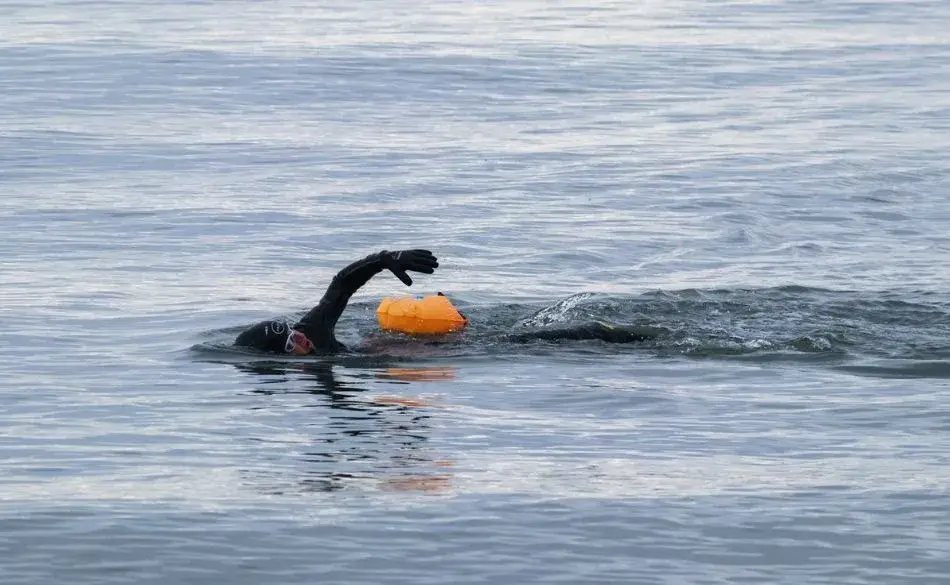
Swimming technique degrades faster than cycling or running fitness. A runner who takes two weeks off loses aerobic fitness gradually — but their running mechanics are deeply ingrained. A swimmer who drops from three sessions per week to one will notice noticeable form breakdown within two to three weeks. Open water swimming in particular relies on continuous practice of breathing patterns, sighting, and stroke efficiency that cannot be maintained on fitness alone.
The minimum: two swim sessions per week, every week. These don’t need to be long — a 25-minute focused pool session maintaining technique is more valuable than a skipped session. If two pool visits per week is logistically difficult, one pool session and one open water session (in warmer months) maintains skills adequately. For time-crunched athletes, a 6am pool session before work is one of the few training slots that genuinely cannot be substituted by indoor alternatives. Our mini triathlon distances guide is worth reading if you’re choosing your first race — shorter distances reduce the swimming demand significantly for athletes who are less confident in the water.
Maintain Running Frequency
Running carries the highest injury risk of the three disciplines when frequency drops and then suddenly increases. A time-crunched athlete who skips running for two weeks to focus on cycling, then runs a longer session close to race day, significantly increases stress fracture and soft tissue injury risk. The minimum: two runs per week, at least one of which is off the bike (a brick run). These runs don’t need to be long — a 20-minute run after a 45-minute ride gives you both brick adaptation and weekly run frequency in a time-efficient block. Our guide on running twice a week covers whether two runs per week is genuinely enough to maintain running fitness — the short answer is yes, with appropriate session structure.
Cut Cycling Volume First
Cycling fitness holds better with reduced frequency than either swimming or running. A trained cyclist who drops from four rides per week to two maintains a higher proportion of their cycling fitness than a swimmer who drops from four swims to two maintains of their swim fitness. Cycling is also the most time-flexible discipline — a 45-minute structured indoor trainer session provides equivalent training stimulus to 60–75 minutes of outdoor riding, making it the most compressible discipline when time is genuinely short. Indoor cycling platforms (Zwift, Wahoo, Garmin) make short, structured sessions maximally efficient.
When time gets tight, the priority order is: swim × 2 first (non-negotiable), run × 2 second (protect frequency), then fill remaining time with cycling. This is counterintuitive for athletes who are already strong cyclists — the discipline you’re best at is the easiest to maintain at lower frequency, so it’s the right one to deprioritise.
The Brick Session: Two Disciplines in One Block
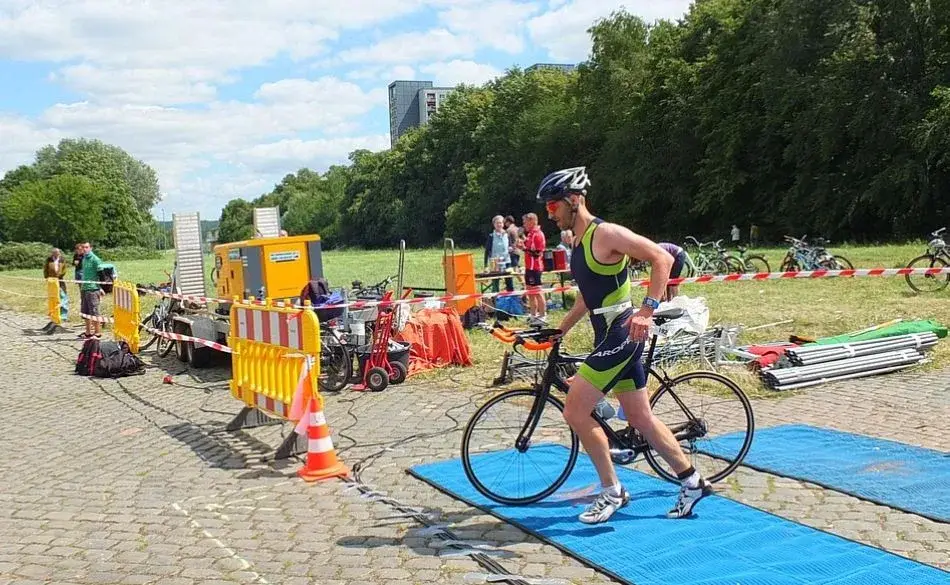
Brick workouts — a bike session followed immediately by a run, with no rest between — are the single most time-efficient training tool for triathletes. They accomplish three things simultaneously: cycling fitness, running fitness, and triathlon-specific neuromuscular adaptation (training your legs to run after cycling, which feels profoundly different until you’ve practised it).
For time-crunched athletes, one brick per week replaces two separate sessions while adding race-specific preparation that neither session alone provides. Our guide on running off the bike covers the specific adaptation this trains — the “dead legs” sensation in the first kilometre off the bike diminishes dramatically with brick practice and is something athletes who skip bricks always notice badly on race day.
Time-efficient brick formats:
Short weekday brick (60 minutes): 40 minutes on the trainer at moderate-to-hard effort, transition immediately to a 20-minute run at race effort. Total time: 65 minutes including transition. Provides both disciplines, race-specific leg adaptation, and threshold training in one block.
Weekend brick (90–120 minutes): 75-minute outdoor ride at steady effort, transition to a 20–30-minute run at easy-to-moderate effort. This is the single most important session for Olympic-distance and 70.3 preparation — it mimics the bike-to-run transition at length that approaches race-day demands.
Mini brick (45 minutes): For genuinely time-constrained weeks — 30-minute trainer session, 15-minute run. Maintains the neuromuscular connection and brick habit without requiring a full session block.
Sample Training Weeks for Time-Crunched Athletes
These sample weeks are built around real constraints: work, commute, and limited recovery time. Each protects swim frequency, maintains running, and compresses cycling into efficient formats.
Sprint Triathlon: 6-Hour Week
| Day | Session | Duration | Notes |
|---|---|---|---|
| Monday | Rest | — | Full recovery |
| Tuesday | Pool swim | 30 min | Technique focus: drills + 400m threshold effort. Early morning or lunchtime. |
| Wednesday | Indoor trainer + short run (brick) | 60 min total | 40 min trainer at moderate effort, transition to 20-min easy run. |
| Thursday | Run (intervals) | 40 min | 10 min warm-up, 5 × 3 min at 5K effort / 2 min easy, 10 min cool-down. |
| Friday | Pool swim | 30 min | Aerobic easy swim — maintain technique, no hard efforts. |
| Saturday | Longer outdoor ride + transition run | 90 min total | 70-min ride at moderate effort, 20-min easy run off the bike. |
| Sunday | Rest or easy walk | — | Recovery |
Total: approximately 6 hours. Two swims, two rides (one indoor, one outdoor), two runs, two brick elements. Every session has a purpose — no junk miles.
Olympic Triathlon: 8-Hour Week
| Day | Session | Duration | Notes |
|---|---|---|---|
| Monday | Rest | — | Full recovery |
| Tuesday | Pool swim (threshold) | 45 min | Warm-up, 6 × 100m at effort with 20 sec rest, cool-down. |
| Wednesday | Indoor trainer + run (brick) | 75 min total | 50 min trainer including 3 × 8 min threshold intervals, 25-min easy run. |
| Thursday | Easy run | 45 min | Conversational pace. Zone 2 throughout. |
| Friday | Pool swim (aerobic) | 40 min | Continuous aerobic swim with open water technique drills (sighting, bilateral breathing). |
| Saturday | Longer ride + run (brick) | 120 min total | 90-min outdoor ride at steady effort, 30-min run at moderate effort. |
| Sunday | Easy run or rest | 30 min or — | Only if legs feel good. Easy pace only — no effort. |
Total: approximately 7.5–8 hours. Three swims, three rides (two indoor, one outdoor), three runs, two brick elements. This produces a solid Olympic triathlon performance for an athlete with any reasonable background fitness.
Time Management Strategies That Actually Work
Split your commute. Cycle or run to work even one day per week. A 20-minute run commute each way gives you a 40-minute easy run session without needing to carve additional time out of your day. This works particularly well for running — cycling to work in triathlon-relevant gear can be awkward depending on your workplace, but a morning run commute with a bag of work clothes is genuinely practical.
Use lunch for swimming. A 30-minute lunchtime pool session — typically available at most city pools and many corporate gym facilities — is the highest-return use of a lunch break for triathletes. The water is usually quieter midday, and 25 minutes of focused swimming maintains technique reliably. You return to work without the sweaty-post-run problem.
Make the trainer your default for cycling. Indoor cycling platforms compress training time meaningfully — 45 minutes of structured interval work on a trainer produces training stimulus equivalent to 60–70 minutes of outdoor riding. For athletes fitting evening trainer sessions in after the kids are in bed, our guide on cycling before sleep covers whether late-night sessions affect sleep quality. For morning sessions, a trainer before work is one of the few training windows that doesn’t require daylight, particular weather, or commute time to a specific location.
Protect the Saturday morning block. For most working athletes, Saturday morning is the highest-value training window of the week — the longest uninterrupted block before family and social commitments fill the day. Protect this for the long ride or the longer brick. A 90-120 minute Saturday morning brick followed by a 30-minute Sunday run gives you the week’s most important training with minimal disruption to the rest of your schedule. Our guide on triathlon training frequency covers how the distribution of sessions across the week affects adaptation — the Saturday-Sunday back-to-back is specifically addressed there.
Treat training sessions like meetings. 220 Triathlon’s coaching guidance identifies this as the single most effective time-management habit: schedule sessions in your calendar as non-negotiable appointments. A run at 6:30am on Tuesday is more likely to happen if it’s blocked in your calendar than if it exists only as an intention. The athletes who train consistently with limited time don’t find more time — they protect the time they have from the encroachment of other demands.
What Honest Expectations Look Like by Distance
Triathlon training guides often undersell the minimum commitment needed. Here’s an honest account of what 5–8 hours per week actually produces on race day:
Sprint triathlon at 5–6 hours/week: You will finish, probably comfortably, and enjoy it. You won’t win your age group unless your background fitness is exceptional, but you’ll have a positive race-day experience and be ready to go again. This is exactly the right target for a first-time triathlete with limited training time.
Olympic triathlon at 7–8 hours/week: You will finish with a manageable race experience — the swim and bike should feel controlled, and the run may be challenging in the final third but not survival mode. Meaningful performance improvement at this distance typically requires moving toward 9–10 hours, but 7–8 hours is sufficient for a solid age-group result.
Ironman 70.3 at 8–9 hours/week: You can finish a 70.3 on this volume, but the last 10km of the run will be genuinely hard. A 70.3 on 10–12 hours per week produces a race that you can execute to plan; on 8 hours, you’re finishing rather than racing. Still a meaningful achievement — just set realistic expectations.
For athletes who are new to triathlon and still calibrating distance and commitment, our guide on whether you need a coach for your first triathlon provides a clear framework by distance. The guide on triathlon event order covers the race-day sequence, transitions, and what to expect if this is your first event.
The Minimum Viable Week: When Life Goes Sideways
Every triathlete training around a busy life will have weeks where even the 5-hour plan is impossible — travel, illness, work crisis. The minimum viable training week that keeps you on track:
Two swims of 25–30 minutes (swim technique above all). One brick of 45–60 minutes (trainer + 15-minute run). One easy run of 30 minutes. Total: approximately 2.5–3 hours.
This is not a training week that builds fitness. It is a maintenance week that prevents deconditioning and keeps the neuromuscular patterns of all three disciplines active. One minimum viable week doesn’t hurt your race preparation. Two consecutive minimum viable weeks require acknowledging that your preparation is behind target and adjusting expectations accordingly.
For athletes returning to training after an enforced break due to illness, injury, or life demands, our return to exercise guide covers the connective tissue lag concept and the 50% rule for safe volume rebuilding — directly applicable to triathlon training rebuilds after missed weeks.
Time-Crunched Triathlon Coaching and Plans
A coach builds your week around your actual schedule — not the hours you wish you had. SportCoaching's triathlon coaching adapts weekly based on your real availability, prioritising the sessions with the highest return for your target race.
FAQ: Triathlon Training When You're Short on Time
How many hours a week do you need to train for a triathlon?
Sprint: 5–7 hours/week for 8–12 weeks. Olympic: 7–10 hours/week for 12–16 weeks. Ironman 70.3: 8–12 hours/week for 16–20 weeks. Full Ironman: 10–15+ hours/week — not the right distance for genuinely time-crunched athletes.
What is the minimum training needed for a sprint triathlon?
4–5 hours per week for 8–10 weeks produces a comfortable sprint triathlon finish. Non-negotiable: 2 swims/week, 1 longer ride, 1 brick workout (bike then run). Everything else builds on this foundation.
Which triathlon discipline should I cut when time is short?
Cut cycling volume first — it holds best with reduced frequency. Protect swimming (technique degrades fastest) and running (injury risk if frequency drops then spikes). Two swims and two runs per week are the minimum to maintain across a training block.
Can you do a triathlon on 5 hours of training per week?
Yes, for a sprint triathlon. Five hours per week for 10–12 weeks is a viable sprint preparation. Distribute as 2 swims (1 hr), 2 rides (2 hrs), 1 run (1 hr), with 1 brick built into one of the rides. Produces a comfortable finish for any athlete with reasonable fitness background.
Find Your Next Triathlon Race
Ready to put your training to the test? Here are some upcoming triathlon events matched to this article.
PTC Triathlon and Duathlon April 2026
Wellcamp Airport Duathlon & Fun Run 2026