Quick Answer
Triathletes are among the fittest athletes in the world. By VO2max alone, cross-country skiers record higher values. By breadth of endurance fitness, training volume, and multi-sport capacity — especially at Ironman distance — triathletes make the strongest case for the title. The real answer depends on your definition of fitness.First: What Does "Fitness" Actually Mean?
The word fitness covers a wide range of physiological qualities that are genuinely distinct from each other. An Olympic weightlifter and an Ironman triathlete are both extraordinarily fit — but almost entirely in different ways. Before comparing athletes across sports, the specific fitness components in question need to be defined.
The key fitness components relevant to this comparison are aerobic capacity (VO2max), lactate threshold, muscular endurance, sport-specific economy, strength and power, flexibility and mobility, body composition, and mental toughness. No single sport develops all of these simultaneously. The question of “fittest athlete” therefore becomes: fittest in what specific domain, and for what purpose?
The most commonly used scientific measure for comparing endurance fitness across sports is VO2max — the maximum rate at which the body can absorb, transport, and use oxygen during exercise, expressed in millilitres per kilogram of bodyweight per minute (ml/kg/min). It is the closest thing sport science has to a universal endurance fitness benchmark. It is not perfect — lactate threshold, economy, and mental fortitude all matter enormously in actual performance — but it provides a comparable, measurable number across athletes and sports.
VO2max by Sport: Where Triathletes Sit
| Sport | Elite male VO2max (ml/kg/min) | Elite female VO2max (ml/kg/min) | Notes |
|---|---|---|---|
| Cross-country skiing | 80–96+ | 65–80+ | Highest of any sport; uses full body |
| Cycling (road) | 70–84 | 60–72 | Indurain 88; Svendsen 97.5 (record) |
| Marathon running | 70–85 | 62–75 | Kipchoge ~85; Benoit 78.6 (women's record) |
| Triathlon | 65–80 (~70 avg) | 60–66 | Elite women avg 65.6 (PubMed study) |
| Rowing | 68–75 (relative) | 58–65 | High absolute VO2max; heavier body mass reduces relative value |
| Swimming | ~70 | ~60 | Upper-body dominant; constrained by breathing mechanics |
| Soccer / football | 55–65 | 50–58 | Mix of aerobic and explosive demands |
| General population (20–29) | ~45 | ~38 | Average untrained young adult |
Elite triathletes average approximately 70 ml/kg/min — comparable to elite marathon runners and professional cyclists, and well above team sport athletes and the general population. The highest VO2max ever recorded was 97.5 ml/kg/min by Norwegian Oskar Svendsen in 2012 — a cyclist, not a triathlete. Norwegian cross-country skier Bjørn Dæhlie recorded 96 ml/kg/min. No triathlete appears in the all-time top VO2max list.
By this single metric, triathletes are not the fittest athletes — cross-country skiers are, primarily because skiing uses the arms, legs, and core simultaneously, generating the highest possible total oxygen demand. When running or cycling, the arms contribute comparatively little to propulsion; in cross-country skiing, the upper body and poles drive meaningful propulsion, forcing the cardiovascular system to support a far larger total working muscle mass.
Why Cross-Country Skiers Top the VO2max Charts
Understanding why skiers outperform triathletes on VO2max requires understanding what VO2max measures. VO2max is limited primarily by cardiac output — how much oxygenated blood the heart can deliver to working muscles per minute. The more muscle mass actively contracting, the higher the total oxygen demand, and the more the heart must adapt.
Cross-country skiing engages both upper and lower body in sustained, coordinated propulsion. The poles drive backward with each stride, engaging lats, triceps, and core — muscle groups that contribute minimally in running or cycling. This full-body recruitment means the heart must supply oxygen to a larger total muscle mass, producing a higher cardiac output stimulus during training and a correspondingly higher VO2max adaptation over years of competition.
Cycling, by contrast, is primarily leg-driven. Running is also lower-body dominant, with arms swinging freely rather than propulsively. Swimming is upper-body dominant. Triathlon combines three sports — but none of them individually, and not all three simultaneously. The heart of an elite triathlete is extraordinary by any standard — but it has not been trained by full-body simultaneous propulsion in the way that elite cross-country skiing demands.
The Case for Triathletes as the Fittest Athletes
The VO2max comparison paints an incomplete picture of what fitness means in practice. When the definition of fitness expands beyond a single laboratory measurement, the case for triathletes becomes very strong.
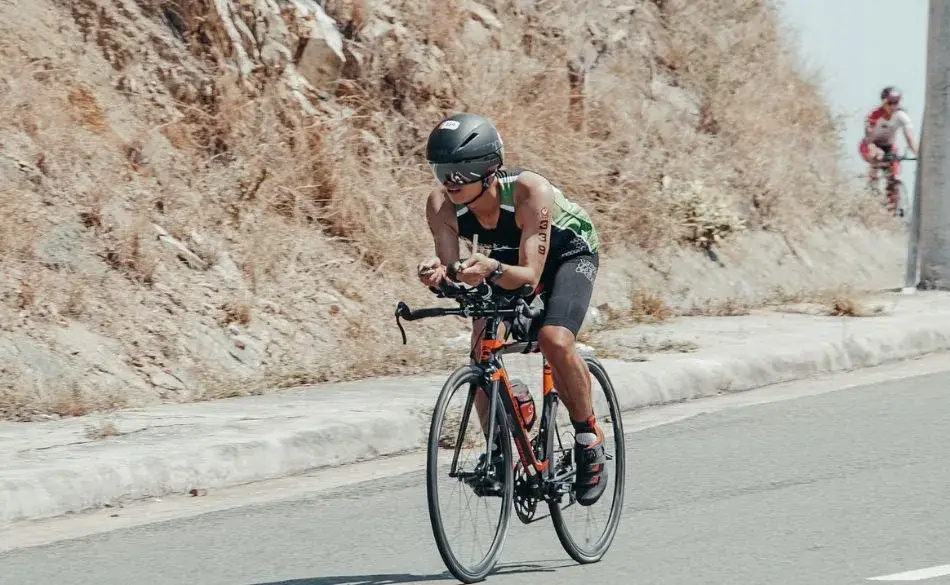
Multi-discipline aerobic development. A triathlete develops elite-level aerobic fitness across three fundamentally different movement patterns simultaneously — swimming (upper body and coordination), cycling (sustained leg power), and running (weight-bearing impact endurance). No other mainstream endurance sport requires an athlete to maintain competitive fitness across multiple disciplines at the same time. A marathon runner’s cycling fitness atrophies; a professional cyclist’s running capacity is limited. A triathlete must sustain all three. Our cycling for runners guide covers how aerobic fitness crosses over between disciplines — and the limits of that crossover.
Extraordinary training volume. Elite Ironman triathletes train 25–35+ hours per week across three sports. Professional cyclists and marathon runners train similarly high volumes in their single sport. The difference is that triathletes impose this volume across three different biomechanical patterns, demanding adaptation in swim, bike, and run simultaneously. The musculoskeletal system, cardiovascular system, and metabolic system are all developed in three distinct movement contexts.
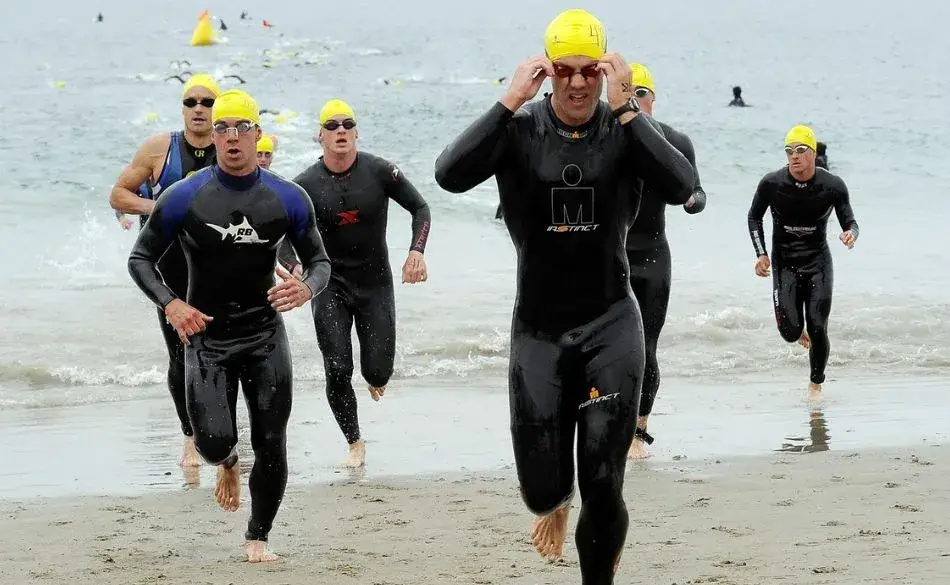
Ironman as the pinnacle of endurance. A full Ironman — 3.8km of open water swimming, followed immediately by 180km of cycling, followed immediately by a 42.2km marathon — is one of the most demanding single-day endurance events on the planet. The swim, bike, and run cover 226.3km in total. Elite professionals finish in approximately 7.5–8.5 hours; age-group athletes complete the event in 10–14 hours. The metabolic, cardiovascular, and psychological demands of sustaining effort across 10–14 hours of continuous exercise in three sports are genuinely exceptional. Our full Ironman distance guide and half Ironman distance guide cover what each event demands physiologically. Our Ironman training plans and half Ironman training plans are structured around the progressive volume and multi-discipline demands of these events.
Pain tolerance research. Research from Tel Aviv University tested triathletes and non-athletes on pain identification, intensity rating, and tolerance. Triathletes identified pain just as well as non-athletes (demonstrating the effect was not simply reduced nerve sensitivity), but perceived it as less intense and tolerated it significantly longer. Triathletes rated pain lower in intensity, tolerated it longer, and inhibited it better than individuals in a control group. Researchers attributed this to both physiological adaptations from high training volumes and psychological factors — triathletes reported fearing and worrying less about pain. This pain tolerance profile helps explain how triathletes sustain effort through the final hours of an Ironman at a physiological cost that would cause most athletes to stop.
Cardiovascular markers. Elite triathletes display exceptional cardiovascular adaptations: enlarged cardiac chambers, high stroke volume, low resting heart rates (typically 40–50 bpm), and high capillary density across multiple muscle groups developed through three different training modalities. The breadth of cardiovascular adaptation in triathletes — spanning swimming, cycling, and running — is wider than in single-sport athletes.
Where Triathletes Are Not the Fittest
Intellectual honesty requires acknowledging the limits of triathlon fitness, not just its strengths.
Peak aerobic capacity. As the VO2max data shows, cross-country skiers and the very best cyclists and marathon runners exceed elite triathletes on this metric. A triathlete training 10 hours per week across three sports develops each at a lower volume than a single-sport specialist training 10 hours in one discipline. Sport specificity matters — the best marathon runner in the world can run faster than the best Ironman triathlete in the world, because running is all they do.
Strength and power. Triathlon is an endurance sport. Body composition in elite triathletes is typically very lean (low body fat, moderate muscle mass) — optimal for sustained aerobic output but not for generating maximal force. Olympic weightlifters, shot-putters, rugby players, and gymnasts develop strength, power, and explosive capacity that triathletes do not train. A definition of fitness that includes maximum strength, vertical jump, or peak sprint power will not favour triathletes.
Sport-specific skill. An elite triathlete is not the fastest swimmer, cyclist, or runner in the world — they are the best at combining all three. In any individual discipline, a specialist will outperform a triathlete. This is not a weakness of the sport but a structural reality: the training time must be divided three ways.
Flexibility and mobility. Endurance sport does not systematically develop flexibility. Gymnasts, dancers, martial artists, and yoga practitioners have superior flexibility to triathletes. If flexibility is weighted heavily in a definition of fitness, triathletes rank lower.
How Triathletes Compare: A Broader Fitness Framework
| Fitness component | Triathlete ranking | Who leads |
|---|---|---|
| VO2max (aerobic ceiling) | Very high (3rd–4th among sports) | Cross-country skiers, elite cyclists |
| Multi-sport aerobic endurance | Best of any sport | Triathletes (no other sport combines 3) |
| Training volume sustained | Exceptional (25–35+ hrs/wk elite) | Comparable to pro cyclists, marathon runners |
| Pain tolerance / mental toughness | Among the best (research-supported) | Triathletes, ultrarunners |
| Single-sport speed (swim/bike/run) | Below sport-specific specialists | Specialists in each discipline |
| Maximal strength / power | Low relative to strength sports | Olympic weightlifters, sprinters, rugby |
| Flexibility / mobility | Below sport-specific athletes | Gymnasts, dancers, martial artists |
| Body composition (lean mass) | Excellent — very low body fat | Comparable to marathon runners, cyclists |
The Ironman Athlete: A Special Case
Within triathlon itself, there is a significant spectrum. A sprint triathlete (750m swim, 20km bike, 5km run) is an athletic generalist who needs speed across three disciplines but whose race lasts under an hour. An Ironman triathlete is something categorically different.
Completing an Ironman requires the body to sustain aerobic output for 10–14 hours continuously across three disciplines — managing glycogen depletion, heat regulation, hydration, fat oxidation, and musculoskeletal fatigue simultaneously over a distance of 226km. The metabolic demands of this sustained output require fat oxidation efficiency, glycogen conservation strategy, gut function under load, and a cardiovascular system capable of sustaining effort for more than half a day. These demands are genuinely unique — no other mainstream non-staged endurance event makes comparable demands across multiple simultaneous disciplines.
The physiological adaptations required to complete an Ironman at a competitive pace — strong Zone 2 aerobic base, developed fat oxidation, multi-sport musculoskeletal resilience — represent a breadth of conditioning that few athletes in any sport can match. Our Zone 2 running pace guide covers the aerobic base training that forms the foundation for Ironman performance specifically. To find your next event, our triathlon event calendar lists races from sprint through to full Ironman distance across Australia and New Zealand.
Verdict: What Does the Evidence Say?
By VO2max alone: cross-country skiers are the fittest athletes by this specific measure, with values of 80–96+ ml/kg/min compared to triathletes’ average of ~70 ml/kg/min.
By multi-sport aerobic endurance breadth: triathletes — and particularly Ironman athletes — make the strongest case for the fittest title. No other sport requires elite-level aerobic conditioning across three fundamentally different movement patterns simultaneously. The sheer scope of physiological adaptation required is unmatched.
By overall athletic capacity including strength, power, and skill: the answer becomes sport-specific — a gymnast is more flexible, a sprinter faster, a weightlifter stronger.
The most honest answer is that “fittest athlete” is not a single category — it is a spectrum of different qualities. Within that spectrum, elite triathletes hold an exceptional position: extraordinary aerobic capacity, remarkable training volumes, unique multi-discipline endurance, and documented pain tolerance that supports hours of sustained effort. Whether that makes them the fittest depends on what you are asking them to be fit for. For endurance across multiple disciplines over hours and hours of effort — there is no better comparison.
Notable VO2max benchmarks: Highest ever recorded — Oskar Svendsen (cyclist, Norway) 97.5 ml/kg/min (2012). Highest female recorded — Joan Benoit (marathon runner, USA) 78.6 ml/kg/min. Eliud Kipchoge (marathon) estimated ~85 ml/kg/min. Miguel Indurain (Tour de France cyclist) 88 ml/kg/min. Elite triathlete average ~70 ml/kg/min. Average untrained adult male ~35–45 ml/kg/min.Train for the Broadest Endurance Fitness of Your Life
SportCoaching's triathlon training plans develop swim, bike, and run fitness simultaneously — from sprint distance to full Ironman — structured around your available time, current fitness, and target event.
FAQ: Are Triathletes the Fittest Athletes?
Are triathletes the fittest athletes?
By multi-sport endurance breadth, triathletes — especially Ironman athletes — make the strongest case. By VO2max alone, cross-country skiers record higher values (80–96+ ml/kg/min vs triathletes’ ~70 ml/kg/min). The answer depends on how fitness is defined. Triathletes are extraordinary athletes; they are not definitively the fittest by all measures.
What VO2max do elite triathletes have?
Elite male triathletes average approximately 70 ml/kg/min; elite females approximately 60–66 ml/kg/min. These values are comparable to elite marathon runners and professional cyclists, and far above the general population average of 35–45 ml/kg/min.
Which sport produces the fittest athletes?
By VO2max: cross-country skiing. By multi-discipline endurance: triathlon. By strength and power: Olympic weightlifting and sprinting. No single sport produces the fittest athletes across all fitness dimensions. The answer is sport-specific and depends entirely on the fitness component being measured.
How fit do you need to be to complete an Ironman?
Most age-group Ironman finishers have VO2max values of approximately 50–65 ml/kg/min. The primary demands are aerobic base, fat oxidation efficiency, musculoskeletal durability, and the ability to sustain effort across 10–14 hours. Peak VO2max matters less than the ability to sustain a high percentage of it for many hours without glycogen depletion.
Do triathletes have higher pain tolerance than other athletes?
Research from Tel Aviv University confirmed that triathletes tolerate pain significantly better than non-athletes — perceiving it as less intense and enduring it longer — while still identifying it normally. Both physiological and psychological factors contribute. This pain tolerance is considered central to performance in multi-hour events like half Ironman and Ironman.
Find Your Next Triathlon Race
Ready to put your training to the test? Here are some upcoming triathlon events matched to this article.
fisiocrem Triathlon Port Stephens 2026
You Yangs Off-road 2026