










Find Your Next Cycling Race
Ready to put your training to the test? Here are some upcoming cycling events matched to this article.
 Coach Graeme
Last updated:
Most cyclists spend years riding without a plan. They do the same group ride every Saturday, spin easy during the week, and wonder why their fitness has plateaued. Sound familiar?
A structured cycling training plan changes everything. It tells you what to do, when to do it, and why each session matters. Whether you are training outdoors on Australian roads or on Zwift in your garage, a plan that balances intensity, endurance, and recovery is the fastest path to getting stronger on the bike.
Not sure where to start with training?
Tell us your goal and schedule, and we’ll give you clear direction.
No obligation. Quick, practical advice.
Explore our cycling workouts and tips for more helpful articles and resources.
A good cycling training plan includes three to five rides per week with a mix of endurance, threshold, and interval sessions, plus rest days. Training should be based on your FTP or heart rate zones, progress gradually over 12 weeks, and include a recovery week every three to four weeks.
Riding without structure is how most people start cycling, and it works at first. Simply getting on the bike more often will improve your fitness. But after a few months, unstructured riding leads to what coaches call junk miles — rides that are too hard to recover from but too easy to drive real adaptation.
A structured cycling training plan solves this by ensuring that each session has a purpose. Easy rides are genuinely easy. Hard rides are hard enough to trigger fitness gains. Rest days are respected rather than filled with guilt rides.
The result is that you improve faster while spending less total time on the bike. Every hour counts because every hour has a target. Cyclists who follow a structured plan consistently see FTP gains of 10 to 20 percent in their first 12-week training block, even on as little as six to eight hours per week.
Functional Threshold Power, or FTP, is the maximum power in watts that you can sustain for approximately one hour. It is the single most important number in cycling training because every training zone is calculated as a percentage of your FTP.
If your FTP is 200 watts, your endurance rides should be around 110 to 150 watts, your tempo efforts around 150 to 180 watts, and your threshold intervals right around 190 to 210 watts. Without knowing your FTP, you are guessing at intensity, and guessing leads to either undertraining or overtraining.
How to test your FTP:
The 20-minute test. After a thorough warm-up, ride as hard as you can sustain for 20 minutes. Multiply your average power by 0.95 to estimate your FTP. This is the most common field test and works well for most cyclists.
The ramp test. Power increases by a set amount every minute until you cannot hold the target. Available on Zwift, TrainerRoad, and most smart trainers. It removes pacing guesswork and is a good option for cyclists who find the 20-minute test mentally tough.
A lab test. The most accurate option. A graded exercise test with blood lactate sampling at an exercise physiology clinic gives precise threshold data. Many universities and sports science clinics across Australia offer these tests. If you are serious about your training, it is worth doing once.
You should retest your FTP every six to eight weeks to keep your training zones accurate. For a deeper look at what your FTP means and how to improve it, read our guide on FTP meaning in cycling and how much you can increase your FTP.
Both heart rate and power are useful training metrics, but they measure different things.
Power tells you exactly how much work you are doing right now. It responds instantly to changes in effort and is not affected by fatigue, heat, caffeine, or sleep quality. If you have a power meter, it is the most objective and precise way to structure your training.
Heart rate tells you how your body is responding to that work. It is influenced by temperature, hydration, fatigue, stress, and even the time of day. Heart rate is slower to respond than power, which makes it less useful for short intervals but valuable for monitoring long-term trends like aerobic fitness and recovery.
The best approach is to use both. Train by power for interval sessions where precise intensity matters. Use heart rate as a secondary check on endurance rides and to monitor fatigue trends over time. If you do not have a power meter, heart rate zones are still an effective way to structure your training. Read our full heart rate zone training guide for detailed zones and how to calculate them.
Note that cycling heart rate zones are typically five to ten beats per minute lower than running zones. If you do both sports, set separate zones for each. Our cycling power zone calculator can help you set power-based training zones from your FTP.
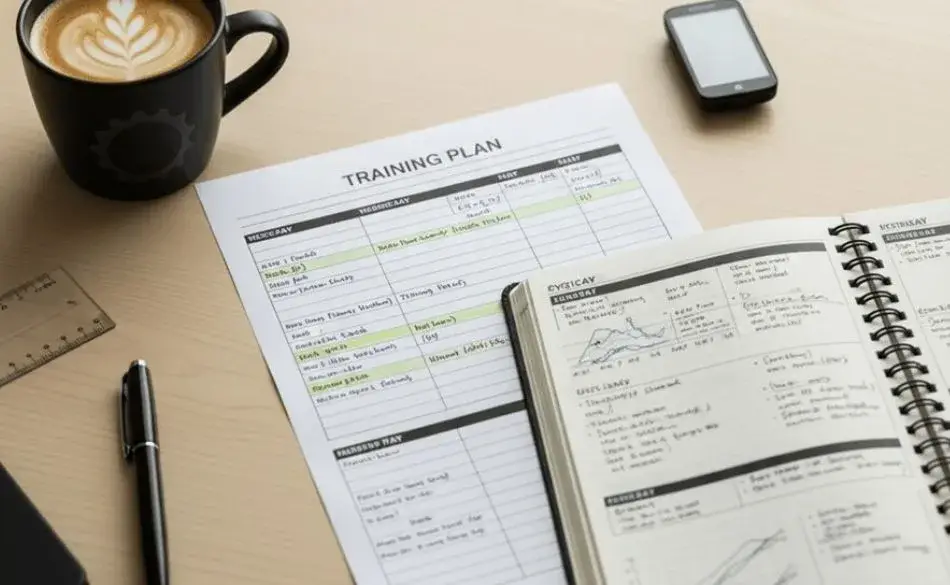
Here is an example of a well-structured training week for a cyclist training five days per week on six to eight hours total. This balances quality interval work with endurance riding and adequate recovery.
👉 Swipe to view full table
| Day | Session | Duration | Intensity |
|---|---|---|---|
| Monday | Rest day | — | — |
| Tuesday | Threshold intervals | 60–75 min | Zone 4 (FTP) |
| Wednesday | Recovery spin or rest | 30–45 min | Zone 1 |
| Thursday | Sweet spot or VO2 max intervals | 60–75 min | Zone 3–4 or Zone 5 |
| Friday | Rest day | — | — |
| Saturday | Endurance ride | 2–3 hours | Zone 2 |
| Sunday | Group ride or tempo | 1.5–2.5 hours | Zone 2–3 |
The two hard sessions on Tuesday and Thursday provide the stimulus for fitness improvement. The endurance ride on Saturday builds aerobic base. The recovery and rest days allow your body to absorb the training and get stronger. If you can only ride three or four days per week, keep the two interval sessions and one endurance ride, and cut the recovery spin.
We offer structured cycling training plans for specific goals and events. Browse all of our cycling training plans to find one that matches your target.
A well-structured 12-week cycling training plan follows a progressive model that builds fitness in phases. This is the same periodisation approach used by professional cyclists, scaled to suit recreational and amateur riders.
Weeks 1–4: Base phase. The focus is on building aerobic endurance and establishing training consistency. Most rides are in zone 2 with one or two tempo sessions per week. Total weekly volume increases gradually by around 10 percent per week. This phase develops the aerobic engine that all higher-intensity work relies on.
Weeks 5–8: Build phase. Intensity increases. Threshold and sweet spot intervals replace some of the tempo work. VO2 max intervals may be introduced for one session per week. Volume stays steady or increases slightly. This is where most of your FTP gains happen.
Weeks 9–11: Peak phase. The highest-intensity block. Interval sessions become more race-specific with efforts at and above threshold. Volume may decrease slightly to allow for higher quality in the hard sessions. If you are targeting an event, this phase sharpens your fitness.
Week 12: Taper. Volume drops by 40 to 50 percent while intensity remains. This allows your body to fully absorb the training block and arrive at your event or testing day feeling fresh and strong.
Every third or fourth week within each phase should be a recovery week where volume drops by 30 to 40 percent. This prevents overtraining and allows adaptation to occur.
Indoor cycling has changed the way cyclists train. Whether it is a hot Australian summer, a rainy winter, or simply a time-crunched Tuesday evening, indoor training on a smart trainer gives you a controlled, distraction-free environment to execute quality sessions.
Zwift is the most popular indoor cycling platform in Australia and worldwide. It offers structured workouts, training plans, group rides, and virtual races. For interval sessions, Zwift’s ERG mode on a smart trainer automatically adjusts resistance to keep you at your target power, which makes it easy to execute sessions precisely.
A good Zwift training plan follows the same principles as any cycling training plan — progressive overload, balanced intensity, and recovery. The difference is that every session happens in a controlled environment where variables like wind, traffic, and terrain are removed. This makes indoor training ideal for hard interval work where hitting exact power targets matters.
Tips for effective indoor cycling training:
Use a fan. Cooling is the single biggest factor in indoor performance. Without adequate airflow, your body overheats and power output drops. A strong fan pointed at your upper body makes a significant difference.
Fuel properly. It is easy to forget to eat and drink when you are focused on intervals. For sessions over 60 minutes, aim for 30 to 60 grams of carbohydrate per hour and drink to thirst.
Retest your FTP on the trainer. FTP measured outdoors is often different to indoor FTP. Set separate zones for indoor and outdoor riding if you notice a consistent difference.
For specific indoor workouts to try, read our guide to 10 Zwift workouts every cyclist should try. If you are comparing indoor platforms, we have covered Rouvy vs Zwift and MyWhoosh vs Zwift in detail.
These are the four workout types that appear in virtually every effective cycling training plan. Each one targets a different part of your fitness.
Sweet spot intervals (88–93% of FTP). The most time-efficient workout for building FTP. Typical sessions include two to three efforts of 15 to 20 minutes at sweet spot intensity with five minutes of recovery between efforts. Sweet spot training delivers a high training stimulus without the deep fatigue of riding at full threshold.
Threshold efforts (95–105% of FTP). Riding at or just above your FTP builds your ability to sustain high power for longer. Classic sessions include two efforts of 20 minutes at FTP, or four efforts of 10 minutes with short recovery. These sessions are mentally and physically demanding.
VO2 max intervals (106–120% of FTP). Short, hard efforts of three to five minutes that push your cardiovascular system to its limit. These build your ceiling — the higher your VO2 max, the more room you have to raise your FTP. A typical session is five efforts of four minutes at 110 to 115 percent of FTP with three to four minutes of recovery.
Endurance rides (55–75% of FTP). Long, steady rides in zone 2 that build your aerobic base. These should feel comfortable enough to hold a conversation. Two to four hours depending on your goals and available time. Do not underestimate the importance of these rides — they form the foundation of cycling fitness and should make up the majority of your weekly volume.
For more detail on getting started with structured workouts, read our cycling interval training guide for beginners.
For rides under 60 minutes, water is usually enough. For rides over 60 minutes, aim for 30 to 60 grams of carbohydrate per hour from gels, bars, or sports drink. For longer rides or high-intensity sessions, push towards 60 to 90 grams per hour. Practise your fuelling strategy in training so race day is not the first time you try a new product.
After riding, consume a meal or snack with protein and carbohydrate within 30 to 60 minutes of finishing. In hot Australian conditions, particularly during summer, you may need 500 to 1000 millilitres of fluid per hour with electrolytes. The basics matter more than supplements — eat enough, drink enough, and recover properly.
Following a static training plan is better than no plan at all. But a plan cannot see how your body is responding to training. A cycling coach can.
At SportCoaching, we work with cyclists across Australia and internationally, from weekend riders chasing their first fondo to competitive racers targeting national-level events. Here is what coaching adds beyond a plan:
Personalised zones and progression. Your training zones are set from your actual test data and updated every time you retest. Your plan progresses at the rate your body can handle, not at a predetermined schedule.
Weekly analysis. Every week, we review your power data, heart rate trends, and how you felt. If your numbers are dropping, we adjust before overtraining sets in. If you are flying, we push the progression.
Accountability and structure. Knowing that someone is reviewing your training changes how you show up. Easy rides stay easy. Hard rides get done. The riders who improve fastest are not always the most talented — they are the most consistent.
Race and event preparation. Whether it is a local criterium, a gran fondo, the Amy Gillett Gran Fondo, or the Bowral Classic, we build your plan around your target cycling events with specific pacing strategies based on your power data.
Coach’s tip: The biggest gains we see in new coaching clients do not come from harder training. They come from better training structure — making easy rides easier, hard rides harder, and recovery a non-negotiable part of the program.
A personalised cycling training plan built around your FTP, your schedule, and your goals is the fastest way to improve. At SportCoaching, every session has a purpose and every week moves you forward.
If you want data-driven training with weekly feedback from an experienced coach, cycling coaching gives you the structure, accountability, and expertise to get faster.
Start Cycling CoachingHow often should I cycle to get fit?
Three to five rides per week is the sweet spot for most cyclists. Three rides with two interval sessions and one endurance ride will build solid fitness. Five rides allows for more volume and variety. The key is consistency over weeks and months rather than cramming in big weeks followed by time off the bike.
What is a good FTP for a recreational cyclist?
For male recreational cyclists, an FTP of 200 to 250 watts or 2.5 to 3.5 watts per kilogram is a solid benchmark. For female recreational cyclists, 150 to 200 watts or 2.0 to 3.0 watts per kilogram is strong. FTP varies enormously based on training history, age, and genetics. The most useful comparison is your FTP now versus your FTP three months ago. For more benchmarks, read our guide on average FTP by age.
Do I need a power meter to follow a cycling training plan?
A power meter makes training more precise and is the gold standard for structured cycling training. However, you can follow a training plan using heart rate zones or even perceived effort. If you ride indoors on a smart trainer, most trainers have built-in power measurement, which gives you accurate data without needing a separate power meter on your bike.
Can I follow a cycling training plan on Zwift?
Yes. Zwift is an excellent platform for following a structured training plan. ERG mode on a smart trainer controls resistance automatically to keep you at your target power, which makes interval execution easier. Many coaches, including SportCoaching, deliver Zwift-compatible workouts directly through TrainingPeaks.
How long does it take to see results from a cycling training plan?
Most cyclists notice improvements in fitness and perceived effort within three to four weeks of consistent structured training. Measurable FTP gains typically appear after six to eight weeks. A full 12-week training block is enough time for significant, lasting improvement that shows up in both your numbers and how you feel on the bike.
Ready to put your training to the test? Here are some upcoming cycling events matched to this article.
Head Coach & Founder, SportCoaching
Graeme is the founder of SportCoaching and has coached more than 750 athletes from 20 countries, from beginners to Olympians, in cycling, running, triathlon, mountain biking, boxing, and skiing. His coaching philosophy and methods form the foundation of SportCoaching's training programs and resources.
No matter your goals, SportCoaching offers tailored training plans to suit your needs. Whether you’re preparing for a race, tackling long distances, or simply improving your fitness, our expert coaches provide structured guidance to help you reach your full potential.
Structured cycling coaching to build power, endurance, and speed.
What’s included
Browse upcoming Australian running, cycling, and triathlon events in one place. Filter by sport, check dates quickly, and plan your training around something real on the calendar.
Choose your plan to get started with personalized training plans designed to help you reach your goals.


Minna Backman
When you’re new, feedback is especially important, and Graeme is highly skilled at both analyzing numbers and understanding the importance of mental strength.