




Find Your Next Triathlon Race
Ready to put your training to the test? Here are some upcoming triathlon events matched to this article.
 Coach Graeme
Last updated:
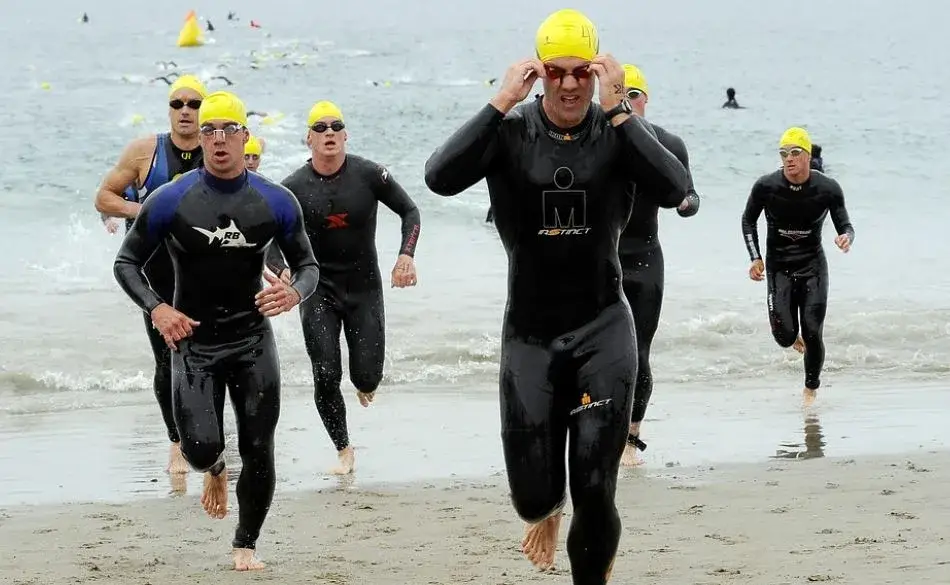
Scroll through any triathlon finish line photo and you will see the full spectrum of human body types — tall and slight, compact and muscular, heavy-framed and powerful, built like swimmers, built like runners, and built like neither. The idea that there is one archetypal triathlete physique is immediately disproved by looking at actual race participants, not promotional imagery. What triathlon training does consistently produce — across every starting body type — is a specific set of physical adaptations: reduced body fat, increased cardiovascular efficiency, and functional muscular development distributed across the legs, core, and upper body in proportions unique to the three-sport training demand. This article covers what training for triathlon actually does to your body, how each discipline shapes you differently, what the research says about somatotypes and performance, and why there is no "perfect" triathlete build.
Not sure where to start with training?
Tell us your goal and schedule, and we’ll give you clear direction.
No obligation. Quick, practical advice.
Explore our triathlon training articles for more helpful articles and resources.
In 2021, Kristian Blummenfelt won the Ironman World Championship in St George, Utah. The reaction was extraordinary — not because of the performance itself, but because of Blummenfelt’s physique. His fellow competitors, spectators, and media commentators noted that he looked more like a rugby player than a triathlete. He was visibly heavier and more muscular than most of the elite field. He won anyway, by a significant margin.
Precision Hydration’s analysis of the reaction is pointed: “We were unwilling to dedicate the title of ‘best body type for IRONMAN’ to the one we’d just watched defeat the very best athletes in the world.” Blummenfelt’s victory was a demonstration that performance is the product of training quality, aerobic capacity, and smart preparation — not conforming to a visual stereotype.
This matters beyond the elite. The triathlete population across age groups is visually diverse, and deliberately so. Triathlon’s distance structure — from super-sprint to Ironman — is specifically suited to different body profiles. A heavier, powerful athlete who would struggle on a hilly 70.3 run may be entirely competitive on a flat, fast Ironman course. The range of distances and terrain means that body type rarely completely excludes anyone from competitive participation.
What the research does support: excess body fat — above the performance range appropriate for competitive racing — is a disadvantage in running and on hilly bike courses. This is distinct from the idea that a specific body shape is required. Two athletes of very different heights, builds, and natural body compositions can both be at their respective performance optima while looking nothing alike. Scientific Triathlon’s review is explicit: “There is no one optimal body composition for a triathlete. It is individual.”
The three-sport nature of triathlon produces more complete physical adaptation than any single-sport training. Each discipline contributes distinct muscular and physiological development, and the combination creates a balanced fitness profile that is distinctive to triathlon.
| Discipline | Primary muscles developed | Secondary muscles / systems | Visible physical change |
|---|---|---|---|
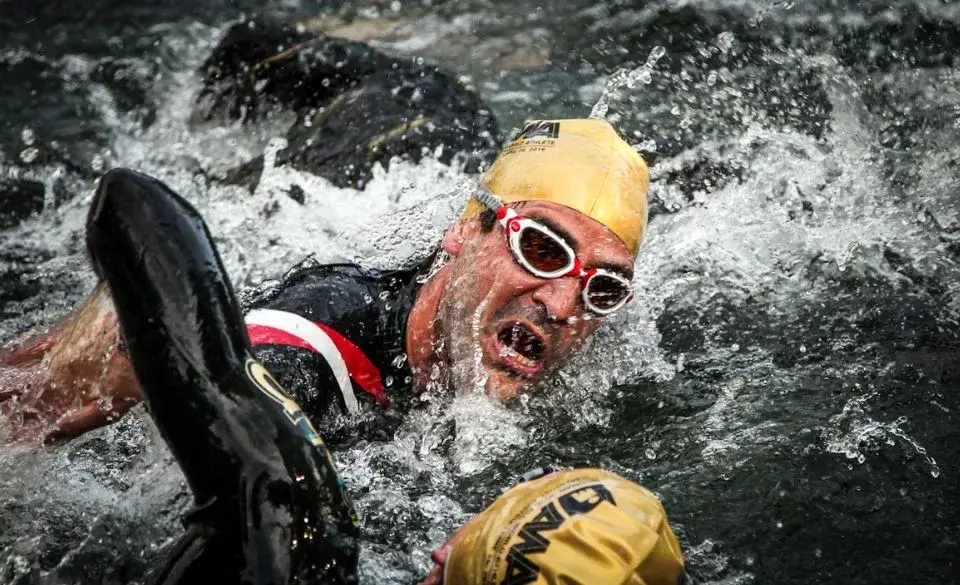
| Swimming | Latissimus dorsi, shoulders (deltoids), triceps | Core rotation, hip flexors, chest | V-shape upper back; shoulder and lat definition; improved posture |
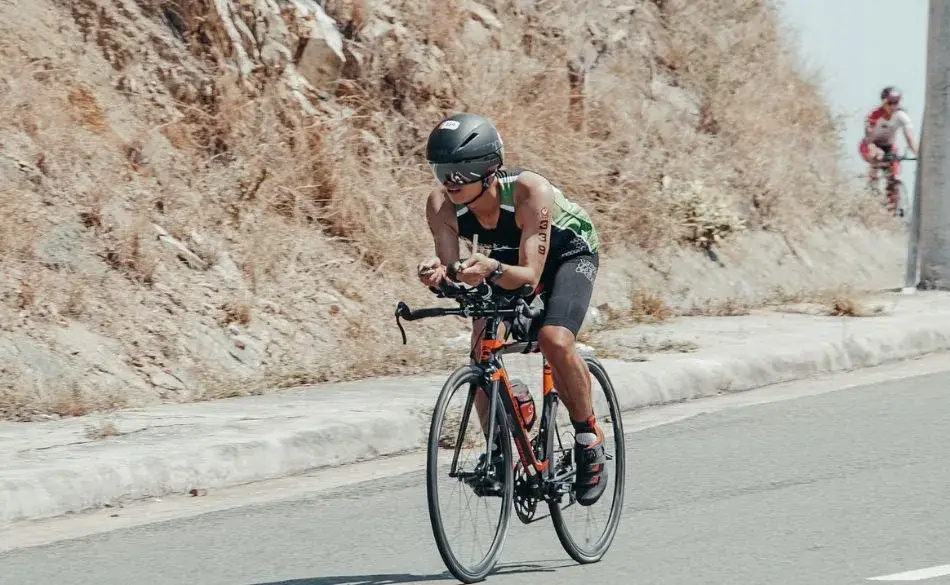
| Cycling | Quadriceps, glutes, hamstrings, calves | Hip flexors, lower back, core stabilisers | Quad and glute definition; reduced body fat around legs and hips |
| Running | Calves (gastrocnemius/soleus), hamstrings, hip flexors | Core, glutes, tibialis anterior | Lean lower legs; visible calf and hamstring definition; overall fat reduction |
| Triathlon combined | All of the above — comprehensive coverage | Cardiovascular system, mitochondrial density, aerobic base | Lean, proportional development across whole body; reduced body fat; functional strength throughout |
Swimming’s contribution to upper body development is the most distinctive difference between triathletes and pure runners or cyclists. Runners often have underdeveloped upper bodies; cyclists have strong legs but variable shoulder and back development depending on their position. Triathletes — particularly those who swim 3+ times per week — develop noticeable lat and shoulder definition from the pull phase of freestyle swimming. Pro triathletes consistently cite pull-ups as a useful test of swim-specific upper body power.
Cycling’s contribution is primarily the quadriceps — the most visually distinctive muscle group in an experienced triathlete’s legs. Hours of sustained pedalling at moderate to high cadence develops quad endurance, mass, and definition that pure runners typically lack. For cyclists adding running to their programme, this transition actually requires care — the quad-dominant cycling movement pattern doesn’t naturally produce the hamstring and calf activation that running requires.
Running strips body fat more aggressively than the other two disciplines per unit of time, due to its full weight-bearing impact and high metabolic cost. Experienced runners are typically leaner in the lower body than cyclists or swimmers of equivalent training volume. The combination of all three disciplines produces the most comprehensive body composition improvement of any endurance sport programme.
Somatotyping — the classification of body types into ectomorph (lean and linear), mesomorph (muscular and medium-framed), and endomorph (heavier and rounder) — is a simplified model, but it provides useful guidance for race selection and training emphasis.
| Somatotype | Physical characteristics | Natural triathlon advantages | Challenges | Best suited to |
|---|---|---|---|---|
| Ectomorph | Lean, light, limited natural muscle bulk | Running efficiency, hill climbing on bike, heat dissipation | Building swim-specific power; cold water tolerance; sustaining power over long flat courses | Hilly sprint/Olympic; hilly 70.3 and Ironman courses |
| Mesomorph | Medium frame, naturally muscular, moderate body fat | Power output, sprint-distance speed, strong swim; adapts quickly to training | Carrying muscle mass on long run legs; body weight increases cost of running at distance | Sprint and Olympic distance; shorter-course racing where power is rewarded |
| Endomorph | Heavier frame, higher natural body fat, strong lower body | Buoyancy in the swim (less effort to stay horizontal); power on flat bike courses; resilience | Running performance (weight directly impacts cost); hill climbing; heat management | Flat long-course events; cold-water swims; flat Ironman courses |
These are tendencies, not determinants. Research from PMC on half-Ironman body composition found that higher ectomorphy scores were associated with better overall Ironman performance — but this reflects the typical demands of Ironman racing (hilly courses, long run) rather than a universal principle. Flat-course Ironman events actively reduce the ectomorph advantage and increase the competitiveness of more powerful builds.
220 Triathlon’s body composition analysis adds an important nuance on swimming: body fat provides buoyancy, which reduces the effort required to maintain a horizontal, streamlined position in the water. Triathletes with very low body fat in the lower body may actually spend more energy fighting leg sinkage during the swim than athletes carrying slightly more fat in the lower limbs. This partially offsets the run and bike disadvantage of additional body fat — making the triathlon body composition equation more complex than “lean is always better.”
For context on how distance selection interacts with your body type and current fitness, our guide on triathlon fitness requirements covers which distances are appropriate for different starting points, and our mini triathlon distances guide covers the full distance spectrum from super-sprint through Ironman.
Triathlon training produces physical change across multiple timescales. Understanding what to expect — and when — prevents the common early discouragement of athletes who don’t yet see visible results after a few weeks.
The earliest adaptations are largely invisible but immediately felt. Resting heart rate begins declining. Blood plasma volume increases — more blood volume means better oxygen delivery and faster heat dissipation. Neuromuscular coordination improves across all three disciplines, making movement feel less effortful at the same pace or power. Breathing at easy effort becomes more controlled. These adaptations don’t show in the mirror but are measurable within the first month and underpin every physical change that follows.
Body fat begins reducing noticeably during this phase, particularly in the lower body. The combination of swimming, cycling, and running represents a significant weekly caloric expenditure — typically 2,000–4,000 calories per week for a moderate training volume, depending on body size and intensity. This deficit, even without dietary changes, produces measurable body fat reduction within 6–8 weeks. Leg muscles begin showing improved definition, particularly the quadriceps from cycling and the calves from running. Upper back and shoulder development from swimming becomes apparent. This is the phase where most athletes first notice visible physical change.
By this stage, connective tissue — tendons, ligaments, bone density — has adapted to the repeated loading of training. This is a critical phase that beginners frequently rush: cardiovascular fitness develops faster than structural tissue, creating an injury risk window where the heart and lungs can handle more volume than the joints and tendons can safely absorb. The 10% rule (increasing weekly training load by no more than 10% per week) is most important during this phase. Muscle development becomes more pronounced and specific — triathletes typically show the V-shape upper back from swimming combined with quad-dominant leg development from cycling. Our guide on building a cardio base covers the physiological timeline in more detail.
Full adaptation to the demands of triathlon training — the ability to complete three disciplines in a single race and recover normally, the body composition associated with regular multi-sport training, and the running-off-the-bike tolerance that distinguishes experienced triathletes from beginners — typically requires 12–24 months. PMC research on elite U23 female triathletes found that even within a full competitive season, VO2max continued improving in both cycling and running, with fat percentage progressively decreasing across measurement points. Physical development is not complete at six months — it continues for years with consistent training.
Training for three sports simultaneously produces a different physical profile from training exclusively for one. This comparison helps set expectations for athletes transitioning from another sport:
| Sport background | Upper body | Lower body | Body fat | Transition to triathlon |
|---|---|---|---|---|
| Pure runner | Underdeveloped — minimal upper body work | Lean, hamstring/calf dominant | Typically low | Swimming adds shoulder/lat mass; cycling adds quad strength; overall balance improves |
| Pure cyclist | Variable — depends on position and years riding | Quad dominant, well-developed glutes | Variable | Running adds calf/hamstring definition and further fat loss; swimming adds upper body balance |
| Pure swimmer | Strong lats, shoulders, chest | Often underdeveloped — non-weight-bearing training | Higher than runners/cyclists of same fitness | Running and cycling add significant lower body development and reduce body fat |
| Triathlete | Functional upper body — lats, shoulders, core | Balanced — quad (cycling), hamstring/calf (running) | Typically low with proportional distribution | N/A — this is the target profile |
The triathlete body profile — balanced upper and lower body development, low body fat, well-developed aerobic capacity — is broadly considered one of the most well-rounded fitness profiles in sport. Quora’s analysis by experienced triathletes describes it as “an ideal way to develop great overall conditioning and an appealing physique” specifically because no single muscle group dominates and the combined demands produce whole-body development that specialist training does not. Our swimming vs running comparison covers the distinct physical changes each discipline produces when trained alone.
A common early motivation for starting triathlon is body composition — losing weight, becoming leaner, looking fitter. This is a legitimate starting point, but the most effective approach is to train for performance and let body composition follow, rather than training primarily for fat loss.
Triathlete’s research-based guidance is direct: athletes who train for performance — improving swim times, bike power, run pace — produce better body composition outcomes than athletes who train for fat loss and use performance as a secondary metric. This is because performance-focused training drives higher-quality aerobic adaptation, more complete muscular development, and better hormonal response to training. Cutting calories during training to accelerate fat loss typically degrades training quality and impairs the very adaptations that produce lasting body composition improvement.
The practical principle: follow a structured training plan, fuel your sessions adequately, and allow 3–6 months for body composition changes to become clearly visible. The changes will come — but they are a byproduct of training well, not a goal to be chased separately. Our Zone 2 training guide covers the intensity at which most triathlon base training should be conducted — the aerobic zone that builds the fat-burning efficiency and cardiovascular foundation for all three disciplines. For athletes building training frequency, our guide on how often to train for triathlon covers the minimum sessions per week that produce reliable body adaptation at each distance. And for athletes who want to understand body composition in more detail specific to race performance, our ideal triathlon race weight guide covers the research on body fat targets, watts per kilogram, and timing of weight management in a training season.
For older athletes considering triathlon, body composition changes are still achievable but the timeline is longer and recovery needs are greater. Our guide for older and heavier runners covers how to approach endurance training progressively, with injury prevention as a priority alongside fitness development. Athletes wanting to accelerate their aerobic development alongside fat loss can use our interval training guide for the higher-intensity sessions that supplement base training once an aerobic foundation is established.
Train for Triathlon With a Structured, Personalised Plan
SportCoaching's triathlon coaching builds a programme around your current body type, fitness level, and race goals — structured phases that produce real physical adaptation without overtraining. AUD $143/month, no lock-in, 90-day performance guarantee.
What does a triathlete’s body look like?
There is no single triathlete body type. Age-group triathletes compete across all body types and sizes. What consistent triathlon training produces: reduced body fat, lean functional muscle in legs, core, and upper back, and strong cardiovascular fitness. Elite triathletes tend to be lean with low body fat, but even at elite level Kristian Blummenfelt’s 2021 Ironman World Championship win showed that no single physique dominates.
Does triathlon training change your body?
Yes — significantly. Cardiovascular adaptations within 4–8 weeks; body fat reduction and early muscle definition within 8–12 weeks; full structural adaptation (tendons, connective tissue, sport-specific muscle balance) over 12–24 months. PMC research found 6.9–10% VO2max improvement in cycling and 7.1–9.1% in running over a 13-week half-Ironman training period.
What body type is best for triathlon?
No single type. Ectomorphs suit hilly courses. Endomorphs suit flat long-course events. Mesomorphs excel at short-distance speed. Performance is produced by training quality and appropriate race selection, not body type. There is a triathlon distance that suits every body type.
How long does it take for your body to change from triathlon training?
Cardiovascular changes: 4–8 weeks. Visible body composition change: 8–16 weeks. Distinct tri-athlete muscle development (lats from swimming, quads from cycling, lean legs from running): 3–6 months. Full adaptation to multi-sport training: 12–24 months of consistent training.
Does triathlon make your body more muscular?
It builds lean endurance-specific muscle — not bulk. Swimming develops lats, shoulders, and core. Cycling builds quads and glutes. Running develops calves, hamstrings, and hip flexors. The result is balanced functional development across the whole body. Scale weight rarely increases significantly — muscle gain is typically offset by fat loss.
Ready to put your training to the test? Here are some upcoming triathlon events matched to this article.


Head Coach & Founder, SportCoaching
Graeme is the founder of SportCoaching and has coached more than 750 athletes from 20 countries, from beginners to Olympians, in cycling, running, triathlon, mountain biking, boxing, and skiing. His coaching philosophy and methods form the foundation of SportCoaching's training programs and resources.
No matter your goals, SportCoaching offers tailored training plans to suit your needs. Whether you’re preparing for a race, tackling long distances, or simply improving your fitness, our expert coaches provide structured guidance to help you reach your full potential.
Personalised coaching to improve your swim, bike, and run performance.
What’s included
Browse upcoming Australian running, cycling, and triathlon events in one place. Filter by sport, check dates quickly, and plan your training around something real on the calendar.
Choose your plan to get started with personalized training plans designed to help you reach your goals.


Minna Backman
When you’re new, feedback is especially important, and Graeme is highly skilled at both analyzing numbers and understanding the importance of mental strength.