



Quick Answer
Format: 4 athletes (2M + 2W), each completes a super-sprint triathlon in succession. Distances (Olympic): 300m swim, ~7–8km bike, 1.8–2km run per leg. Each leg: ~20 minutes. Total race time: Under 90 minutes. Current order: Male-Female-Male-Female (from 2022 onwards). Key rule: Draft-legal — riders may follow wheels on the bike; road bikes required (no TT bikes). Olympic debut: Tokyo 2020 (2021), won by Great Britain.How the Triathlon Mixed Relay Works
The triathlon mixed relay is not a relay in the traditional sense — it is not divided into three disciplines assigned to three different athletes, as in a standard triathlon relay. Instead, each of the four team members completes their own complete mini-triathlon: swim, bike, and run in sequence. When a team member finishes their run, they tag the next teammate (via hand slap), who immediately enters the water for their swim. The clock runs continuously from the first athlete’s start to the last athlete’s finish line crossing. All handovers and transitions count toward the team’s total time.
The practical result is that all four athletes must be proficient across all three disciplines — there is no opportunity to hide a weak swimmer by giving them only the bike leg. This distinguishes the mixed relay from the standard three-person relay (where specialists can cover individual disciplines) and is one of the reasons it produces such competitive racing.
The Tagging Zone
When an athlete completes their run leg, they enter a designated tagging zone before the water entry point. The next teammate must be waiting in the zone and receives the tag before entering the water. Tagging incorrectly — too early (athlete receiving the tag starts the swim before being legally tagged) or outside the zone — results in a time penalty. At elite events, the tagging sequence is monitored by officials. For age-group events, the rules are similar but the tagging procedures vary by event organiser.
Draft-Legal Racing
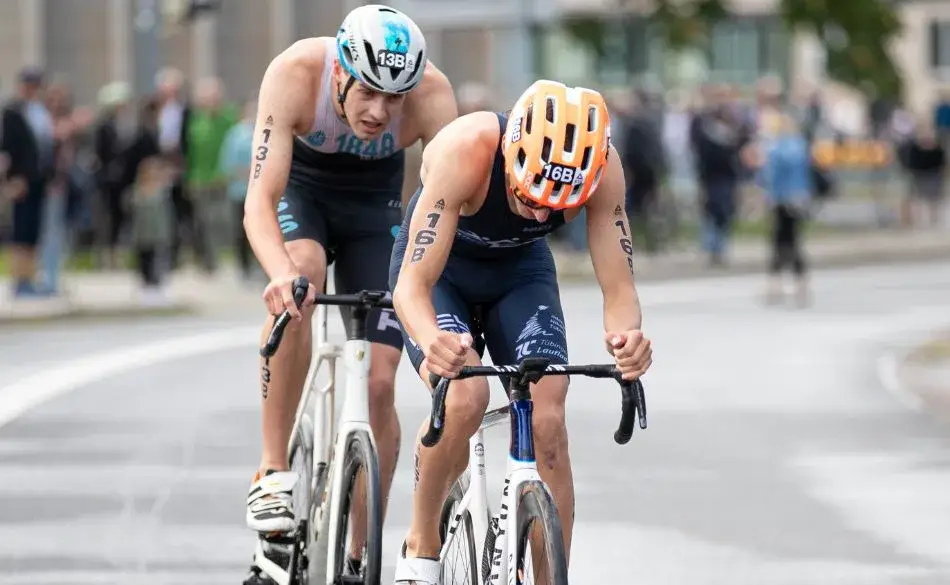
The mixed relay is a draft-legal event under World Triathlon rules, meaning athletes are permitted to ride in each other’s slipstream during the bike leg. This is a fundamental difference from most age-group non-drafting triathlon and from Ironman events. Draft-legal racing requires road bikes (no TT bikes or aerobars are permitted), rewards bike-handling skills and tactical positioning, and makes pack dynamics central to the race. Athletes who can stay with the front pack on the bike preserve energy for the run and maintain their team’s overall position; athletes dropped on the bike face a significant deficit.
Distances: Olympic vs Age-Group vs Youth
| Level | Swim (per leg) | Bike (per leg) | Run (per leg) | Approx leg time | Total race time |
|---|---|---|---|---|---|
| Olympic (Tokyo 2020) | 300m | 6.8km | 2km | ~20 min | ~80–90 min |
| Olympic (Paris 2024) | 300m | ~7–8km | 1.8km | ~20 min | ~80–90 min |
| World Triathlon Age Group | 250–300m | 5–8km | 1–2km | ~20–25 min | ~85–100 min |
| Typical grassroots event | 200–300m | 5–6km | 1–1.5km | ~15–25 min | ~60–100 min |
Distances vary slightly between venues — the course is designed around the specific geography of each race city — but remain within the super-sprint range throughout. The key characteristic is brevity: each leg is approximately 20 minutes of intense racing, making it closer to a track or swimming relay in character than to a traditional endurance triathlon event. For context on how super-sprint distances compare to other triathlon distances, our mini triathlon distances guide covers the full spectrum from super-sprint through Ironman.
The Order: Male-Female Sequencing
The order in which male and female athletes compete has changed since the event’s introduction, and understanding the history explains the current format.
| Event | Order | Who crosses the finish line |
|---|---|---|
| Tokyo 2020 Olympics | F–M–F–M | Male athlete |
| 2022 onwards (World Triathlon) | M–F–M–F | Female athlete — first time in Olympic history |
| Paris 2024 Olympics | M–F–M–F | Female athlete |
| Age group (general) | Alternating M–F or F–M | Varies by event organiser |
The change to MFMF was introduced by World Triathlon from 2022 onwards following the Tokyo 2020 Games, specifically to ensure a woman crosses the Olympic finish line for the first time in the event’s history. The format is intended to alternate each Olympiad. The order decision is strategically significant at the elite level — the athlete on the last leg carries the greatest pressure and the greatest opportunity for a dramatic sprint finish.
History: From World Championships to Olympic Gold
The triathlon mixed relay did not begin at the Olympics — it has a longer competitive history that built the credibility needed for Olympic inclusion.
2009: The first Mixed Relay World Championship was held in Des Moines, Iowa, USA. Switzerland won the inaugural title. The format immediately showed its potential for spectator-friendly, team-oriented racing.
2010: The mixed relay debuted at the Singapore Youth Olympic Games — the first Olympic programme appearance of the format.
2014: Hamburg, Germany became the long-term home of the Mixed Relay World Championships, hosting the event annually for most subsequent years. Hamburg’s city-centre course, consistently drawing over 250,000 spectators, demonstrated the format’s mass appeal.
2017: The International Olympic Committee announced the triathlon mixed relay would join the Olympic programme at Tokyo 2020, alongside several other new mixed-gender team events designed to increase gender equality across the Games.
2021 (Tokyo 2020 Olympics): The mixed relay made its Olympic debut on July 31, 2021. Great Britain won gold, with a team of Alex Yee, Georgia Taylor-Brown (both individual silver medallists earlier in the week), Jonny Brownlee, and Jess Learmonth. The victory made Jonny Brownlee the most decorated Olympic triathlete in history with three medals. The USA took silver, France bronze. The race immediately became one of the most talked-about moments of the Tokyo Games.
2024 (Paris Olympics): The mixed relay was held on August 5, 2024, the third and final triathlon event at the Paris Games. France won gold on home soil, with Great Britain taking silver — completing an extraordinary individual and relay medal haul for the British team across both the individual races and the relay.
At the World Championship level, France has been the dominant nation with five titles between 2015 and 2023, while Germany, Great Britain, and Switzerland have also been consistent podium presences.
Race Strategy: What the Research Shows
The short, draft-legal, high-intensity nature of the mixed relay creates distinctive strategic considerations that differ meaningfully from individual triathlon racing.
Swimming determines positioning. Research published in PMC (2024) analysed 129 national teams across five World Triathlon Series mixed relay events and two European Championships in 2022–2023. The study found that position at the end of the swim leg strongly influenced which pack an athlete joined on the bike. In draft-legal racing, the pack you join on the bike determines your energy expenditure and run arrival time. Athletes who exit the swim in the leading group can draft on the bike, conserve energy, and arrive at the run leg fresher than those who chase from behind.
Cycling is the longest and most critical discipline. Despite the short absolute duration, the bike leg accounts for more of the total elapsed time than swimming or running. Research by Quagliarotti et al. (2022) identified cycling as the most important predictor of overall mixed relay result — both for individual leg performance and for team outcomes. Athletes who can drive pace on the bike, break away from packs, or sustain high power while drafting are disproportionately valuable in this format.
The third leg is disproportionately influential. Martínez-Sobrino et al. (2023) found that the performance of the third relay leg was most relevant for the overall team result — this is the second female athlete under the current MFMF order (or the second male under the old FMFM). The third leg tends to be where leading teams consolidate advantages or where teams in contention make decisive moves. Elite teams concentrate particular attention on who occupies this position.
Team ordering is a tactical decision. Unlike an athletics relay where the order is largely fixed by lane assignment, triathlon mixed relay ordering within the male-female alternation is a genuine tactical choice. Coaches assess which athletes are in best form, which match-ups create problems for rival teams’ stronger athletes, and which athlete is best suited to handle the pressure of the anchor position under race conditions. USA Triathlon coaching guidance notes that team order is typically not finalised until close to race day.
The super-sprint intensity requires specific preparation. Spain’s national team head coach Iñaki Arenal described the key training difference for mixed relay: “athletes need to be stronger and faster, so we have to change the pace of the training sessions in order to improve power rather than endurance.” The super-sprint format rewards explosive capacity, high-end aerobic power, and speed — different emphases from the 90-minute sustained-effort demands of Olympic-distance individual triathlon. Our interval training guide covers the type of speed work that develops the high-intensity capacity most relevant to relay-format racing.
How Mixed Relay Differs From Other Triathlon Formats
| Format | Athletes per team | Each athlete does | Drafting | Total race time |
|---|---|---|---|---|
| Individual triathlon (sprint) | 1 | Full 750m/20km/5km | Legal (World Triathlon) / Illegal (most age-group) | ~55–75 min |
| Standard relay (3-person) | 3 (1 per discipline) | One discipline only (swim, bike, or run) | Varies | ~55–90 min |
| Mixed relay (Olympic) | 4 (2M + 2W) | Full super-sprint triathlon each | Legal | ~80–90 min |
| Olympic distance individual | 1 | 1.5km/40km/10km | Legal (World Triathlon) / Illegal (age-group) | ~1:50–2:30 |
For a comprehensive comparison of triathlon formats and what distinguishes standard triathlons from draft-legal racing and relay events, our guide to triathlon event order covers the complete race structure. Our Ironman vs standard triathlon comparison covers the full distance spectrum.
For Amateur Athletes: How to Compete in a Mixed Relay
Mixed relay triathlon is no longer exclusively an elite format. Age-group and amateur opportunities exist at multiple levels and the format is particularly well-suited to beginners — the 20-minute individual leg is one of the most accessible triathlon experiences available.
World Triathlon Age Group Championships. A mixed relay category at age-group world championship level was introduced, bringing the Olympic format to competitive age-groupers. Teams of four (2M + 2W) in compatible age-group brackets compete over super-sprint distances.
Triathlon Australia and state events. Triathlon Australia has promoted relay formats at various national and state events. Check the SportCoaching triathlon event calendar for upcoming Australian triathlon events that include relay categories.
Local festival and club events. Many grassroots triathlon events now include a relay category alongside individual events. Some run a specific mixed relay; others allow any four-person team. These are excellent entry points for triathletes wanting to experience relay racing before attempting a full individual event.
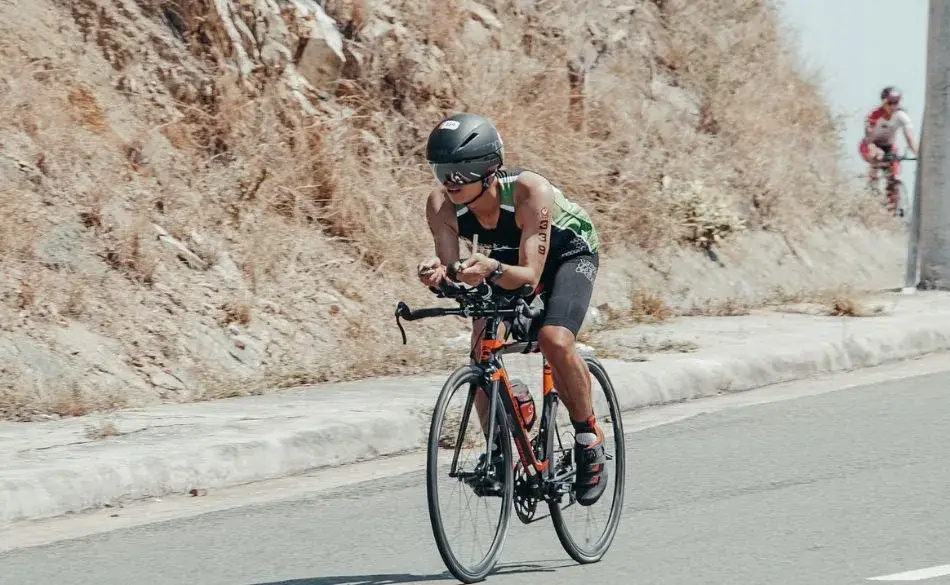
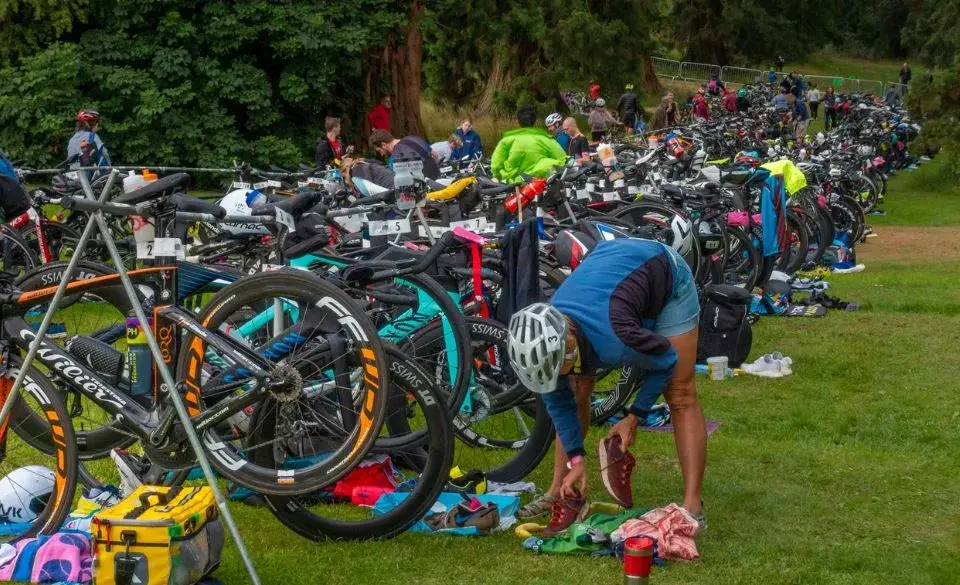
Gear requirements. Because the mixed relay is draft-legal, road bikes are required — TT bikes and clip-on aerobars are not permitted. This actually reduces the barrier to entry compared to standard triathlon, where a TT bike is often considered important. A standard road bike is ideal. Otherwise the gear is the same as a sprint triathlon: wetsuit (where permitted), goggles, run shoes, and a number belt. Our triathlon transitions guide covers the T1 and T2 sequences relevant to relay transitions.
Training for a mixed relay. Because the individual leg is only ~20 minutes at high intensity, training emphasis shifts toward speed, explosive aerobic power, and race-pace familiarity rather than long-distance endurance. Athletes preparing for a mixed relay should prioritise short, sharp sessions rather than the long bike rides and extended runs that characterise 70.3 or Ironman preparation. Interval swimming, cycling at VO2 max intensity, and high-cadence run work are all directly relevant. Our time-crunched triathlon training guide covers how to structure effective triathlon training around limited weekly hours — directly applicable to relay-format preparation.
Why the Mixed Relay Has Become the Olympics' Most Exciting Triathlon Event
Several structural features of the mixed relay format produce consistently dramatic racing that standard individual events rarely match:
Continuous action. The race is essentially non-stop for 90 minutes — at any moment, an athlete is in the water, on the bike, or running. There are no quiet periods between competitors’ starts.
Multiple lead changes. Because four legs create four opportunities for lead changes, the mixed relay produces more dramatic pivots in the standings than a two-hour individual race. A team can lose 15 seconds on the swim leg and recover it on the bike; a dominant run can erase a multiple-position deficit.
Team emotion. Athletes who have just raced their individual events hours or days earlier return for their teammates. The visible intensity of athletes watching their teammates race — cheering from the tagging zone — is unusual for a sport where competitors are typically focused inward during racing.
Gender equality in real-time. The alternating male-female format means men and women are visibly equal contributors to the outcome in a single race, rather than competing in separate events. The format was specifically designed to promote this equality and has succeeded in creating it at the highest competitive level.
For athletes inspired by the mixed relay and considering entering triathlon, our guide on whether you need a coach for your first triathlon covers how to approach the sport at any distance, and our guide to the best triathlons in Australia covers the full race calendar for finding your first event.
Train for Triathlon With Expert Coaching
Whether you're targeting a mixed relay, a first sprint triathlon, or a full Ironman, SportCoaching provides personalised triathlon coaching — structured phases, weekly adjustments, and direct coach access. AUD $143/month, no lock-in, 90-day performance guarantee.
FAQ: Triathlon Mixed Relay
What is a triathlon mixed relay?
A team event where four athletes (2 men + 2 women) each complete a super-sprint triathlon in succession, tagging the next teammate after finishing their run. It is draft-legal. Olympic debut: Tokyo 2020, won by Great Britain.
What are the distances in an Olympic triathlon mixed relay?
Each leg: 300m swim, ~7–8km bike, 1.8–2km run. Each leg takes approximately 20 minutes. Total race time under 90 minutes. Distances vary slightly between venues but remain within the super-sprint range.
What order do athletes race in the triathlon mixed relay?
Current order (2022 onwards): Male-Female-Male-Female. Previous order (Tokyo 2020): Female-Male-Female-Male. The format alternates each Olympiad. Under MFMF, a woman crosses the finish line — the first time in Olympic history.
Can amateur athletes compete in a triathlon mixed relay?
Yes — through Triathlon Australia events, state triathlon championships, World Triathlon Age Group Championships, and some local festival events that offer relay categories. Each individual leg is only ~20 minutes, making it one of the most beginner-accessible triathlon formats.
Why is the triathlon mixed relay draft-legal?
It follows World Triathlon (ITU) rules, which permit drafting at short-course events. This requires road bikes (no TT bikes), rewards bike-handling and pack tactics, and significantly influences race strategy — swimming position determines which bike pack you join, which is a key performance determinant.
Find Your Next Triathlon Race
Ready to put your training to the test? Here are some upcoming triathlon events matched to this article.
Wellcamp Airport Duathlon & Fun Run 2026
Airlie Beach Triathlon 2026