Want help turning consistency into progress? Coaching keeps your training simple, structured, and sustainable.
Start Coaching →
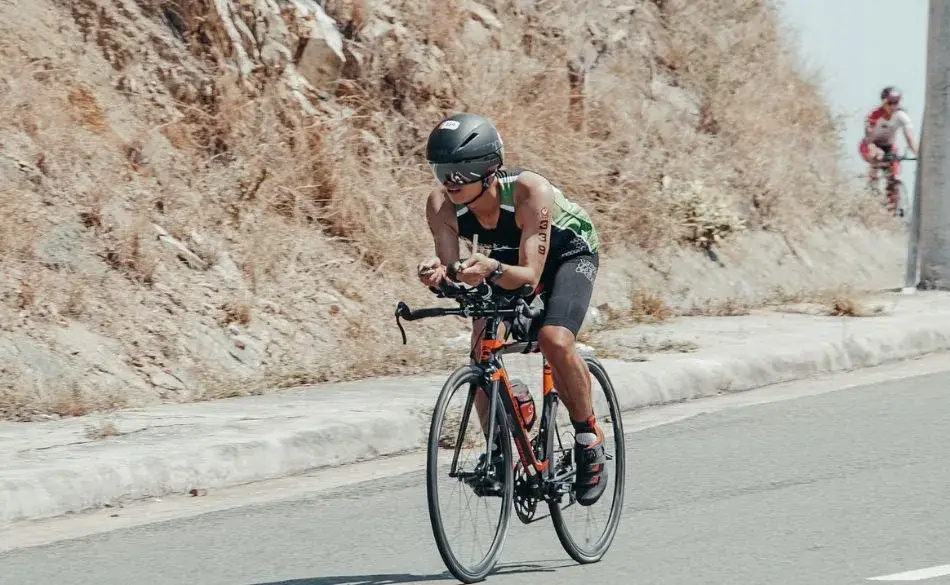
Clydesdale triathlon athlete cycling during a race, showcasing strength and endurance.

Last updated:

Clydesdale Triathlon: Complete Training and Racing Guide

Triathlon's reputation as a sport for lean, lightweight athletes is both persistent and inaccurate. Bigger, heavier athletes complete triathlons at every distance, from sprint events to full Ironman, and many compete at a high level within their division. The Clydesdale category exists precisely because body weight is a legitimate physical variable in multisport racing — heavier athletes carry more load over every stride and pedal stroke, generate more ground impact, and face different aerodynamic and mechanical demands than lighter competitors. Racing Clydesdale is not a consolation category. It is a fair and logical division that allows larger athletes to compete against others with similar physical dynamics.

This guide covers everything: Australian weight standards, how each discipline plays to and against Clydesdale physiology, gear selection, a 12-week sprint triathlon training plan, and race-day strategy.

Chat with a SportCoaching coach

Not sure where to start with training?

Tell us your goal and schedule, and we’ll give you clear direction.

No obligation. Quick, practical advice.

Article Categories:

Explore our triathlon advice and tips for more helpful articles and resources.

Whether you’re a first-timer wondering if this category is right for you, or a seasoned athlete looking for new ways to improve, this guide covers everything you need to race strong and proud.

Quick Answer

The Clydesdale division is for male triathletes over 100kg in Australian events (80kg for women in the Athena division). It’s optional — you can choose Clydesdale or race in your standard age group. Each discipline has specific considerations for heavier athletes: swimming rewards bigger athletes (buoyancy); cycling is competitive on flats but harder on hills; running requires the most injury management due to higher ground impact. The most important training principle for Clydesdale athletes: build slower than you think you need to — connective tissue adapts at half the rate of cardiovascular fitness.

Clydesdale Weight Standards: Australia vs USA

Weight thresholds for Clydesdale and Athena divisions vary by governing body and individual race director. This creates genuine confusion — particularly for athletes who have seen both pound-based and kilogram-based standards in different contexts.

👉 Swipe to view full table
Organisation / Context Clydesdale (Men) Athena (Women) Notes
Australian events (Triathlon Australia / Elite Energy) 100kg+ 80kg+ Most common Australian standard; check each event
USA Triathlon (USAT) sanctioned events 220lb (~100kg)+ 165lb (~75kg)+ Changed from 200lb/150lb in 2013
Some smaller/local events (AU) 100kg+ 75kg+ Athena threshold varies — verify at registration
Age sub-groups (both systems) 39 and under / 40 and over Masters Clydesdale/Athena where offered

The practical takeaway for Australian athletes: if you weigh 100kg or more, you qualify for Clydesdale at the vast majority of Australian triathlon events. Always verify the specific threshold in your event’s registration details, as individual race directors can set their own standards. Some events also conduct weigh-ins at packet pickup; others operate on the honour system.

Clydesdale vs Age Group: Which Should You Choose?

Choosing to race Clydesdale is entirely voluntary, and many athletes who qualify by weight choose to race in their standard age group instead. Neither choice is inherently right. The decision comes down to what you’re looking for from the race experience.

👉 Swipe to view full table
Reason to Choose Clydesdale Reason to Stay in Age Group
You want to race against athletes of similar size and physical demands You prefer to be measured against the general field
You're new to the sport and a podium position would be motivating Your age group is small enough to be competitive anyway
Your goal race has a strong Clydesdale field (common at larger events) Your goal race has a small Clydesdale field (common at smaller local events)
You identify with the Clydesdale community and ethos You're losing weight during training and may drop below threshold

One practical note: if you register as Clydesdale and then lose weight during training, policies vary. Some events allow a division change before race day; others lock you in at registration. If you’re actively training and expect your weight to change significantly, clarify this with the event director before registering.

How Each Discipline Affects Clydesdale Athletes

Swimming: The Buoyancy Advantage

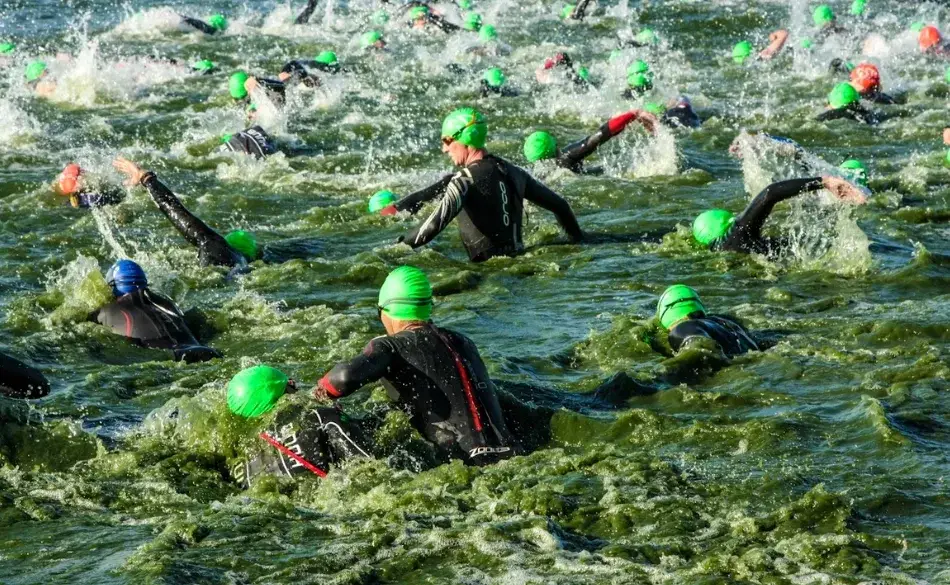
Of the three disciplines, swimming tends to be the most forgiving for larger athletes. Water buoyancy reduces the effective weight load on joints, which means the cardiovascular and technique demands dominate over body composition. Heavier athletes with good technique can be very competitive in the swim, and many Clydesdale athletes who come from strength or team sports backgrounds find swimming the discipline they can most quickly develop.

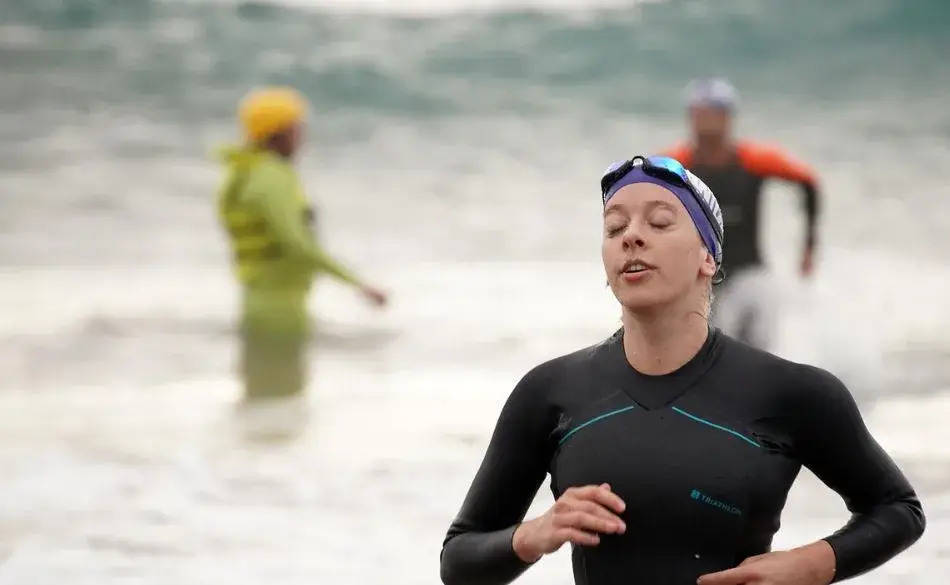
Two specific considerations apply. First, wetsuit fit: standard wetsuits are designed around lean athlete proportions, and athletes with broader chests, shoulders, or torsos often find standard sizes restrict arm movement, particularly through the stroke recovery phase. Wetsuits with flexible shoulder panels and specific larger-frame options (brands including Roka, Orca, and Zoot offer extended sizing) make a tangible difference to comfort and stroke efficiency. A wetsuit that restricts shoulder rotation adds fatigue and cost time over longer swim distances. Second, open water anxiety: this is not unique to Clydesdale athletes, but the adrenaline and breath-holding that comes with the mass swim start can cause panic that has nothing to do with fitness. Practising open water swimming — not just pool swimming — before race day, and arriving early to preview the swim course, significantly reduces this risk.

Cycling: Power on the Flat, Physics on the Hills

The relationship between Clydesdale athletes and cycling is genuinely nuanced and more favourable than most people expect. Larger athletes often generate more absolute power output — heavier legs and stronger muscle mass translate to higher wattage on the bike. On flat and gently rolling terrain, this power advantage is real and can allow Clydesdale athletes to be very competitive with lighter athletes in the overall field.

The physics shifts on climbs. Cycling speed on a hill is primarily determined by watts per kilogram (W/kg), not absolute watts. A 100kg athlete producing 250 watts has a W/kg of 2.5; a 70kg athlete producing 200 watts has a W/kg of 2.86 — and the lighter rider climbs faster despite producing less power. This is why heavier athletes tend to lose time on climb-heavy bike courses and recover it on flat or descent sections. When choosing events, a flatter bike course rewards Clydesdale athletes more than a hilly one.

On descents, the physics reverses: a heavier rider travels faster downhill at the same effort, and many Clydesdale athletes report making up significant time on descents. At the draft-legal amateur level, being heavier at the front of a group also provides aerodynamic shelter for lighter riders following — a dynamic you can observe in any mass-start amateur race.

Running: The Discipline That Requires the Most Care

Running is where Clydesdale athletes face the greatest injury risk, and it deserves the most careful approach during training. The reason is straightforward: ground reaction force during running is approximately 2.5 to 3 times body weight with each footstrike. At 100kg, each step applies roughly 250–300kg of force to the foot, ankle, knee, and hip complex. Over a 5km run that might involve 4,000+ footstrikes, that cumulative load is substantial — and it does not scale proportionally with cardiovascular fitness.

The most important insight for Clydesdale runners comes from sports coaching: muscles and cardiovascular fitness adapt to training load in weeks; tendons and ligaments adapt in months. Many heavier athletes make rapid fitness gains in the first 6–8 weeks of run training — heart rate drops, pace improves, effort reduces — and then increase training load faster than their connective tissue can tolerate. The result is shin splints, plantar fasciitis, Achilles tendinopathy, or knee pain that sidelines the athlete for weeks. The solution is not running less — it is building more gradually than feels necessary, with a target increase of no more than 10% in weekly running volume per week. Calf and lower leg strength work is particularly valuable for Clydesdale runners — see the calf strengthening guide for exercises that apply equally to runners and cyclists. For broader off-discipline strength work, see the strength training guide for runners.

Practical running guidance specific to Clydesdale athletes:

  • Footwear: High-cushion, stability running shoes are a priority. HOKA (Bondi, Clifton), Brooks (Adrenaline, Glycerin), and ASICS (Kayano, GT series) have models built for higher load bearing. Get a professional gait analysis at a running-specific shoe retailer — the extra cost of a proper fitting pays back in reduced injury risk.
  • Surfaces: Train on grass, trails, athletics tracks, or treadmills where possible. Concrete is the hardest running surface; its impact absorption is minimal. Even a mix of 50% off-road and 50% road training significantly reduces cumulative joint load.
  • Run-walk strategy: A run-walk protocol — e.g. run 3 minutes, walk 1 minute — is not a sign of inadequate fitness. For athletes new to running or managing higher body weight, it reduces per-session impact load while allowing the connective tissue adaptation to catch up with cardiovascular fitness. Many Clydesdale athletes run their fastest races using a structured run-walk plan.

Gear Guide for Clydesdale Triathletes

👉 Swipe to view full table
Item What to Look For Why It Matters for Clydesdale Athletes
Bike frame Verified weight capacity ≥ body weight + 15–20kg (for gear, kit, and dynamic load); aluminium or quality carbon Standard frames are often rated to 100–110kg combined rider + bike weight; confirm spec before buying
Wheels / wheelset 32+ spokes; avoid deep-section aero wheels for training; check weight rating Fewer spokes = less structural redundancy under high load; spoke failures more common on lightweight wheels
Saddle Wide enough for your sit bone width; rails rated for your weight; avoid ultra-light carbon rails Carbon saddle rails have weight limits; titanium or chromoly rails are more durable at higher body weights
Pedals / cleats Platform or road clipless; body weight rated; avoid ultra-light options Higher load on pedal-cleat interface under power; budget pedals with plastic bodies can fail
Running shoes High cushion, stability category; gait analysis recommended; 10–12mm drop for most Ground reaction force scales with body weight; cushioning mitigates per-stride impact load
Wetsuit Extended/larger sizing with flexible shoulder panels; brands offering larger fits: Roka, Orca, Zoot, Zone3 Standard sizing restricts shoulders on larger frames; restricted rotation increases fatigue and slows stroke
Race kit / tri suit Extended sizing; anti-chafe flatlock seams; Body Glide or similar lubricant Chafing on thighs, underarm, and bra-strap areas is more pronounced at higher body weights over long distances
Helmet Australian Standards certified (mandatory); fit around head size, not weight Helmet weight rating is for head/helmet; AUS Standards sticker required at all Triathlon Australia events

For athletes coming from a cycling background, the resistance band training guide for cyclists includes upper body and stability work that translates well to triathlon. A professional bike fit deserves specific mention. Larger athletes benefit disproportionately from a proper fit because the leverage forces acting on the bike — particularly at the saddle and handlebars — are higher, and suboptimal positioning causes greater discomfort and injury risk. A fit also optimises power transfer and aerodynamic position for your specific proportions. Most dedicated triathlon or cycling retailers offer fits from $100–$250 AUD; it is one of the highest-return investments available to any serious triathlete.


Nutrition and Hydration for Clydesdale Athletes

Clydesdale athletes generally have higher absolute energy and fluid needs than lighter athletes during training and racing, because more mass requires more energy to move and generates more metabolic heat. Several specific considerations apply:

Sweat rate and electrolytes: Larger athletes typically produce more sweat volume than smaller athletes at equivalent exercise intensity, which means greater sodium and electrolyte losses per session. During rides and runs over 60–75 minutes, especially in Australian summer heat, electrolyte replacement — not just water — matters more for Clydesdale athletes than the average. A sports drink or electrolyte tab with sodium is more appropriate than water alone for sessions over 90 minutes. See the electrolytes guide for endurance athletes for detailed guidance.

Caloric needs scale with body weight: Energy expenditure during cycling and running is approximately proportional to body weight times distance. A 100kg triathlete burns roughly 40% more calories over the same run distance than a 70kg athlete. This has two implications: fuelling during longer sessions requires more attention than generic advice suggests, and total daily caloric intake needs to support both training load and — if relevant — a moderate deficit for body composition goals. Attempting large caloric deficits during high-volume triathlon training typically impairs recovery, increases injury risk, and reduces training quality.

12-Week Sprint Triathlon Training Plan for Clydesdale Athletes

The following plan targets a sprint triathlon (750m swim / 20km bike / 5km run) as a first race target. It is structured around three priorities: building swim technique, developing cycling endurance, and conditioning the body to run without injury. Sessions are kept shorter in weeks 1–4 to allow connective tissue adaptation before volume increases.

👉 Swipe to view full table
Week Swim Bike Run / Walk Rest Days Total Time
1–2 2 × 30 min technique focus (drills + easy laps) 2 × 30 min easy Zone 2 3 × 20 min run-walk (3 min run / 2 min walk) 2 full rest days ~4.5 hrs
3–4 2 × 35 min (add 200m continuous sets) 2 × 40 min Zone 2; 1 × brick (20 min bike + 10 min run-walk) 3 × 25 min run-walk (4 min run / 1 min walk) 2 full rest days ~5.5 hrs
5–6 2 × 40 min (include one open water session if possible) 2 × 45 min; 1 × brick (30 min bike + 15 min run) 3 × 30 min run-walk (5 min run / 1 min walk) 1–2 rest days ~6.5 hrs
7–8 2 × 45 min (practice race-pace sets, 4 × 100m) 1 × 60 min endurance; 1 × brick (40 min bike + 20 min run) 2 × 35 min continuous run; 1 × 25 min easy 1–2 rest days ~7 hrs
9–10 2 × 45 min (open water if possible; practice sighting) 1 × 60–70 min; 1 × brick (45 min bike + 25 min run) 2 × 35–40 min continuous; nutrition and hydration practice 1 rest day ~7.5 hrs
11 (Peak) 1 × 45 min + 1 × race-distance practice swim (750m) 1 × race-distance ride (20km); 1 × brick (20km + 5km) 1 × 40 min; 1 × 5km easy run-through 2 rest days ~7 hrs
12 (Race Week) 1 × 20 min easy; course preview if possible 1 × 30 min very easy spin 1 × 20 min easy jog 3–4 rest days ~2 hrs

Key programming notes for this plan:

Brick sessions (bike immediately followed by run) are the most race-specific training available in triathlon. The “jelly legs” sensation of running off the bike — caused by blood flow redistribution and neuromuscular switching — is worse when you’ve never trained it. Including at least one brick session per week from week 4 onwards ensures your legs know what to expect on race day.

Listen to connective tissue, not cardio. If your cardiovascular fitness is improving and you feel like you can do more, resist the urge to increase running volume rapidly. Shin soreness, heel tenderness, or knee pain early in the plan are warning signs — reduce running volume, not intensity, and allow an extra rest day. The plan is designed to be completed feeling somewhat controlled throughout; if you feel completely fresh every session, you’re building a buffer, not falling behind.

When you’re ready to move to Olympic distance, see the triathlon coaching programme and the guide to triathlon distances for how to progress beyond the sprint. For athletes eventually targeting longer events, the Ironman 70.3 cut-off times guide explains the time limits that apply at each discipline.

Race Day Strategy for Clydesdale Athletes

Swim Start

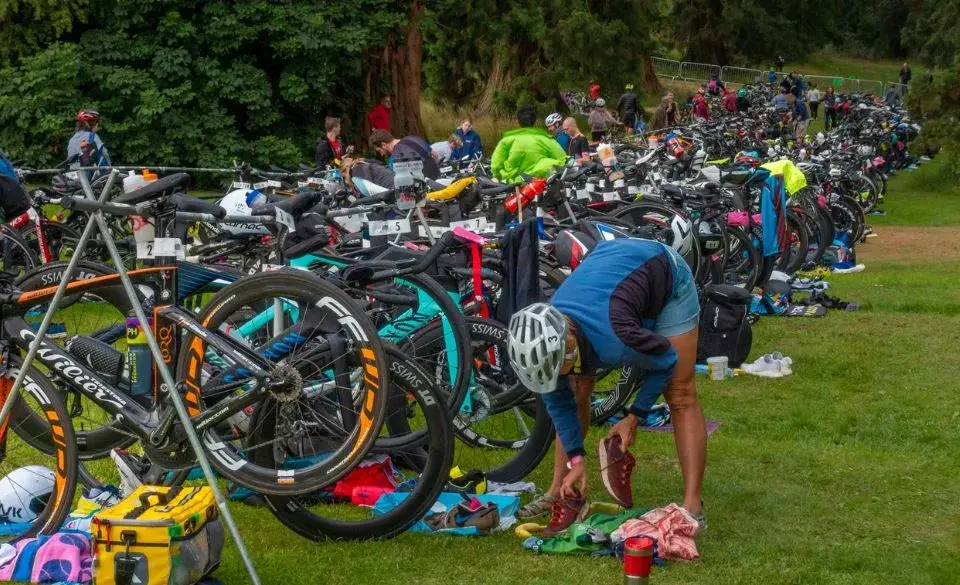
In wave starts, Clydesdale athletes are typically placed in a mid-field wave rather than with the elite or age group leaders. Seed yourself honestly within your wave — starting at the front when you’re a newer swimmer creates congestion and contact; starting at the back means swimming through others’ wake. Aim for the outside of the swim buoy line to find cleaner water if the course allows. Practise your transition from swim to bike during training — running on wet ground in bare or socked feet feels different than you expect.

Bike Leg

Most Clydesdale athletes benefit from starting the bike at moderate effort rather than hard. Your cardiovascular system is already elevated from the swim; a controlled first 5km on the bike allows heart rate to settle and legs to find their rhythm. On flat sections, use your power advantage — sit in an aerodynamic position, maintain a cadence of 80–90 rpm, and resist the urge to push big gears at low cadence. On climbs, shift early, keep cadence up, and accept that you’ll lose time relative to lighter athletes. You may recover some of it on descents — stay relaxed, trust your bike, and use gravity rather than fighting it.

Run Leg

The run in a sprint triathlon is 5km — most Clydesdale athletes can walk this distance in under an hour if needed. The goal in training and in racing is not to avoid walking; it is to run as much as your body allows without breaking down in the final kilometre. A run-walk strategy decided before the race (e.g. run 500m, walk 100m) is more effective than starting out running and collapsing into an unplanned walk. Hydrate at every aid station. If your legs feel heavy off the bike, that’s normal — it typically resolves within the first 1–2km.

Chafing Prevention

Apply Body Glide, Vaseline, or an equivalent anti-chafe product to thighs, underarms, and anywhere your tri suit seams contact skin before the race. Do this before the swim, not after — wetsuit removal and the swim-to-bike transition mean you’ll have no opportunity to apply it mid-race. Wear your full race kit during at least two full brick sessions before race day to identify any chafing points while there’s still time to address them with different kit or lubrication strategy.

Want a triathlon plan built around your body, your schedule, and your goals?

Our coaches work with athletes of all sizes and backgrounds — including Clydesdale and Athena competitors at sprint through to Ironman distance. Training plans are built to your available days, your current fitness, and how your body responds to load, not a generic template.

FAQ: Clydesdale Triathlon

What is the Clydesdale category in triathlon?
A weight-based division for larger male triathletes — 100kg or more in most Australian events. The female equivalent is Athena (typically 80kg+). Both categories are optional: athletes who qualify can choose to race in them or remain in their standard age group. Divisions split into sub-groups of 39 and under, and 40 and over.

What is the Clydesdale weight limit in Australia?
Most Australian triathlon events (Triathlon Australia sanctioned) use 100kg for men and 80kg for women. This is broadly equivalent to the US USAT standard of 220lb (100kg) and 165lb (75kg), though the Athena threshold varies. Always check your specific event’s registration page.

Should I race Clydesdale or age group?
Choose Clydesdale if you want to race against athletes of similar size, are motivated by podium opportunities in a smaller field, or identify with the community. Stay in age group if you prefer the general field, your age group is competitive, or you expect your weight to change before race day.

Is triathlon suitable for heavier athletes?
Yes. Swimming is especially accessible due to water buoyancy; cycling is competitive on flat terrain where absolute power matters; and running requires careful build-up but is achievable with the right footwear, surface choices, and a gradual training progression. See the guide to triathlon distances to find the right starting point.

What bike should a Clydesdale triathlete use?
Prioritise a frame with a verified weight capacity above your body weight plus 20kg for gear. Look for 32+ spokes on wheels, titanium or chromoly saddle rails, and a professional bike fit for your proportions. Most aluminium and quality carbon frames from major brands accommodate athletes up to 120–130kg combined rider and equipment weight.

How long to train for a sprint triathlon as a Clydesdale athlete?
10–16 weeks of consistent training is realistic for most athletes new to the sport. The limiting factor is usually connective tissue adaptation rather than cardiovascular fitness — building too quickly leads to shin splints, Achilles issues, and plantar fasciitis. The 12-week plan above is designed with this in mind. For athletes already active in one discipline (swimmers, cyclists), the timeline can be shorter.

Find Your Next Triathlon Race

Ready to put your training to the test? Here are some upcoming triathlon events matched to this article.

Graeme - Head Coach and Founder of SportCoaching

Graeme

Head Coach & Founder, SportCoaching

Graeme is the founder of SportCoaching and has coached more than 750 athletes from 20 countries, from beginners to Olympians, in cycling, running, triathlon, mountain biking, boxing, and skiing. His coaching philosophy and methods form the foundation of SportCoaching's training programs and resources.

750+
Athletes
20+
Countries
7
Sports
Olympic
Level

Start Your Fitness Journey with SportCoaching

No matter your goals, SportCoaching offers tailored training plans to suit your needs. Whether you’re preparing for a race, tackling long distances, or simply improving your fitness, our expert coaches provide structured guidance to help you reach your full potential.

  • Custom Training Plans: Designed to match your fitness level and goals.
  • Expert Coaching: Work with experienced coaches who understand endurance training.
  • Performance Monitoring: Track progress and adjust your plan for maximum improvement.
  • Flexible Coaching Options: Online and in-person coaching for all levels of athletes.
Learn More →

Choose Your Next Event

Browse upcoming Australian running, cycling, and triathlon events in one place. Filter by sport, check dates quickly, and plan your training around something real on the calendar.

View Event Calendar