






Find Your Next Triathlon Race
Ready to put your training to the test? Here are some upcoming triathlon events matched to this article.
 Coach Graeme

Last updated:
Buying a triathlon bike the wrong size is one of the most expensive mistakes in triathlon. Unlike a road bike — where a misfit is mostly a comfort problem — a wrongly sized tri bike limits your ability to achieve a sustainable, aerodynamic position. On a long-course race, that matters a great deal: you spend more time on the bike than in any other discipline, and then you have to run off it.
This guide covers how to find your tri bike size, why size labels vary wildly between brands, and what measurements actually matter — including how to use stack and reach to compare bikes reliably.
Not sure where to start with training?
Tell us your goal and schedule, and we’ll give you clear direction.
No obligation. Quick, practical advice.
Explore our triathlon training resources for more helpful articles and resources.
< 160cm (< 5’3″): XS — frame 47–49cm
160–168cm (5’3″–5’6″): S — frame 50–52cm
168–175cm (5’6″–5’9″): M — frame 52–54cm
175–183cm (5’9″–6’0″): L — frame 54–56cm
183–190cm (6’0″–6’3″): XL — frame 56–58cm
> 190cm (> 6’3″): XXL — frame 58–61cm
These are general starting points only. Verify with the specific brand’s geometry chart and compare stack and reach — not size labels.
The single most disorienting thing about tri bike sizing is that the same physical bike size can carry completely different labels across brands. There is no industry standard. Some brands use centimetre numbers (48, 51, 54, 56, 58); some use T-shirt sizes (XS, S, M, L, XL); some use both on different models. The same rider can genuinely fit a Medium from one brand, a Large from another, and a 54cm from a third — and all three bikes can be the same size.
Slowtwitch founder Dan Empfield described fitting himself to multiple tri bikes and finding he was a Medium Dimond Marquise, Large Trek Speed Concept, 54cm Quintana Roo, 56cm Felt, Medium Canyon, and Large Cervelo — all bikes with similar stack and reach dimensions. The labels were different; the bikes were essentially the same size.
This means: never buy a triathlon bike based on the size label alone, and never assume your road bike size number transfers to a tri bike. The only reliable comparison tool is stack and reach — the actual geometric dimensions of the frame.
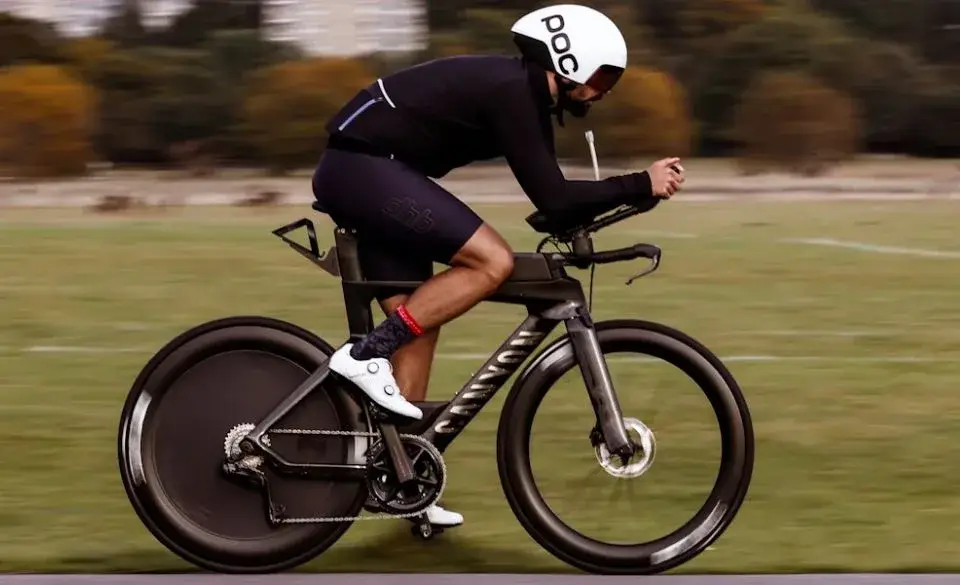
The core reason road bike sizing doesn’t apply directly to tri bikes is seat tube angle. Road bikes typically use seat tube angles of 72–74°. Triathlon bikes use 76–80°. This steeper angle moves the rider’s hips 30–50mm further forward over the bottom bracket compared to the same rider on a road bike of nominally the same size.
That forward shift changes how the frame dimensions translate to fit. A rider sitting further forward over the BB on a tri bike needs a shorter effective top tube to reach the aero bars comfortably — which means they often fit a smaller frame number than their road bike. A rider who fits a 56cm road bike commonly fits a 54cm or even a 52cm tri bike, depending on brand and geometry. Going on road bike size number alone routinely leads to buying a tri bike that’s too large.
The steep seat tube angle is also functionally important: it opens the hip angle for pedalling in the aero position, and — critically for triathlon — it spares the hamstrings and glutes for the run. This is why tri bikes have such specific geometry. They’re designed around the constraint of a run following the ride, not just speed on the bike alone. For more on how the bike leg connects to the run, the Ironman 70.3 cut-off times guide and full Ironman cut-off times guide give useful context on managing the full race.
Inseam is the most important single measurement for initial sizing. It is the distance from your crotch to the floor, measured barefoot. To measure accurately: stand with your back flat against a wall, place a hardback book between your legs with the spine pushed firmly against your crotch (simulating saddle pressure), and measure from the floor to the top of the book. This gives a more accurate number than measuring against a doorframe or using your jeans inseam length.
A rough saddle height calculation: inseam × 0.883 = the distance from the centre of the bottom bracket to the top of the saddle. This is Greg LeMond’s method and works well as a starting point. For a rider with an 80cm inseam, the starting saddle height is approximately 70.6cm. See the LeMond saddle height method guide for the full approach.
Frame stack is the vertical distance from the centre of the bottom bracket to the centre of the top of the head tube. Frame reach is the horizontal distance between the same two points. These measurements describe the physical dimensions of the frame itself, independent of any size labelling. Because they are standardised (every manufacturer measures the same points), stack and reach are the only reliable way to compare bike sizes across brands.
A rider who knows their required stack and reach can look up any brand’s geometry chart and immediately identify which frame size provides those dimensions — without needing to guess from the size label or test-ride every brand.
For triathlon bikes specifically, the more practically useful measurements are arm pad stack and arm pad reach. These measure from the bottom bracket to the position of the arm pads on the aero bars — where your elbows actually rest when riding. Frame stack and reach describe the frame; arm pad stack and reach describe your actual riding position.
Arm pad stack and reach matter because a given frame can accept a wide range of aerobar positions depending on spacers, extensions, and pad height adjusters. Two frames with the same frame stack may produce different arm pad positions depending on how the bike is set up. When comparing bikes, especially used bikes, always ask for or calculate the arm pad stack and reach for the configuration you’d be riding.
Two riders of the same height can have very different torso and leg proportions. A rider with a long torso and shorter legs relative to height may need a larger frame or longer reach than their height alone suggests. A rider with short torso and long legs may fit a smaller frame or need a shorter stem. Height and inseam together capture most of this variation — a significant difference between height and inseam (much more or much less than average) is a signal to check the manufacturer’s geometry chart carefully rather than relying on a height-only chart.
The following table gives a starting-point size range by height and approximate inseam. Always cross-check the specific brand’s geometry chart before purchase.
| Height | Approximate Inseam | Frame Size (cm) | Notes |
|---|---|---|---|
| < 160cm (< 5'3") | < 73cm | 47–49cm | Very limited selection; some brands start at 48cm |
| 160–165cm (5'3"–5'5") | 73–76cm | 48–51cm | Check arm pad stack carefully — small frames can have limited adjustment range |
| 165–170cm (5'5"–5'7") | 76–78cm | 50–52cm | Most common smaller frame range |
| 170–175cm (5'7"–5'9") | 78–81cm | 51–54cm | Many riders fall in this overlap — compare stack and reach for both sizes |
| 175–180cm (5'9"–5'11") | 81–83cm | 53–55cm | Most common mid-range |
| 180–185cm (5'11"–6'1") | 83–85cm | 54–57cm | Significant brand variation here — size 54 at one brand may equal 56 at another |
| 185–190cm (6'1"–6'3") | 85–88cm | 56–58cm | Riders with longer torsos may size up |
| > 190cm (> 6'3") | > 88cm | 58–61cm | Fewer brand options at the top end |
Use this table to identify a starting-point size range. Then go to the geometry chart of any brand you’re considering and compare the frame stack and reach values for the sizes on either side of your starting point. This is the correct process — not relying on the size label.
The table below shows how the same physical size range is labelled differently by major tri bike brands. These figures are approximate and vary by model year and specific model — always check the current geometry chart.
| Approximate Fit (for ~175–180cm rider) | Cervelo | Canyon | Trek | Quintana Roo | Felt |
|---|---|---|---|---|---|
| Mid-range size | M or 54cm (model-dependent) | M | M or 54cm | 54cm | 56cm |
The practical takeaway: a 175cm rider could fit a 54cm Cervelo, a Medium Canyon, and a 56cm Felt — and all three may be the same physical size once you check stack and reach. Cervelo acknowledges this on some models by noting that their numerical sizing aligns with road bikes (56cm road = 56cm tri); others deliberately use different numbers to match typical rider expectations. The only way to compare is geometry data, not the number on the bike.
Many riders fall between two frame sizes. The general guidance:
If you’re between sizes and have a long torso or long arms relative to your height, size up. You’ll need more reach and will likely be happier with the larger frame’s geometry.
If you’re between sizes and have a short torso or prefer a more upright starting position (common for beginners or those new to aero position), size down. Smaller frames are easier to open up with spacers and stem adjustment than to make feel smaller.
If you’re uncertain about aero position flexibility — if you’re new to riding in the aero position or have limited hip flexibility — size conservatively and use a higher arm pad stack to start. You can always lower the front end as your flexibility improves. It is much harder to make a too-aggressive position work than to gradually build toward it. The KOPS saddle positioning guide and saddle height guide are useful starting points before finalising any fit.
Used bikes represent good value but come with sizing risk. The frame size label tells you very little. Before buying any used tri bike:
Get the brand, model, and year, then look up the geometry chart. Confirm the frame stack and reach values for that specific model and size. Compare against your fit target or known riding position. Check whether the aerobars included with the bike are adjustable enough to achieve your required arm pad stack and reach. Many used bikes are sold with aftermarket aerobars in a fixed configuration — confirm the adjustment range before buying.
If you cannot test-ride the bike in a proper aero position, ask for the current arm pad stack and reach measurements from the seller. If they cannot provide them, factor the cost of a professional fit session into your purchase price before committing.
The appropriate position varies somewhat by race distance, and this can influence sizing decisions at the margins.
| Race Distance | Position Priority | Sizing Implication |
|---|---|---|
| Sprint / Olympic | Aggressive aero acceptable; short duration on bike | Can use steeper, more aggressive fit; smaller frame size with lower stack sometimes appropriate |
| 70.3 (Half Ironman) | Balance of aero and sustainability | Standard fit; most riders should target a position they can hold for 2–3 hours comfortably |
| Full Ironman | Sustainability over 5–8 hours critical; preserving run legs paramount | Slightly more conservative arm pad stack; do not chase the most aggressive position; size to allow a comfortable, repeatable position |
For long-course racing in particular — 70.3 and full Ironman — a position that looks fast in a photo but cannot be sustained for hours is counterproductive. The bike split matters, but so does arriving at the run in a position to actually run. The Ironman vs triathlon distances guide and 70.3 swim distance guide cover the full race structure context.
A professional fit is recommended if you are: spending more than a few hundred dollars on a tri bike, buying a used bike without a reference position, experiencing recurring knee, back, or neck pain on the bike, or targeting a long-course event where you’ll be in the aero position for hours. A fit session on an adjustable jig gives you target arm pad stack and reach measurements that are brand-agnostic — you can take those numbers to any manufacturer’s geometry chart and immediately identify which frame size fits you.
Once you have a good position dialled in, the next priority is building the fitness and power to use it effectively. The FTP benchmarks guide and FTP improvement guide give context on the power side of the equation, and the triathlon training plans cover structured preparation for any race distance.
Training for a triathlon and want a structured plan?
Whether you're preparing for your first sprint, targeting a 70.3, or building toward an Ironman, our triathlon coaching builds a weekly plan around your available training days, current fitness, and race goals.
What size triathlon bike do I need?
Start with your height and inseam as a rough guide (see the table above), then verify by comparing frame stack and reach values from the manufacturer’s geometry chart. Riders under 168cm typically fit 47–52cm frames; 168–175cm fits 52–54cm; 175–183cm fits 54–56cm; above 183cm fits 56–61cm. These are starting points — body proportions, flexibility, and riding goals all affect the final answer.
Is a triathlon bike the same size as a road bike?
Not necessarily. The steeper seat tube angle on a tri bike (76–80° vs 72–74° on a road bike) moves your hips further forward, which means you often fit a smaller tri bike frame number than your road bike. Never assume your road bike size transfers. Always check the geometry chart.
What is stack and reach on a triathlon bike?
Frame stack is the vertical distance from the bottom bracket centre to the top of the head tube. Frame reach is the horizontal distance between the same points. These are the universal sizing language — they let you compare any two bikes regardless of what size label they carry. For tri bikes, arm pad stack and arm pad reach (from BB to where your elbows rest) are the most practically useful fit measurements.
Why do different brands use different size names?
There’s no industry standard for triathlon bike sizing. The same physical frame dimensions can be called a Medium by one brand, a 54cm by another, and a Large by a third. Compare stack and reach numbers from geometry charts — not size labels.
Should I size up or down if I’m between sizes?
Long torso or long arms relative to height: size up. Short torso, limited flexibility, or new to aero position: size down. When in doubt, a professional fit on an adjustable jig gives you specific target measurements to compare against any brand’s geometry chart.
Ready to put your training to the test? Here are some upcoming triathlon events matched to this article.



Head Coach & Founder, SportCoaching
Graeme is the founder of SportCoaching and has coached more than 750 athletes from 20 countries, from beginners to Olympians, in cycling, running, triathlon, mountain biking, boxing, and skiing. His coaching philosophy and methods form the foundation of SportCoaching's training programs and resources.
No matter your goals, SportCoaching offers tailored training plans to suit your needs. Whether you’re preparing for a race, tackling long distances, or simply improving your fitness, our expert coaches provide structured guidance to help you reach your full potential.
Personalised coaching to improve your swim, bike, and run performance.
What’s included
Browse upcoming Australian running, cycling, and triathlon events in one place. Filter by sport, check dates quickly, and plan your training around something real on the calendar.
Choose your plan to get started with personalized training plans designed to help you reach your goals.


Minna Backman
When you’re new, feedback is especially important, and Graeme is highly skilled at both analyzing numbers and understanding the importance of mental strength.