





Find Your Next Triathlon Race
Ready to put your training to the test? Here are some upcoming triathlon events matched to this article.
 Coach Graeme
Last updated:
The swim is the shortest leg of an Ironman 70.3 by time, yet it occupies more mental real estate than the bike and run combined. For many athletes, it's the part they fear most. The good news: with structured preparation, the 1.9 km open water swim becomes the most manageable part of your race day — not the most daunting. This guide covers everything you need to prepare for it properly.
Not sure where to start with training?
Tell us your goal and schedule, and we’ll give you clear direction.
No obligation. Quick, practical advice.
Explore our triathlon workouts and tips for more helpful articles and resources.
At 1.9 km, the 70.3 swim is 400 metres longer than an Olympic-distance swim and exactly half the full Ironman swim of 3.8 km. In pool terms it is 76 lengths of a 25-metre pool, or 38 lengths of a 50-metre pool. Most athletes who can complete a comfortable 2 km pool swim have the base endurance to cover the 70.3 swim distance — the open water environment is what usually makes it feel harder than the numbers suggest.
The swim typically takes 20–30 minutes of your overall race time, compared to 2–3 hours on the bike and 1.5–3 hours on the run. In terms of total energy expenditure, the swim is the smallest contributor of the three disciplines. Its strategic importance is disproportionate to its duration: how you swim — specifically your pacing, heart rate management, and the physical and mental state you exit the water in — affects the entire rest of your race day.
For full context on how the swim fits into the wider 70.3 race structure, the Ironman vs triathlon distances guide and 70.3 cut-off times guide cover the time limits and pacing requirements across all three disciplines. Athletes competing at larger body weights who may have additional considerations around buoyancy and pacing can find specific guidance in the Clydesdale triathlon guide.
The table below gives realistic benchmark swim times for age-group athletes based on aggregated 70.3 race data. These are finish times for the swim leg, not including T1 transition.
| Age Group | Men — Competitive | Men — Average | Women — Competitive | Women — Average |
|---|---|---|---|---|
| 18–24 | 28–32 min | 33–38 min | 30–34 min | 35–40 min |
| 25–29 | 28–33 min | 33–39 min | 31–35 min | 35–41 min |
| 30–34 | 29–34 min | 34–40 min | 31–36 min | 36–42 min |
| 35–39 | 30–35 min | 34–41 min | 32–37 min | 37–43 min |
| 40–44 | 31–36 min | 35–42 min | 33–38 min | 37–44 min |
| 45–49 | 32–37 min | 36–43 min | 34–40 min | 38–46 min |
| 50–54 | 33–39 min | 37–45 min | 35–42 min | 39–48 min |
| 55–59 | 35–42 min | 39–48 min | 37–44 min | 41–51 min |
| 60+ | 37–45 min | 42–52 min | 40–48 min | 44–56 min |
Finish times are easier to train to when translated into pool pace. The table below shows the approximate 100m pace each finish time requires over 1,900m.
| Target Finish Time | Required Pace (per 100m) | Context |
|---|---|---|
| 25 minutes | 1:19/100m | Elite age-grouper / ex-competitive swimmer |
| 30 minutes | 1:35/100m | Strong age-grouper; top 10–15% at most events |
| 35 minutes | 1:50/100m | Competitive mid-pack; achievable with consistent training |
| 40 minutes | 2:06/100m | Average for recreational triathletes; solid result |
| 45 minutes | 2:22/100m | Comfortable conservative pace; well within cut-off |
| 55 minutes | 2:54/100m | Approaching the cut-off buffer; needs structured training |
| 1 hour 10 min (cut-off) | 3:41/100m | Minimum pace to avoid cut-off |
Knowing your current pool pace for 1,900m (or your CSS — Critical Swim Speed — for a more structured benchmark) lets you work backwards to a realistic finish time target and a training pace to practise at.
The standard swim cut-off for most Ironman 70.3 events is 1 hour 10 minutes from your wave start. This applies to your individual wave — not the first wave of the day. If your wave starts 30 minutes after the first wave, your cut-off clock starts 30 minutes later too.
The cut-off pace of 3:41 per 100m is slow by most swimmers’ standards — it is approximately the pace of a very comfortable breaststroke. Any swimmer who can cover the distance in freestyle, even slowly, will typically finish well inside it. The cut-off becomes relevant for athletes who panic in the open water, get caught in severe currents, or have never swum the full distance in training.
A practical target for nervous or beginner swimmers is a conservative 50–55 minute finish time. That gives approximately 15–20 minutes of buffer against the cut-off while requiring only a 2:37–2:54/100m pace — achievable after 12–16 weeks of structured swim training for most adults with basic swimming ability.
For a full breakdown of 70.3 cut-off times across swim, bike, and run, and what pacing each requires, see the Ironman 70.3 cut-off times guide.
Ironman’s wetsuit rules apply to all 70.3 branded events worldwide. Understanding them matters because wearing or not wearing a wetsuit significantly affects your buoyancy, warmth, and swim time.
| Water Temperature | Age-Group Athletes | Professional Athletes |
|---|---|---|
| Below 16°C (60.8°F) | Wetsuit mandatory | Wetsuit mandatory |
| 16°C – 24.5°C (60.8°F – 76.1°F) | Wetsuit permitted and recommended | Wetsuit permitted (up to 21.9°C / 71.5°F) |
| Above 24.5°C – 28.8°C (76.1°F – 83.8°F) | Non-competitive wetsuit wave only — not eligible for AG awards or WC slots | Wetsuit not permitted |
| Above 28.8°C (83.8°F) | No wetsuit permitted | No wetsuit permitted |
Maximum wetsuit thickness under Ironman rules is 5mm. Booties (neoprene foot coverings) are not permitted unless the water temperature is 18.3°C (65°F) or colder. Gloves are not permitted.
A well-fitting wetsuit in wetsuit-legal conditions typically improves swim time by 2–4 minutes for a 1.9km swim — partly through buoyancy (higher body position means less drag) and partly through warmth (cold water increases oxygen consumption). Practise in your wetsuit before race day: shoulder restriction, buoyancy change, and the process of removing it in T1 all need to be familiar before race morning.
Most 70.3 swim training happens in a pool. Pool swimming and open water swimming use the same stroke, but the environment introduces several variables that require specific practice:
Lane lines provide a visual reference and create a small drafting effect. Without them, swimmers who rely on them for navigation or psychological security can feel disoriented. Pool training in the middle of a lane (away from the ropes) helps simulate this.
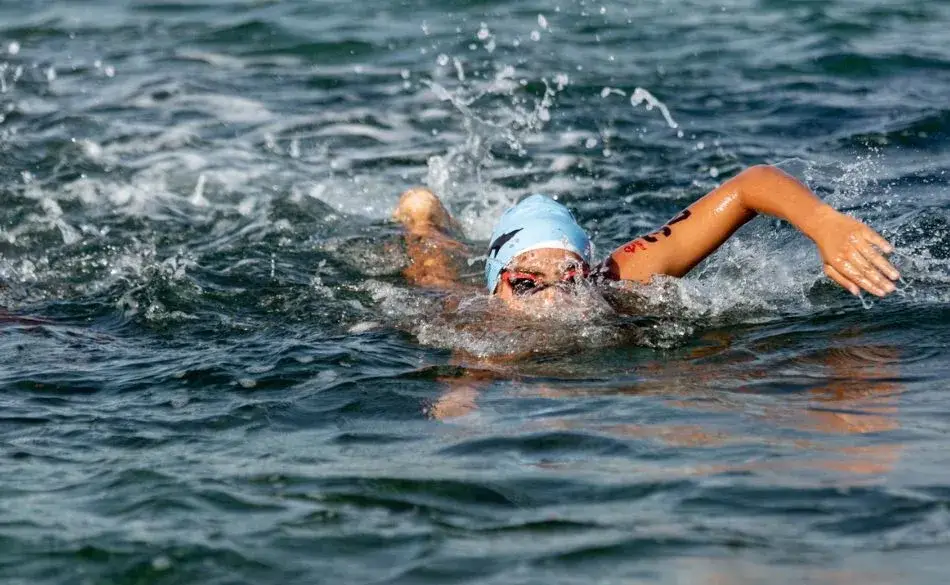
Open water is typically murky or opaque. You cannot see the bottom, cannot see other swimmers’ feet clearly, and cannot see where you’re going. Sighting — lifting your eyes briefly above the water to check your navigation — replaces the visual reference of pool lane lines.
Open water conditions are never perfectly calm. Even lakes produce surface chop from wind. Ocean and river venues add current. Your pool pace will not translate directly to your open water pace — most swimmers are 5–10% slower in rough open water conditions than their pool pace suggests.
Cold water stiffens muscles, speeds up breathing, and can trigger a brief panic reflex. A wetsuit in cold water changes your body position significantly — your hips ride higher, you need less kick, and your stroke rate may change. All of these effects need to be experienced and adapted to before race day, not on race morning.
70.3 events typically use wave starts — groups of 40–200 athletes entering the water at 5–8 minute intervals based on age group. The first 200–400 metres of the swim can involve significant physical contact: kicks to the face, arms across bodies, being swum over. This is normal and improves significantly after the first few minutes as the field spreads out.
Sighting is the skill most pool swimmers underestimate before their first open water event, and the one that causes the most time losses on race day. An athlete who swims 5% extra distance due to poor sighting adds roughly 95 metres to their 1.9 km swim — approximately 2–4 minutes.
The most efficient sighting method is to lift only your eyes — not your full head — above the water surface during the forward momentum of your stroke. As your lead hand enters the water at the front of your stroke, press that arm down briefly and use the momentum to raise your eyes just above the surface. You don’t need to see in detail: you just need to confirm the direction of the next buoy. Then complete your breath rotation to the side as normal. This method keeps your body position flatter than a full head-lift and costs less energy.
In calm conditions with good visibility, every 8–12 strokes (approximately every 15–25 seconds) is usually sufficient. In choppy conditions, visibility is lower and you may need to sight every 4–6 strokes. When approaching a buoy, buoy turn, or finish, increase sighting frequency.
Buoys bob in the water and can be hard to spot in choppy conditions or with the sun behind them. Pick a fixed landmark directly beyond the buoy — a tree, building, or distinctive mark on the far bank — and aim for that. This is more reliable than trying to spot a small orange buoy from water level.
Where you line up at the start of your wave determines your first 200 metres significantly. Front centre is fastest but most congested — experienced swimmers who are comfortable with contact. Front sides are slightly longer (outside a rectangular course) but have less contact. Back of the field is the calmest but requires swimming through slower traffic as you pass them. For first-timers or nervous swimmers, starting at the back-outside edge of the wave is the least stressful option. You will swim marginally further, but the calm water is worth it.
The most common 70.3 swim error is starting too fast. Adrenaline at the race start, the energy of the field around you, and the excitement of the moment all push you to swim harder than you intend. A pace that feels comfortable in training can produce a heart rate 15–20 beats above normal in the first 100–200 metres of a race. Going out hard also depletes glycogen faster and creates lactic acid that makes the early bike leg harder than it needs to be.
The goal for most athletes is to exit the water feeling like they could have gone faster — not at maximum effort. Target your 35–40 minute pace (approximately 1:50–2:06/100m) from the first stroke and hold it. Negative splits (swimming the second half faster than the first) are ideal.
Lucy Charles-Barclay’s recommendation is useful here: if you are stepping up from Olympic distance, target a pace 2–3 seconds per 100m slower than your Olympic-distance race pace. That adjustment accounts for the longer distance and the energy you need to preserve for the bike and run.
Drafting is legal in the 70.3 swim. Swimming directly behind another swimmer — within approximately 0.5–1 metre of their feet — reduces drag and can save 15–20% of your energy expenditure at the same speed. Finding a slightly faster swimmer and sitting on their feet is a genuine performance strategy, not a shortcut. In the chaotic first few minutes of the swim, this is difficult to execute — focus on drafting once the field has spread out after the first 300–400 metres.
Many athletes experience light-headedness or dizziness when they stand up from horizontal swimming — this is a normal postural blood pressure adjustment and passes within a few seconds. Walk the exit ramp at a pace you can manage rather than sprinting and stumbling. Unzip your wetsuit to the waist as you run toward T1 so the removal process is faster once you arrive at your transition spot. Nutrition planning for the bike and run legs should also be practised — the energy gels guide and electrolyte strategy guide cover fuelling for the long course that follows the swim.
For most 70.3 athletes, 2–3 swim sessions per week of 2,000–3,000m each produces sufficient adaptation. Two sessions per week is adequate for athletes with a swimming background; three sessions is recommended for those who need meaningful improvement. The total weekly swim volume at peak training should be 4,000–6,000m for most athletes.
A common mistake is only swimming the race distance in training — 1,900m — and expecting to be comfortable on race day. Train to 2,500–3,000m sessions so that the race distance feels well within your capacity.
Endurance base: Continuous swims of 1,500–2,500m at comfortable aerobic pace. These build the physical base to sustain the race distance. Example: 4 × 500m on 30-second rest.
Pace intervals: Swim sets at or slightly faster than your target race pace, with controlled rest. These train your body to hold your target per-100m pace under mild fatigue. Example: 10 × 200m at race pace on 20-second rest.
Threshold sets: Harder efforts that build your aerobic ceiling. Example: 5 × 400m at threshold effort (harder than race pace, controlled breathing) on 45-second rest.
Open water practice: At least one session per week in open water in the 8–12 weeks before your event. Practice sighting, wetsuit swimming, and if possible, mass starts with other swimmers.
| Session | Type | Volume | Key Focus |
|---|---|---|---|
| Session 1 (Mon/Tue) | Endurance base | 2,200m | WU 400m easy. MS: 4×400m @ comfortable aerobic pace, 30s rest. CD 200m easy. |
| Session 2 (Wed/Thu) | Pace intervals | 2,400m | WU 400m. Drills 4×50m. MS: 10×200m @ target race pace, 20s rest. CD 200m. |
| Session 3 (Sat/Sun) | Open water | 2,000m+ | Practice sighting, wetsuit, mass start simulation. One continuous 1,900m effort. |
Crossing the centreline: When your hand entry crosses to the other side of your body’s midline, it causes your hips to snake side to side, increasing drag significantly. Entry should be shoulder-width, in line with the shoulder of the entering arm.
Dropped elbow in the catch: Pulling through the water with a bent elbow that drops before the hand means you’re pushing down rather than back, generating little propulsion. A high elbow catch — where the elbow stays higher than the hand as you set up the pull — is the single biggest technique change for most recreational swimmers.
Two-beat kick in cold water: A minimal two-beat kick conserves energy and is appropriate at race pace. In cold water, however, leg muscles cool faster than upper body muscles. A slightly more active kick in cold conditions helps maintain blood flow and body warmth, as well as keeping the hips up.
Overkicking in training: Many swimmers train with a heavy leg kick that works fine in the pool but exhausts the legs for the bike leg. Practice a relaxed, low-beat kick in long sets — 2 kicks per stroke cycle is efficient for most triathletes.
| Item | Notes |
|---|---|
| Triathlon wetsuit | Full-length suit for most conditions; sleeveless for warmer water. Must be ≤5mm. Race in what you've trained in. |
| Swim goggles | Clear or lightly tinted lenses for overcast/early morning starts; mirrored or dark tint for sunny conditions. Test leak-free in training — never debut goggles on race day. |
| Swim cap | Provided by the race (required — identifies wave). Wearing a silicone cap underneath adds warmth and prevents the race cap from sliding off your goggles. |
| Anti-chafe lubricant | Apply around the neck and underarms where the wetsuit collar rubs. Body Glide, Vaseline, or similar. Chafing from a 40-minute swim is minor; rubbing through a 4–7 hour race day is not. |
| Earplugs (optional) | Useful for swimmers sensitive to cold water or prone to ear infections from open water exposure. |
| Timing chip | Worn on the ankle. Do not remove it until after the finish line. |
Athletes approaching their first 70.3 who are comfortable with 500–600m pool swims typically need 12–16 weeks of structured swimming to be confident over 1.9 km in open water. The progression:
Weeks 1–4: Build to a continuous 1,200–1,500m pool swim. Establish three sessions per week. Introduce basic drills (pull buoy, catch-up drill) to begin addressing technique.
Weeks 5–8: Build to a continuous 1,900m pool swim. Introduce pace intervals. First open water sessions — beginning with shorter distances to build comfort before extending to race distance.
Weeks 9–12: Train sessions of 2,000–2,500m. Consistent open water practice weekly. One wetsuit swim per week minimum. Practice sighting every session, pool or open water.
Weeks 13–16 (pre-race): Taper swim volume. One race-pace 1,900m effort in race conditions (open water, wetsuit, with sighting). Final week: short, easy swims only — the work is done.
For athletes combining swim training with structured bike and run work, the triathlon training plans cover periodised programmes for all three disciplines. The best triathlon training books are also a useful supplement for understanding the principles behind triathlon periodisation. Athletes who want to understand how the swim connects to the full race day can also read the triathlon order of disciplines guide.
Preparing for your first or next 70.3?
Our triathlon coaching builds structured swim, bike, and run programmes around your available training days, current fitness, and race goals — including open water swim sessions and race-specific preparation in the weeks before your event.
How long is the swim in an Ironman 70.3?
1.9 km (1.2 miles / 1,900 metres / 2,078 yards). Always open water. The swim cut-off is 1 hour 10 minutes from your wave start, requiring approximately 3:41/100m pace.
What is a good swim time for Ironman 70.3?
A competitive age-group time is 28–34 minutes (men) or 30–36 minutes (women), corresponding to roughly 1:29–1:47/100m. The average recreational age-grouper finishes in 33–42 minutes. Under 40 minutes puts you in the faster half of most fields. The cut-off is 1:10, so most swimmers have significant buffer with structured training.
Can you wear a wetsuit in Ironman 70.3?
Yes, in most conditions. Wetsuits are permitted for age-group athletes when the water temperature is at or below 24.5°C (76.1°F), and mandatory below 16°C (60.8°F). Above 24.5°C, you may be allowed to wear one in a non-competitive wave, but you forfeit eligibility for age-group awards and World Championship slots. Wetsuits are banned above 28.8°C (83.8°F).
How many times a week should I swim for 70.3?
Two to three sessions per week. Two is sufficient if swimming is your strongest discipline. Three is recommended if you need significant improvement. At least one session should be open water practice in the 8–12 weeks before your event.
How do you sight in open water swimming?
Use the crocodile eye technique: as your lead arm enters the water, briefly lift just your eyes above the surface to spot your target buoy or landmark, then breathe to the side as normal. Sight every 8–12 strokes in calm conditions. Practise in the pool by picking a fixed point at the far end of the lane before every length.
What should I do if I panic in the open water?
Stop swimming and roll onto your back or tread water — a wetsuit makes floating easy. Take slow, controlled breaths until your heart rate drops. You can grab a kayak or buoy to rest without being disqualified, though you cannot advance your position while holding it. Once calm, restart with a gentle breaststroke before returning to freestyle. Most open water panic is short-lived and manageable with practice in training.
Ready to put your training to the test? Here are some upcoming triathlon events matched to this article.


Head Coach & Founder, SportCoaching
Graeme is the founder of SportCoaching and has coached more than 750 athletes from 20 countries, from beginners to Olympians, in cycling, running, triathlon, mountain biking, boxing, and skiing. His coaching philosophy and methods form the foundation of SportCoaching's training programs and resources.
No matter your goals, SportCoaching offers tailored training plans to suit your needs. Whether you’re preparing for a race, tackling long distances, or simply improving your fitness, our expert coaches provide structured guidance to help you reach your full potential.
Personalised coaching to improve your swim, bike, and run performance.
What’s included
Browse upcoming Australian running, cycling, and triathlon events in one place. Filter by sport, check dates quickly, and plan your training around something real on the calendar.
Choose your plan to get started with personalized training plans designed to help you reach your goals.


Minna Backman
When you’re new, feedback is especially important, and Graeme is highly skilled at both analyzing numbers and understanding the importance of mental strength.